Apps Like Rocket Money: 6 Alternatives for 2026
Rocket Money (formerly Truebill) became the default answer for "an app that finds my forgotten subscriptions and cancels them." The pitch is real: connect a bank account, get a list of recurring charges, and pay a fee to have a service cancel things on your behalf.
But Rocket Money is not the only model, and for a lot of users it is not the right one. Some want subscription awareness without bank linking. Some want bill negotiation but not the cancellation service. Some want general budgeting with a subscription view, rather than a subscription-first tool. If you are searching for apps like Rocket Money in 2026, this guide breaks the alternatives down by what you are actually trying to solve. For an honest look at the safety question, see our is Rocket Money safe review.
Why People Look for Rocket Money Alternatives
A handful of patterns repeat in App Store reviews and Reddit threads.
The premium fees. Rocket Money's "pay what you think is fair" model lands most users between $7 and $14 per month, and the cancellation service takes 35 to 60 percent of first-year savings on negotiated bills. The total cost can quietly exceed the subscriptions Rocket Money is supposed to be saving you from.
The bank-aggregator model. Rocket Money requires Plaid bank connections. Users uncomfortable sharing transaction history with a third party look for alternatives that skip the aggregator model entirely.
Subscription detection accuracy. Rocket Money sometimes flags one-time charges as recurring, missing the real subscription buried in a different vendor name. Users who care about precision tend to add a manual tracker for the small list of subscriptions they actually want to monitor.
Cancellation reliability. The cancel-on-behalf service does not work universally. Some providers require account holder verification or specific cancellation flows the service cannot complete. Users who hit those cases sometimes prefer to cancel directly.
6 Apps Like Rocket Money Worth Trying
| App | Best For | Pricing | Bank Link | Cancellation Service |
|---|---|---|---|---|
| Rocket Money | Full-service cancel + negotiate | Free / $7-14 mo | Required | Yes |
| Trim | Bill negotiation focus | Free / 33% of savings | Required | Yes |
| BillShark | Negotiation specialist | 40% of savings | Required | Yes |
| Bobby | Privacy-first manual tracking | Free / $1.99 one-time | None | No |
| Subby | Clean iOS subscription tracker | $1.99/mo or $14.99/yr | None | No |
| Finny | Automatic capture, no bank link | Free / low-cost Pro | None | No |
| Apple Settings | Built-in App Store subs | Free | None | No (manual only) |
Trim
Trim is the closest direct competitor to Rocket Money. Bank connection through Plaid, automatic subscription detection, and a bill negotiation service that takes 33 percent of first-year savings (slightly less than Rocket Money's 35-60 percent range). The cancellation service is competent but less prominent than Rocket Money's.
Best for: users who want Rocket Money's full-service model with slightly lower negotiation fees.
BillShark
BillShark is bill-negotiation-first. They specialize in cable, phone, internet, and insurance, and the success fee is 40 percent of first-year savings. The subscription tracking and cancellation service are secondary features rather than the main pitch.
Best for: users with high recurring bills (cable, internet, insurance) who want a specialist negotiator. Less suitable as a general subscription tracker.
Bobby
Bobby is the philosophical opposite of Rocket Money. No bank connection, pure manual entry, and a one-time $1.99 purchase for the Pro features. You log subscriptions yourself, set the renewal cadence, and Bobby reminds you before charges hit.
Bobby cannot discover subscriptions you have forgotten about. Its strength is keeping what you know about organized, with notifications that beat Rocket Money's reminder system. Best for: users who care about privacy more than discovery.
Subby
Subby is a polished iOS subscription tracker that splits the difference between Bobby and Rocket Money. Manual entry like Bobby, with iCloud sync, widgets, family sharing, and stronger notification options. Pricing starts at $1.99/mo or $14.99 per year.
Best for: users who want a dedicated subscription tracker with notification depth, without bank connection requirements.
Finny
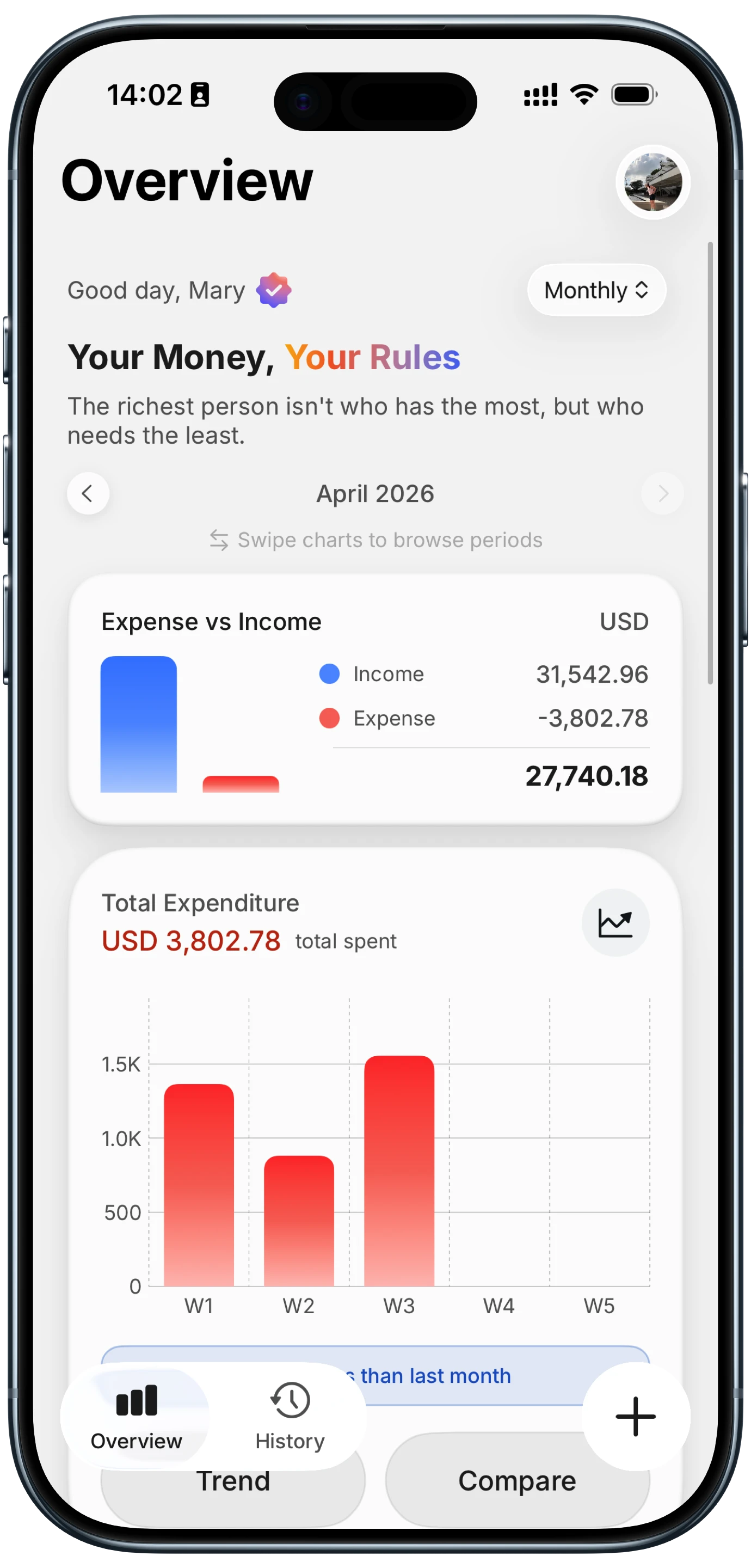
Finny is an expense tracker that captures spending automatically without ever connecting to your bank. It works two ways: Tap to Track logs your Apple Pay purchases on their own, and Screen Log records any payment on your screen with a single press, whether that is an online order, a bank transfer, a credit card app, or a receipt or renewal email. Subscriptions land alongside your other expenses as you pay them, rather than being pulled from a bank feed. AI text input, voice logging, and batch receipt scanning are bundled into the same app.
Here is Screen Log logging an on-screen payment in one press, with nothing linked to your bank:
The tradeoff is honest: without reading your bank, Finny cannot auto-discover charges you have already forgotten about. It is also not subscription-specific, so the dedicated subscription views are not as detailed as Bobby or Subby. The upside is automatic capture with nothing linked for a third party to hold, plus broader expense tracking. For more on no-bank-link tracking, see our track expenses without linking your bank guide.
Apple's Built-In Settings (Free, Already on Your Phone)
The free option most users skip. Settings, Apple ID, Subscriptions on iPhone shows every subscription that bills through your Apple ID, with cancel buttons one tap away. Apple cannot see direct-billed subscriptions (Netflix on the web, gym memberships, productivity tools), so this only covers half the universe, but it covers the half you most likely want to cancel first.
Pair Apple's built-in screen with a quarterly email search for "receipt" and "renewal," plus a credit card statement scan for monthly charges between $5 and $30, and you have replicated 80 percent of Rocket Money's discovery for free. For the full walkthrough, see our how to cancel subscriptions on iPhone guide.
Bank-Aggregator Apps vs Privacy-First Trackers
The Rocket Money category splits cleanly into two models.
Bank-aggregator apps (Rocket Money, Trim, BillShark) connect to your bank through Plaid, scan transactions, and find subscriptions automatically. They are the only category that can discover charges you have forgotten about. The tradeoff is the data exchange: another party reads your transaction history continuously.
Privacy-first trackers (Bobby, Subby, Finny, Apple Settings) skip the bank-aggregator model entirely. They cannot discover subscriptions for you. Their job is to keep the ones you know about organized, with reminders, family sharing, or expense-tracker integration.
There is no universally right answer. Bank-aggregator apps reduce work but expand data exposure. Privacy-first trackers reduce data exposure but require a quarterly manual audit to catch forgotten charges.
How to Choose
If you want discovery and concierge cancellation: Rocket Money. The full-service model is best-in-class if you trust the bank-aggregator model.
If you want negotiation specifically: Trim or BillShark. Specialists with cleaner fee structures.
If you care about privacy: Bobby, Subby, or Finny. No bank linking, manual tracking, organized reminders. Pair with a quarterly DIY audit using Apple Settings plus email search.
If you want subscription tracking inside a broader expense tracker: Finny is the one app on this list that captures spending automatically and tracks subscriptions alongside general expenses, with no bank link.
If you only care about App Store subscriptions: Apple's built-in Settings screen is free, already on your phone, and adequate.
The cheapest effective answer for most users is the combination Apple Settings + quarterly email audit + a privacy-first manual tracker for ongoing reminders. The cost is 20-30 minutes per quarter of attention.
Common Questions
What is the best alternative to Rocket Money in 2026?
The best alternative depends on what you want. For full-service cancellation, Trim is the closest competitor with slightly lower fees. For privacy-first tracking without bank connections, Bobby, Subby, or Finny each cover different parts of the workflow. For users who only need App Store subscription management, Apple's built-in Settings screen is free and adequate.
Is there a free alternative to Rocket Money?
Apple's built-in subscription screen (Settings, Apple ID, Subscriptions) is free and handles App Store charges completely. Bobby has a free tier for basic manual tracking. Finny has a permanent free tier for unlimited manual expense and subscription tracking, with automatic capture (Tap to Track and Screen Log) on the Pro tier. None of these can discover hidden charges automatically the way Rocket Money does.
Are apps like Rocket Money safe to use?
Bank-aggregator apps in this category (Rocket Money, Trim, BillShark) use industry-standard encryption and Plaid for credential handling. None has reported a major data breach. The privacy tradeoff is the aggregator model itself, not security weaknesses in any specific app. Apps that skip bank linking (Bobby, Subby, Finny) avoid the aggregator model entirely.
Can apps like Rocket Money cancel any subscription?
Not universally. Cancel-on-behalf services work for many common providers but fail for services that require account holder verification, specific cancellation flows, or providers that have not granted cancellation authority. When the service fails, you have to cancel directly through the provider.
How does Rocket Money compare to Trim?
Both are bank-aggregator apps with subscription detection and bill negotiation. Trim's negotiation fee is 33 percent of first-year savings (Rocket Money is 35-60 percent). Rocket Money has more polish and a more aggressive cancellation service. For most users the choice comes down to interface preference; the underlying capability is similar.
Want subscription awareness without giving an app access to your bank?
Download Finny to track spending without ever connecting to your bank. Tap to Track logs your Apple Pay purchases automatically, and Screen Log records any payment on your screen with a single press. Free tier, offline support, and a low-cost Pro tier.