What Is Compound Interest? Definition and Formulas
Ever wondered how your savings grow faster over time? The answer lies in compound interest: the secret to exponential financial growth. Understanding how compound interest works can help you make smarter investment decisions and maximize your returns.
In this guide, we'll break down what compound interest means, how it's calculated, and how you can use it to build wealth over time. For related foundations, see our explainers on APR vs APY and what is dollar cost averaging.
What Is Compound Interest?
Compound interest is the interest you earn not only on your initial investment (the principal) but also on the interest that accumulates over time.
In simpler terms, your money earns interest on both the original amount and the interest it has already earned: this is often described as "interest on interest."
Key Components of Compound Interest
- Principal (P): The initial amount of money invested or borrowed.
- Rate (r): The annual interest rate (in decimal form).
- Time (t): The number of years the money is invested or borrowed.
- Compounding frequency (n): How often interest is added to the principal (annually, quarterly, monthly, etc.).
The Compound Interest Formula
The general formula for calculating the future value with compound interest is:
$$ A = P \times \left(1 + \frac{r}{n}\right)^{n \times t} $$
To find just the compound interest earned:
$$ CI = A - P $$
Where:
- $A$ = final amount after interest
- $P$ = principal (initial investment)
- $r$ = annual interest rate (as a decimal)
- $n$ = number of compounding periods per year
- $t$ = time in years
Example Calculation
If you invest $1,000 at an annual interest rate of 5% compounded monthly for 3 years:
$$ A = 1000 \times \left(1 + \frac{0.05}{12}\right)^{12 \times 3} = $1,161.62 $$
That's an extra $161.62 just by letting your money compound! For more worked examples like this, see how compound interest works, with examples.
How to Calculate Compound Interest
Follow these steps to calculate compound interest:
Step 1: Identify Your Inputs
Gather your values:
- Principal ($P$): Your starting amount
- Rate ($r$): Annual interest rate as a decimal (e.g., 5% = 0.05)
- Time ($t$): Number of years
- Compounding periods ($n$): Times per year interest compounds
Step 2: Apply the Future Value Formula
$$ A = P \times \left(1 + \frac{r}{n}\right)^{n \times t} $$
Step 3: Calculate Compound Interest Earned
$$ CI = A - P $$
Step 4: Use a Calculator
For quick calculations, use tools like Finny's Compound Interest Calculator to automate this process instantly.
Pro Tip: Compounding more frequently (like monthly or daily) results in higher returns than annual compounding: even at the same interest rate.
Compounding Frequency Comparison
| Frequency | n value | Example at 5% for 10 years on $10,000 |
|---|---|---|
| Annually | 1 | $16,288.95 |
| Semi-annually | 2 | $16,386.16 |
| Quarterly | 4 | $16,436.19 |
| Monthly | 12 | $16,470.09 |
| Daily | 365 | $16,486.65 |
As you can see, more frequent compounding leads to slightly higher returns!
Common Questions
What's the difference between simple and compound interest?
Simple interest only grows on the principal:
$$ SI = P \times r \times t $$
Compound interest grows on both the principal and accumulated interest, leading to exponential growth over time.
Does compounding always help investors?
Generally yes, but it can also work against you if you have debt with compounding interest, like credit cards. The same exponential growth that builds your savings can also rapidly increase what you owe. On the savings side, compound interest is especially powerful when combined with an environment of rising prices, since it helps your returns outpace inflation over time. To maximize compounding on your savings, consider a high-yield savings account that compounds interest daily or monthly.
How often should I compound my savings?
Monthly compounding is common for most savings accounts, but the more frequent the compounding, the better your returns. Look for accounts that compound daily for maximum benefit.
Tools and Resources
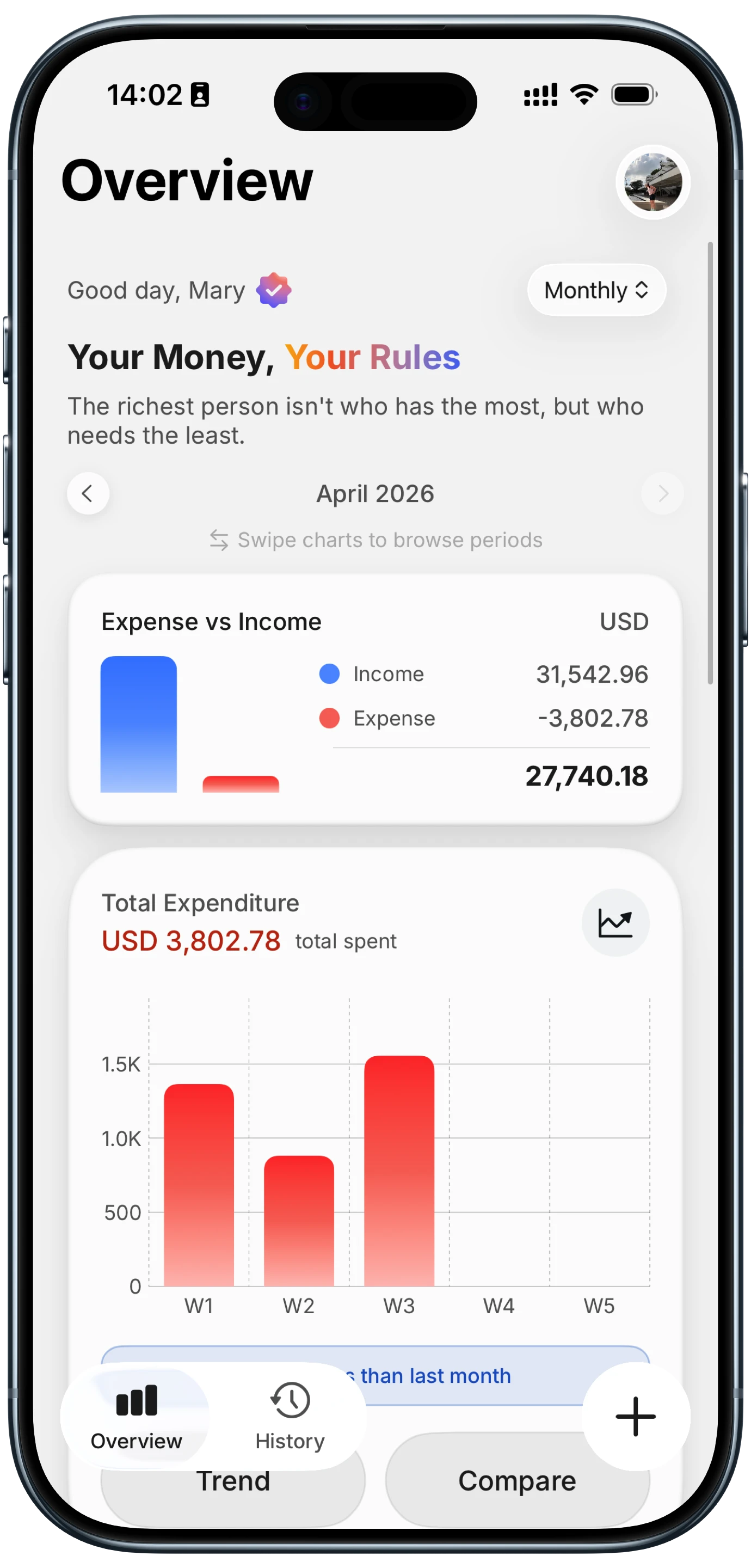
Finny helps you visualize how your savings grow over time with built-in compound interest charts, goal-tracking tools, and a free Compound Interest Calculator you can try right now.
You can also explore external tools like:
Both let you experiment with different rates, amounts, and timeframes to see how compounding affects your money.
Conclusion: Let Compound Interest Work for You
Compound interest is one of the most powerful tools in personal finance: it rewards patience and consistency. By saving and investing regularly, you can let time and compounding grow your wealth automatically. For the savings habit that feeds the compounding engine, see our guide on what is pay yourself first, and for the longer-horizon view, what is financial freedom.
Start Growing Your Money Today
You don't need a finance degree to plan your future: just the right mindset and tools.
Try Finny: your beautifully simple iOS finance tracker that helps you budget, track, and grow with ease.