AI Budget Planner: Can AI Actually Help You Budget Better?
Budgeting apps have been promising to fix your finances for over a decade. Now they are adding "AI" to the pitch. The question worth asking is whether an AI budget planner is genuinely better than a spreadsheet, a traditional budgeting app, or even a pen and a notebook.
The answer is nuanced. AI does some things well: it reduces data entry friction, categorizes spending faster, and can surface patterns you might miss on your own. But it does not solve the hardest part of budgeting, which is sticking to the plan you set. This guide takes a balanced look at what AI can and cannot do for your budget, compares the major tools available in 2026, and helps you decide whether an AI budgeting app is worth the switch. For a broader overview of tracking tools, see our best money tracker apps in 2026 guide, and for a deeper look at the category as a whole, our roundup of AI budget management tools in 2026.
What Traditional Budgeting Looks Like
Before evaluating what AI adds, it helps to understand what budgeting involves without it.
A traditional budget has three steps:
- Plan: Decide how much to allocate to each spending category for the month. Rent, groceries, transportation, entertainment, savings, and so on.
- Track: Record every expense and assign it to a category.
- Review: Compare actual spending to the plan. Adjust next month's allocations based on what you learned.
Each step has friction. Planning requires knowing your income and estimating expenses. Tracking requires consistent logging. Reviewing requires analyzing numbers and making decisions. Most people who abandon budgeting do so because step two, the daily tracking, demands too much effort.
Traditional budgeting tools address this in different ways.
Pen and Paper Budgeting
Write your budget categories and limits on paper. Track spending by writing down each purchase. Calculate totals manually. This method is free, private, and simple, but the manual math and lack of visualization make it tedious for most people beyond a few weeks.
Spreadsheet Budgeting
Create a budget in Excel or Google Sheets. Set up categories with monthly limits. Enter expenses daily or weekly. Use formulas to calculate remaining balances. This offers more power than paper but requires spreadsheet skills and is cumbersome on mobile devices.
YNAB (You Need A Budget)
YNAB applies zero-based budgeting principles: every dollar of income is assigned a purpose before you spend it. It supports both bank-linked importing and manual entry. The methodology is proven, and the community is strong.
Strengths: Clear budgeting philosophy, strong educational resources, works across platforms, supports both manual and linked entry.
Limitations: Costs $14.99 per month or $99 per year. The zero-based approach has a learning curve. Manual entry uses traditional form fields, not AI-assisted input. The methodology requires more upfront planning than simple tracking.
PocketGuard
PocketGuard focuses on showing you how much money is safe to spend after bills and savings goals. It links to your bank accounts and calculates your "in my pocket" number.
Strengths: Simple concept. Good for people who want one number to guide daily spending. Clean interface.
Limitations: Requires bank connection. Limited customization. The simplicity that makes it accessible also limits its usefulness for detailed budget analysis.
What AI Adds to Budgeting
AI does not change the three-step structure of budgeting. You still plan, track, and review. What AI changes is how much effort each step requires.
Faster Tracking Through AI Input
The biggest practical impact of AI on budgeting is in the tracking step. When you can type "groceries $52" instead of navigating form fields, or speak "gas station twenty-eight dollars" instead of opening a dropdown menu, daily tracking becomes fast enough to sustain.
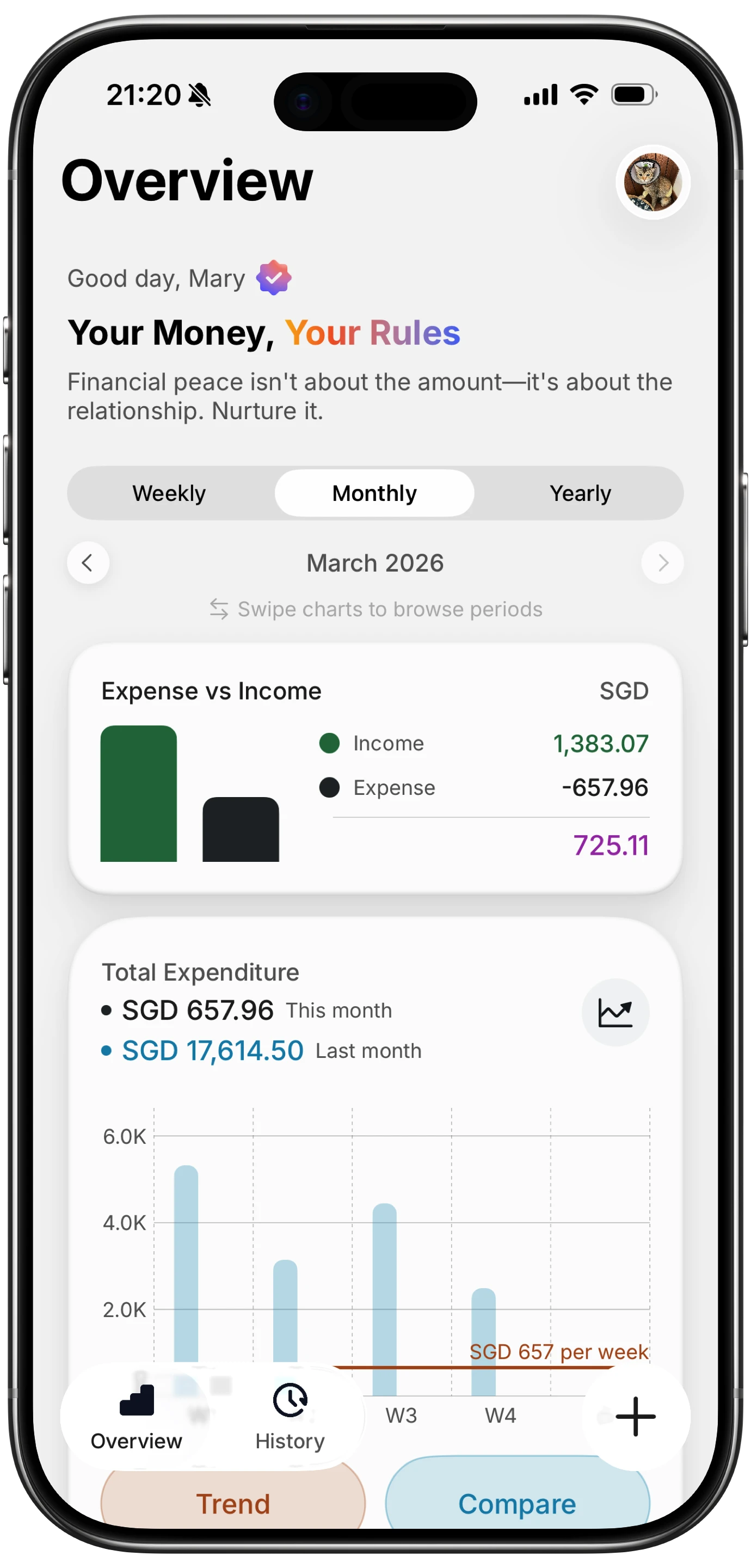
Finny app's Overview feature
This is not a small improvement. The tracking step is where most budgets fail. If AI input reduces the time per entry from thirty seconds to five seconds, and you log eight transactions per day, you save about three minutes daily. More importantly, the reduced friction means you are far more likely to track at all.
Smarter Categorization
AI-powered categorization assigns expenses to budget categories without manual selection. Type "Starbucks $6" and the app knows that is Coffee or Dining. Type "Shell $45" and it maps to Gas or Transportation.
This saves a few seconds per entry and reduces the cognitive load of choosing from a category list every time. Over time, good AI categorizers learn your preferences: if you always recategorize "Target" from Shopping to Groceries, the app starts defaulting to Groceries.
The limitation is ambiguity. A single merchant can span multiple categories, and AI cannot read your mind about which category a specific purchase belongs to. The confirmation step matters.
Pattern Detection
Some AI budgeting tools identify spending patterns you might not notice on your own. "You have spent 30% more on dining this month compared to last month." "Your grocery spending peaks on Sundays." "You have three subscriptions totaling $47 per month that you have not used recently."
These insights are useful when they are accurate and actionable. They are less useful when they state the obvious ("You spent money on food this week") or when the data behind them is incomplete.
Budget Suggestions
A few tools go further and suggest budget allocations based on your income and spending history. "Based on your last three months, we suggest budgeting $400 for groceries, $200 for dining, and $150 for transportation."
These suggestions provide a reasonable starting point, especially for people who have no idea how much they spend in each category. But they are backward-looking: they tell you what you have been spending, not what you should be spending. Your budget should reflect your goals, not just your habits.
What AI Cannot Do for Your Budget
This is where the balanced assessment matters. AI has clear limitations in the budgeting context.
AI cannot set priorities for you. Should you spend more on housing or save more for retirement? Should you cut dining out or cut subscriptions? These are value-based decisions that depend on your life circumstances, goals, and preferences. AI can show you the numbers. It cannot tell you what matters more.
AI cannot enforce discipline. Knowing you have exceeded your dining budget does not stop you from ordering takeout. Budget adherence is a behavioral challenge, not a data challenge. AI can send you an alert, but you still have to respond to it.
AI cannot account for life changes. Job loss, medical expenses, moving to a new city, having a child: these events reshape your budget fundamentally. AI trained on your past spending patterns cannot anticipate or plan for these changes. Human judgment and flexibility are essential.
AI cannot guarantee accuracy. Every AI categorization model has an error rate. If you rely on AI without reviewing, your budget data will contain mistakes. Small errors compound: a $50 expense in the wrong category for six months misrepresents your spending by $300 in that category.
AI cannot replace financial literacy. Understanding concepts like compound interest, debt prioritization, emergency funds, and tax implications is more important than any app feature. AI tools are most useful for people who already understand the basics and want to reduce busywork. For foundational concepts, our budgeting for beginners guide covers the essentials.
AI Budgeting Tools Compared
| Feature | EveryDollar | Monarch Money | Copilot Money | Finny |
|---|---|---|---|---|
| Budgeting Method | Zero-based | Flexible | Flexible | Track and analyze |
| AI Input | No | No | No | Text, Voice, Receipt |
| Bank Connection | Premium only | Required | Required | Not required |
| Offline Support | No | No | No | Yes |
| Free Tier | Yes | No | No | Yes |
| Price (paid) | $17.99/mo | $14.99/mo | $14.99/mo | a low monthly price |
| AI Categorization | No | Yes | Yes | Yes |
| Spending Insights | Manual review | AI-generated | AI-generated | Analytics dashboard |
Where Each Tool Fits
EveryDollar is a good choice if you want a guided zero-based budgeting approach with a simpler interface than YNAB. It is less about AI and more about a disciplined framework built around Dave Ramsey's methodology.
Monarch Money works best for households that want shared budgeting with automatic bank syncing. The AI categorization and insights are solid, but the value proposition centers on comprehensiveness rather than AI.
Copilot Money appeals to iOS users who value design and want automatic tracking with strong visualization. The AI is behind the scenes, improving categorization and detecting subscriptions.
Finny suits people who want AI applied to the input step rather than the analysis step. If your main barrier to budgeting is the effort of logging expenses, Finny's text, voice, and receipt input methods address that directly. The absence of a bank connection requirement adds privacy, and offline support means you can track anywhere.
Building a Budget That Actually Works
Whether you use AI tools or not, effective budgeting comes down to a few principles.
Start simple. Begin with three to five categories: necessities, wants, savings, and debt payments. A 50/30/20 Budget Calculator is a quick way to get starter allocations based on your income. Add detail later once you have a month of data. Over-categorizing from the start creates friction that leads to abandonment.
Track before you budget. Spend one month logging every expense without setting limits. At the end of the month, you will know where your money goes. Set your budget based on reality, not guesses.
Review weekly, not monthly. A monthly review is too late to adjust. Weekly reviews let you course-correct before overspending compounds. Fifteen minutes on Sunday is enough.
Adjust without guilt. Budgets are plans, not promises. When you overspend in one category, reduce another. When life changes, revise the whole budget. Rigidity leads to frustration and abandonment.
Use the fastest tracking method available. The budget is only as good as the data behind it. If tracking is too slow, data quality drops. AI-assisted input keeps data flowing with minimal friction. For more on tracking approaches, see our guide on how to track expenses.
Should You Switch to an AI Budget Planner?
The honest answer: it depends on where your current budgeting process breaks down.
If your problem is tracking consistency, an AI budget planner that reduces input friction will help. Faster logging means more complete data, which means a more accurate budget.
If your problem is understanding your spending, AI-generated insights and pattern detection can surface useful information you might not find on your own.
If your problem is discipline and adherence, AI will not solve it. No app can make you spend less. What it can do is show you clearly and quickly what you are spending, which gives you the information you need to make better decisions.
If your current system works and you are budgeting consistently, there is no reason to switch tools for the sake of "AI." The technology should serve the process, not the other way around.
Common Questions About AI Budget Planners
What is an AI budget planner?
An AI budget planner is a budgeting tool that uses artificial intelligence to assist with expense logging, categorization, and spending analysis. The AI component typically handles natural language input parsing, receipt scanning, auto-categorization, and pattern detection to reduce the manual work of maintaining a budget.
Can AI create a budget for me?
AI can suggest budget allocations based on your past spending patterns. These suggestions are useful as starting points but should not replace your own judgment about priorities. A budget should reflect your goals, not just your historical spending averages.
Is an AI budgeting app better than a spreadsheet?
For tracking speed, yes. AI input is significantly faster than manual spreadsheet entry, especially on mobile. For customization and analysis depth, spreadsheets offer more flexibility. The best choice depends on whether speed or customization matters more to you.
Do AI budget apps need access to my bank account?
Some do, some do not. Monarch Money, Copilot Money, and Simplifi by Quicken support or require bank linking. Finny uses AI for input parsing without any bank connection. The privacy implications differ significantly between these approaches.
How much do AI budgeting apps cost?
Prices range from free to $17.99 per month. EveryDollar, Monarch, and Copilot each cost between $14.99 and $17.99 per month. Finny offers a free tier with core features and a Pro plan at a low monthly or yearly price.
Want to simplify budget tracking with AI-powered input?
Download Finny to log expenses in seconds using text, voice, or receipt scanning. No bank connection required, works offline, and your data stays on your device. Start with the free tier and upgrade to Pro if you want advanced analytics.