Smart Budget App: What Makes a Budget App Actually Smart in 2026?
Every budget app calls itself "smart" in 2026. Open any app store listing, and you will find the word repeated in descriptions, screenshots, and review responses. But what does "smart" actually mean when applied to a budgeting tool? Is it just a marketing label, or does it describe real capabilities that change how you manage money?
A genuinely smart budget app does more than store your transactions. It reduces the effort required to track spending, organizes your data without constant manual sorting, and surfaces patterns you would not notice on your own. The technology behind this is a combination of AI input parsing, automatic categorization, spending analytics, and in some cases, predictive budgeting. If you are curious whether AI can go further and actually help you set a budget, our guide on whether AI can help you budget better digs into that question.
This guide defines what separates a smart budgeting app from a basic one, compares the major options available in 2026, and helps you decide which features actually matter for your situation. For a broader look at tracking tools, see our best money tracker apps in 2026 guide.
What "Smart" Actually Means in a Budget App
The word "smart" gets applied loosely, so it helps to break it down into specific capabilities. A budget app earns the label when it does one or more of the following things that a basic tracker cannot.
Smart Input
Traditional budget apps require you to fill out form fields: amount, category, date, merchant, notes. A smart app lets you type "lunch $14" or speak "gas station thirty-two dollars" and extracts the structured data automatically. This is natural language processing applied to expense entry, and it reduces input time from 15 to 30 seconds down to about 5 seconds per transaction.
Receipt scanning also qualifies as smart input. Instead of manually typing receipt data, you photograph the paper, and the app extracts merchant, total, date, and sometimes line items. The difference between basic OCR and genuinely smart scanning is accuracy with varied receipt formats. For more detail on receipt scanning technology, see our best receipt scanner apps in 2026 guide.
Smart Categorization
A basic app asks you to select a category from a dropdown. A smart app suggests a category based on what you typed, spoke, or scanned, then lets you confirm or correct. Over time, it learns from your corrections and gets more accurate.
The technology here is pattern matching combined with machine learning. If you always categorize transactions at a specific coffee shop as "Coffee," the app learns that association. If you correct a "General" categorization to "Groceries" for a local market, the app remembers for next time.
Smart Analytics
Basic analytics show you a pie chart of spending by category. Smart analytics go further: they compare your spending to previous periods, identify unusual transactions, track category trends over time, and highlight where your money is going relative to your budget targets.
The most useful smart analytics are not flashy dashboards but simple, actionable observations. "You spent 30% more on dining this month than last month" is more useful than a detailed breakdown you have to interpret yourself.
Smart Predictions
Some apps attempt to predict future spending based on your history. If you consistently spend $400-450 on groceries each month, the app can project that you will spend roughly the same next month and alert you if you are on pace to exceed it midway through.
Predictive budgeting is the newest and least proven smart feature. It works well for consistent, recurring expenses. It breaks down for irregular spending, unexpected purchases, or lifestyle changes. For more on how AI is evolving in personal finance, see our guide on AI financial coaching and predictive budgeting.
Smart vs Traditional Budget Apps
The distinction between smart and traditional apps is not about one being better. It is about different approaches to the same problem: helping you understand and control your spending.
Traditional Budget Apps
Traditional budget apps are digital versions of paper ledgers. You enter transactions, assign categories, set budgets, and review your spending. The app provides the structure, but you do all the work.
Strengths: Full control over every data point. No AI to disagree with. Works without internet, without accounts, sometimes without even an app (spreadsheets count). Zero learning curve for people comfortable with manual data entry.
Weaknesses: High friction per transaction. The time and effort required cause most people to abandon tracking within two weeks. No assistance with categorization, pattern detection, or input parsing.
Smart Budget Apps
Smart budget apps automate the tedious parts of tracking while keeping you in control of the important decisions. AI handles parsing, categorization, and pattern detection. You handle confirmation, budgeting decisions, and financial planning.
Strengths: Lower friction per transaction means higher consistency over time. AI catches patterns you might miss. Input options like voice and receipt scanning cover more situations. Categorization improves with use.
Weaknesses: AI is not perfect and requires correction. Some features depend on cloud processing, which raises privacy questions. The "smart" label is sometimes marketing rather than substance.
Comparison: Smart Budget Apps in 2026
| Feature | Simplifi by Quicken | Monarch Money | Copilot Money | Finny |
|---|---|---|---|---|
| AI Input (text/voice) | No | No | No | Yes |
| Receipt Scanning | No | No | No | Yes (batch) |
| Auto-Categorization | Rules-based | AI (bank-linked) | AI (bank-linked) | AI (input-based) |
| Spending Analytics | Detailed | Detailed | Detailed | Visual trends |
| Predictive Budgeting | No | Limited | Limited | No |
| Bank Connection Required | Yes | Yes | Yes | No |
| Offline Support | No | No | No | Yes |
| Free Tier | No ($3.99/mo) | No ($14.99/mo) | No ($14.99/mo) | Yes |
| Multi-Currency | Limited | Yes | Yes | Yes (150+) |
| Platform | Web, iOS, Android | Web, iOS, Android | iOS only | iOS |
| Privacy Focus | Low | Medium | Low | High |
Simplifi by Quicken (Personal Finance Tracker)
Simplifi is a streamlined personal finance tracker from Quicken that focuses on spending plans and watchlists rather than traditional budgeting. It connects to your bank accounts and provides a clear view of your cash flow.
Smart features: Simplifi uses rule-based auto-categorization and spending watchlists that alert you when you are approaching limits. It offers a spending plan that accounts for bills, subscriptions, and savings goals. Its clean dashboard and cash flow projections are its strongest differentiators.
Limitations: Simplifi requires bank connections for transaction import. There is no AI-assisted input: no text parsing, no voice entry, no receipt scanning. The app costs $3.99/month or $47.88/year with no free tier. Categorization is rule-based rather than AI-powered, meaning it matches merchants to categories but does not understand context.
Monarch Money
Monarch Money is a comprehensive financial management platform that covers budgeting, investment tracking, and net worth monitoring. It positions itself as a modern replacement for Mint.
Smart features: AI-powered transaction categorization through bank linking. Spending insights that compare periods and highlight trends. Collaborative features for couples and families. Investment tracking alongside expense management.
Limitations: Requires bank connections for core functionality. Manual entry exists but is form-based, not AI-assisted. Costs $14.99/month or $99.99/year. The breadth of features can feel overwhelming for users who just want simple expense tracking. Not ideal for users who prioritize privacy and want to avoid sharing bank credentials.
Copilot Money
Copilot Money is an iOS finance tracker known for its clean design and strong Apple ecosystem integration. It uses AI for transaction categorization and spending analysis.
Smart features: AI categorization that improves over time. Clean visualizations of spending trends. Subscription tracking. Net worth monitoring. Well-designed widgets and Apple Watch support.
Limitations: iOS only. Requires bank connections. Costs $14.99/month or $99/year with no free tier. No AI-assisted input methods. Smart features are primarily analytical rather than input-focused. Not available for Android users.
Finny: Smart Input Without Bank Connections
Finny approaches "smart" from the input side rather than the analysis side. Instead of using AI to analyze bank-imported data, Finny uses AI to make manual entry fast enough that bank connections become unnecessary.
Smart input: Type natural language, speak your expense, or scan receipts (up to five at once). The AI parses amount, merchant, date, and category from any input method. You confirm before saving.
Smart categorization: Categories are suggested based on your input text, receipt content, and past patterns. Corrections teach the model your preferences.
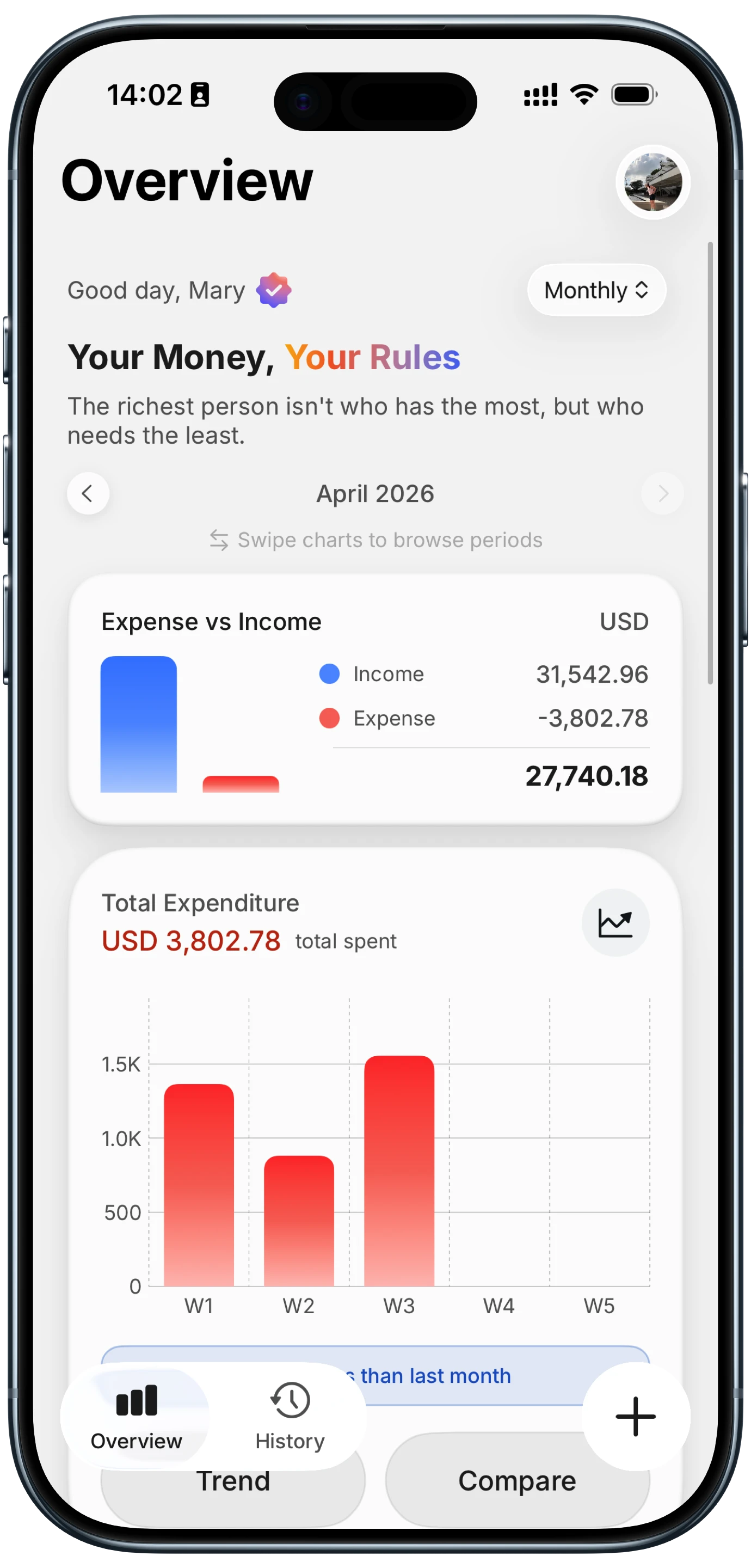
Smart analytics: Visual spending trends show where your money goes by category and time period. Compare months, track category changes, and identify spending patterns.
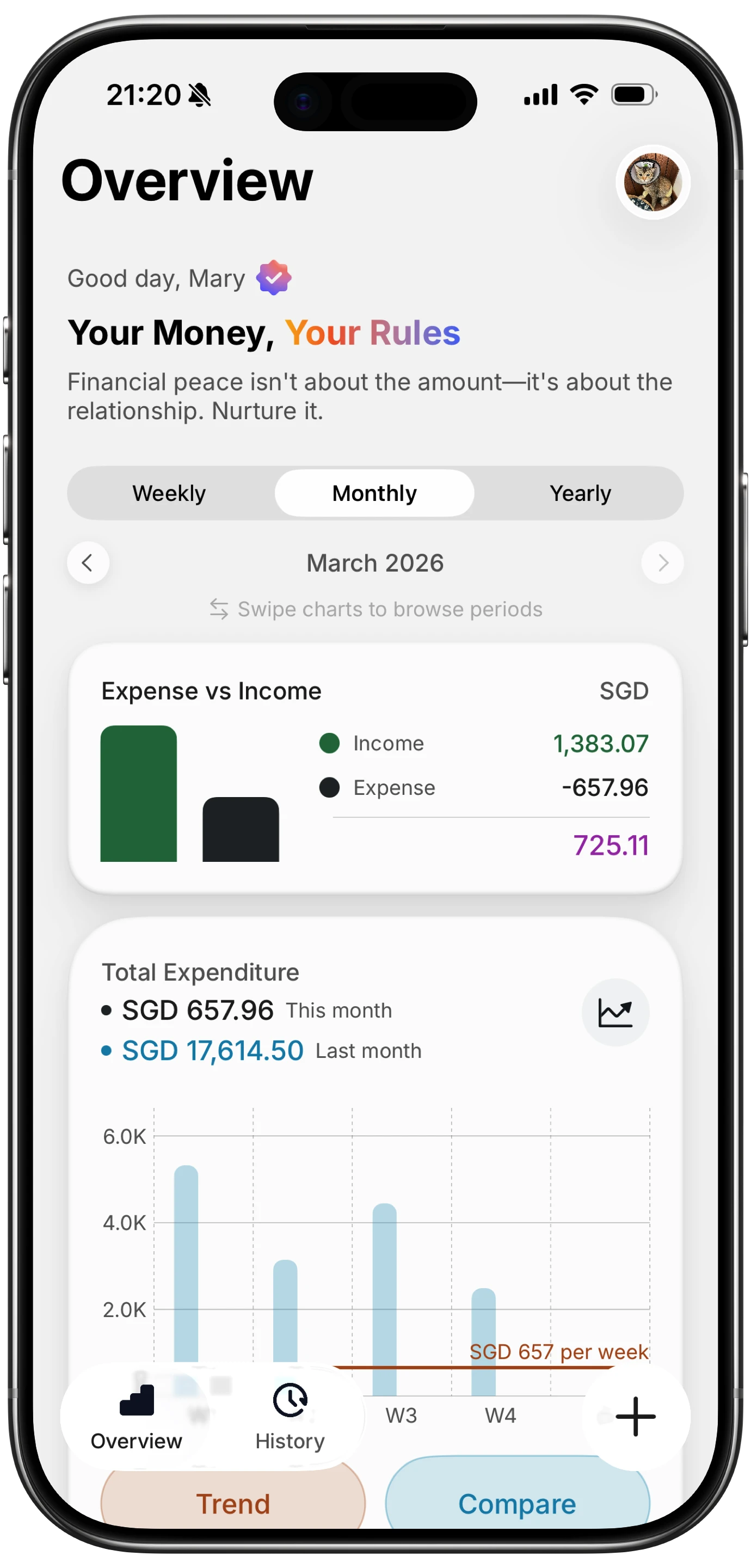
Finny app's Overview feature
Offline-first: All features work without internet. Your data stays on your device. Cloud sync is optional. No bank credentials needed.
Pricing: Free tier available. Pro features at a low monthly or yearly price, which is significantly less than competitors charging $14.99/month.
Which Smart Features Actually Matter
Not all smart features are equally useful. Here is a practical ranking based on what affects daily budgeting habits most.
High Impact
Smart input (text, voice, receipt): This is the feature that determines whether you keep tracking or quit. Reducing per-transaction effort from 20 seconds to 5 seconds makes the difference between a two-week habit and a lasting one. If your budget app does not make input fast and easy, other smart features are irrelevant because you will stop using the app.
Auto-categorization: Manually sorting 30 to 50 transactions per week into categories is the second most common reason people abandon tracking. AI categorization with a confirmation step eliminates this friction while keeping accuracy high.
Medium Impact
Spending analytics: Useful for monthly reviews and identifying trends. Not something you interact with daily, but valuable for making informed budget adjustments. Seeing that dining spending increased 25% last month is actionable information.
Multi-currency support: Essential for travelers and digital nomads, irrelevant for everyone else. If you deal with multiple currencies regularly, this jumps to high impact. For more on this, see our guide on multi-currency expense tracking for digital nomads.
Lower Impact
Predictive budgeting: Interesting in concept but limited in practice. Monthly spending is more variable than models assume. Useful as a rough guideline, not reliable as a precise forecast.
Investment tracking: Valuable if you want one app for everything, but not directly related to the "smart budgeting" problem. Dedicated investment platforms typically do this better.
How to Choose a Smart Budget App
Your choice should depend on your priorities, not on which app has the longest feature list.
If you want automation and do not mind bank connections: Monarch Money or Copilot Money provide AI-powered categorization and analysis of your bank transactions. The trade-off is cost ($14.99/month) and privacy (your bank data on their servers).
If you want a budgeting methodology: YNAB's zero-based approach or EveryDollar's guided budgeting are well-designed, though both come with a learning curve and subscriptions. Neither offers AI input features. For more on zero-based budgeting, see our zero-based budgeting guide.
If you want smart input with privacy: Finny makes logging fast through AI text, voice, and receipt input without requiring bank connections. Your data stays on your device, and the free tier covers core features.
If you are just starting out: Begin with a free option that makes input easy. The biggest risk is not choosing the wrong app, but choosing one with enough friction that you stop using it. Our budgeting for beginners guide covers how to build tracking habits that stick.
The Bottom Line
A truly smart budget app in 2026 reduces the effort of tracking spending without taking away your control. The most impactful smart features are input methods (text, voice, receipt scanning) and auto-categorization, because these directly affect whether you maintain the tracking habit.
Analytics, predictions, and investment tracking are useful additions, but they matter less if the app is too tedious to use daily. Choose based on what keeps you consistent, not what looks impressive on a features page.
Common Questions About Smart Budget Apps
What is the best smart budget app in 2026?
The best option depends on your priorities. For AI-assisted input without bank connections, Finny provides text, voice, and receipt scanning with auto-categorization. For bank-linked automation with detailed analytics, Monarch Money and Copilot Money are strong choices, though both require subscriptions.
What makes a budget app "smart" versus basic?
A smart budget app uses AI or machine learning for input parsing (natural language, voice, receipts), automatic categorization, spending pattern analysis, or predictive budgeting. A basic app requires you to manually enter and categorize every transaction through form fields.
Do smart budget apps need access to my bank account?
Not all of them. Apps like Simplifi by Quicken, Monarch Money, and Copilot Money require bank links for their automation features. Finny uses AI for input parsing without any bank connection, keeping your financial data on your device.
Are smart budget apps worth the subscription cost?
It depends on whether the smart features help you maintain the tracking habit. If a free basic app leads to abandonment within two weeks, a paid smart app that you actually use consistently provides more value. Finny offers a free tier with smart features, making it possible to test without committing to a subscription.
Ready to try a budget app that is actually smart where it matters?
Download Finny to log expenses with AI-powered text, voice, and receipt input. Auto-categorization, offline support, 150+ currencies, and no bank connection required. Free to start, with Pro at a low monthly price.