Intuit shut down the Mint budgeting app on March 23, 2024, after 17 years of service. Millions of users lost their go-to tool for tracking spending, monitoring budgets, and viewing net worth in one dashboard. The official migration path led to Credit Karma, but that app focuses on credit scores and financial product recommendations rather than hands-on budgeting.
Two years later, the mint budget app void has been filled by several strong alternatives. Some replicate what Mint did well. Others improve on areas where Mint fell short, like privacy, offline access, and AI-powered input. A few cost nothing at all.
This guide compares the best Mint replacements available in 2026, with honest breakdowns of pricing, features, and trade-offs. If you are also exploring free options specifically, see our best free budgeting apps in 2026 guide.
What Made Mint Popular (and What to Look For Now)
Mint attracted users with a simple promise: connect your bank accounts, and the app handles the rest. It auto-imported transactions, categorized spending, tracked bills, and showed your net worth across all linked accounts. All for free.
When evaluating replacements, consider which Mint features mattered most to you:
- Automatic transaction import from banks and credit cards
- Spending categorization with charts and breakdowns
- Budget tracking with alerts when you overspend
- Bill reminders and subscription tracking
- Net worth monitoring across accounts
- Free access without a subscription
No single app replicates every Mint feature at the same price point (free). But several come close, and many exceed what Mint offered in specific areas.
Quick Comparison Table
| App | Monthly Price | Bank Sync | Offline | Multi-Currency | AI Input | Privacy Focus |
|---|---|---|---|---|---|---|
| Finny | Free / Optional | No (by design) | Yes | 150+ currencies | Yes | High |
| Monarch Money | $14.99 | Yes | No | Limited | No | Medium |
| YNAB | $14.99 | Yes | No | Manual rates | No | Medium |
| PocketGuard | $12.99 | Yes | No | No | No | Low |
| Rocket Money | $7-14 | Yes | No | No | Limited | Low |
| Goodbudget | Free / $10 | No | Partial | No | No | High |
| Copilot | $13 | Yes | No | Yes | Limited | Medium |
| Empower | Free | Yes | No | No | No | Low |
Empower is the outlier here: it is free, and it is the only option on this list built primarily around investments and net worth rather than budgeting. That makes it a partial Mint replacement rather than a full one, and the free tools come with a sales relationship attached. Our Empower Personal Dashboard review covers what that means in practice.
Best Mint Alternatives in 2026
Finny: Best for Privacy-First Tracking
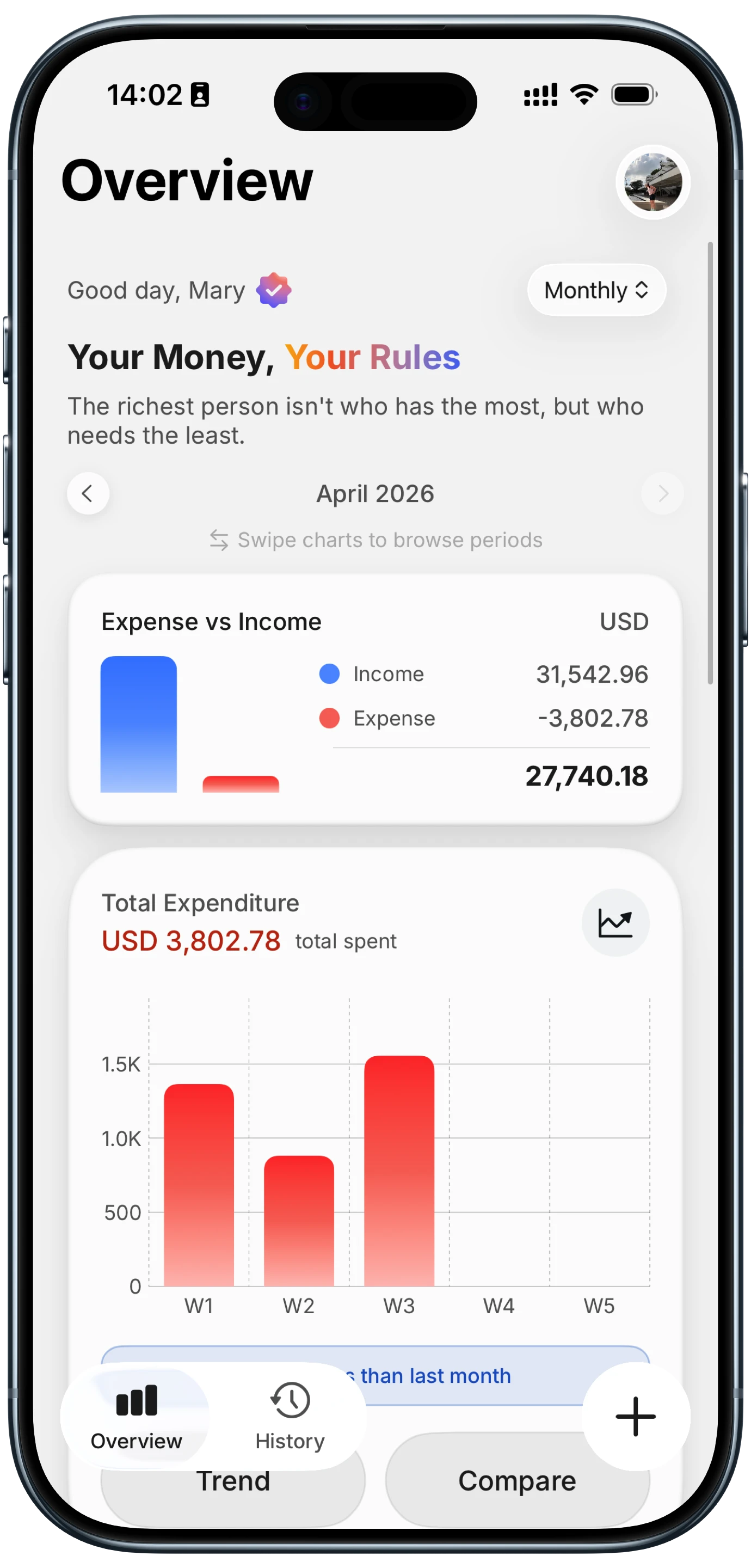
Finny takes the opposite approach from Mint. Instead of connecting to your bank and hoping the sync works, Finny uses AI to make manual tracking faster than automatic imports ever were.
The key difference: Finny never asks for your bank credentials. After years of data breaches and the Mint shutdown itself proving that free services can disappear overnight, many users now prefer tracking expenses without linking their bank. Finny was built around this philosophy from day one.
Input options include natural language text ("groceries $47 at Trader Joe's"), voice dictation, receipt scanning with up to five photos at once via Batch Snap and Log, and even statement screenshot imports. The app handles 50 AI requests per day on the Pro plan.
Multi-currency support goes well beyond what Mint offered. Finny's Unified Currency View keeps each transaction in its original currency while auto-converting totals to your default. For travelers and expats, this is a meaningful upgrade over Mint's US-dollar-only approach.
The free tier includes unlimited manual tracking, custom categories, charts, and support for 150+ currencies. Pro costs a low monthly price, which is a fraction of what most Mint alternatives charge. For context on app security and your financial data, Finny's offline-first design means your data stays on your device.
Best for: Users who want fast, AI-assisted expense tracking without sharing bank login credentials.
Monarch Money: Most Mint-Like Experience
Monarch Money was co-founded by Mint's first product manager, which explains why it feels like the natural successor. The interface is polished, bank syncing works reliably, and the budgeting tools are more detailed than what Mint offered.
Joint account access makes Monarch popular with couples. Both partners can view shared finances, assign budget categories, and track progress toward goals. The cash flow projection feature helps with planning ahead, something Mint never did well.
The drawback is price. At $14.99/month ($99.99/year), Monarch is one of the more expensive options on this list. There is a 7-day free trial, but no permanent free tier. If Mint's free price tag was a major draw for you, Monarch will feel like a significant change. For a closer look at Monarch and seven alternatives, see our apps like Monarch Money comparison.
Bank sync covers most major institutions, and transaction categorization is generally accurate. Investment tracking and net worth monitoring are included, making this the most complete Mint replacement for users who relied on the full dashboard experience.
Best for: Users who want the closest experience to Mint and are willing to pay for it.
YNAB: Best for Changing Your Budgeting Habits
YNAB (You Need a Budget) is not a Mint clone. It uses zero-based budgeting, where every dollar gets assigned a purpose before you spend it. This is a fundamentally different approach from Mint's passive tracking.
For users who tracked spending in Mint but never actually changed their habits, YNAB's method can be transformative. The educational resources, community forums, and structured approach teach budgeting as a skill rather than just providing a dashboard to glance at.
Bank syncing imports transactions, but YNAB still requires you to review and categorize each one. This intentional friction is part of the method. The app costs $14.99/month ($109/year), with a 34-day free trial and free access for college students with a .edu email.
YNAB does not work offline, and multi-currency support requires manual exchange rate adjustments. If you travel frequently, this can become tedious.
Best for: Users who want to actively budget, not just passively track spending.
PocketGuard: Best "How Much Can I Spend?" App
PocketGuard answers one question better than any other app: "How much money do I have left to spend today?" It calculates your available cash after accounting for bills, savings goals, and necessary expenses.
This "In My Pocket" feature is what makes PocketGuard unique. Mint showed you what you spent. PocketGuard shows you what you can still spend safely. For people who routinely overshoot their budget, this forward-looking approach can be more useful.
Bank syncing covers major institutions, and the app auto-categorizes transactions. Bill tracking and subscription detection work well. The interface is clean and simple.
Pricing has increased significantly since 2024. PocketGuard Plus now costs $12.99/month ($74.99/year), up from around $34.99/year just a few years ago. The free version has been eliminated. This is a considerable jump for users who expected a Mint-like free experience.
Best for: Overspenders who need a clear, real-time picture of available money.
Rocket Money: Best for Subscription Management
Rocket Money (formerly Truebill) gained popularity after Mint's shutdown by aggressively courting displaced users. Its strongest feature is subscription tracking and cancellation: the app identifies recurring charges and can negotiate lower bills or cancel services on your behalf.
The free tier covers basic budgeting and subscription detection. Premium membership uses a sliding scale between $7 and $14/month, letting you choose what to pay. Premium adds unlimited custom budgets, net worth tracking, full credit reports, and a customizable dashboard.
For users whose main Mint use case was spotting forgotten subscriptions and tracking recurring bills, Rocket Money does this better than Mint ever did. The budgeting features are decent but not as deep as YNAB or Monarch.
Bank syncing is required for most features, and the app does not work offline. Multi-currency support is absent.
Best for: Users focused on finding and cutting unnecessary subscriptions.
Goodbudget: Best Free Envelope Budgeting
Goodbudget uses the envelope budgeting method, where you allocate money into virtual envelopes for each spending category. When an envelope is empty, you stop spending in that category (or move money from another envelope).
The free tier is genuinely useful: up to 20 envelopes, one account, and basic reporting. The Plus plan at $10/month adds unlimited envelopes, multiple accounts, and debt tracking.
Like Finny, Goodbudget does not connect to banks. All transactions are entered manually. This is a privacy advantage, but it requires more daily effort than auto-syncing apps. The app syncs between devices, so couples or families can share a budget.
Goodbudget lacks AI input, multi-currency support, and advanced analytics. It is a simple, focused tool for people who want structure without complexity.
Best for: Budget beginners who want a simple, visual system with a solid free tier.
Copilot: Best for Apple Users Who Want Bank Sync
Copilot is an Apple-exclusive finance app with strong design and reliable bank syncing. It covers budgeting, spending analysis, investment tracking, and net worth monitoring in a clean, iOS-native interface.
At $13/month ($95/year), Copilot is expensive but well-regarded by Apple users who value design and integration. The app supports multiple currencies and offers basic AI features for transaction tagging.
The 1-month free trial gives you full access to evaluate whether it fits. Copilot requires bank connections for most of its functionality.
Best for: iOS users who want an Apple-native finance dashboard with bank syncing.
Empower: Best Free Investment Tracker
Empower (formerly Personal Capital) offers a free dashboard for net worth tracking, investment analysis, and retirement planning. If Mint's investment tracking and net worth features mattered most to you, Empower actually exceeds what Mint offered in those areas.
The budgeting and day-to-day expense tracking features are basic compared to dedicated budgeting apps. Empower monetizes through its wealth management service (0.89% fee on managed assets), so the free dashboard serves as a lead generation tool.
Bank syncing is required. There is no offline mode or multi-currency support.
Best for: Users who primarily used Mint for investment tracking and net worth monitoring.
Mint vs. These Alternatives: What Changed
The biggest shift since Mint's shutdown is that free, bank-connected budgeting is no longer the default. Most quality alternatives charge $7-15/month. The trade-off is better reliability, active development, and features Mint never had.
The other notable trend is the rise of privacy-first alternatives. Mint required bank connections and monetized user data through targeted financial product ads. Apps like Finny and Goodbudget prove that you can track finances effectively without handing over bank credentials. For a deeper look at this topic, read our guide on finance app security and privacy.
If budget is your primary concern, the best value among paid apps is Finny at a low monthly price. Among completely free options, Goodbudget and Empower serve different but specific needs well. For a full comparison of no-cost options, see our best free budgeting apps guide.
How to Migrate from Mint
If you still have your Mint data export (CSV format), most apps on this list can import it:
- Check your email for the Mint data export you may have downloaded before the shutdown
- Choose your new app based on the comparison above
- Import transaction history if the new app supports CSV import (Finny, YNAB, and Monarch all do)
- Set up categories to match your old Mint categories as closely as possible
- Give it two weeks before judging, as any new system takes time to feel natural
If you did not export your Mint data before the shutdown, you will need to start fresh. The good news is that starting with a clean slate can actually be an opportunity to simplify your category structure and budget approach. If you are also moving from an Android phone to an iPhone in this transition, see our migrate from Android to iPhone money apps guide for cross-platform data continuity tips.
FAQ
Is Credit Karma a good replacement for Mint?
Credit Karma inherited some Mint users through Intuit's official migration, but it is not a budgeting app. It focuses on credit score monitoring, financial product recommendations, and tax filing. If hands-on budgeting and expense categorization were your primary Mint use cases, Credit Karma will not fill that gap. Look at Monarch, YNAB, or Finny instead.
What is the best free Mint alternative in 2026?
For expense tracking without bank connections, Finny's free tier offers unlimited manual tracking, custom categories, charts, and multi-currency support. For envelope-style budgeting, Goodbudget's free plan covers up to 20 envelopes. For investment and net worth tracking, Empower's free dashboard is the strongest option. No single free app replicates everything Mint did.
Can I track expenses without connecting my bank account?
Yes. Finny and Goodbudget both work without bank connections. Finny uses AI-powered input (text, voice, receipt scanning) to make manual tracking fast, while Goodbudget relies on traditional manual entry. For a detailed look at this approach, read our guide on how to track expenses without linking your bank.
Why did Mint shut down?
Intuit discontinued Mint on March 23, 2024, after 17 years. The company chose to consolidate its consumer finance efforts under Credit Karma, another Intuit-owned property. Mint's free model, which relied on financial product referrals and targeted ads, was reportedly no longer sustainable at the scale needed to maintain the service.
Is it safe to connect bank accounts to budgeting apps?
Most reputable budgeting apps use read-only bank connections through services like Plaid, meaning they can view transactions but cannot move money. However, any bank connection introduces a potential security surface. Apps like Finny eliminate this concern entirely by not requiring bank credentials. Your risk tolerance and privacy preferences should guide this decision. Learn more in our finance app security guide.