You just paid for coffee at a café with spotty WiFi. Or you're traveling abroad without a data plan. Or you're simply underground on the subway. In all these moments, your expense tracking app becomes useless if it requires an internet connection.
Offline expense tracking solves this problem by letting you log transactions immediately, regardless of connectivity. The data saves locally and syncs later when you're back online. This article explains how offline tracking works, why it matters, and which apps handle it best.
For a broader comparison of tracking approaches, see our guide on best money tracker apps in 2026, our guide to the best expense trackers without bank login for 2026, and our finance app security and privacy overview.
What Is Offline Expense Tracking
Offline expense tracking means recording your spending without an active internet connection. The app stores transaction data locally on your device and synchronizes with cloud servers when connectivity returns.
This differs from most finance apps that require constant internet access to function. Bank-linked apps, for example, need to communicate with financial institutions in real time. If you're offline, you can't log anything.
Offline-first apps flip this model. They prioritize local storage and treat cloud sync as optional or secondary. Your data lives on your device first, then copies to servers if you choose.
Why Offline Tracking Matters
Reliability in Any Environment
Internet access isn't guaranteed everywhere. Consider these common scenarios:
- Traveling internationally without roaming data
- Underground transit systems with no signal
- Rural areas with limited connectivity
- Buildings with poor reception
- Airplane mode during flights
If you can't log an expense in the moment, you'll likely forget it. Studies show that delayed expense entry leads to significant underreporting. Real-time logging, even offline, produces more accurate records. For practical tips on making daily logging stick, see our guides on how to track daily spending and how to track expenses.
Speed and Responsiveness
Offline apps respond instantly because they don't wait for server communication. There's no loading spinner, no timeout errors, no "retry" buttons. You open the app, enter the expense, and it saves immediately.
This speed matters more than it seems. Every friction point in expense tracking increases the chance you'll skip logging something. Faster apps get used more consistently.
Data Privacy and Ownership
When your data lives locally first, you maintain direct control over it. You decide whether to sync to cloud servers, which devices have access, and how long data persists.
Apps that require constant internet connectivity often stream your financial data to remote servers with every interaction. Offline-first architecture reduces this exposure by keeping data on-device by default.
Battery Efficiency
Constant network communication drains battery. Offline apps that sync periodically rather than continuously tend to use less power. This matters especially when traveling or during long days away from chargers.
How Offline Expense Tracking Works
Local Database Storage
Offline apps maintain a database directly on your device. When you log an expense, it writes to this local database immediately. The record exists on your phone whether or not you have internet.
Common local storage technologies include:
- SQLite: Lightweight relational database
- Realm: Mobile-optimized object database
- Core Data: Apple's persistence framework
These databases handle thousands of transactions without performance issues.
Sync When Connected
Once internet access returns, offline apps synchronize local changes with cloud servers. This sync can happen:
- Automatically when WiFi connects
- On demand when you trigger it manually
- Periodically in the background
Good offline apps handle sync conflicts gracefully. If you edited the same expense on two devices while both were offline, the app needs rules for which version wins.
Conflict Resolution
The standard approach is "last write wins" where the most recent edit takes precedence. More sophisticated apps show you both versions and let you choose. Either way, no data should be lost during sync.
Comparing Offline Expense Tracking Apps
Not all expense trackers handle offline mode equally. Here's how major apps compare:
| App | Offline Support | Sync Method | Local Storage |
|---|---|---|---|
| Finny | Full | Auto + Manual | Yes |
| 1Money | Yes | Auto | Yes |
| Monarch | No | Requires connection | No |
| PocketGuard | No | Requires connection | No |
| Spendee | Yes | Auto | Yes |
| Wallet | Yes | Auto | Yes |
Finny: Best Offline-First Design
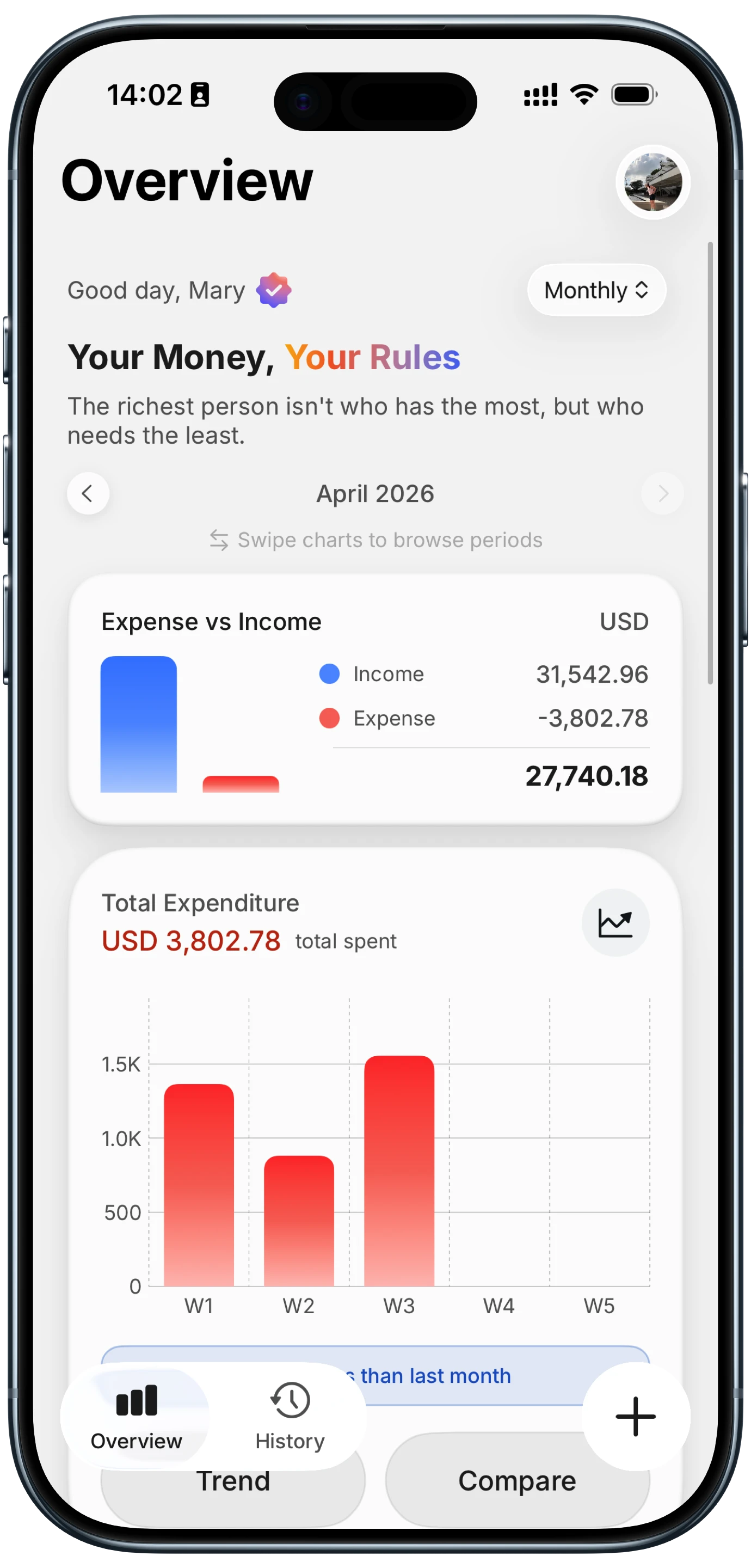
Finny treats offline as the default state, not an exception. All data saves locally first, and cloud sync is optional. You can use the app indefinitely without ever connecting to the internet.
Key offline features:
- Instant local saves: No waiting for server response
- Full functionality offline: Categories, notes, receipts all work
- Background sync: Uploads when WiFi available
- No account required: Use locally without signing up
- Receipt photos stored locally: Images save to device, sync later
This architecture means Finny works reliably in any connectivity situation.
1Money: Good Offline Support
1Money is a straightforward expense tracker that works well offline. It supports manual entry, category management, and basic reporting without an internet connection. The app syncs automatically when online.
Monarch Money and PocketGuard: No Offline Support
Both apps require constant internet because they depend on bank connections for transaction data. You cannot manually log expenses offline. This limits usefulness during travel or in low-connectivity areas.
Spendee and Wallet: Good Offline Support
Both apps support offline transaction entry with automatic sync. However, some features like shared wallets or bank imports require connectivity. Manual tracking works well offline.
Setting Up Offline Expense Tracking
Choose an Offline-First App
Start by selecting an app designed for offline use. Check these criteria:
- Can you log expenses without internet? Test in airplane mode.
- Does sync happen automatically? You shouldn't need to remember to sync.
- Is data stored locally? Verify the app works without an account.
- How are conflicts handled? Make the same edit on two devices and see what happens.
Configure Sync Preferences
Most offline apps let you control when sync occurs:
- WiFi only: Saves mobile data
- Any connection: Syncs more frequently
- Manual only: Maximum control, but requires remembering
For most users, "WiFi only with manual override" balances convenience and data usage.
Develop the Logging Habit
Offline capability only helps if you actually log expenses in the moment. Build the habit:
- Log immediately after every purchase
- Keep the app accessible on your home screen
- Use quick entry features if available
- Review weekly to catch anything missed
The goal is reducing the gap between spending and recording to seconds, not hours.
Offline Tracking for Travelers
International travel is where offline expense tracking proves most valuable. You're constantly spending in unfamiliar currencies without reliable data access.
Multi-Currency Offline Support
Look for apps that handle multiple currencies offline:
- Automatic currency detection based on location
- Stored exchange rates that work without internet
- Currency conversion calculated locally
Finny stores exchange rate data locally and updates rates when connected. This means accurate currency conversion even without internet.
Receipt Capture While Traveling
Foreign receipts are harder to interpret later. Capture them immediately:
- Photograph the receipt in the app
- Let AI extract details (works offline in some apps)
- Add context notes about what the purchase was
- Tag with trip or category
Photos store locally and sync later, so you don't need connectivity to capture receipts.
Expense Reports After the Trip
When you return home with internet access, your offline-logged expenses sync and become available for:
- Generating trip expense reports
- Categorizing spending by location
- Comparing costs across countries
- Submitting reimbursement requests
All the data captured offline becomes fully usable once synced.
Privacy Benefits of Offline-First Apps
Reduced Data Transmission
Every time an app sends data to a server, that transmission can potentially be intercepted or logged. Offline-first apps minimize these transmissions by batching sync operations and keeping data local by default.
No Bank Connections Required
Bank-linked apps require sharing credentials with third-party aggregators. Offline expense trackers that rely on manual entry avoid this entirely. Your bank accounts stay private.
Local Encryption
Quality offline apps encrypt data stored on your device. Even if someone accesses your phone, the expense database remains protected. This local encryption works regardless of internet connectivity.
Delete Without Server Residue
When you delete data in an offline-first app, it removes from your device immediately. Cloud copies delete on next sync. This gives you clearer control over data lifecycle compared to cloud-first apps where deletion timing is less transparent.
Common Questions About Offline Expense Tracking
What is the best offline expense tracker?
Finny offers the most complete offline-first experience, with full functionality available without internet. Manual entry, categories, receipt photos, and analytics all work offline.
Do offline apps sync automatically?
Most offline expense trackers sync automatically when internet access returns. You can usually configure whether sync happens on any connection or WiFi only.
Can I use multiple devices offline?
Yes, but be aware of sync conflicts. If you edit the same expense on two offline devices, the app needs to resolve which version to keep when both sync. Most apps use "last edit wins" logic.
Is offline tracking as accurate as bank syncing?
Manual offline tracking can be more accurate for day-to-day spending because you log context (who, what, why) that bank imports miss. However, bank syncing catches transactions you might forget to log.
How much storage do offline apps need?
Expense data is lightweight. A year of transactions typically uses less than 50MB. Receipt photos take more space, but most apps compress images and let you control storage usage.
The Bottom Line
Offline expense tracking ensures you can log spending in any situation: traveling abroad, underground, or simply in a building with poor reception. Apps that treat offline as the default state rather than an exception provide the most reliable experience.
For travelers, privacy-conscious users, and anyone frustrated by "connection required" errors, offline-first apps solve a real problem. The best ones sync seamlessly when connected while remaining fully functional when not.
Finny exemplifies this approach by storing all data locally first and treating cloud sync as optional. You maintain complete control over your financial data while still getting the convenience of sync when you want it.
Ready to track expenses without worrying about connectivity?
Download Finny to log expenses offline with AI assistance, receipt scanning, and full privacy control. Your data stays on your device until you choose to sync.