A financial plan does not need to be complicated. At its core, it answers three questions: where does your money stand today, where do you want it to go, and what steps will get you there.
The problem is that most people skip the planning part entirely. They budget without knowing their net worth, invest without clearing high-interest debt, or save without a clear goal in mind. Personal financial planning ties all of these pieces together into a single, coherent strategy.
This guide walks through each step in order, from assessing your starting point to building long-term wealth. If you are new to managing money, start with our complete guide to personal finance for the fundamentals before diving in here.
Why You Need a Financial Plan
According to a 2026 Bankrate survey, 43% of Americans cannot cover a $1,000 emergency expense. The personal savings rate sits at roughly 4.5%, well below the long-run average of 8.4%. These are not just statistics. They reflect what happens when people earn money without a plan for where it goes.
A written financial plan changes the trajectory. It forces you to confront debt, prioritize goals, and allocate income deliberately. People who plan are more likely to save consistently, avoid lifestyle creep, and retire on their own terms.
You do not need a financial advisor to start. You need clarity, a few hours, and a willingness to look at the numbers honestly.
Step 1: Calculate Your Net Worth
Your net worth is the single best snapshot of your financial health. It is simply what you own minus what you owe.
Assets include checking and savings accounts, investment accounts, retirement funds, real estate equity, and the value of any property you could sell. Liabilities include credit card balances, student loans, car loans, mortgages, and any other debts.
For context, the median net worth for Americans in their 30s is roughly $48,000, while the median for those in their 50s sits around $180,000. Do not panic if your number is lower. The point is to establish a baseline so you can measure progress.
Write it down. Update it every quarter. Over time, watching this number grow becomes one of the strongest motivators for sticking with your plan. For a deeper look at why this number matters, read our guide on what net worth really means.
Step 2: Set Clear Financial Goals
A plan without goals is just a budget. Goals give your money direction and help you decide what to prioritize when trade-offs arise.
Organize your goals into three timeframes:
- Short-term (under 1 year): Build a $1,000 starter emergency fund, pay off a specific credit card, save for a vacation.
- Medium-term (1 to 5 years): Save a home down payment, pay off student loans, build 6 months of emergency savings.
- Long-term (5+ years): Max out retirement contributions, reach a specific net worth target, achieve financial independence.
Make each goal specific and measurable. "Save more money" is a wish. "Save $500 per month toward a $15,000 down payment by December 2027" is a plan. If you need help defining your targets, our guide on what a financial goal is and how to set one breaks this down further.
Step 3: Build a Budget That Reflects Your Goals
Budgeting is where planning meets daily life. Your budget should allocate every dollar of income toward a specific purpose: necessities, goals, and the things you enjoy.
The 50/30/20 rule is a solid starting framework:
- 50% toward needs: Rent or mortgage, utilities, groceries, insurance, minimum debt payments.
- 30% toward wants: Dining out, entertainment, subscriptions, travel.
- 20% toward savings and debt payoff: Emergency fund contributions, extra debt payments, retirement savings, investing.
These ratios are guidelines, not rules. If you live in a high-cost city, your needs might consume 60% of your income. If you are aggressively paying off debt, your savings allocation might be 30%. Adjust to fit your reality.
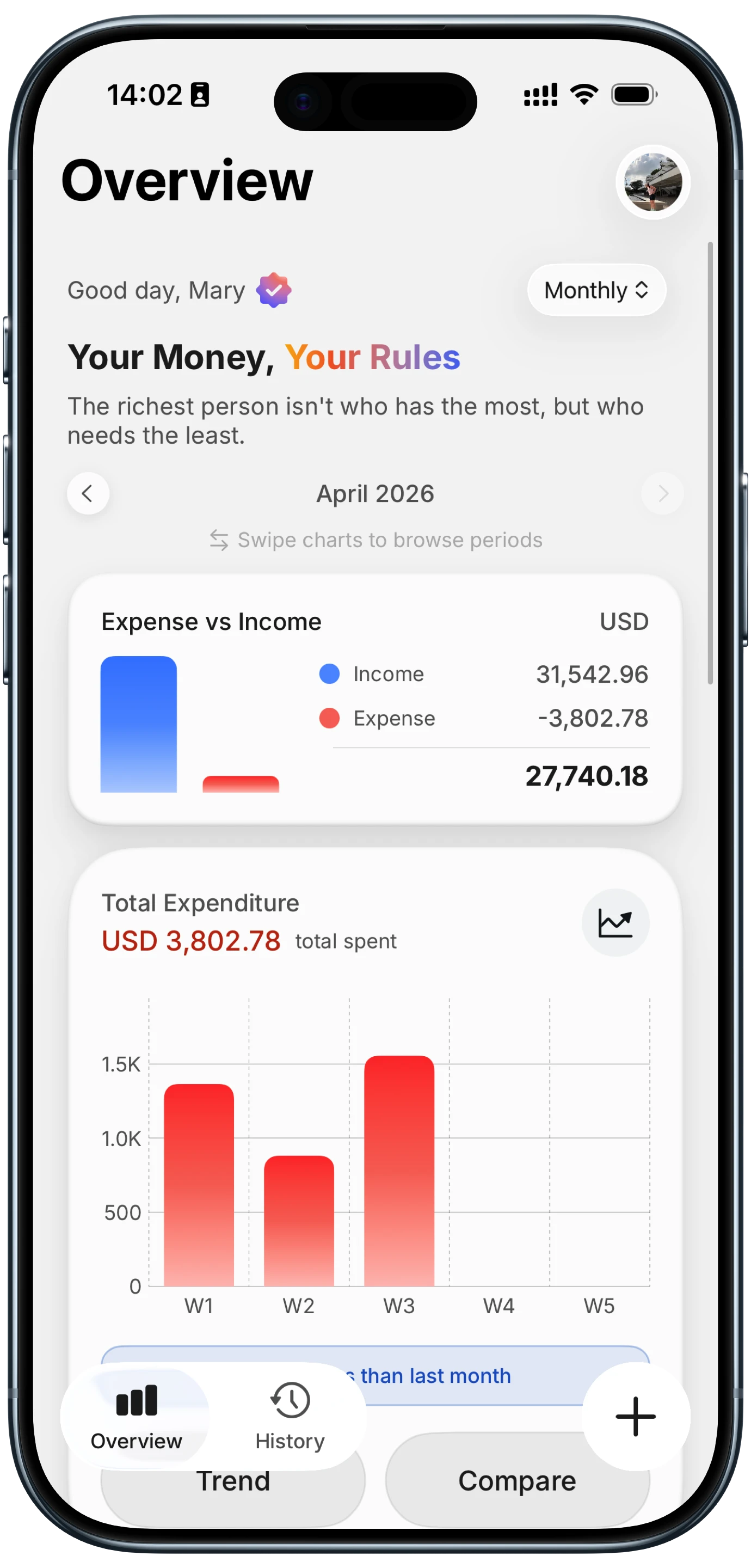
The key is tracking what you actually spend. Many people overestimate how well they stick to a budget until they see the data. An expense tracker like Finny can help here. Its AI-assisted input lets you log transactions by text, voice, or receipt photo, which means less friction and more consistent tracking. Learn the basics in our guide on how to budget money.
Step 4: Build Your Emergency Fund
An emergency fund is the safety net that keeps the rest of your plan intact. Without one, a single car repair or medical bill can force you into credit card debt, derailing months of progress.
Start with a $1,000 starter fund. This covers most minor emergencies and gives you breathing room while you work on other goals. Once your high-interest debt is under control, build toward 3 to 6 months of essential living expenses.
Where to keep it: a high-yield savings account, separate from your checking account. The separation reduces the temptation to dip into it for non-emergencies.
How to build it: automate a fixed transfer each payday. Even $50 per week adds up to $2,600 in a year. Consistency matters more than the amount. Our full guide on what an emergency fund is covers how to calculate your target and where to park the money.
Step 5: Create a Debt Payoff Strategy
Not all debt is equal. A low-interest mortgage is very different from a 24% credit card balance. Your plan should distinguish between the two and attack high-cost debt first.
Two popular approaches:
Debt Avalanche: Pay minimums on everything, then throw extra money at the debt with the highest interest rate. This saves the most money over time.
Debt Snowball: Pay minimums on everything, then throw extra money at the smallest balance first. This creates quick wins and builds momentum.
Both work. The avalanche method is mathematically optimal, saving more in total interest. The snowball method is psychologically effective, keeping you motivated. Some people start with one small snowball win, then switch to avalanche for the rest. Pick whichever approach you will actually stick with.
While paying down debt, avoid taking on new balances. Pause non-essential subscriptions and redirect that money toward your payoff plan.
Step 6: Start Investing for the Future
Investing is how your money grows beyond what you can earn and save. The earlier you start, the more time compound interest has to work in your favor.
Begin with tax-advantaged accounts. In 2026, you can contribute up to $24,500 to a 401(k) and $7,500 to an IRA. If your employer offers a 401(k) match, contribute at least enough to capture the full match. That is free money.
Keep it simple. A low-cost index fund that tracks the S&P 500 or a target-date retirement fund is enough for most people starting out. You do not need to pick individual stocks or time the market.
Automate contributions. Set your 401(k) to deduct from each paycheck. Set up automatic transfers to your IRA or brokerage account. Automation removes the decision fatigue that causes people to skip contributions.
If you have high-interest debt (above 7 to 8%), prioritize paying that off before investing beyond your employer match. The guaranteed return of eliminating a 20% interest rate beats any expected market return.
Step 7: Review Your Insurance Coverage
Insurance is the part of financial planning that protects everything else you have built. It is not exciting, but it is essential.
Review these annually:
- Health insurance: Verify your plan still fits your needs, especially if your health situation or income has changed.
- Auto and home/renters insurance: Shop around every year or two. Rates vary widely between providers.
- Life insurance: If anyone depends on your income, term life insurance is affordable and straightforward. A common guideline is coverage equal to 10 to 12 times your annual income.
- Disability insurance: This protects your ability to earn. Many employers offer short-term disability. Long-term disability coverage is worth considering if your employer does not provide it.
Do not over-insure or under-insure. Match coverage to your actual obligations and dependents.
Step 8: Plan for Retirement
Retirement planning is not just for people in their 50s. The earlier you start, the less you need to save each month to reach the same goal.
Estimate your target. A common rule of thumb is to aim for 25 times your expected annual expenses in retirement. If you plan to spend $50,000 per year, your target is $1.25 million. According to a 2026 CNBC survey, Americans say they need $1.46 million to retire comfortably.
Maximize tax advantages. Contribute to a Roth IRA if your income qualifies (phase-out begins at $150,000 for single filers in 2026). Roth contributions grow tax-free, which is especially valuable if you expect your tax rate to be higher in the future.
Do not touch retirement funds early. Early withdrawals come with penalties and tax hits that compound over time. Leave your retirement accounts alone and let them grow.
Review annually. Check your asset allocation, contribution amounts, and whether you are on track. Many brokerage platforms offer free retirement calculators to project your trajectory.
Step 9: Track Your Progress and Adjust
A financial plan is not a document you write once and forget. Life changes, and your plan should change with it.
Review your full financial picture quarterly. Update your net worth calculation, check your budget against actual spending, and verify that your savings targets are on track.
Tracking daily expenses is what keeps your budget honest between reviews. Tools that reduce logging friction make this sustainable. Finny's voice input and receipt scanning let you capture expenses in seconds, so tracking does not feel like a chore. If you prefer a comprehensive breakdown of how to track expenses, we have a dedicated guide for that.
Major life events like a new job, marriage, a child, or a home purchase should trigger a full plan review. Update your goals, insurance, and beneficiaries whenever your circumstances shift.
Personal Financial Planning Checklist
Use this as a quick reference to make sure you have covered each area:
- Calculate your current net worth (assets minus liabilities)
- List all income sources and their monthly amounts
- Define 2 to 3 short-term, medium-term, and long-term financial goals
- Choose a budgeting method and set category limits
- Set up automatic tracking for daily expenses
- Build a $1,000 starter emergency fund
- Identify all debts with interest rates and balances
- Choose a debt payoff strategy (avalanche or snowball)
- Enroll in employer 401(k) and contribute enough for the full match
- Open and fund an IRA (traditional or Roth)
- Review health, auto, home, life, and disability insurance
- Estimate your retirement savings target
- Set a quarterly review date on your calendar
- Update beneficiaries on all financial accounts
Frequently Asked Questions
How much does it cost to create a personal financial plan?
You can build a solid plan for free using the steps in this guide and a basic expense tracker. If you want professional help, a fee-only financial planner typically charges $200 to $400 per hour or $1,000 to $3,000 for a comprehensive plan. For day-to-day tracking, Finny's free tier covers unlimited manual entries, custom categories, and charts across 150+ currencies.
When should I start investing if I still have debt?
If your employer offers a 401(k) match, contribute enough to get the full match regardless of your debt situation. Beyond that, focus on paying off any debt with an interest rate above 7 to 8% before investing additional money. Once high-interest debt is cleared, split extra funds between investing and remaining lower-interest debt.
How often should I update my financial plan?
Do a light review monthly by checking your budget and savings progress. Do a full review quarterly, updating your net worth and adjusting goals as needed. Any major life event, such as a job change, marriage, or new child, should trigger an immediate review.
What is the best budgeting method for beginners?
The 50/30/20 rule is the simplest starting point because it only requires three categories. As you get more comfortable, you can move to zero-based budgeting for tighter control. The best method is whichever one you will actually follow consistently.
Do I need a financial advisor to create a financial plan?
Most people can build and maintain their own plan using free tools and guides like this one. A financial advisor is worth considering if you have a complex tax situation, significant assets, or major life transitions like selling a business or receiving an inheritance. For everything else, discipline and a good tracking system will get you far.