Budgets fail when they feel like punishment. Tell yourself you can only spend $50 on dining out when you have been spending $400, and you will abandon the budget within a week. The limit was not realistic. If your bigger problem is unplanned purchases pushing you over those caps, see our guides on how to stop overspending and what is impulse spending.
A spending limit is a maximum amount you allow yourself for a specific category over a defined period, usually monthly. Well-set limits control spending without creating constant friction. Poorly-set limits create resentment and get ignored.
This guide explains what spending limits are, how to calculate realistic ones based on your actual spending, and how to adjust them over time. For broader budgeting approaches, see our budgeting for beginners guide.
What Is a Spending Limit
A spending limit is a cap on how much you will spend in a specific category during a set time period. Most people set monthly limits, though weekly limits work for some categories.
Common spending limit categories:
| Category | Typical Limit Range | Notes |
|---|---|---|
| Groceries | $300-600/month | Varies by household size |
| Dining out | $100-400/month | High variability by lifestyle |
| Entertainment | $50-200/month | Streaming, events, hobbies |
| Clothing | $50-150/month | Or larger quarterly limits |
| Personal care | $30-100/month | Haircuts, products, gym |
| Transportation | $200-500/month | Gas, parking, transit |
| Subscriptions | $30-100/month | Streaming, apps, memberships |
Spending limits differ from budget allocations. An allocation says "I plan to spend $300 on groceries." A limit says "I will not exceed $300 on groceries." The limit creates a ceiling that should not be crossed.
Why Spending Limits Matter
Prevents Category Creep
Without limits, spending in discretionary categories grows over time. Dining out might start at $200 monthly then creep to $300, then $400. Limits create awareness of this drift before it damages your overall budget.
Enables Trade-offs
When you hit your dining limit mid-month, you must choose: cook at home for the remaining weeks or take money from another category. This trade-off thinking is healthy budgeting.
Simplifies Daily Decisions
Instead of evaluating every purchase against your total budget, you evaluate it against one category limit. "Can I afford this $50 dinner?" becomes "Is there $50 left in my dining budget this month?"
Creates Spending Freedom
Counterintuitively, limits create freedom. When you know your entertainment limit is $150 and you have spent $80, you can spend $70 without guilt. No mental math against your entire financial situation is needed.
How to Set Realistic Spending Limits
Step 1: Track Current Spending
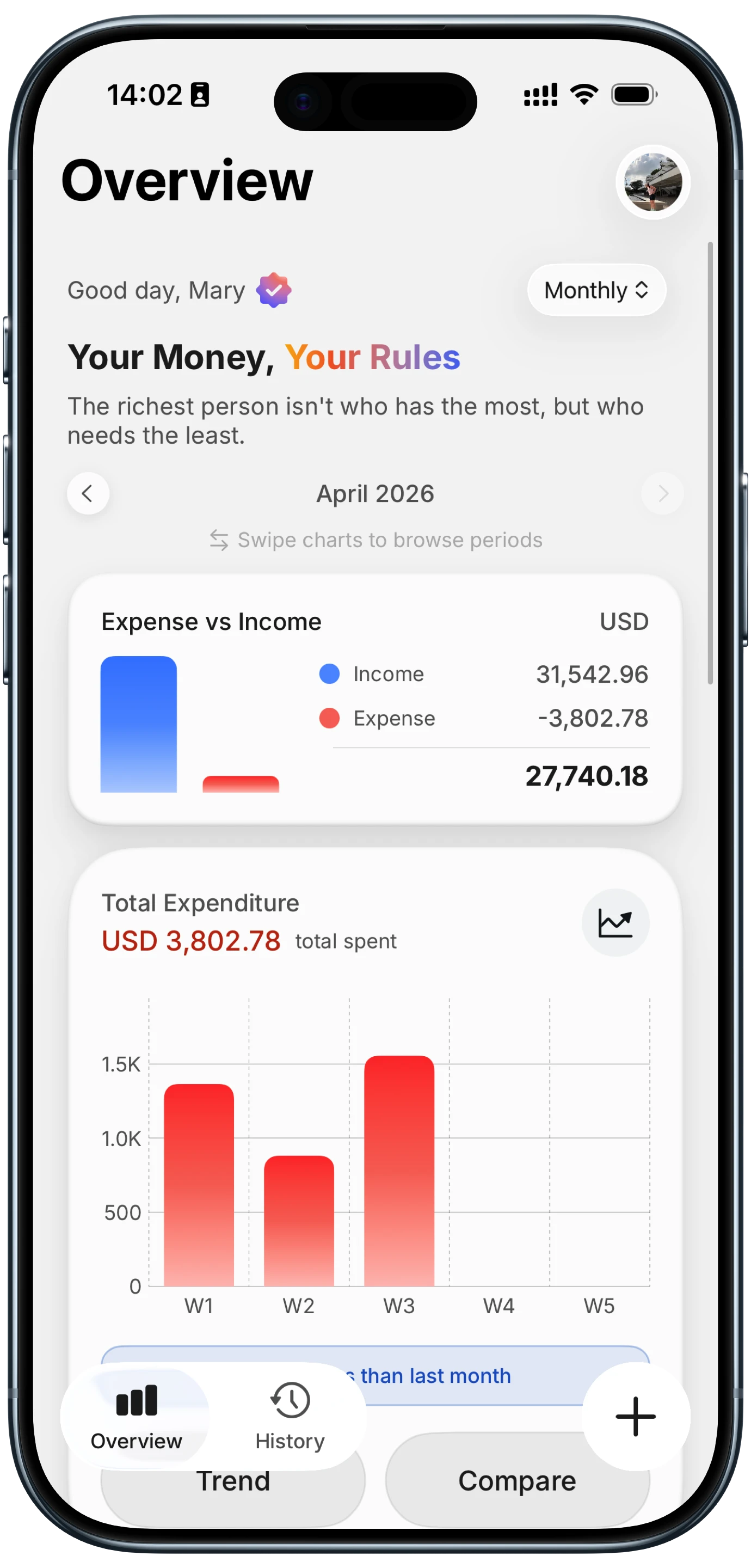
You cannot set realistic limits without knowing your current reality. Track every expense for at least one month, preferably three. An expense tracking app like Finny categorizes spending automatically and shows monthly totals per category.
Look at what you actually spend, not what you think you spend. Most people underestimate discretionary categories by 30-50%.
Step 2: Calculate Your Available Budget
Add up your income. Subtract fixed expenses (rent, utilities, insurance, debt payments). Subtract savings goals. What remains is available for variable spending categories.
Example:
- Monthly income: $5,000
- Fixed expenses: $2,500
- Savings targets: $500
- Available for variable spending: $2,000
This $2,000 must cover groceries, transportation, dining, entertainment, and all other variable categories.
Step 3: Compare Current Spending to Available Budget
If your variable categories total $2,400 but you only have $2,000 available, some limits must be lower than current spending. Identify which categories to cut.
Prioritize cuts in discretionary categories (dining, entertainment, shopping) over necessities (groceries, transportation).
Step 4: Set Limits 10-20% Below Current Spending
For categories you need to reduce, set limits slightly below current spending rather than dramatically below. A 15% reduction is sustainable; a 60% reduction is not.
Example: Dining Out
- Current spending: $350/month
- Target limit: $300/month (14% reduction)
- Not realistic: $100/month (71% reduction)
The $100 limit might be your eventual goal, but getting there requires gradual steps.
Step 5: Build in Some Flexibility
Set a small "miscellaneous" or "buffer" category for unexpected expenses that do not fit elsewhere. This prevents minor surprises from breaking your entire budget.
Category-by-Category Limit Setting
Groceries
Track separately from dining out. Include all supermarket and food store purchases. A common benchmark: $250-350 per person monthly for moderate spending.
How to set your limit:
- Review 3 months of grocery receipts
- Identify patterns (weekly spend, bulk buying, seasonal variation)
- Set limit at current average if budget allows, slightly below if cuts needed
- Adjust for planned changes (eating at home more often = higher grocery limit)
Dining Out
Highly variable and often the first category people cut. Include restaurants, takeout, delivery, coffee shops, and bars.
How to set your limit:
- Calculate current average
- Decide how many meals out you want per week
- Multiply: (meals per week) × 4 × (average meal cost) = monthly limit
- Example: 2 meals/week × 4 × $25 = $200/month
Entertainment
Movies, concerts, sporting events, streaming services, hobbies, video games. Group all leisure spending together or split by type if one area dominates.
How to set your limit:
- List fixed entertainment costs (subscriptions, memberships)
- Add allowance for variable entertainment
- Limit = fixed costs + variable allowance
- Example: $60 subscriptions + $90 variable = $150 limit
Transportation
Gas, parking, tolls, public transit, ride-shares. Partially controllable but depends on commute requirements.
How to set your limit:
- Calculate essential commute costs (unavoidable)
- Add estimate for discretionary driving
- Be realistic about actual usage patterns
- Track for 2-3 months before finalizing
Clothing and Personal Care
Lumpy spending: nothing for months, then a shopping trip. Consider quarterly limits instead of monthly for categories with irregular purchases.
How to set your limit:
- Calculate annual spending on clothing
- Divide by 12 for monthly average (or by 4 for quarterly)
- Monthly limit allows small purchases; save larger purchases for quarters when you have accumulated allowance
Subscriptions
Easy to lose track of. Audit annually — our guide on how to audit subscriptions in 20 minutes gives a step-by-step checklist, and stop subscription creep covers ongoing prevention.
How to set your limit:
- List every recurring subscription
- Total the monthly cost
- Ask: "Do I actively use each one?"
- Cancel unused subscriptions
- Set limit at remaining total plus small allowance for temporary subscriptions
Tracking Spending Against Limits
Setting limits accomplishes nothing without tracking. You must know where you stand in each category throughout the month.
Real-Time Tracking
Log expenses as they happen using an app like Finny. Each purchase updates your category total. You can see at any moment: "I have spent $180 of my $300 dining limit."
Weekly Check-ins
At minimum, review weekly. Compare spending to limits. If a category is running high, adjust behavior for the remaining weeks.
Warning Thresholds
Some people set alerts at 50% and 80% of limits. Reaching 80% with a week remaining signals time to slow down.
End-of-Month Review
Did you stay within limits? Which categories ran over? Which had surplus? Use this information to adjust next month's limits if needed.
What to Do When You Exceed a Limit
Exceeding a limit is not failure: it is information.
In the Moment
If you are about to exceed a limit, you have choices:
- Stop spending in that category for the rest of the period
- Borrow from another discretionary category (but track this)
- Accept the overage and compensate next month
Option 1 is the most disciplined. Option 2 works if another category has room. Option 3 should be rare.
After the Month
If you consistently exceed a specific limit:
- The limit is unrealistic: Raise it and cut elsewhere
- You are not tracking closely enough: Check balances more frequently
- Specific situations cause overages: Plan for them (birthdays, holidays, travel)
Adjusting Limits Over Time
Spending limits are not permanent. Review and adjust quarterly.
When to Raise a Limit
- You consistently hit the limit and feel deprived
- Life circumstances changed (new commute, dietary restrictions)
- You have surplus in another category to reallocate
When to Lower a Limit
- You rarely reach the limit (money sitting unused)
- Financial goals require more aggressive saving
- You naturally reduced spending in that category
Seasonal Adjustments
Some months have predictable variations:
- December: Higher gift and entertainment spending
- Summer: Higher utility bills, vacation costs
- Back-to-school: Higher clothing and supply costs
Adjust limits proactively for these predictable changes rather than blowing budgets unexpectedly.
Common Spending Limit Mistakes
Setting Limits Without Data
Guessing at limits based on what "sounds reasonable" fails. Track actual spending first, then set limits based on reality.
Making Limits Too Tight
Overly restrictive limits feel punishing and get abandoned. Start with modest reductions (10-15%) and tighten gradually over months.
Not Differentiating Categories
A single "miscellaneous" limit hides spending patterns. Break spending into meaningful categories so you can see where money actually goes.
Ignoring Irregular Expenses
Annual subscriptions, car maintenance, medical copays, and gifts are real expenses. Create limits or sinking funds for them rather than treating them as surprises.
Setting and Forgetting
Limits require monitoring. A limit you set but never check against is useless. Build weekly reviews into your routine.
The Bottom Line
A spending limit is a maximum amount you allow yourself for a specific spending category. Realistic limits, based on actual spending data rather than wishful thinking, help control expenses without creating constant frustration.
Set limits by tracking current spending, calculating available budget, and adjusting categories to fit within your means. Start with modest reductions of 10-15% rather than dramatic cuts. Track spending throughout the month so you know where you stand.
Well-designed spending limits create both discipline and freedom. You control where money goes while maintaining permission to spend fully within each category's bounds. For a deeper look at the psychology and practical benefits of caps, see our guide on how spending limits help budgeting.
Common Questions About Spending Limits
What is a spending limit?
A spending limit is a maximum amount you set for a specific budget category over a period, usually monthly. It creates a ceiling that guides your spending decisions and prevents overspending in any single area.
How do I know if my spending limits are realistic?
If you consistently exceed a limit by more than 10% despite genuine effort, the limit may be too tight. If you consistently have significant surplus, the limit may be too loose. Adjust based on several months of data.
Should I have spending limits for every category?
Fixed expenses (rent, utilities, insurance) do not need limits because they are already fixed. Spending limits are most useful for variable discretionary categories like dining, entertainment, shopping, and personal care.
What if I need to exceed my limit for a legitimate reason?
Borrow from another discretionary category if possible, or accept the overage and reduce spending next month to compensate. Occasional overages happen; the goal is overall budget balance, not perfect adherence.
Ready to set and track spending limits based on your actual expenses?
Download Finny to see exactly where your money goes, set category budgets, and monitor your progress throughout the month. Data-driven limits are realistic limits.