Just Combined Finances With Your Partner? Start Here
You moved in together, got married, or simply decided that pretending your accounts are separate is no longer working. The first month of combined money is the most important one, and it is also the one most couples skip. They open a joint account, transfer some money, and assume the system will design itself. A few weeks later, one person feels watched, the other feels alone in the spreadsheet, and a small grocery receipt turns into a long conversation that was never about groceries.
This guide walks through how to combine finances with partner during the first thirty days: choosing a model, doing a complete inventory, running a calm money date, and picking what to track so the system survives past month two. The goal is not a perfect budget. The goal is a shared picture you both trust, built without forced bank logins or spreadsheets that only one of you opens. For a related read on the day-to-day side, see our guide on how to track spending as a couple in 2026.
Step 1: Pick a money model before you pick an app
Most arguments about money are actually arguments about a model that was never agreed on. Before you download anything, decide which of the three common structures fits your life right now. You can change it later. You just cannot skip choosing one.
Fully joint. All income lands in one shared account. All expenses leave from it. Personal spending is allowed but visible. This works well when incomes are similar, both partners are comfortable with full transparency, and there are no large pre-existing debts that one partner does not want to mix in.
Yours, mine, and ours. Each partner keeps a personal account. A third joint account covers shared expenses: rent, groceries, utilities, subscriptions you both use, dates, travel, kids. Each partner contributes a fixed amount or a percentage of income. This is the most popular model because it preserves autonomy without losing shared visibility.
Proportional split. Same as yours, mine, and ours, but contributions to the joint account are weighted by income. If one partner earns 60 percent of the household income, they cover 60 percent of shared costs. This is the fairest model when incomes are very different, especially when one partner is in school, on parental leave, or self-employed with variable months.
There is no morally correct answer. Couples who pick proportional are not less committed than couples who go fully joint. What matters is that the choice is explicit, written down, and revisited every six to twelve months.
Step 2: Do a full money inventory
Before the first money date, each partner should privately complete a one-page inventory. This is not a judgment exercise. It is a baseline. You cannot share a budget if you do not know what you are sharing.
List, on a single page each:
- All checking and savings accounts, with current balances.
- All credit cards, with current balances and minimum payments.
- All loans: student, auto, personal, family, buy-now-pay-later.
- All recurring subscriptions, with monthly amounts.
- All recurring transfers: retirement, investment, savings goals.
- Net monthly income after tax.
- Any large expected expenses in the next six months.
Do this separately, then exchange pages at the money date. Reading your partner's page in silence for two minutes before talking about it is one of the most useful five-minute exercises in a relationship. It removes the urge to react in real time and gives both people a chance to absorb the picture.
Step 3: Run the first money date
The first money date is not the place to design a five-year financial plan. It is a working session with one outcome: a simple shared system you can both run for thirty days. Keep it under ninety minutes. Pick a calm time, not right after work, not right before bed. Order food. Put phones face down except for inventories.
A working agenda for the first money date:
- Exchange inventories (10 minutes, silent reading first, then questions).
- Confirm the model you chose in Step 1, and the contribution amounts.
- List the shared expenses the joint account will cover. Be specific. Does Netflix count? Does the gym? Does a wedding gift for a friend you both know?
- Pick the tracking tool you will both use. One tool, not two.
- Set the categories you will track. Five to eight is enough for month one.
- Schedule the next money date (15 to 30 minutes, weekly or biweekly).
- Write down what is off the table for now: investing strategy, large purchases, retirement timing. These deserve their own dates later.
For a deeper look at this ritual on its own, see what is a money date. The tool you pick matters less than the agreement to use the same one. Two partners with different apps will end up with two different versions of reality, which is exactly the problem you are trying to solve.
Step 4: Decide what to track in month one
The most common first-month mistake is trying to track everything. You do not need a category for haircuts in April. You need a system you will still be using in June. Limit yourselves to five to eight shared categories the first month. A starter set:
- Housing (rent or mortgage, plus utilities)
- Groceries
- Eating out and coffee
- Transportation (gas, transit, rideshare)
- Subscriptions
- Personal (each partner gets a flat amount, no questions asked)
- Savings and goals
- Everything else
The "everything else" category is intentional. It absorbs the noise so you do not spend the first month renaming categories. At the end of month one, look at what landed in "everything else" and split out anything over five percent of your spending into its own category.
Personal allowances are not optional. Every working model needs an amount each partner can spend without explaining. The number can be small. Twenty dollars a week is enough. The point is that the system has a built-in pressure release valve, so the joint account never feels like surveillance.
Step 5: Avoid the "one tracks, one doesn't" trap
This is the single most common reason couples abandon shared budgeting in month two. One partner becomes the bookkeeper. The other partner forgets, then feels nagged, then disengages. Within six weeks, the bookkeeper is either secretly resentful or quietly maintaining the budget alone, which means there is no shared budget at all.
Three habits prevent this:
Make logging take less than ten seconds. If entering an expense requires opening an app, picking a category from a long list, and typing notes, it will not happen. Voice input, receipt scanning, and a short category list all reduce friction. The partner who is less interested in money will only stay engaged if the cost of participation is near zero.
Review together, not separately. A weekly fifteen-minute review where you both look at the same screen is worth more than two separate reviews. The point is shared understanding, not individual reporting.
Rotate the role. If one partner sets up the system, the other partner runs the weekly review. If one partner enters the receipts, the other partner reconciles the joint account at month end. Symmetry matters more than efficiency in the first six months.
Step 6: Joint vs separate accounts in practice
The joint vs separate accounts question gets framed as ideological, but it is mostly logistical. You can run any of the three models above with any account structure. The accounts are plumbing. The model is the agreement.
A practical setup that works for most couples in month one:
- One joint checking account for shared bills.
- One joint savings account for shared goals (emergency fund, vacation, deposit).
- Each partner keeps their existing personal checking and savings.
- Each partner sets up an automatic transfer on payday into the joint checking, in the agreed amount.
You do not need to close any accounts in month one. You do not need to combine retirement. You do not need to put each other on credit cards. Those are month-six decisions, not month-one decisions. Keep the first month boring on purpose.
For more on choosing a tracking app for two people, the best budgeting apps for couples in 2026 compares the main options. If kids are part of the picture, our family budget app guide covers the wider household setup.
Where Finny fits, briefly
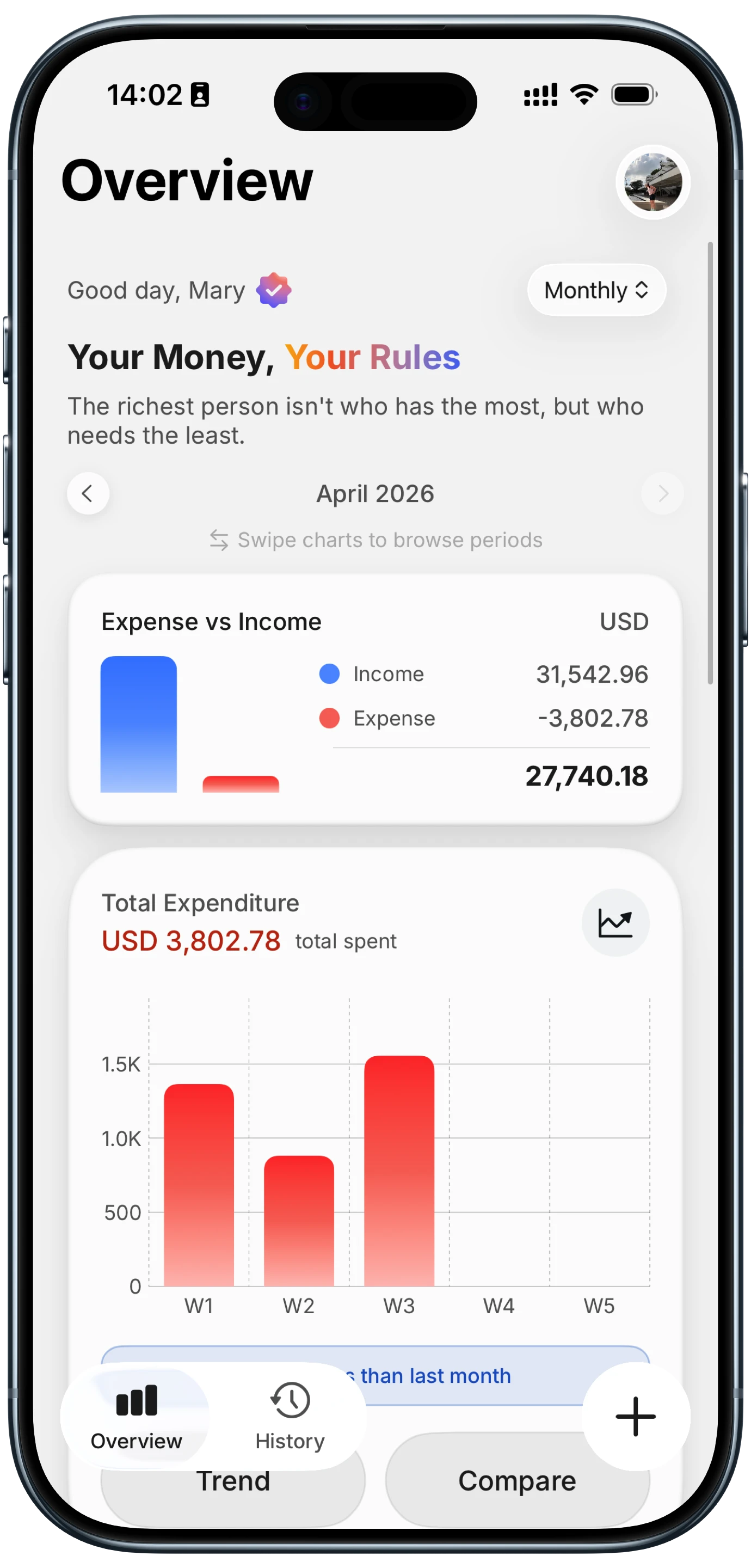
If you want shared visibility without handing your bank credentials to a third party, Finny is built for that. It is a privacy-first iOS expense tracker with no required bank login, which matters for couples where one partner is uncomfortable linking accounts. Each partner can log expenses by text, voice, or receipt photo in under ten seconds, and you can set per-person budget categories so the personal allowance stays clearly separated from shared spending.
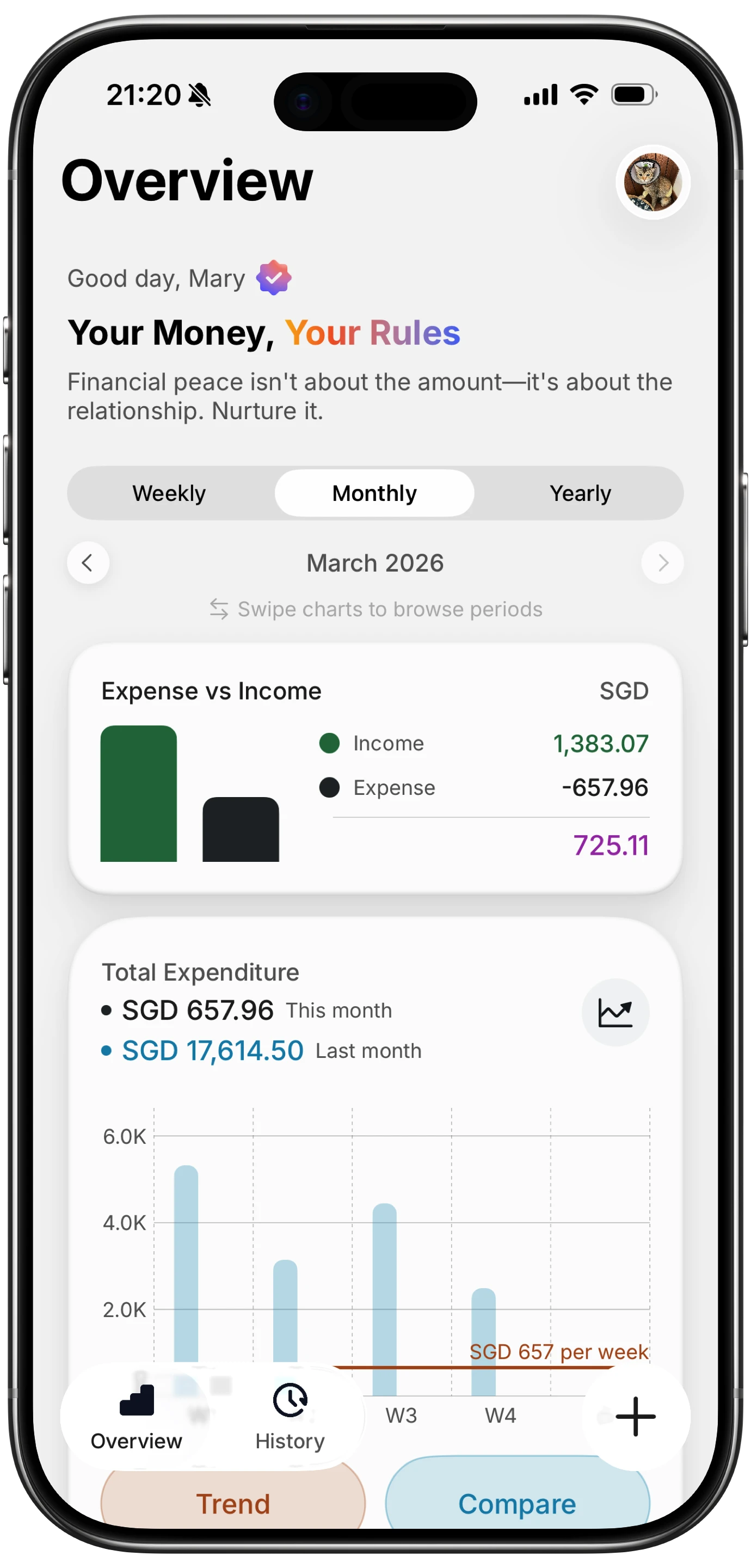
Finny app's Overview feature
It is not the only option, and the point of this guide is not the app. The point is that whatever tool you pick should make logging fast enough that both partners actually do it.
The first month, in one paragraph
Pick a model. Do private inventories. Run a ninety-minute money date. Open a joint checking account if you do not have one. Set up automatic transfers on payday. Pick one shared app. Limit yourselves to five to eight categories. Each partner gets a no-questions-asked personal allowance. Do a fifteen-minute review together every week. Schedule the month-end review now, before you forget. That is the entire first month. For broader budgeting context once the system is running, see our overview on how to budget money and our deeper guide on the budgeting app for couples workflow.
Common Questions About Combining Finances With a Partner
Should we have joint or separate accounts when we combine finances?
Both work. Fully joint accounts give the cleanest shared view but require high comfort with transparency. Separate accounts with a shared joint account for bills, often called yours, mine, and ours, preserves autonomy and is the most common setup. Proportional contributions to that joint account make sense when incomes differ significantly. The account structure is less important than agreeing on a written model and revisiting it every six to twelve months.
How much should each partner contribute to the joint account?
If incomes are similar, a flat fifty-fifty split is the simplest. If one partner earns noticeably more, a proportional split based on percentage of household income is fairer. Calculate it once, write it down, and automate the transfer on payday so it does not require monthly decisions. Revisit the percentages whenever income changes meaningfully, such as a new job, parental leave, or a freelance shift.
What if one of us is a spender and the other is a saver?
This is normal and not a problem to solve in month one. The personal allowance line in your budget is the answer. Each partner gets a fixed amount they can spend without justification. The saver does not have to watch the spender buy coffee. The spender does not have to defend the coffee. The shared categories stay shared, and the personal categories stay personal. Most spender-saver tension comes from missing this line, not from the underlying difference.
How often should we have a money date after the first one?
Weekly fifteen-minute reviews for the first three months, then biweekly once the system is stable. Add a longer monthly review at month end to look at category totals and decide what to adjust. Quarterly, schedule a ninety-minute session for bigger questions like savings goals, debt payoff order, or upcoming large expenses. Calendar them in advance. Money dates that depend on someone remembering to suggest one tend to disappear.
Do we need a budgeting app or is a spreadsheet enough?
Both can work, but the test is whether both partners will actually use it. Spreadsheets favor the partner who likes spreadsheets, which means the other partner often disengages. A shared app with fast logging by text, voice, or receipt photo lowers the participation cost for the less enthusiastic partner. If you go with a spreadsheet, keep it simple, share editing access, and review it together rather than asynchronously.
Ready to share a budget without sharing bank logins?
Download Finny to log expenses by text, voice, or receipt scan in seconds. No bank connections required, offline-first, and per-person budget categories that keep shared spending and personal spending clearly separated.