How to Split Household Bills Fairly on Different Salaries
The rent comes due, the streaming charges roll in, and the grocery receipt sits on the counter. One partner earns more than the other. Splitting everything fifty fifty has started to feel uneven, but switching to a percentage based system feels awkward to bring up over dinner. Most couples never put words to this tension, so it stays in the background and quietly shapes resentments over time.
This guide is about how to split bills fairly when two people in the same household earn different paychecks. We will walk through three honest models, with worked math using a $5,000 and $7,000 monthly net income example, so you can see what each method actually looks like on paper. The point is not to push one answer. It is to help you and your partner pick a model you both understand, then revisit it when life changes. We will also touch on how shared category visibility, without sharing bank logins, can take the heat out of money conversations.
For a wider view of money habits as a couple, see our guide to the best budgeting apps for couples in 2026.
The Setup: Why a Single Rule Rarely Fits Both People
Imagine two partners. One earns $5,000 per month after tax. The other earns $7,000 per month after tax. Combined, the household brings home $12,000. Suppose their shared bills total $4,000 per month: rent, utilities, internet, groceries, streaming, and a shared insurance plan.
If they split everything down the middle, each person pays $2,000 toward bills. The lower earner has $3,000 left over. The higher earner has $5,000 left over. On paper that looks even, but the lower earner is spending 40 percent of their net income on shared bills, while the higher earner spends about 28.6 percent. The same dollar amount, very different weights.
If they split bills proportionally to income, the lower earner pays roughly 41.7 percent of $4,000, which is $1,668. The higher earner pays roughly 58.3 percent, which is $2,332. Both are spending the same share of their income, around 33 percent, on shared bills. They are now carrying equal weight, even though one writes a bigger check.
The third option keeps a foot in both worlds. Each partner contributes a fixed amount to a joint bills account, then keeps the rest of their paycheck personal. We will get into the math below.
None of these is the right answer for every couple. The right answer is the one you both agree to and revisit on schedule.
Method 1: The Equal Split, Fifty Fifty Down the Line
The equal split is the simplest. Every shared bill gets divided in half. Rent of $2,400 becomes $1,200 each. A $180 grocery run becomes $90 each. A $15.99 streaming charge becomes $8 each, give or take a rounding.
Where Equal Splits Work
This model fits couples whose incomes are close, say within 10 to 15 percent of each other. It also works when both partners value autonomy over equity, when each person treats the relationship as two financially independent adults sharing a roof. Some couples in their twenties prefer this, especially when neither person has dependents and both want to keep clear lines around personal money.
Where Equal Splits Get Painful
Run the numbers above. The lower earner gives up 40 percent of their income before any personal spending. The higher earner gives up 28.6 percent. Over a year, that gap compounds. The lower earner saves less, builds less of a cushion, and can feel quietly squeezed every time a bill goes up. If you ever want to upgrade an apartment, the lower earner often becomes the one who says no, and the relationship absorbs that no without naming it.
If you choose this method, make sure both partners are honest about whether the split actually feels fair after rent. If it does not, it is fine to switch.
Method 2: The Proportional Split, Each Pays a Share of Their Income
The proportional split sets each partner's contribution as the same percentage of their income. With $5,000 and $7,000 net incomes, the lower earner contributes 5,000 divided by 12,000, or about 41.7 percent. The higher earner contributes 7,000 divided by 12,000, or about 58.3 percent.
For the same $4,000 shared bills:
- Lower earner: 0.417 times $4,000, which is $1,668
- Higher earner: 0.583 times $4,000, which is $2,332
After bills, the lower earner has $3,332 left. The higher earner has $4,668 left. Both are spending 33.3 percent of their income on shared expenses. The dollar amounts are different, but the weight is identical.
How to Calculate It Each Month
You only need three numbers: each partner's net monthly income and the total shared bill. To get one partner's share, divide their income by the combined income, then multiply by the bill total. A simple shared note or spreadsheet works. So does a budgeting app that lets both partners log to the same dashboard, which we will come back to in a moment.
For couples with variable income, freelancers, contractors, commission earners, recalculate the percentages every quarter using a rolling three month average. Do not redo the math every paycheck. That gets exhausting fast.
Where Proportional Splits Work
This model fits any couple where one income is meaningfully larger, around 20 percent or more. It is the most common recommendation from financial planners for long term partners, married couples, and anyone planning kids. It scales well: when one partner gets a raise or takes time off, the percentage adjusts and the household keeps working.
Where Proportional Splits Need Care
Two issues come up. First, the higher earner sometimes feels they are being penalized for earning more. Second, the lower earner sometimes feels uncomfortable receiving what looks like a discount. Neither feeling is wrong. Both deserve to be talked about openly. Many couples find the discomfort fades once they realize the percentage of income each spends is now identical, which is the actual definition of equal weight.
Method 3: Yours, Mine, and Ours, A Joint Account for Shared Bills
The third model splits the difference between the first two. Both partners keep their own bank accounts. They open a joint account, sometimes called a bills account, and each contributes a fixed monthly amount. The joint account pays rent, utilities, groceries, and any other expense both partners agreed counts as shared. Everything left in personal accounts is theirs to spend, save, or invest.
Worked Example
Same household, $5,000 and $7,000 net. Shared bills are $4,000. The couple decides to fund the joint account proportionally, so the lower earner sets up an automatic transfer of $1,668 on payday, and the higher earner transfers $2,332. After transfers, the lower earner has $3,332 in personal money. The higher earner has $4,668. The joint account always has enough to cover bills, and neither partner has to think about who owes what when groceries get expensive in November.
You can also fund the joint account equally, $2,000 each, if your incomes are similar. Or you can pick a flat number both partners can comfortably hit, like $1,800 each, and cover any overage from a third source like savings or a buffer.
Where This Model Works
This is the most common setup for couples in long term partnerships who want a clean line between shared life and personal life. It gives the lower earner privacy around personal spending and gives the higher earner a sense of fairness, since the joint account handles its own bills. It also makes shared goals easier to fund, since you can route a savings transfer through the same joint structure.
For a deeper look at running a joint setup with an app, see our guide to the best budgeting app for couples.
Where This Model Needs Care
You need clear rules about what counts as shared. Is a date night shared? A vacation? A friend's wedding gift? Couples avoid most arguments by writing down a short list at the start: rent, utilities, groceries, household supplies, shared subscriptions, joint travel. Anything outside the list is personal. Revisit the list every six to twelve months.
Comparison Table
| Method | Lower earner pays | Higher earner pays | Best for | Main risk |
|---|---|---|---|---|
| Equal Split | $2,000 (40% of income) | $2,000 (28.6%) | Similar incomes, high autonomy | Quiet resentment over time |
| Proportional Split | $1,668 (33.3%) | $2,332 (33.3%) | Income gap of 20% or more | Awkward to set up |
| Yours/Mine/Ours | Fixed transfer in | Fixed transfer in | Long term partners | Needs clear shared list |
The Awkward Conversation, Handled Gracefully
The hardest part of switching from equal to proportional is the first conversation. A few ways to make it lighter.
Start with curiosity, not a proposal. Try, "I have been reading about how couples split bills, and I wanted to look at our numbers together." This frames the talk as joint research, not a complaint.
Bring numbers, not feelings. Show the percentages, not the dollar amounts alone. Saying "we are both spending different shares of our income on the same bills" is easier to hear than "I cannot afford this."
Agree on a trial period. Pick three months to try a new model. Put a calendar reminder to review. If either partner hates it, you switch back. Time pressure dissolves the fear that this is permanent.
If you have never talked openly about money before, our guide to what a money date is covers a calm format for these conversations.
When to Revisit the Agreement
Money decisions made in your twenties rarely fit your thirties. Set a yearly review, ideally in January or on an anniversary, to recheck three things.
Income changes. Raises, layoffs, switching to part time, going freelance. Each of these changes the percentages.
Life changes. Moving in, marriage, kids, a parent moving in, one partner going back to school. Each shifts the shared bill list and often the model itself.
Goal changes. Saving for a house, paying off debt, planning a sabbatical. These usually mean increasing the joint contribution and decreasing personal spend.
Couples who track shared spending in one place have an easier time with these reviews, because the data is sitting there waiting. For practical workflows, see how couples track spending together in 2026.
Where a Shared Tracker Fits
This is where a tool can quietly help. Most banking apps assume one user per account. Linking both partners' bank logins to a third party app can feel invasive, and some couples are not willing to do it. The alternative is a shared expense app where both partners log to the same dashboard, see the same categories, and never have to share their personal bank credentials.
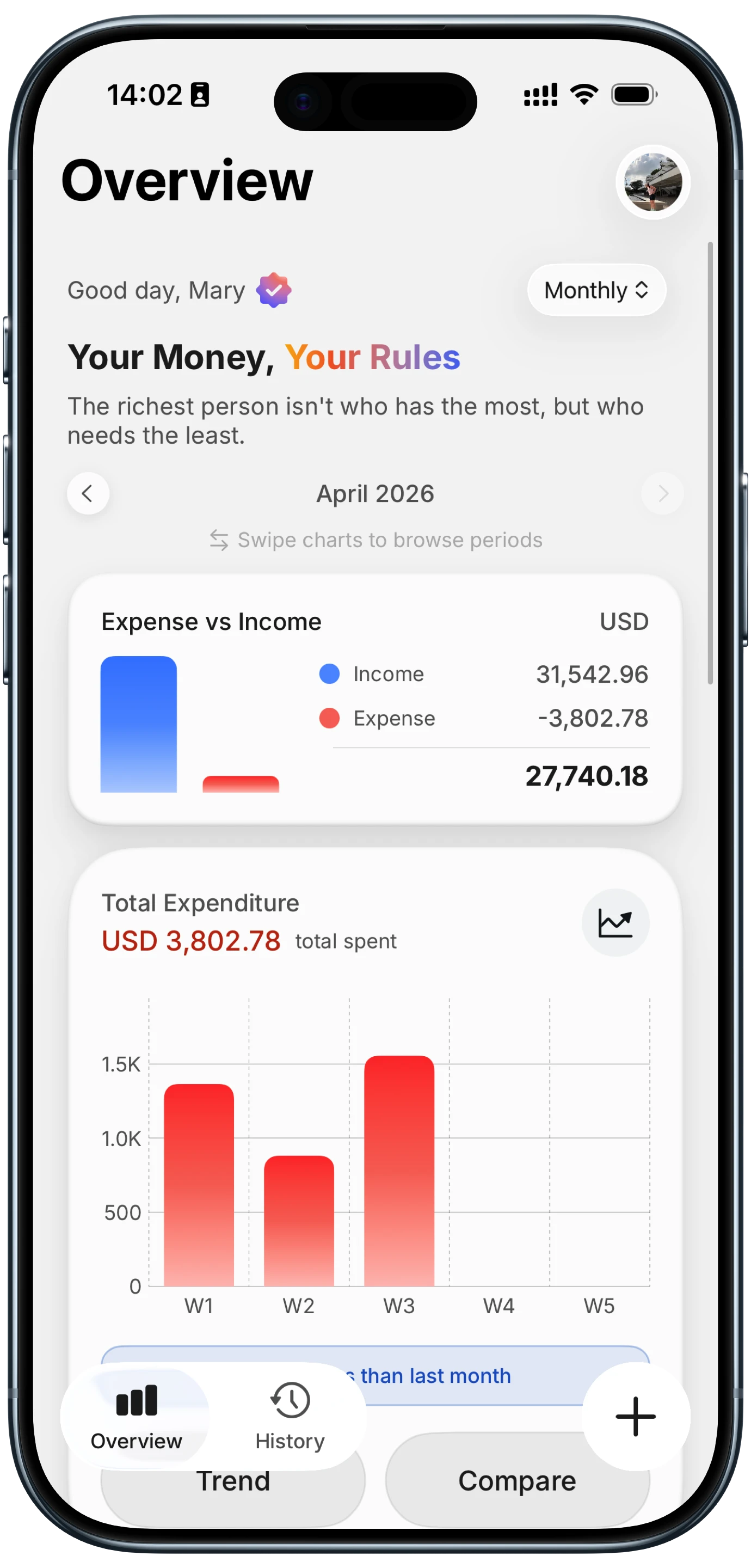
Finny is built around that approach. Both partners can add transactions to shared categories like rent, groceries, and utilities, and see a combined view at the end of the month. Logging is meant to be quick: tap to add, type a sentence, or batch scan a stack of receipts from the photo library. There is no bank link required, which keeps personal accounts personal while still giving the household a clear shared picture.
For families managing more than two people, our guide to the family budget app covers the same ideas at a household scale. If you live with non-romantic roommates, our guide on how to track shared expenses with roommates walks through the same math without the relationship dynamics.
The Bottom Line
There is no single right way to split bills with someone you live with. The fifty fifty split is simple but quietly punishes the lower earner. The proportional split shares the weight evenly but takes a calmer conversation to set up. The yours, mine, and ours model gives both partners breathing room around personal money while keeping shared bills predictable.
Pick a model you both understand. Run the numbers on paper before agreeing. Put it on a calendar to revisit. And if you want a low friction way to see shared spending without sharing logins, log it together in the same app and let the data do the talking.
For a broader budgeting framework, see our guide to how to budget money.
Common Questions About Splitting Bills Fairly
Is it fair to split bills 50/50 if one partner earns more?
It depends on how much more. If incomes are within roughly 10 to 15 percent of each other, fifty fifty usually feels fair. Once the gap widens past 20 percent, the lower earner spends a much higher share of their income on shared bills, which can quietly erode savings and create resentment. At that point, most couples are happier with a proportional split or a yours, mine, and ours setup.
How do you split bills proportionally by income?
Add both partners' net monthly incomes together. Divide each partner's income by the combined total to get their percentage. Multiply that percentage by the shared bill total to get each partner's contribution. With $5,000 and $7,000 net incomes and $4,000 in bills, the split is $1,668 and $2,332. Recalculate every quarter or whenever incomes change.
Should couples have a joint account for bills?
A joint account is not required, but it makes a yours, mine, and ours model much easier to run. Both partners set up automatic transfers into the joint account on payday, and the joint account pays the household bills. This avoids monthly reconciliations and keeps personal accounts private. Keep a simple written list of what counts as a shared expense to avoid friction.
How often should we revisit how we split bills?
Once a year at minimum, plus any time someone gets a raise, changes jobs, takes parental leave, or the household structure changes. A short twenty minute review in January is usually enough. Pull up the last three months of shared spending, recheck the percentages, and adjust the joint contribution if needed. Couples who skip reviews often discover years later that one partner has been quietly under saving.
What if my partner refuses to switch from a 50/50 split?
Bring numbers, not arguments. Show the percentage of income each of you spends on shared bills, not just the dollar amounts. Propose a three month trial of a different model with a clear review date. If they still refuse and the current split is genuinely straining your savings, that is a conversation worth having with a financial counselor or therapist, since it usually points to a deeper question about how the relationship handles money.
Ready to track shared spending without sharing bank logins?
Download Finny to log expenses using AI, receipts, or text. No bank connections, offline support, and a shared view that lets both partners stay on the same page.