Retirement planning often feels abstract. You hear numbers like "save a million dollars" without understanding where they come from or whether they apply to your situation. The reality is that your retirement number depends on one thing: how much you actually spend each year.
The 4% rule gives you a simple formula for turning your annual spending into a concrete retirement target. This guide covers where the rule came from, how to apply it with real numbers, where it falls short, and why tracking your expenses is the most practical first step toward knowing when you can retire. For a broader look at managing your money, see our complete personal finance guide.
What Is the 4% Rule
The 4% rule is a retirement withdrawal guideline that says you can withdraw 4% of your investment portfolio in the first year of retirement, then adjust that amount for inflation each year, and have a high probability of not running out of money over a 30-year period.
In practical terms, if you retire with $1,000,000, you would withdraw $40,000 in your first year. If inflation runs at 3% the next year, you would withdraw $41,200. The year after that, you adjust again based on inflation.
The rule works backward too. If you know your annual expenses, multiply by 25 to get your target portfolio size. Spending $50,000 per year means you need $1,250,000. Spending $30,000 per year means you need $750,000.
This is why the 4% rule is sometimes called the "multiply by 25" rule. They are the same concept from different angles.
The Trinity Study: Where the 4% Rule Comes From
The 4% rule originated from a 1998 academic paper commonly called the Trinity Study, conducted by three professors at Trinity University in Texas: Philip Cooley, Carl Hubbard, and Daniel Walz. The study examined historical U.S. stock and bond market data from 1926 to 1995 to determine what withdrawal rates would have sustained a portfolio over various time periods.
Their findings showed that a portfolio allocated roughly 50% to stocks and 50% to bonds, with a 4% initial withdrawal rate adjusted annually for inflation, survived at least 30 years in approximately 95% of all historical periods tested.
Financial planner William Bengen had reached a similar conclusion independently in 1994, publishing his research in the Journal of Financial Planning. He analyzed rolling 30-year periods going back to 1926 and found that 4% was the highest "safe" withdrawal rate that never depleted a portfolio in any historical scenario.
Both Bengen's work and the Trinity Study relied on U.S. market data during a period that included the Great Depression, World War II, the stagflation of the 1970s, and multiple recessions. The fact that the 4% rate held through these periods gave it credibility.
How the 4% Rule Works: Step by Step
Applying the 4% rule involves three steps.
Step 1: Know Your Annual Expenses
This is the foundation of the entire calculation. You need to know what you actually spend in a year, not what you think you spend. Most people underestimate their annual spending by 20-30% because they forget irregular expenses like car repairs, insurance premiums, medical bills, and holiday spending.
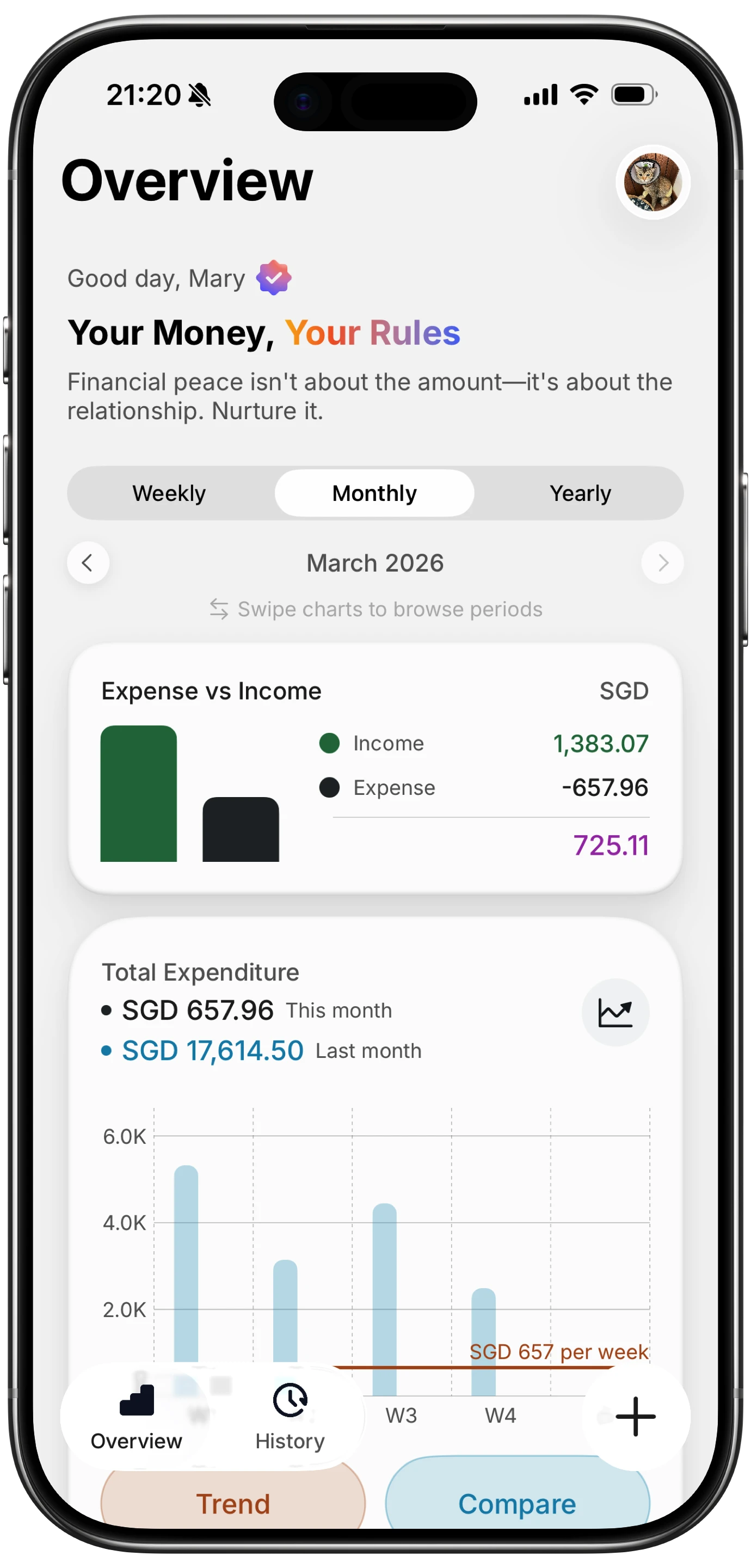
Finny app's Overview feature
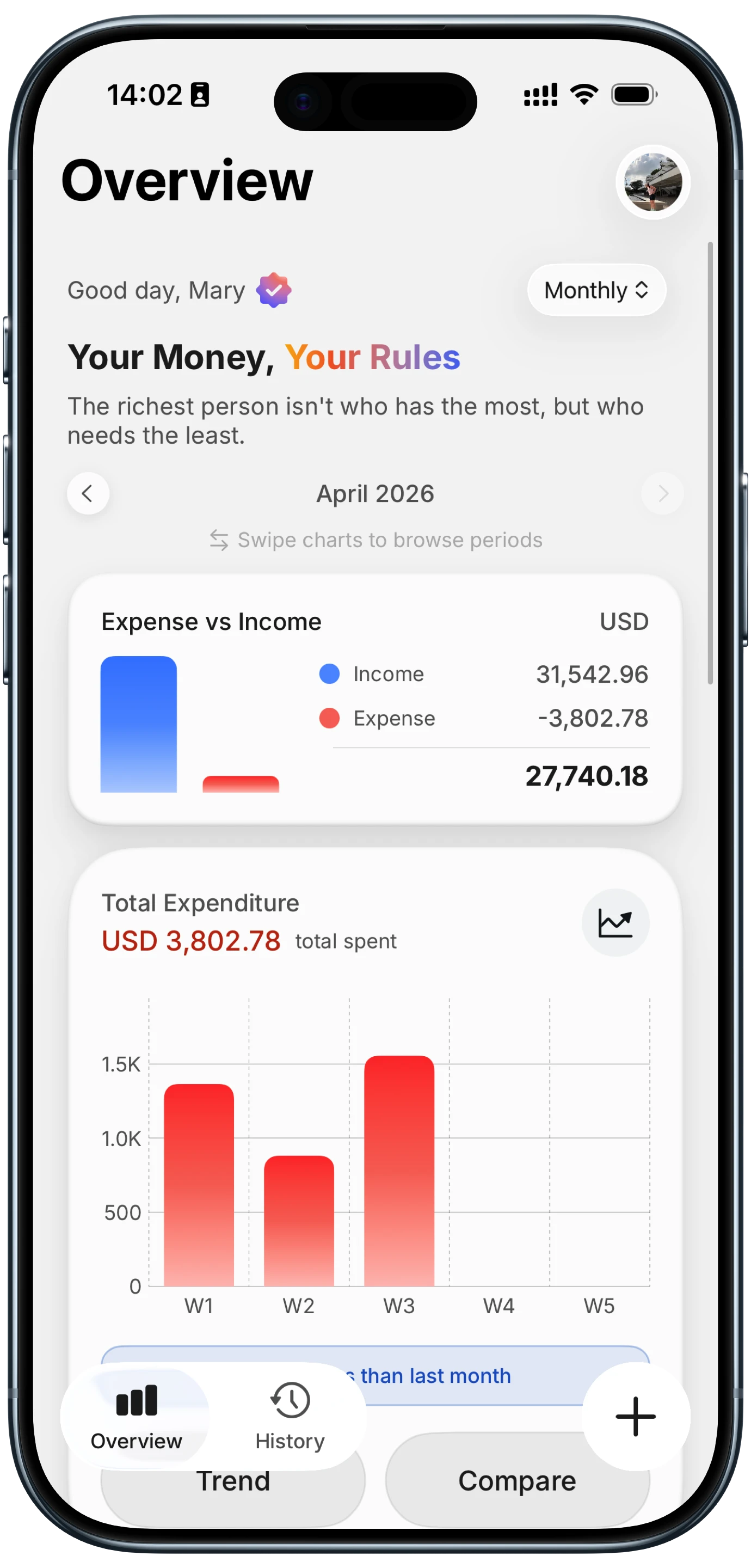
An expense tracker gives you this number with precision. If you have been logging spending in Finny for several months, you can extrapolate your annual total. Include everything: rent or mortgage, groceries, utilities, subscriptions, transportation, healthcare, entertainment, and irregular costs. For techniques on capturing every dollar, see our guide on how to track expenses.
Step 2: Multiply by 25
Once you know your annual spending, multiply it by 25. This gives you the portfolio size that would allow a 4% first-year withdrawal equal to your current spending.
Here are examples at different spending levels:
| Annual Expenses | Retirement Portfolio Needed (x25) | Monthly Withdrawal (Year 1) |
|---|---|---|
| $30,000 | $750,000 | $2,500 |
| $40,000 | $1,000,000 | $3,333 |
| $50,000 | $1,250,000 | $4,167 |
| $60,000 | $1,500,000 | $5,000 |
| $80,000 | $2,000,000 | $6,667 |
| $100,000 | $2,500,000 | $8,333 |
The gap between $40,000 and $60,000 in annual spending is $500,000 in required savings. This is why reducing expenses has such a powerful effect on retirement timelines. Every $1,000 you cut from annual spending reduces your retirement target by $25,000.
Step 3: Adjust Withdrawals for Inflation
After your first year of retirement, you no longer withdraw a fixed 4% of your portfolio. Instead, you take the previous year's withdrawal amount and increase it by the inflation rate.
Here is how it looks over five years with 3% average inflation, starting with a $1,000,000 portfolio:
| Year | Withdrawal | Remaining Portfolio (Approx.) |
|---|---|---|
| 1 | $40,000 | $960,000 + market returns |
| 2 | $41,200 | Varies with market |
| 3 | $42,436 | Varies with market |
| 4 | $43,709 | Varies with market |
| 5 | $45,020 | Varies with market |
The portfolio is assumed to continue earning returns from stocks and bonds. In most historical scenarios, market growth outpaced withdrawals plus inflation, meaning the portfolio actually grew over time. In some 30-year periods, retirees following the 4% rule ended up with more money than they started with.
A Worked Example: From Expense Tracking to Retirement Number
Let's walk through a concrete scenario.
Sarah is 35 and wants to estimate her retirement target. She has been tracking her expenses for the past eight months using an app and extrapolates her annual spending:
- Housing (rent, utilities, insurance): $18,000
- Food (groceries, dining): $7,200
- Transportation: $4,800
- Healthcare: $3,600
- Subscriptions and entertainment: $2,400
- Clothing and personal: $1,800
- Travel: $3,000
- Irregular expenses (gifts, repairs, fees): $4,200
- Total annual spending: $45,000
Using the 4% rule: $45,000 x 25 = $1,125,000
Sarah now has a concrete target. She does not need to guess or use a generic recommendation. Her number is based on her actual spending patterns.
If Sarah reduces her annual expenses by $5,000 through cutting subscriptions and cooking more, her target drops to $1,000,000, saving her $125,000 in required portfolio growth. This is why expense tracking and retirement planning are connected. You cannot optimize what you do not measure.
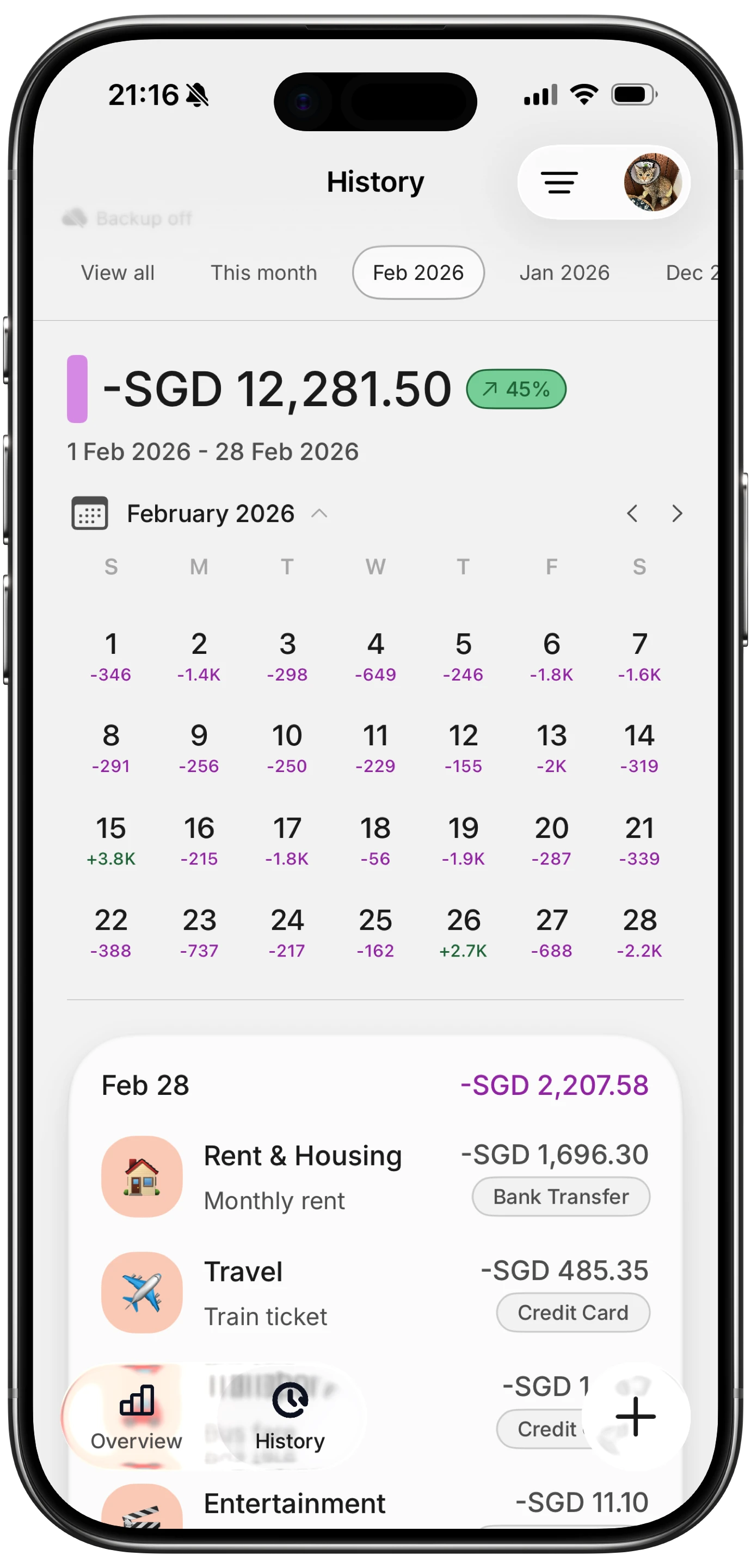
Finny app's History calendar feature
Criticisms and Limitations of the 4% Rule
The 4% rule is a useful starting point, but it has real limitations that deserve attention.
It Assumes a 30-Year Retirement
The original research tested 30-year periods. If you retire at 65 and live to 95, the math works. If you retire at 40 and live to 95, you need the portfolio to last 55 years. Early retirees typically use a lower withdrawal rate, often 3% to 3.5%, which means multiplying annual expenses by 29 to 33 instead of 25.
It Is Based on U.S. Historical Data
The Trinity Study used U.S. stock and bond returns, which have been among the strongest in the world over the past century. Investors in other countries with lower historical returns may not achieve the same outcomes. Future U.S. returns could also differ from historical averages.
It Does Not Account for Sequence of Returns Risk
If the market drops significantly in your first few years of retirement, withdrawing 4% from a shrinking portfolio can permanently damage your long-term outcome. A retiree who starts withdrawing during a bull market has a very different experience than one who starts during a recession, even if long-term average returns are identical.
Inflation May Not Be Predictable
The rule assumes you adjust for actual inflation each year. During periods of unusually high inflation, this can accelerate portfolio depletion. The 1970s tested this limit, and while the 4% rule survived, lower withdrawal rates provided more comfort.
Spending Is Not Constant
Real retirement spending tends to follow a pattern: higher in early retirement (travel, activities), lower in middle retirement, and potentially higher again in late retirement (healthcare). The 4% rule assumes steady inflation-adjusted withdrawals, which may not reflect your actual spending curve.
Modern Updates and Alternatives
Several researchers and financial planners have proposed modifications to the original 4% rule.
The Variable Percentage Withdrawal Method
Instead of a fixed inflation-adjusted amount, some planners recommend withdrawing a fixed percentage of your current portfolio each year. If your portfolio drops, you withdraw less. If it grows, you withdraw more. This protects the portfolio during downturns but creates income variability.
The Guardrails Approach
This method sets an upper and lower bound for withdrawals. If your portfolio grows significantly, you give yourself a raise. If it drops below a threshold, you cut spending temporarily. This balances portfolio protection with lifestyle stability.
The 3.3% Rule for Early Retirees
For retirements lasting longer than 30 years, some planners recommend 3% to 3.5% withdrawal rates. This means multiplying annual expenses by 29 to 33. The lower rate provides a larger margin of safety for longer time horizons.
Dynamic Spending Strategies
These approaches adjust withdrawals based on market conditions, portfolio performance, and remaining life expectancy. They require more active management but can improve outcomes compared to a rigid formula.
Why Expense Tracking Is the Foundation
Every retirement calculation starts with one number: your annual spending. Yet most people skip this step and use rough estimates instead. The difference between estimating $40,000 and actually spending $52,000 is a $300,000 gap in your retirement target.
Tracking expenses for even six months gives you reliable data to work with. You catch the irregular costs that budgets miss: the annual insurance premium, the car maintenance, the dental work, the gift-giving season. These add up to thousands of dollars that mental estimates consistently overlook.
With Finny, you can review your spending categories over time and calculate your true annual run rate. That number, plugged into the 4% rule, gives you a retirement target grounded in reality rather than guesswork. To learn more about understanding where your money goes, check out our guide on how to budget money.
The Bottom Line
The 4% rule remains one of the most practical tools for retirement planning. It translates a vague goal into a specific number: take your annual expenses, multiply by 25, and you have your target portfolio. While the rule has limitations, particularly for early retirees and during unusual market conditions, it provides a solid starting framework.
The most important step is not choosing between a 3.5% or 4% withdrawal rate. It is knowing your actual annual expenses. Without that number, every retirement calculation is built on guesswork. Start by tracking what you spend today, and the math for tomorrow becomes clear.
Common Questions About the 4% Rule
What is the 4% rule in simple terms?
The 4% rule says you can withdraw 4% of your retirement savings in the first year, then adjust that amount for inflation each year, and your money should last at least 30 years. If you have $1,000,000 saved, you would withdraw $40,000 in year one.
How do I calculate my retirement number using the 4% rule?
Multiply your annual living expenses by 25. If you spend $50,000 per year, you need $1,250,000 in investments to retire using the 4% rule. The more accurately you track your spending, the more reliable this number becomes.
Is the 4% rule still valid in 2026?
The 4% rule remains a useful guideline, though some financial planners now recommend 3.3% to 3.5% for more conservative projections, especially for early retirees or during periods of market uncertainty. The core principle of basing withdrawals on a sustainable percentage still holds.
Does the 4% rule include Social Security?
The 4% rule applies to your investment portfolio only. Social Security benefits reduce the amount you need to withdraw from your portfolio. If your annual expenses are $50,000 and Social Security covers $20,000, you only need to withdraw $30,000 from investments, which means a portfolio of $750,000 instead of $1,250,000.
What if I want to retire early using the 4% rule?
For retirements longer than 30 years, consider using a 3% to 3.5% withdrawal rate to increase the odds your portfolio survives. This means multiplying annual expenses by 29 to 33 instead of 25. Accurate expense tracking becomes even more important when the timeline is longer.
Ready to find your retirement number?
Download Finny to track your real spending across every category. With clear data on your annual expenses, you can calculate exactly how much you need to retire, no guesswork required.