How to Budget Money: Practical Methods That Work
You know you should budget. You have probably tried before: opened a spreadsheet, typed in some numbers, felt good for a week, and then stopped. That cycle is not a personal failure. It is a sign that the method did not fit your life.
How to budget money effectively depends less on discipline and more on choosing an approach that matches how you think about spending. Some people need rigid structure. Others need flexibility. The method matters more than motivation, because motivation fades but a good system keeps working.
This guide covers the most practical budgeting methods, compares their strengths and weaknesses, and helps you decide which one to use. If you are completely new to budgeting, start with our budgeting for beginners overview first.
What Budgeting Actually Means
A budget is a plan that tells your money where to go before you spend it. Instead of looking back at the end of the month and wondering what happened, you look forward and decide in advance. If you are new to the concept, our guide on what a budget is covers the fundamentals in more detail.
Every budgeting method answers the same core question: how should I divide my income across spending, saving, and debt repayment? The differences come down to how detailed the plan is and how much flexibility it allows.
Budgeting does not mean depriving yourself. It means funding what matters to you and cutting what does not. A person who budgets $300 for dining out is not restricted. They have given themselves permission to spend $300 on something they enjoy, while making sure rent, savings, and other priorities are covered.
The 50/30/20 Method
The 50/30/20 rule divides your after-tax income into three buckets:
- 50% for needs. Rent, utilities, groceries, insurance, minimum debt payments, and anything required to live and work.
- 30% for wants. Dining out, entertainment, hobbies, shopping, subscriptions, and other discretionary spending.
- 20% for savings and extra debt payments. Emergency fund, retirement contributions, investments, and accelerated debt payoff.
Who It Works For
This method is best for people who want a simple framework without tracking every dollar. If your income is stable and your spending is relatively predictable, the 50/30/20 split provides guardrails without micromanagement. You can use our 50/30/20 Budget Calculator to see exactly how your income breaks down across the three buckets.
Limitations
The 50/30/20 rule struggles in high cost-of-living areas where needs alone can consume 60% or more of income. It also lacks the granularity to identify specific problem areas. You might know that your "wants" category is over budget, but not whether the issue is restaurants, subscriptions, or impulse purchases.
Zero-Based Budgeting
Zero-based budgeting assigns every dollar of income to a specific purpose. At the end of the planning process, your income minus your allocated expenses equals zero. This does not mean you spend everything. It means every dollar has a job, including dollars assigned to savings.
For example, if you earn $4,000 after tax:
| Category | Amount |
|---|---|
| Rent | $1,200 |
| Groceries | $400 |
| Utilities | $200 |
| Transportation | $250 |
| Insurance | $150 |
| Dining out | $200 |
| Entertainment | $100 |
| Clothing | $75 |
| Subscriptions | $50 |
| Emergency fund | $300 |
| Retirement | $400 |
| Debt payoff | $500 |
| Miscellaneous | $175 |
| Total | $4,000 |
Who It Works For
Zero-based budgeting is ideal for people who want maximum control over their money. It forces deliberate decisions about every spending category. Our detailed guide on zero-based budgeting explains how to implement this method from scratch.
Limitations
This method requires more time upfront and needs regular adjustment as expenses change. If your income varies month to month (freelancers, gig workers), creating a zero-based budget requires estimating income, which adds complexity.
The Envelope Method
The envelope method divides cash into physical envelopes labeled with spending categories. When an envelope is empty, you stop spending in that category until the next month.
Digital versions of this method use virtual envelopes in an app. The concept is the same: fixed amounts per category, and when the money runs out, spending stops.
Who It Works For
The envelope method works well for people who struggle with overspending in specific categories. The physical (or digital) constraint makes limits tangible. It is especially effective for variable spending categories like groceries, dining out, and entertainment.
Limitations
Physical envelopes do not work for online purchases, which make up a growing share of spending. Digital envelope apps solve this, but add the complexity of choosing and maintaining the right tool. The method also requires consistent cash withdrawals if using physical envelopes, which is less practical in a mostly cashless economy.
Comparing Budgeting Methods
| Feature | 50/30/20 | Zero-Based | Envelope |
|---|---|---|---|
| Setup time | Low | High | Medium |
| Weekly maintenance | Low | Medium | Medium |
| Spending detail | Low | High | Medium |
| Flexibility | High | Low | Medium |
| Best for | Simple lifestyles | Full control | Overspenders |
| Works with variable income | Moderate | Difficult | Moderate |
| Requires tracking every purchase | No | Yes | Per category |
No single method is universally best. The right choice depends on your income stability, how much control you want, and how much time you are willing to invest in managing your budget. If you want to go beyond budgeting and build a broader financial plan, our personal finance strategy guide walks through a step-by-step approach.
How to Set Up Your Budget in 5 Steps
Regardless of which method you choose, the setup process follows the same pattern:
-
Calculate your monthly after-tax income. Include salary, side income, and any regular sources of money. If your income varies, use the average of the last three months or your lowest recent month for a conservative estimate.
-
List your fixed expenses. These are bills that stay roughly the same each month: rent, insurance, loan payments, subscriptions. Total them up.
-
Estimate your variable expenses. Review the last two to three months of spending to estimate what you typically spend on groceries, dining, gas, entertainment, and other flexible categories. If you have not been tracking expenses, start now. Our guide on how to track expenses explains how.
-
Assign your income. Using your chosen method, allocate income to each category. Make sure savings and debt payments are included, not just spending categories.
-
Track and adjust. A budget is a living document. Track your actual spending against your plan, and adjust category amounts each month as you learn your real patterns.
Tools for Budgeting
Spreadsheets
Free and fully customizable. Google Sheets and Excel both work. The downside is that you must build the structure yourself and manually enter every transaction. Spreadsheets work best for people who enjoy tinkering with formulas and have simple financial lives.
EveryDollar (Dave Ramsey's Budget App)
EveryDollar is built around zero-based budgeting with a simpler, more guided interface. The free tier lets you create a zero-based budget manually, while the premium plan adds bank connections. It costs $17.99 per month or $79.99 per year.
Goodbudget
Goodbudget digitizes the envelope method. You create virtual envelopes and allocate income to each one. The free tier allows 20 envelopes with one account. The Plus plan ($10/month) adds unlimited envelopes, multiple accounts, and debt tracking.
PocketGuard
PocketGuard focuses on showing you how much you have left to spend after covering bills, goals, and necessities. It connects to bank accounts and categorizes transactions automatically. The free version covers basics, while Plus ($7.99/month) adds more features.
Finny
Finny approaches budgeting from the tracking side. Rather than requiring you to set up a detailed budget framework upfront, it focuses on making expense recording fast and frictionless through AI-powered voice, text, and receipt input. You can track spending in over 150 currencies, work entirely offline, and review your spending analytics to inform your budgeting decisions. Finny does not require bank connections, which keeps your financial data private. The free tier covers core tracking, and Pro is available at a low monthly or yearly price.
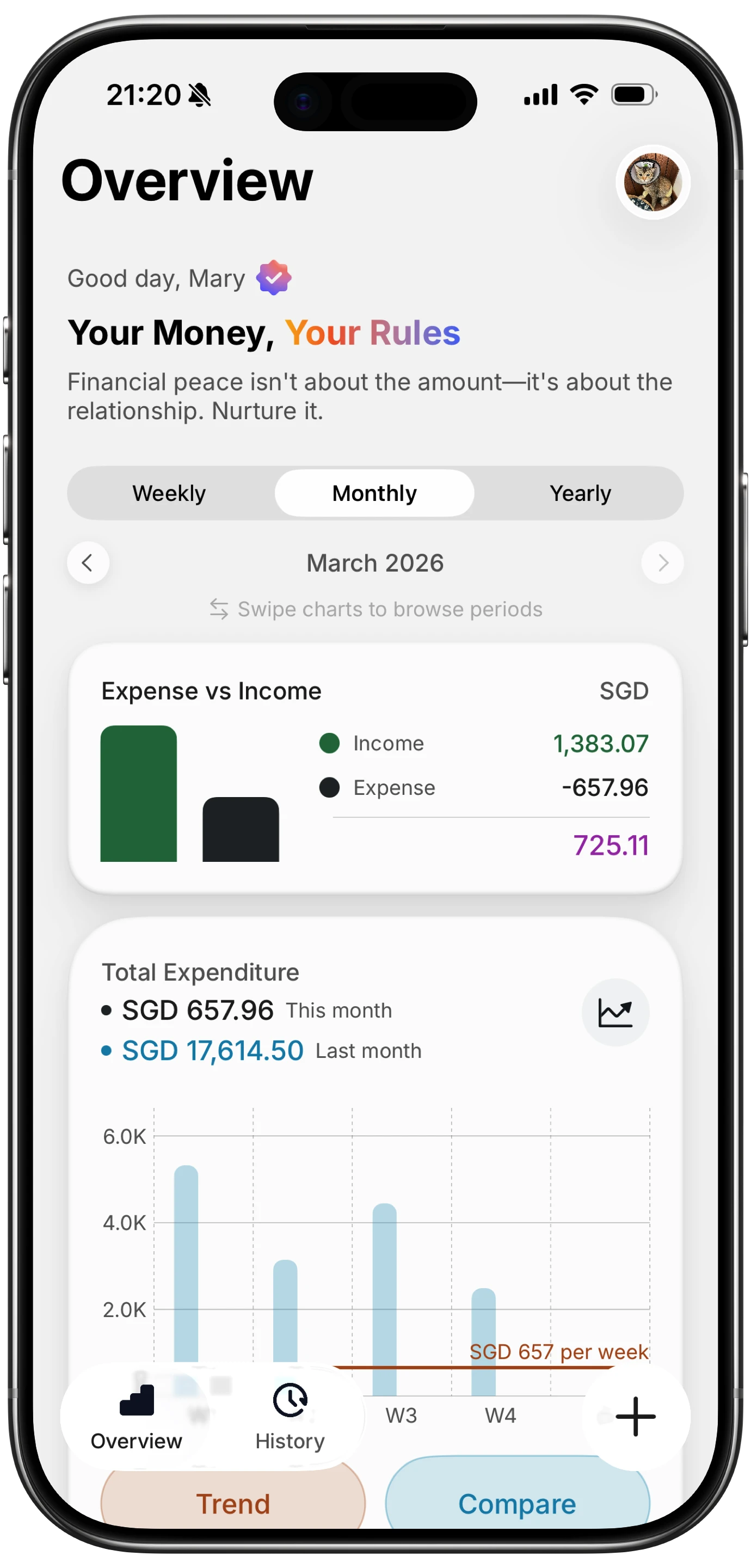
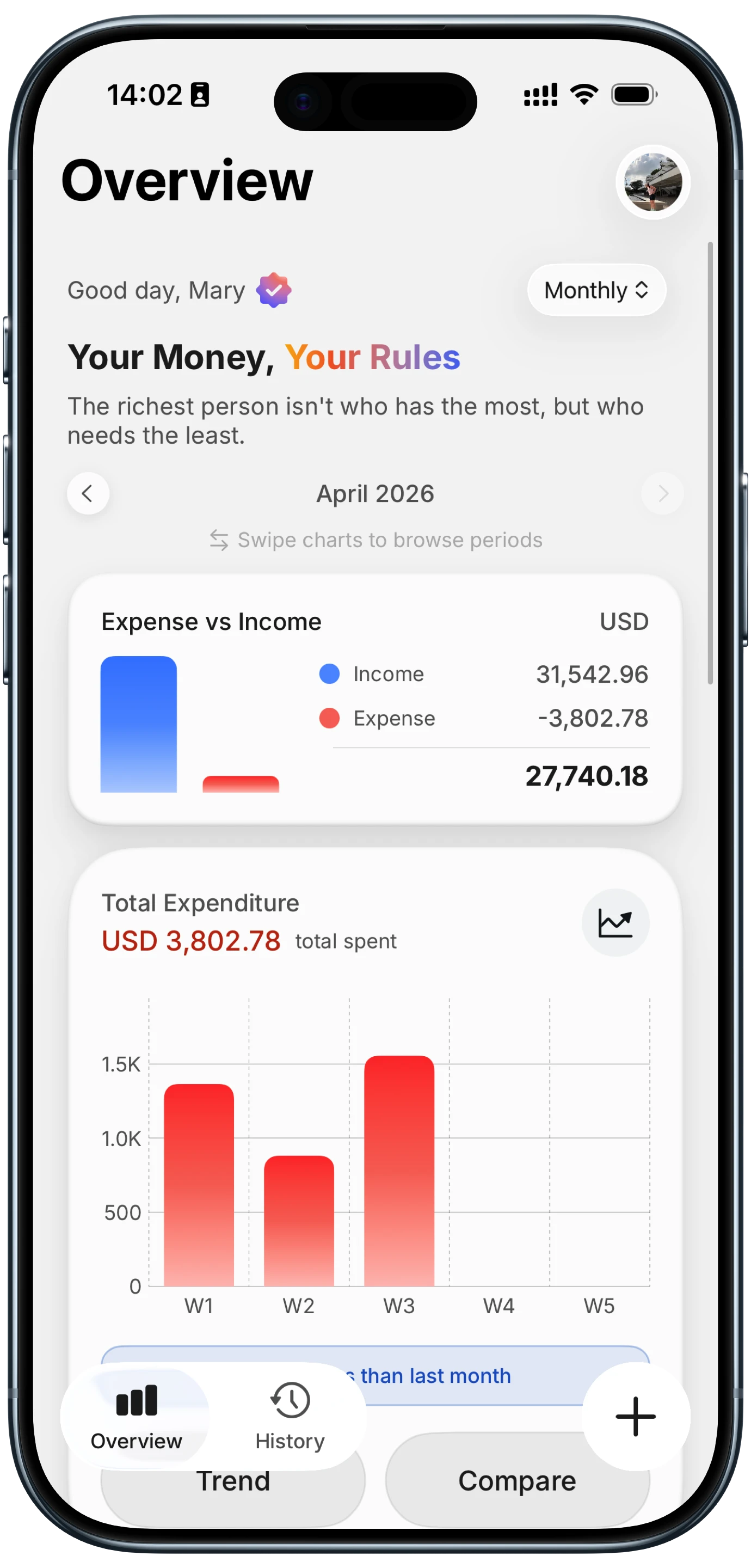
Finny app's Overview feature
Common Budgeting Mistakes
Setting Unrealistic Category Amounts
If you currently spend $500 on dining out, budgeting $100 for next month will likely fail. Cut gradually: try $400 first, then $350 the following month. Sustainable change is slow.
Forgetting Irregular Expenses
Car registration, annual insurance premiums, holiday gifts, and medical co-pays do not happen monthly but still need funding. Divide annual irregular expenses by 12 and include that amount in your monthly budget.
Budgeting Without Tracking
A budget without expense tracking is just a wish list. You need to compare actual spending to planned spending regularly. Without tracking, you have no way to know whether your budget is working. For tips on building a consistent tracking habit, see our guide on AI expense tracking vs manual methods.
Giving Up After One Bad Month
Every budgeter has months where spending exceeds the plan. This does not mean the budget failed. Review what happened, adjust if needed, and continue. Consistency over months matters more than perfection in any single month.
Common Questions About Budgeting Money
What is the easiest budgeting method for beginners?
The 50/30/20 method is the simplest starting point. It requires minimal setup, no detailed tracking, and provides a clear framework for dividing income. Once you are comfortable, you can switch to a more detailed method like zero-based budgeting.
How much should I save each month?
A common target is 20% of after-tax income, following the 50/30/20 guideline. If that is not realistic given your current expenses, start with whatever you can. Even 5% is better than nothing. Increase the percentage as you reduce expenses or grow your income.
What is the best budget money app?
The best app depends on your preferred budgeting method and how much automation you want. YNAB suits zero-based budgeters. Goodbudget works for envelope budgeting. Finny works well if you want fast, private expense tracking without bank connections. See our best money tracker apps in 2026 guide for a full comparison.
How often should I update my budget?
Review your budget weekly to compare actual spending against planned amounts. Adjust category allocations monthly as you learn your real spending patterns. Major life changes (new job, move, salary change) warrant a complete budget rebuild.
Do I need to track every expense to budget effectively?
For the 50/30/20 method, you mainly need to know your totals for each bucket. For zero-based and envelope budgeting, tracking every expense is essential because those methods depend on knowing exactly where each dollar goes.
Ready to take control of your spending?
Download Finny to start tracking expenses with AI-powered input, offline support, and spending analytics. No bank connections required, and your financial data stays private.