7 Apps Like Cleo to Try in 2026
Cleo became famous for one thing: the sassy AI chatbot that roasts your spending. For a while, that was enough. A talking penguin that calls out your third DoorDash order of the week is funnier than opening a spreadsheet, and it made budgeting feel less like homework.
But something shifts after the novelty fades. The jokes repeat, the cash advance caps feel smaller than advertised, and the subscription shows up on your statement next to the very expenses you were trying to cut. If you are hunting for apps like cleo in 2026, you are not alone. Some people want the humor without the fees. Some want the cash advance without the chatbot. Some want structured budgeting that actually sticks. This guide segments the options by intent so you can match the right tool to your real reason for looking. For a broader view, see our best money management apps for 2026 guide.
Why People Look for Cleo Alternatives in 2026
Cleo has around four million users and a long track record, but search trends for "cleo alternatives" have climbed steadily over the past two years. A few patterns show up again and again in reviews, Reddit threads, and Better Business Bureau complaints.
The humor wears off. What feels edgy at sign-up can feel repetitive after a month, and once you have seen the same roasts three times, the app stops delivering the dopamine hit that made it stick.
The cash advance gap is real. In March 2025, the FTC reached a $17 million settlement with Cleo over claims that the app exaggerated advance amounts and downplayed express fees. Users routinely report being approved for $30 or $50 after paying $5.99 to $14.99 for a subscription that promised "up to $250" or "up to $500."
Budgeting is shallow. Cleo does a solid job flagging spending, but it is not built for envelope budgeting, zero-based budgeting, or long-term goal planning. People who graduate from "stop overspending" to "build a system" often outgrow it.
Privacy concerns linger. Like most US cash advance apps, Cleo relies on Plaid bank connections, reads transaction history, and nudges you toward paid tiers based on that data. That tradeoff is fine for some users and uncomfortable for others.
What Cleo Does Well, and Where It Falls Short
Before we get to the alternatives, here is an honest look at Cleo as it stands in 2026. It is still a legitimate app with real strengths, and dismissing it entirely would be unfair to readers whose needs it genuinely fits.
What Cleo does well
- Onboarding is fast and the tone disarms people who avoid finance apps.
- The "roast" and "hype" modes make checking your balance feel less dreadful.
- Cash advances up to $250 (Plus) or $500 (Builder) are available with no credit check and no interest.
- The Cleo Builder secured card is a reasonable credit-building option for thin-file users.
- Free tier offers basic spending tracking with no strings attached.
Where Cleo falls short
- Advertised cash advance limits rarely match real approvals. Many users get $20 to $50 on first use.
- Express fees run $3.99 to $9.99 per advance on top of the monthly subscription.
- Cancelling has historically been difficult, which was part of the FTC action.
- Budgeting features are thin compared to dedicated tools.
- The chatbot format makes reviewing a month of spending feel clunky.
- Support response times during payment disputes are a recurring complaint.
Pricing as of 2026: Cleo Plus is $5.99 per month (or $44.99 annually) and Cleo Builder is $14.99 per month. There is also a smaller Cleo Grow tier at $2.99 per month for basic goal-setting.
If the humor and the cash advance are what you want, and you can live with the fees, Cleo is still a defensible choice. If you want more structure, deeper budgeting, better privacy, or a different interface, keep reading.
7 Apps Like Cleo Worth Trying in 2026
Here is a quick comparison before the deep dives.
| App | Best For | Starting Price | Chatbot UI | Cash Advance |
|---|---|---|---|---|
| Cleo | Humor plus small advances | Free / $5.99 mo | Yes | Up to $250 to $500 |
| Bright Money | AI debt payoff plus advances | Free / $14 mo | No | Up to $750 |
| Albert | All-in-one with human advisors | From $11.99 mo | Partial | Up to $250 |
| Charlie | Text-based money coaching | Free banking tier | Yes | No (banking focused) |
| Copilot Money | Predictive AI categorization | $13 mo or $95 yr | No | No |
| Rocket Money | Bill negotiation and subs | Free / $7 to $14 mo | No | No |
| Finny | Structured AI logging, privacy | Free / $1.99 mo | No | No |
Bright Money
Bright Money is the closest direct competitor to Cleo's cash advance pitch with a much heavier AI backbone. Its MoneyScience system runs 34 algorithms to build personalized debt payoff plans, automate transfers, and optimize for credit score improvement. Advances go up to $750, loans up to $10,000, and rent reporting can push credit history two years back.
Pricing is $14 per month for Bright Premium, with quarterly, six-month, and annual plans that drop the effective rate. There is no chatbot gimmick, which some users will miss and others will celebrate. Bright is best if you want Cleo's cash advance feature scaled up and paired with serious debt management rather than jokes.
Albert
Albert positions itself as an all-in-one personal finance assistant, and it is the only app on this list that pairs AI with actual human "Genius" advisors you can text for advice on real questions. Features include automatic savings, fractional share investing from $1, cash advances up to $250, and a banking layer through Albert Cash.
Albert Genius starts at $11.99 per month, with higher tiers up to $29.99 that unlock more advisor access and premium features. A 30-day free trial lowers the risk of trying it. If you wanted Cleo's guidance but with real people behind the answers, Albert is the upgrade path.
Charlie
Charlie started as a text-message chatbot, which makes it spiritually closest to Cleo's original format. A friendly penguin would message you about balances, due dates, and savings nudges without requiring an app. In 2026, Charlie has pivoted and is now the standard banking provider for Americans age 62 and up, with early Social Security access, fraud protection, and 55,000 in-network ATMs.
That pivot means Charlie is no longer a drop-in Cleo replacement for younger users, but it is worth knowing about if you are helping an older parent find a finance tool. The conversational, low-pressure approach still applies.
Copilot Money
Copilot Money is what you pick when you liked the idea of AI in your finances but wanted zero chatbot. It uses machine learning to predict transaction categories with around 93 percent first-pass accuracy, and each user gets a private AI model that learns spending patterns over time. The interface is a clean dashboard built for iPhone, iPad, and Mac.
Pricing is $13 per month or $95 per year, which undercuts YNAB and Monarch. The catch: Apple only. No Android, no web, no Windows. If you are in the Apple ecosystem and want predictive AI without the "roast me" overlay, Copilot is the most polished pick. For more AI-specific options, see our AI finance tracker overview.
Rocket Money
Rocket Money is the app to pick when your real pain is recurring charges rather than daily spending. It finds subscriptions you forgot about, cancels them on your behalf, and negotiates bills like internet, phone, and insurance. On average, Rocket Money saves its customers around 20 percent on telecom bills, with a success fee of 35 to 60 percent of first-year savings when a negotiation works.
Pricing is a "pay what you think is fair" model from $7 to $14 per month for premium, with a free tier that covers subscription detection but not cancellation. Rocket Money is not a Cleo replacement for chatbot fans, but it handles an entire category of money leaks that Cleo barely touches.
Finny
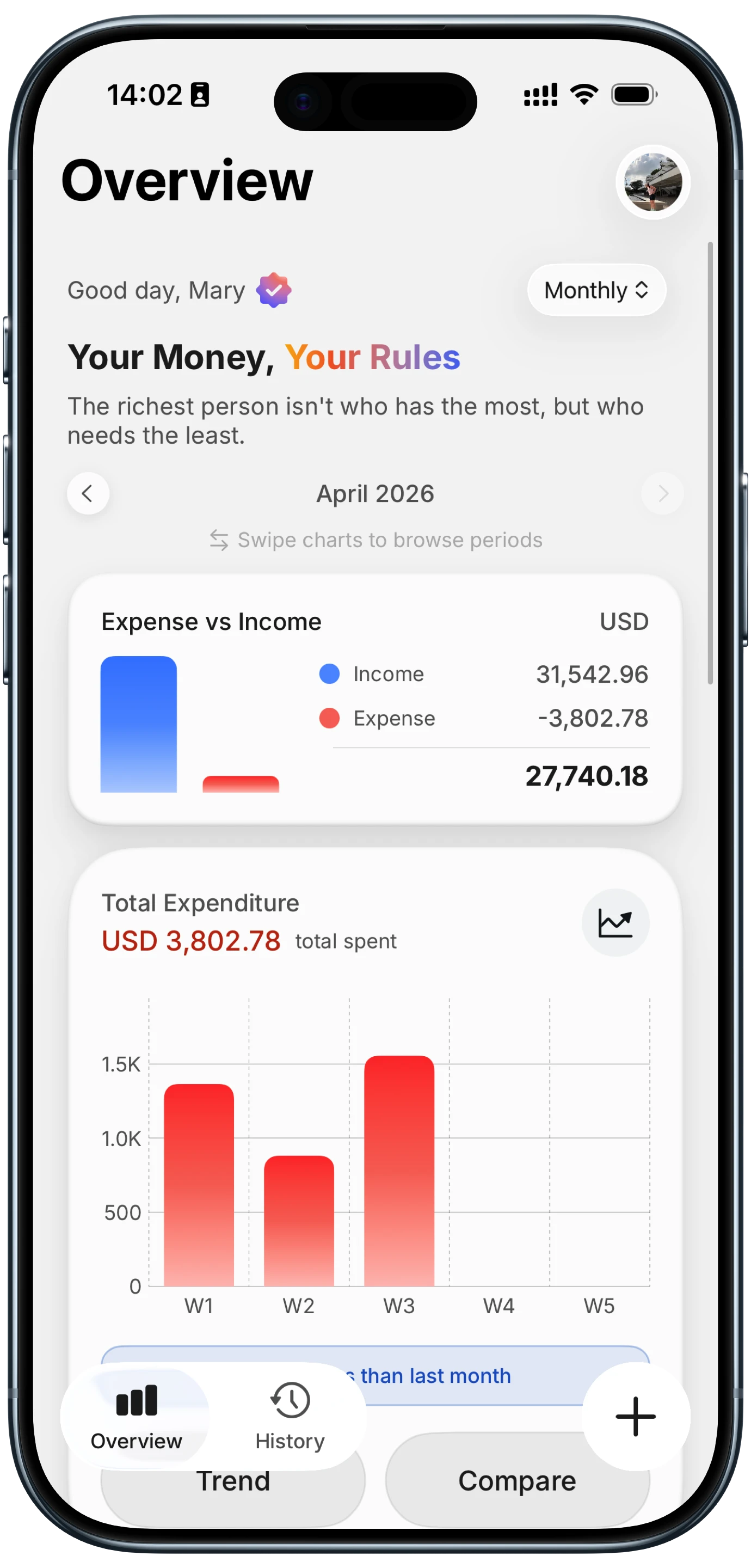
Finny takes the opposite approach from Cleo. Instead of a chatbot that reacts to your bank feed, Finny is a structured expense tracker with AI-assisted input and no bank connections required. You can log expenses by typing a natural-language sentence, dictating with voice, or snapping up to five receipts at once with batch scan. Apple Pay transactions can auto-log through a Tap to Track Shortcut that uses NFC.
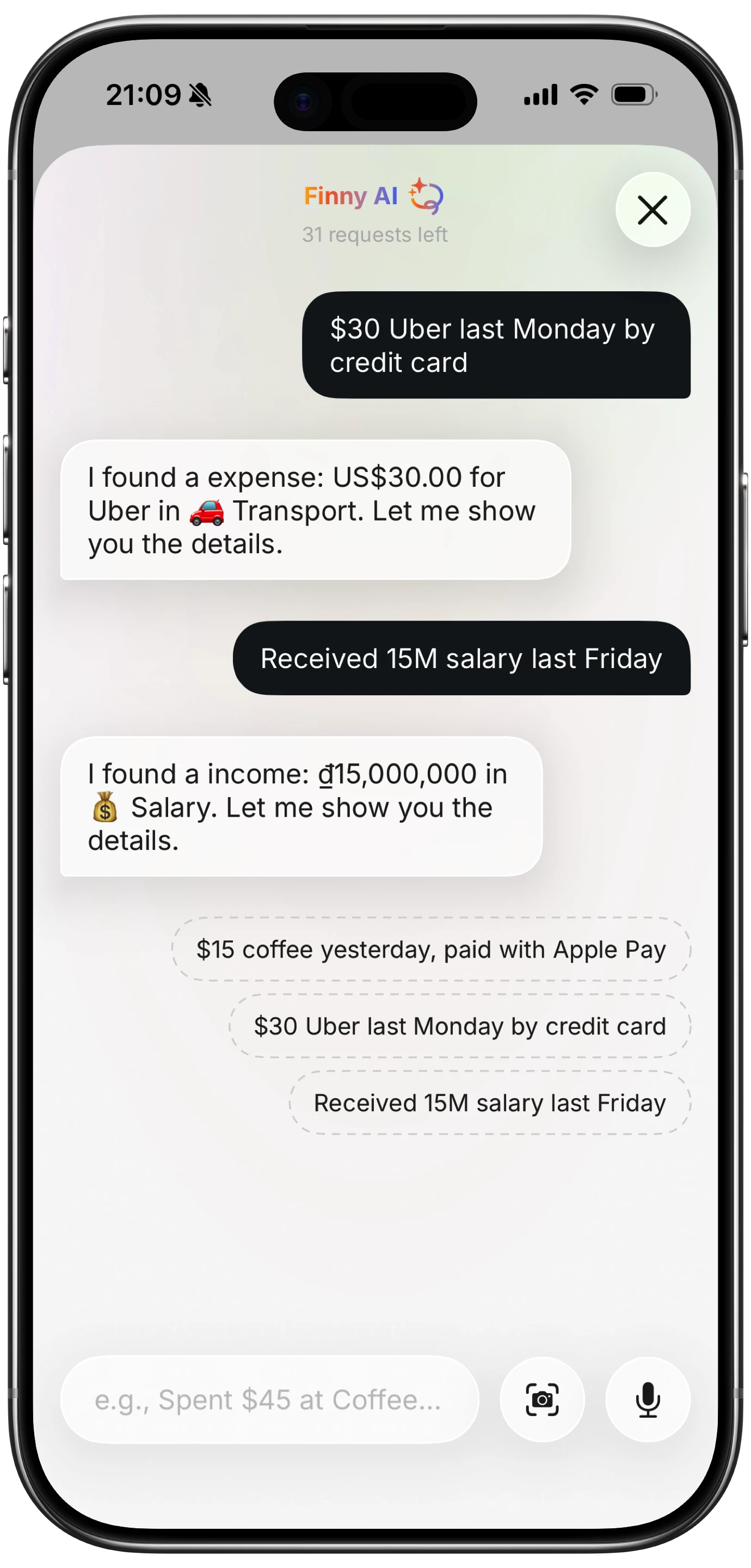
The privacy model is the headline difference. Data stays on device by default, nothing is sold, and nothing is shared with advertisers. Pricing is free for unlimited manual tracking with custom categories, charts, and 150+ currencies, or $1.99 per month for Pro (AI input, receipt scanning, Tap to Track). That is significantly cheaper than YNAB at $14 per month or Cleo's $5.99 to $14.99 tiers.
Finny is best if you liked the AI assistance in Cleo but wanted to drop the chatbot format, lose the bank connection, and pay less.
Chatbot Money Apps vs Structured Trackers
Cleo, Charlie, and to a lesser extent Albert lean on conversational interfaces. Copilot Money, Rocket Money, and Finny lean on structured dashboards. The choice between them is not just aesthetic. It changes how you interact with your money day to day.
Chatbot apps work well when you avoid finance apps entirely and need something that feels social. The back-and-forth lowers the activation energy. A nudge that arrives as a text message is harder to ignore than a chart in a menu you never open. For people who have tried spreadsheets three times and quit, a chatbot can be the thing that finally sticks.
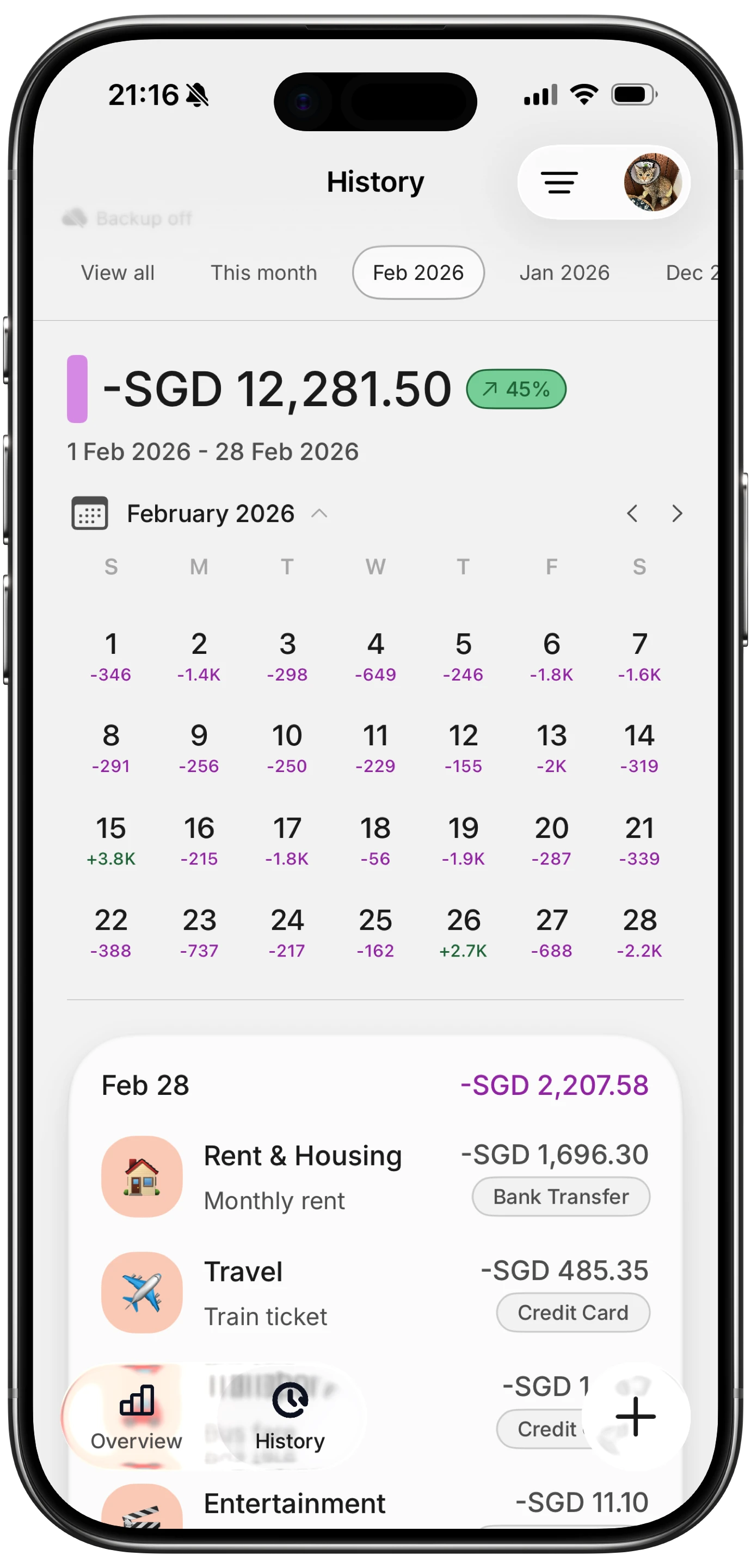
Structured trackers work well when you want to see patterns across weeks and months. Dashboards, categories, and filters answer questions a chatbot cannot answer quickly, like "how much did I spend on groceries in March compared to February" or "what is my average daily coffee spend this quarter." Once you start asking those questions, a chat log becomes the slow path.
The honest tradeoff: chatbots drive engagement but plateau on depth. Structured trackers go deeper but lose users who do not open them. Some people need both at different life stages. Starting with a chatbot to build the habit and graduating to a structured tracker once the habit sticks is a reasonable path.
There is also a middle option. Apps like Finny use AI to process natural-language input ("lunch with Kim, $18") and then file it into a structured system. You get the low-friction feel of chatting without losing the dashboards, reports, and historical view that chatbots cannot match. That hybrid is where a lot of 2026 apps are converging.
Which Cleo Alternative Fits You
Pick based on the reason you typed "apps similar to cleo" into Google in the first place.
If you want the cash advance: Bright Money is the strongest alternative for larger advances (up to $750) and comes with a serious AI debt management layer. Albert is a good second pick if you want smaller advances plus investing and savings under one roof.
If you want better budgeting: Copilot Money wins on predictive categorization and clean dashboards for Apple users. For a broader budgeting app shortlist including couples and family options, see our best budgeting apps for couples in 2026 guide.
If you want AI coaching without the jokes: Albert pairs AI with human "Genius" advisors you can actually text, which is a real differentiator in 2026. Bright Money's MoneyScience is the pure-AI alternative.
If you want the chatbot feel for a different audience: Charlie is now focused on banking for 62-plus users, so it may fit a parent better than it fits you. For younger users, the chatbot era is mostly over.
If you care about privacy and low cost: Finny gives you AI-assisted logging, offline support, no bank connections, and a $1.99 Pro tier. It is the most different from Cleo on this list, which is the point for privacy-first users.
If your real problem is recurring charges: Rocket Money pays for itself if it cancels one forgotten streaming service or lowers one internet bill. Pair it with any tracker above for day-to-day expenses.
Frequently Asked Questions
Is Cleo still worth it in 2026?
Cleo is still worth it for a narrow group: people who avoid finance apps, enjoy the chatbot humor, and need occasional small cash advances of $20 to $50 without credit checks. It is less defensible if you want predictable advance amounts, deeper budgeting, privacy-first design, or a lower subscription fee. The March 2025 FTC settlement forced clearer fee disclosure and easier cancellation, so the experience has improved, but the fundamentals have not changed much.
What is the best free alternative to Cleo?
Finny has a free tier with unlimited manual expense tracking, custom categories, charts, and 150+ currencies, all without bank connections. Rocket Money's free tier covers subscription detection. Empower offers free net worth and investment tracking. For Apple-only users who want AI categorization, Copilot Money has a 30-day trial but no permanent free tier.
Are apps like Cleo safe to use?
Most reputable Cleo alternatives use bank-level encryption and Plaid or similar aggregators for bank connections, which is generally safe but does mean a third party is reading transaction history. Apps that avoid bank connections, like Finny, reduce that exposure. The 2025 FTC settlement with Cleo was about advertising practices, not data breaches, so the safety story is mostly about what you are comfortable sharing and with whom.
What is the best app like Cleo for cash advances?
Bright Money offers up to $750 with no interest and no credit check, which is larger than Cleo's $250 to $500 range. Albert offers up to $250 paired with investing and savings. Dave, Brigit, and Earnin are other cash-advance-focused apps worth comparing, though each has its own fee structure for express funding.
Can I use multiple Cleo alternatives at once?
Yes, and many people do. A common 2026 stack looks like one structured tracker for day-to-day spending, one bill negotiator like Rocket Money for recurring charges, and one cash advance app held in reserve for emergencies. Just watch the subscription costs. Stacking three $10 apps wipes out the savings the apps are supposed to deliver.
Ready to track spending without the chatbot or the bank connection?
Finny is a privacy-first expense tracker with AI text input, voice logging, and batch receipt scanning. No bank links, offline support, and a $1.99 per month Pro tier when you outgrow the free plan.