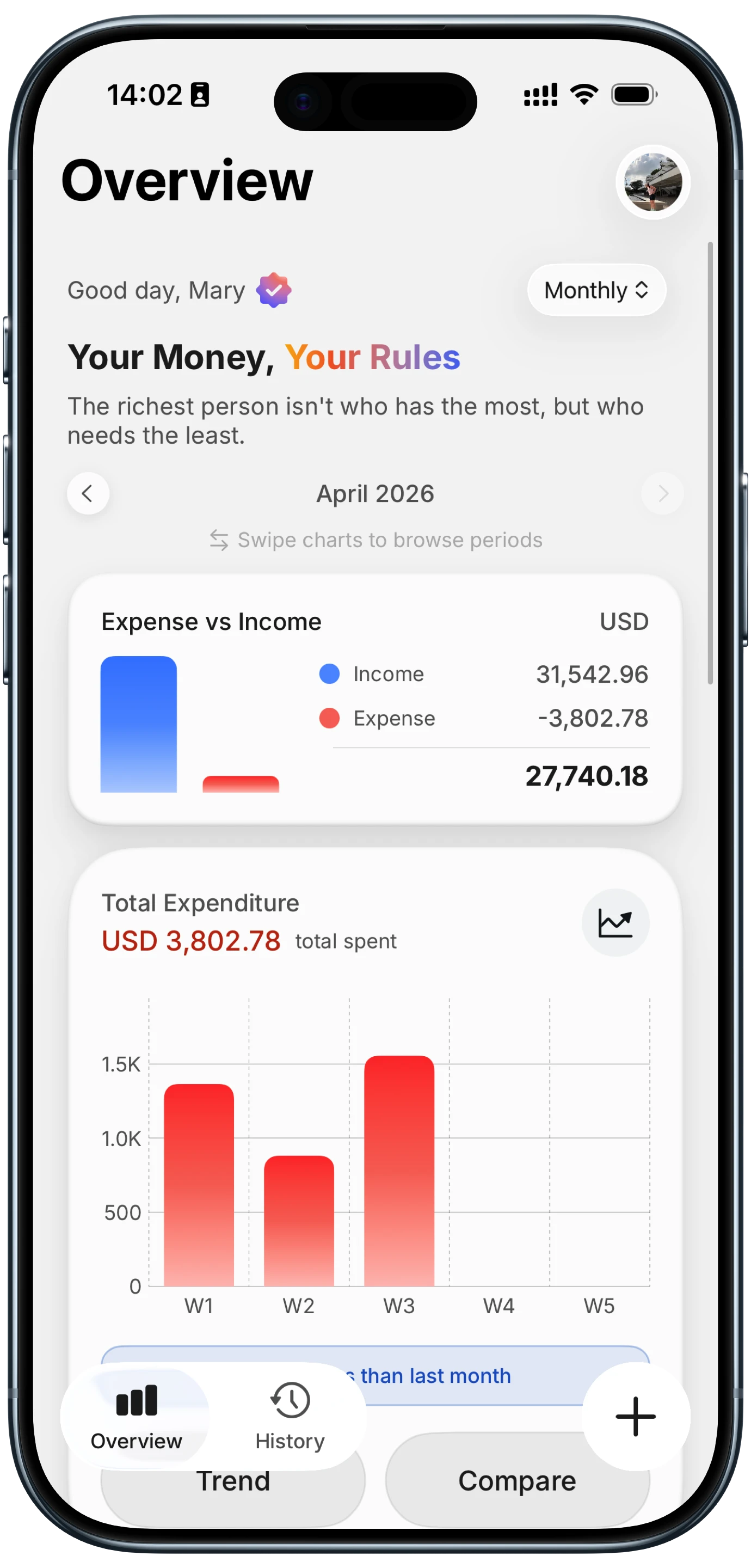
Managing money together is one of the hardest parts of any relationship. Different incomes, competing priorities, and unclear ownership of expenses create friction that spreadsheets and mental math cannot solve. The right app reduces those arguments by giving both partners visibility without eliminating individual autonomy.
The best budgeting apps for couples in 2026 take different approaches to shared finances. Some require linking every bank account. Others let you track manually with full privacy. A few are built specifically for two-person households, while others adapt individual tools for shared use.
We compared six popular options on what matters most to couples: pricing for two people, shared budget features, privacy controls, and how much setup friction each app creates. If you are looking for individual tracking, see our guide to the best expense tracker apps in 2026.
How We Evaluated These Apps
Every app was assessed based on real-world couple usage patterns. We focused on:
- Two-person cost: Does the subscription cover both partners, or does each person pay separately
- Shared visibility: Can both partners see the same budgets, goals, and transactions in real time
- Privacy controls: Can you choose what to share and what to keep personal
- Setup friction: How long before both partners are actively using the app
- Budgeting approach: Envelope-based, zero-based, tracking-only, or flexible
- Bank linking requirements: Whether you must connect bank accounts or can track manually
For a broader look at how couples can track shared spending without bank connections, read our guide on how to track spending as a couple in 2026.
Quick Comparison Table
| App | Monthly Price | Covers Both Partners | Bank Linking Required | Privacy Controls | Budgeting Method | Offline Support |
|---|---|---|---|---|---|---|
| Honeydue | Free | Yes | Optional | Granular | Tracking + bills | No |
| YNAB | $14.99/mo | Yes (up to 6) | Yes | Limited | Zero-based | No |
| Monarch Money | $14.99/mo | Yes | Yes | Basic | Flexible | No |
| Goodbudget | Free / $10/mo | Yes (2 devices free) | No (Premium only) | Limited | Envelope | Partial |
| Copilot | $13/mo | No (single user) | Yes | None | Tracking + budgets | No |
| Finny | a low monthly price | No (individual) | No | Full | Manual tracking | Yes |
The Best Budgeting Apps for Couples in 2026
Honeydue: Best Free Option for Couples
Honeydue is the only app on this list built exclusively for couples, and it is completely free. Both partners get their own account, linked together so you can see shared finances in one dashboard.
The standout feature is granular privacy control. You choose exactly what your partner sees for each account: full transactions and balances, balances only, or nothing at all. This solves the biggest tension point in couple budgeting, where one partner wants full transparency and the other wants some personal spending freedom.
Honeydue supports bank account linking but does not require it. You can add accounts manually if you prefer not to share credentials with a third party. The built-in chat lets you discuss transactions directly within the app, and bill tracking with reminders helps ensure nothing gets missed.
The trade-off is limited budgeting depth. Honeydue tracks spending and bills effectively but does not offer envelope budgeting, zero-based budgets, or detailed financial goals. If you want a simple shared dashboard for monitoring household spending, it works well. If you want structured budgeting, you will need something else.
Pricing: Free (optional tip of $1 to $10/month)
Best for: Couples who want free, shared expense visibility with strong privacy controls.
YNAB: Best for Zero-Based Budgeting Together
YNAB (You Need a Budget) is the most disciplined budgeting system available, and its 2026 pricing now includes sharing with up to six people on a single subscription. Both partners get full access to the same budget, which makes it genuinely useful for couples willing to commit to the method.
The zero-based approach means every dollar of income gets assigned to a category before you spend it. Couples use this to align on priorities: how much goes to rent, groceries, dining out, and individual "fun money" categories. When both partners work within the same budget, spending decisions become less about permission and more about shared planning.
YNAB requires bank linking to import transactions automatically, though you can enter them manually. There is no way to hide accounts from a shared partner, which means full financial transparency is built into the system. For some couples, that is the point. For others, it is a dealbreaker.
The learning curve is steep. YNAB's four-rule methodology takes time to internalize, and both partners need to understand it for the system to work. At $14.99/month ($109/year), it is also one of the most expensive options. College students can get a free year.
Pricing: $14.99/month or $109/year
Best for: Couples committed to zero-based budgeting who want complete shared visibility.
Monarch Money: Best for Comprehensive Household Finance
Monarch Money positions itself as a complete financial dashboard for households. One subscription covers both partners with separate logins, and the shared dashboard shows the entire household's financial picture: bank accounts, investments, net worth, and budgets.
The budgeting approach is more flexible than YNAB. You can set spending limits by category without assigning every dollar. Both partners see real-time updates, and you can tag transactions by person to track individual versus shared spending. Shared financial goals, such as building an emergency fund or saving for a home, give both partners a visual progress tracker.
Monarch requires bank account linking and does not work without it. Privacy controls are basic: both partners see everything in the shared household. There is no option to hide individual accounts or transactions. The app also requires an internet connection and does not work offline.
At $14.99/month ($99.99/year), Monarch is a premium option. There is no free tier beyond a 7-day trial. The annual plan occasionally has promotional pricing for new users.
Pricing: $14.99/month or $99.99/year
Best for: Couples who want a full financial dashboard with investments, net worth, and flexible budgets.
Goodbudget: Best for Envelope Budgeting Without Bank Linking
Goodbudget brings the envelope budgeting method to your phone. You create virtual envelopes for each spending category, fill them with your monthly budget, and track spending against those limits. The free plan lets two devices share the same set of envelopes, which makes it a natural fit for couples.
The key advantage for privacy-conscious couples: Goodbudget does not require bank linking on the free plan. Both partners manually enter expenses, which means no sharing of bank credentials and no automatic data collection. This manual approach also forces both partners to engage with their spending, which often leads to better awareness than automatic tracking.
The free plan limits you to 10 envelopes, one account, and one year of history. Goodbudget Plus ($10/month or $80/year) unlocks unlimited envelopes, up to five devices, seven years of history, and optional bank import.
The downside is that manual entry creates friction. If one partner stops logging expenses, the shared budget becomes inaccurate. Goodbudget also lacks investment tracking, net worth calculations, and AI input features.
Pricing: Free (limited) or $10/month ($80/year)
Best for: Couples who want envelope budgeting without connecting bank accounts.
Copilot: Best Design, But Single-User Only
Copilot is one of the most polished finance apps available, with clean visualizations and a well-designed interface. It connects to bank accounts, categorizes transactions automatically, and provides spending insights that are genuinely useful.
However, Copilot is fundamentally a single-user app. There is no shared access, no partner invites, and no way for two people to view the same data. If both partners want to use it, each needs a separate subscription. Even then, you cannot see each other's spending or collaborate on budgets.
Copilot is also Apple-only. There is no Android app, no web dashboard, and no Windows support. If one partner uses Android, Copilot is not an option.
For couples where one partner manages household finances and does not need the other to actively participate, Copilot works well as a personal tool. But it is not a couples budgeting solution.
Pricing: $13/month or $95/year (per person)
Best for: Individuals (not couples) who want a premium, design-focused finance app on Apple devices.
Finny: Best for Privacy-First Manual Tracking
Finny takes a different approach to couple budgeting. Rather than linking bank accounts or creating shared dashboards, it focuses on making manual expense logging so fast that both partners actually do it consistently.
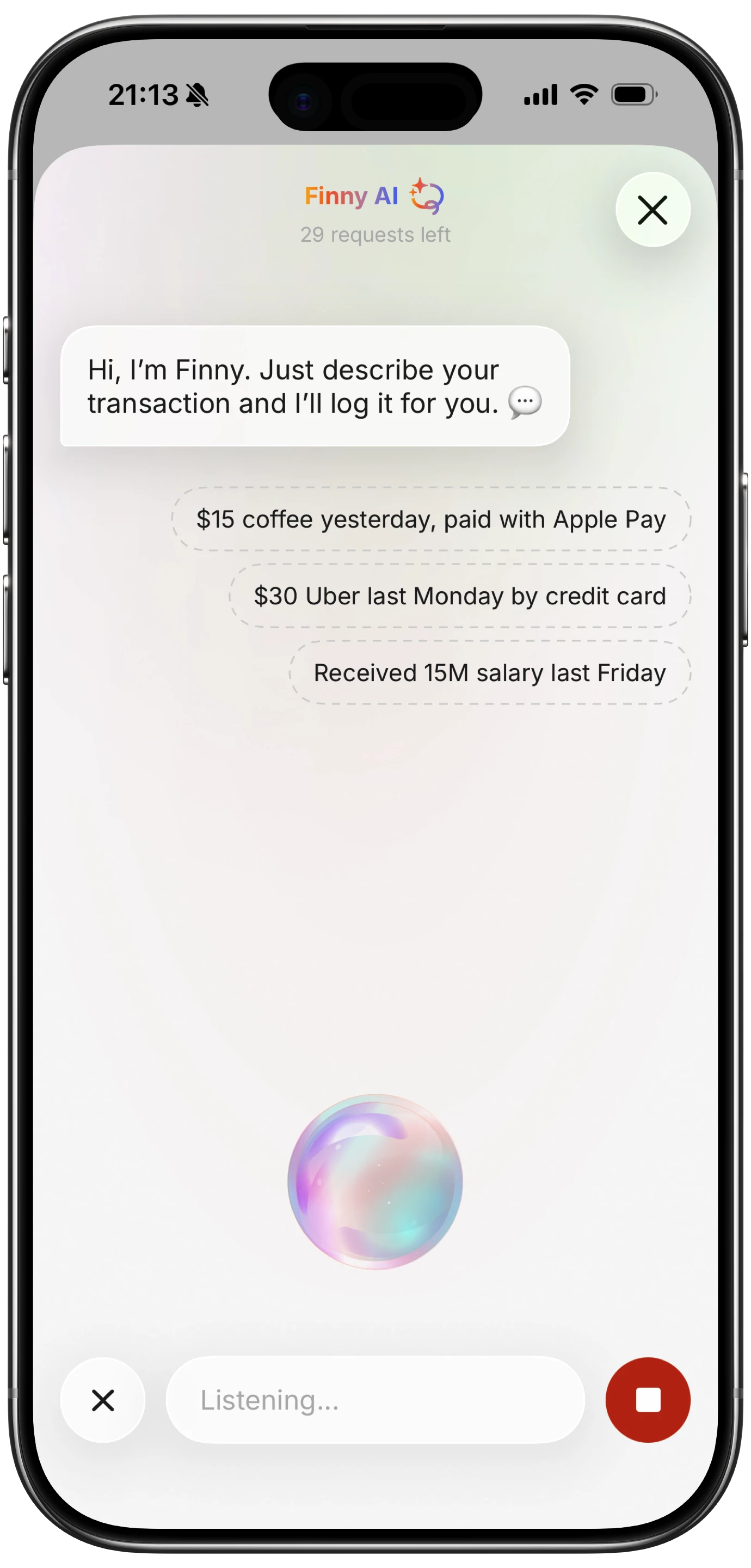
Finny app's voice input feature
The AI input options remove the biggest barrier to manual tracking. You can type a natural sentence like "groceries 85 at Costco," dictate it by voice, scan up to five receipt photos at once, or import statement screenshots. Each expense takes seconds to log, which means both partners can realistically track every purchase without it feeling like a chore. For more on how this works, see our guide on how to track expenses.
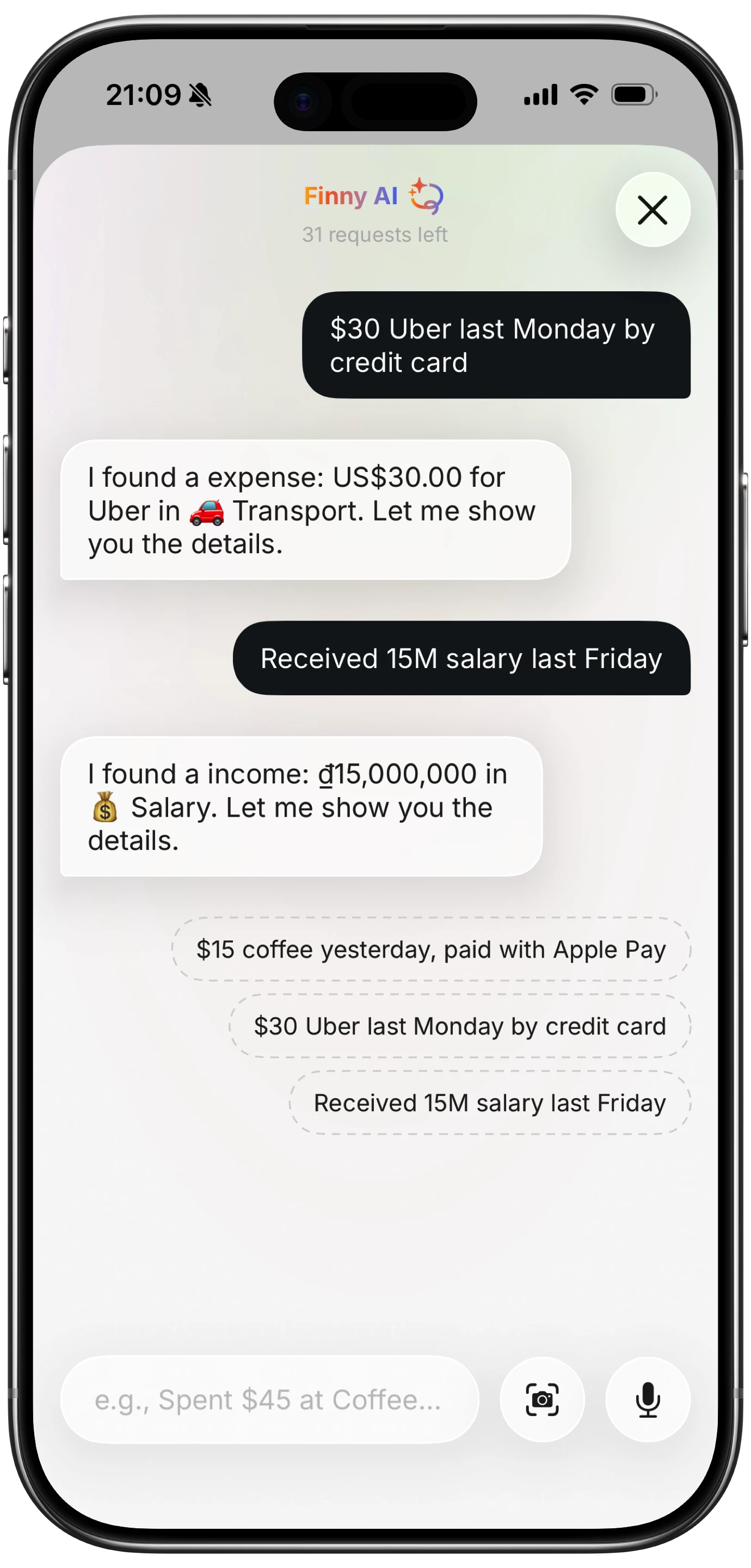
Finny app's AI chat feature
Finny does not require bank connections and works fully offline. This is useful for couples who want to track spending together without sharing financial credentials with any third party. Each partner runs their own instance, maintaining full privacy while still tracking household expenses.
At a low monthly or yearly price for Pro, Finny costs a fraction of what Monarch, YNAB, or Copilot charge. The free tier includes unlimited manual tracking, custom categories, multi-currency support, and full dashboard features.
The limitation is clear: Finny is not a shared household dashboard. Both partners track independently. There is no real-time shared view of combined spending. For couples who need separate-but-coordinated tracking rather than a merged financial picture, that independence is the feature.
Pricing: Free (limited AI) or a low monthly or yearly price
Best for: Couples who want fast, private, manual tracking without bank connections or high costs.
How to Choose the Right App for Your Relationship
The best app depends on your couple budgeting style.
If you want full financial merger: YNAB or Monarch Money. Both provide shared dashboards where both partners see everything. YNAB is better for structured, zero-based budgeting. Monarch is better for a flexible financial overview that includes investments and net worth.
If you want shared visibility with privacy: Honeydue. It is the only free option built specifically for couples, and its granular privacy controls let each partner choose what to share. For a broader look at no-cost options, see our roundup of the best free budgeting apps for couples.
If you want structured budgets without bank linking: Goodbudget. The envelope method works well for couples who agree on spending categories and are willing to enter expenses manually.
If you want fast, independent tracking: Finny. Both partners log expenses on their own devices with AI input, then compare notes during regular money conversations. No bank credentials shared, no subscription over $2/month.
If one partner manages everything solo: Copilot. Beautiful and capable, but designed for one person.
What About Splitwise and Venmo?
Splitwise and Venmo are popular for splitting bills, but they are not budgeting apps. Splitwise tracks who owes whom across shared expenses. Venmo handles payments. Neither provides budgets, spending categories, financial goals, or household-level financial visibility.
If your only need is splitting restaurant checks or tracking shared rent payments, these tools work fine. If you want to manage your combined finances, save toward goals, or understand where your household money goes each month, you need one of the apps listed above.
Frequently Asked Questions
What is the best free budgeting app for couples?
Honeydue is the best free option built specifically for couples. Both partners get full access to shared dashboards, bill tracking, and privacy controls without paying anything. Goodbudget also has a free tier, but it limits you to 10 envelopes and two devices. For individual tracking that both partners can use independently, Finny's free tier includes unlimited manual logging, custom categories, and multi-currency support.
Do both partners need separate subscriptions?
It depends on the app. YNAB, Monarch Money, Honeydue, and Goodbudget all include partner access within a single subscription or free account. Copilot and Finny are individual apps, meaning each partner would need their own subscription if both want Pro features. The cost difference matters: two Finny Pro subscriptions total $3.98/month, which is still cheaper than one YNAB subscription at $14.99/month.
Can couples budget together without linking bank accounts?
Yes. Goodbudget and Finny both work without bank connections. Goodbudget uses manual envelope budgeting with shared access on two devices. Finny uses AI-powered manual input that makes logging expenses fast enough to sustain as a daily habit. Honeydue also works without bank linking, though it is designed to work best with connected accounts. For a full guide on bank-free approaches, see how to track spending as a couple.
Is it safe to link bank accounts to budgeting apps?
Most major budgeting apps use services like Plaid or MX to connect to banks through read-only access, meaning the app can view transactions but cannot move money. That said, any third-party connection introduces some risk. If privacy is a priority, apps like Finny and Goodbudget let you track spending manually without sharing any banking credentials. The trade-off is that manual tracking requires both partners to actively log expenses.
How often should couples review their budget together?
A weekly 15-minute check-in works for most couples. Review the past week's spending, flag anything unexpected, and confirm you are on track for monthly goals. Some couples prefer a more detailed monthly review where they evaluate category spending, adjust budgets for the next month, and discuss larger financial decisions. The frequency matters less than the consistency. Pick a schedule that works for both partners and protect that time.
Download Finny to log expenses using AI, receipts, or text. No bank connections, offline support, and full control over your financial data.