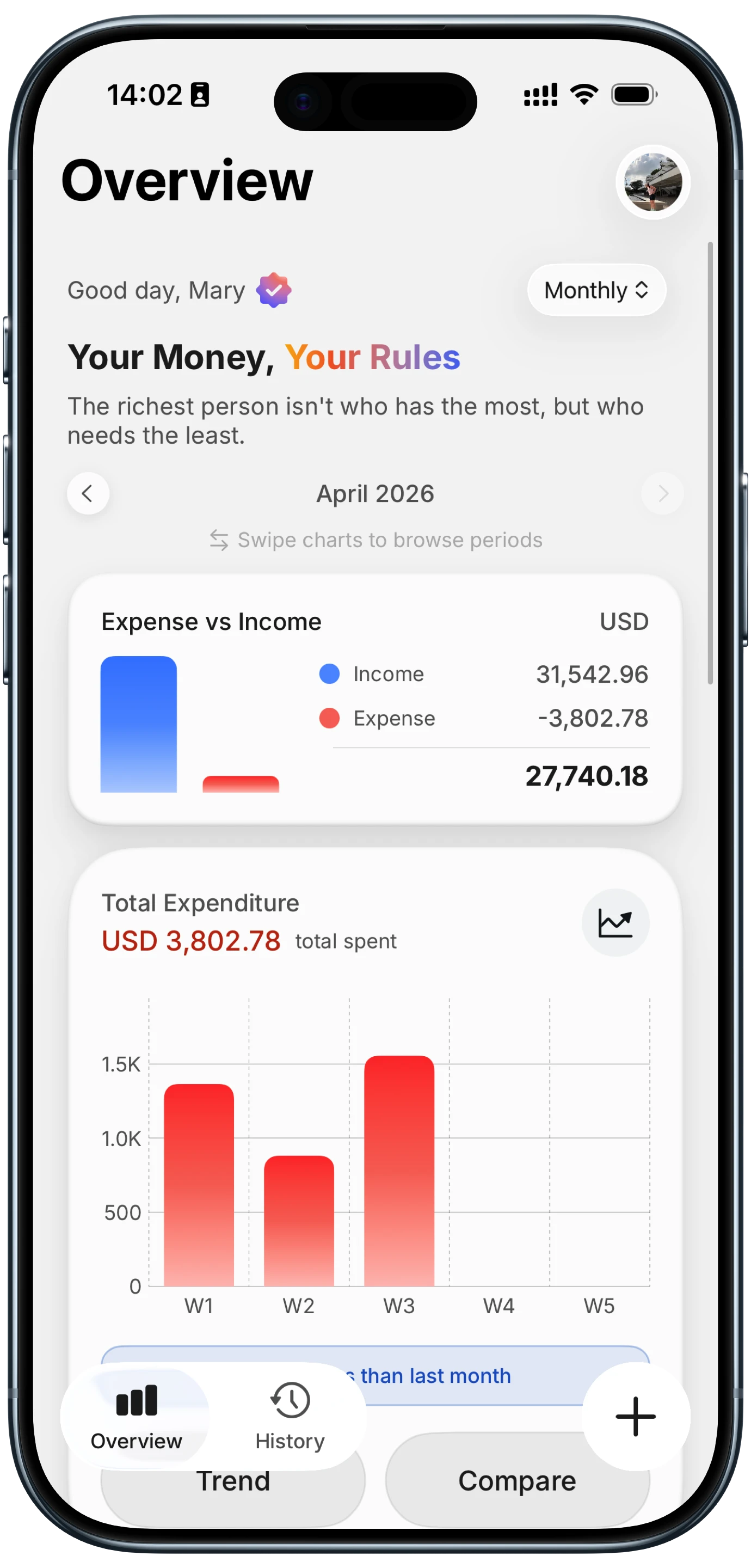
A money management app helps you stay on top of your finances without spreadsheets, paper budgets, or guesswork. But the category is broad. Some apps focus purely on expense tracking. Others handle budgeting, bill reminders, investments, and net worth calculations. Picking the right one depends on which part of money management matters most to you.
This guide covers the best options in 2026 across three categories: expense tracking, budgeting, and all-in-one financial management. We tested each app on real accounts and daily use to evaluate how well they deliver on their promises.
If you are specifically looking for expense trackers, our best expense tracker apps in 2026 guide goes deeper on that category. For long-term habits that make any app more effective, see our guide on building money habits.
Three Types of Money Management Apps
Not every finance app does the same thing. Understanding the differences helps you avoid paying for features you will never use.
Expense trackers focus on recording what you spend. They are built for speed and simplicity. You log purchases manually or through bank sync, and the app shows you totals, trends, and category breakdowns. These work best for people who want awareness of their spending patterns.
Budgeting apps add a planning layer. They let you set spending limits by category, track progress against those limits, and alert you when you are overspending. Some use specific methodologies like zero-based budgeting or the envelope system.
All-in-one platforms combine expense tracking, budgeting, bill management, investment monitoring, and net worth tracking. They aim to be your single financial dashboard. The tradeoff is usually complexity and higher cost.
Most people only need one or two of these functions. Paying $14 per month for an all-in-one platform when you just want to track daily spending is not a good use of money.
Quick Comparison Table
| App | Type | Price | Bank Sync | AI Features | Offline | Multi-Currency | Best For |
|---|---|---|---|---|---|---|---|
| Finny | Expense Tracker | a low monthly price | No | Text, voice, receipt, chat | Yes | 150+ currencies | Fast AI-powered tracking |
| YNAB | Budgeting | $14.99/mo | Yes | No | No | Limited | Zero-based budgeting |
| Monarch Money | All-in-One | $14.99/mo | Yes | AI assistant | No | Limited | Complete financial dashboard |
| Copilot | All-in-One | $13/mo | Yes | Limited | No | Yes | Apple ecosystem users |
| PocketGuard | Budgeting | $12.99/mo | Yes | No | No | No | "How much can I spend" answers |
| Goodbudget | Budgeting | Free/$10/mo | No | No | Partial | No | Envelope budgeting |
| Spendee | Expense Tracker | Free/$1.25/mo | Optional | No | Partial | Yes | Visual spending analysis |
| Wallet by BudgetBakers | All-in-One | Free/$4.49/mo | Optional | No | Yes | Yes | Multi-account management |
| Empower | Investment Tracking | Free | Yes | No | No | No | Net worth and retirement |
Best Money Management Apps in 2026
Finny: Best for Effortless Expense Tracking
Finny is purpose-built for one thing: making expense tracking as fast and frictionless as possible. It does not try to be an all-in-one platform. Instead, it focuses on the part of money management most people struggle with: actually recording what they spend.
The standout feature is Tap to Track. When you pay with Apple Pay, the transaction is logged in Finny instantly. No opening the app, no typing, no categorizing. The expense is recorded before you put your phone away.
Beyond that, Finny offers multiple AI input methods. Type a natural sentence like "groceries 62 dollars at Trader Joe's," speak it by voice, scan receipts (up to five at once with Batch Snap and Log), or chat with the AI to log transactions. The app handles 50 AI requests per day on the Pro tier.
For people who manage money across borders, Finny's Unified Currency View preserves each transaction in its original currency while converting totals to your default. This means you can spend in euros, yen, and dollars without losing track of what you actually paid in each currency.
The app works fully offline, does not require bank connections, and costs a low monthly price. The free tier includes unlimited manual tracking, custom categories, charts, and support for over 150 currencies. For a deeper look at how to manage finances without bank linking, read our guide on how to manage personal finances.
Pricing: Free tier available. Pro at a low monthly or yearly price.
Best for: Anyone who wants fast, private expense tracking with AI input at a fraction of the cost of competitors.
YNAB: Best for Zero-Based Budgeting
YNAB (You Need a Budget) teaches a specific budgeting philosophy: give every dollar a job. You assign your available money to categories before you spend it, then track actual spending against those assignments. When you overspend in one category, you pull money from another.
This proactive approach works well for people who want strict control over their finances. YNAB's educational resources, live workshops, and community forums make it more than just software. It is a system for changing how you think about money.
Bank syncing imports transactions automatically, though you still need to review and approve each one. The app supports goal tracking, debt payoff planning, and multi-device sync. Age of Money, a metric that shows how long your dollars sit before being spent, helps measure financial stability over time.
The price is the biggest barrier. At $14.99 per month or $109 per year, YNAB is one of the most expensive personal finance apps. There is no free tier after the 34-day trial. It also lacks AI features, does not work offline, and its multi-currency support requires manual rate adjustments.
Pricing: $14.99/month or $109/year. 34-day free trial.
Best for: People committed to zero-based budgeting who want a proven system with strong educational support.
Monarch Money: Best All-in-One Financial Dashboard
Monarch Money aims to be the single app for your entire financial life. It combines budgeting, expense tracking, investment monitoring, net worth tracking, bill reminders, and collaborative features for couples. Recent updates added an AI assistant, weekly spending recaps, and improved goal-setting tools.
The dashboard pulls in data from linked bank accounts, credit cards, loans, and investment accounts. Visualizations are clean and customizable. Category management is flexible, and the collaborative tools let partners tag expenses and set shared goals.
Monarch costs $14.99 per month or $99.99 per year. It does not work offline, and multi-currency support is limited compared to dedicated international trackers. The free trial is only seven days, which is not much time to evaluate a complex financial platform.
Pricing: $14.99/month or $99.99/year. 7-day free trial.
Best for: Couples or individuals who want a single platform for budgeting, tracking, investments, and net worth.
Copilot: Best for Apple Users Who Want a Premium Experience
Copilot is exclusive to Apple devices (iPhone, iPad, Mac) and delivers a polished financial management experience. It syncs with bank accounts and credit cards, categorizes transactions, detects subscriptions, and provides spending insights with well-designed charts.
The investment tracking feature shows portfolio performance alongside your spending data, giving a more complete picture of your financial health. Subscription detection is particularly useful. Copilot identifies recurring charges and helps you spot services you may have forgotten about.
At $13 per month or $95 per year, Copilot is expensive, though slightly cheaper than YNAB and Monarch. The lack of Android support, web access, and offline mode limits its audience. Bank syncing is required for core functionality.
Pricing: $13/month or $95/year.
Best for: Apple ecosystem users who value design and want automated financial tracking with investment insights.
PocketGuard: Best for Quick Spending Answers
PocketGuard solves a specific problem: how much money can I safely spend right now? Its "In My Pocket" feature calculates your available spending money by subtracting bills, savings goals, and necessities from your income. The answer updates in real time as transactions sync from your bank.
This simplicity is PocketGuard's strength. You do not need to set up elaborate budgets or categorize every transaction. The app does the math and gives you a number. For people who find budgeting overwhelming, this approach removes the complexity.
The free version limits you to one linked bank account. Premium ($12.99/month or $74.99/year) unlocks multiple accounts, custom categories, and cash flow planning. PocketGuard does not work offline and does not support multiple currencies.
Pricing: Free (1 account) or $12.99/month ($74.99/year).
Best for: People who want a simple answer to "how much can I spend" without detailed budgeting.
Goodbudget: Best for Envelope Budgeting Without Bank Sync
Goodbudget digitizes the classic envelope budgeting method. You create virtual envelopes for spending categories, fill them with your income at the start of each month, and subtract as you spend. When an envelope is empty, you stop spending in that category or move money from another.
All entries are manual, which Goodbudget considers a feature rather than a limitation. Typing in each purchase forces you to be intentional about spending. The app syncs across devices so couples or families can share the same set of envelopes.
The free tier gives you 10 envelopes and one year of transaction history. Premium ($10/month or $80/year) adds unlimited envelopes, five years of history, and debt tracking. The lack of bank integration and AI features means more manual effort, but that is the point of the envelope method.
Pricing: Free (10 envelopes) or $10/month ($80/year).
Best for: Fans of envelope budgeting who want a manual, mindful approach to money management.
Spendee: Best for Visual Spending Analysis
Spendee turns your spending data into clear, colorful visualizations. Category breakdowns, spending trends, and income-vs-expense charts are the centerpiece of the app. It supports both manual entry and optional bank sync.
Shared wallets make Spendee useful for couples, roommates, or families tracking expenses together. The free tier covers basic tracking, and premium starts at just $1.25 per month, making it one of the most affordable options with bank sync.
Multi-currency support is available, though it is not as comprehensive as Finny's approach to preserving original transaction currencies. Offline reliability has been an issue in past versions, with syncing sometimes causing duplicate entries.
Pricing: Free or from $1.25/month.
Best for: Users who value attractive data visualization and want affordable tracking with optional bank sync.
Wallet by BudgetBakers: Best for Multi-Account Management
Wallet by BudgetBakers handles the complexity of tracking finances across multiple accounts, cards, and cash. You can create separate wallets for each payment method and see consolidated reports across all of them.
The app offers manual entry, bank sync, and import from CSV files. Budgeting features include spending limits by category and forecasting based on past patterns. It works on both iOS and Android with cross-device sync.
The interface can feel cluttered, especially for new users. There are many settings and options to configure before the app works the way you want. But for people who actively manage several accounts, the flexibility is worth the setup time.
Pricing: Free tier or $4.49/month.
Best for: People who juggle multiple bank accounts, credit cards, and cash and want everything in one place.
Empower (formerly Personal Capital): Best for Investment and Retirement Tracking
Empower is free and focused on the wealth-building side of money management. It aggregates your investment accounts, tracks net worth, analyzes portfolio allocation, and provides retirement planning tools. The Investment Checkup feature compares your portfolio to recommended allocations.
Expense tracking is available but basic. Empower's budgeting features are secondary to its investment tools. The app makes money by offering advisory services to users with significant assets, which is why the tracking tools remain free.
If your primary concern is spending and budgeting, Empower is not the right choice. But as a complement to a dedicated expense tracker, it fills the investment monitoring gap well.
Pricing: Free.
Best for: Investors who want portfolio tracking, net worth monitoring, and retirement planning in one dashboard.
How to Choose the Right Money Management App
Start by identifying your primary need. Here is a simple framework:
If you mainly want to track daily spending: Choose Finny for AI-powered speed, Spendee for visual clarity, or Spending Tracker for simplicity. You do not need a $14/month budgeting platform.
If you want structured budgeting: YNAB is the strongest zero-based system. Goodbudget works well for envelope budgeting. PocketGuard is the simplest if you just want to know how much you can spend.
If you want everything in one place: Monarch Money offers the most complete dashboard. Copilot is the premium Apple-only option. Wallet by BudgetBakers offers a more affordable multi-account solution.
If you want investment tracking: Empower is free and purpose-built for it. Monarch and Copilot include investment features as part of their paid platforms.
The most important factor is whether you will actually use the app. A free tracker you open daily beats a $14/month platform you abandon after two weeks. Start simple, and add complexity only when you need it. For more on developing sustainable money habits, see our guide to building money habits.
Frequently Asked Questions
What is the best free money management app?
Empower is the best free option for investment and net worth tracking. For expense tracking, Finny's free tier offers unlimited manual logging, custom categories, charts, and support for over 150 currencies. Goodbudget's free tier handles basic envelope budgeting. Each excels at a different part of money management.
Do money management apps require bank connections?
Not all of them. Finny, Goodbudget, and DailyBean work entirely without bank connections. Others like Spendee and Wallet by BudgetBakers offer bank sync as optional. Apps like Monarch, Copilot, and PocketGuard are designed around bank sync and work best with it enabled. If you would rather get budgeting features from your bank itself, see our look at banks with the best money management tools.
Are money management apps safe to use?
Reputable apps use bank-level encryption and read-only access to your accounts (they cannot move money). However, if sharing bank credentials concerns you, apps like Finny offer a privacy-first approach with no bank connections required. You get full tracking capabilities through manual entry, AI input, and Tap to Track for Apple Pay, without ever sharing login details. For a deeper look at this topic, see our guide on how to track expenses.
How much should I pay for a money management app?
That depends on what you need. Full-featured budgeting platforms like YNAB ($14.99/month), Monarch ($14.99/month), and Copilot ($13/month) charge premium prices. If expense tracking is your primary goal, Finny delivers AI-powered features at a low monthly price. Free options like Empower and Goodbudget cover specific needs well. Avoid paying for features you will not use.
What is the difference between a budgeting app and an expense tracker?
An expense tracker records and categorizes your spending so you can see where money goes. A budgeting app adds forward-looking planning: you set spending limits, allocate income to categories, and track progress against those targets. Some apps do both, but dedicated tools tend to do each job better. If you are just starting out, an expense tracker is the simpler entry point. For a complete overview of personal finance strategies, check out our best expense tracker apps guide.