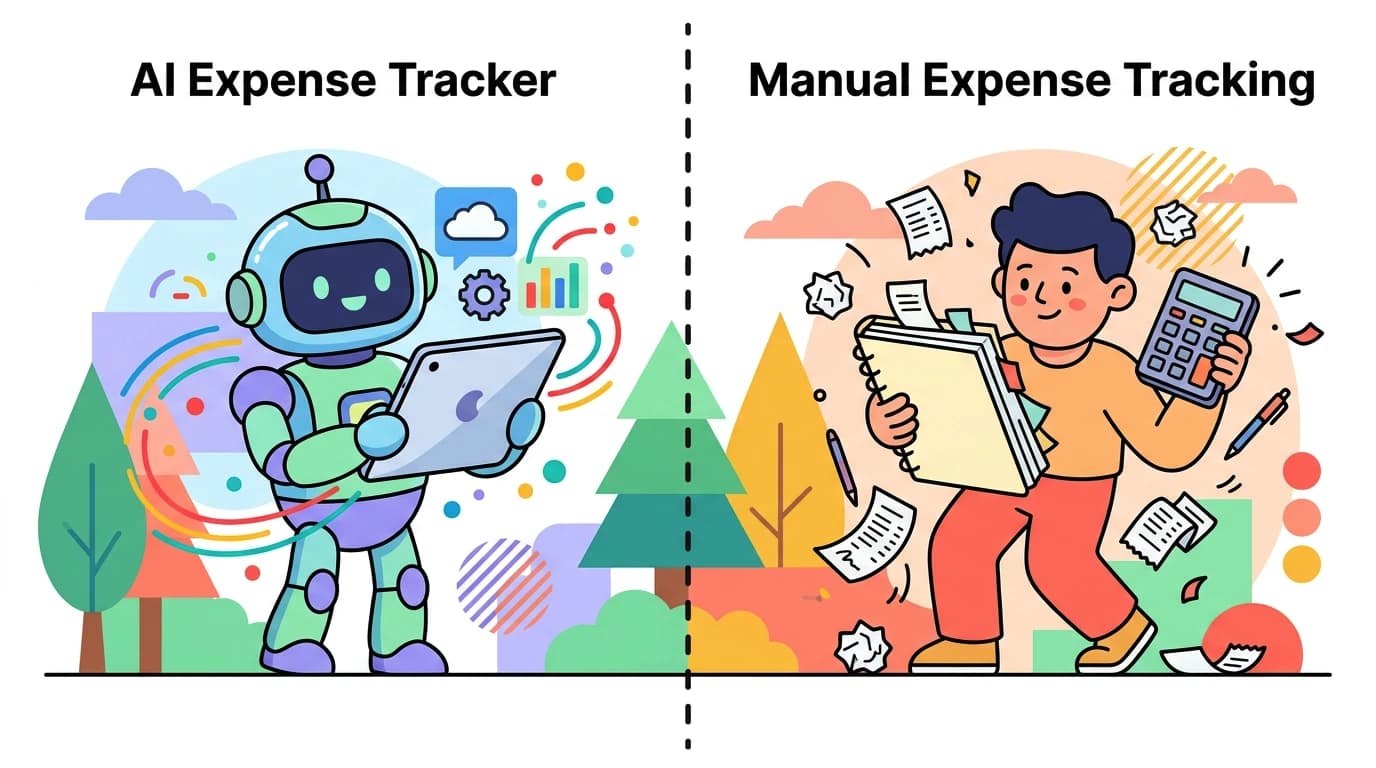
Money is the leading cause of stress in relationships. Not because couples disagree about how much to spend, but because they lack visibility into what is actually being spent. When neither partner has a clear picture of household finances, assumptions fill the gaps, and assumptions lead to arguments.
Tracking spending as a couple does not require merging your entire financial life. It does not require handing over your bank login credentials to a third-party app. And it does not require one partner to become the household accountant while the other checks out.
What it requires is a shared system that both partners will actually use. This guide covers the approaches that work, the apps that support them, and a practical setup that respects both transparency and privacy. For general expense tracking methods, see our guide on how to track expenses. You can also explore our comparison of the best budgeting apps for couples in 2026 for app-specific recommendations.
Why Most Couples Fail at Expense Tracking
The typical failure pattern looks like this: one partner signs up for a budgeting app, links their bank accounts, sets up categories, and starts tracking. The other partner is supposed to do the same. They download the app but never finish setup. Or they link their accounts but stop checking the app after two weeks.
The problem is not motivation. It is friction.
Apps that require bank linking create immediate barriers. One partner may be uncomfortable sharing their login credentials with a third-party service. Different banks have different linking processes, and some fail repeatedly. Joint accounts might link easily, but individual accounts add complexity about what should be visible to whom.
Then there is the maintenance burden. Categories need adjusting, uncategorized transactions pile up, and someone has to reconcile everything. When that responsibility falls on one person, resentment builds.
The solution is not a more powerful app. It is a simpler system.
Three Approaches to Couple Spending Tracking
Approach 1: Fully Linked Accounts
Both partners link all bank accounts, credit cards, and investment accounts to a single app. Everything is visible to both people. The app automatically imports and categorizes transactions.
Pros: Complete visibility, automatic imports, minimal manual work.
Cons: Requires sharing bank credentials with a third party, privacy concerns for individual spending, complex setup with multiple accounts, ongoing maintenance when bank connections break.
Best for: Couples with fully merged finances who are comfortable with third-party bank access.
Approach 2: Manual Tracking With Shared Access
Both partners log expenses manually into a shared system. No bank linking required. Each person records their own purchases, and both can view the combined picture.
Pros: No bank credentials shared, complete control over what is tracked, works with any bank or payment method, faster setup.
Cons: Requires discipline to log consistently, risk of forgotten transactions.
Best for: Couples who value privacy, use multiple payment methods (cash, e-wallets, international accounts), or are uncomfortable with bank linking.
Approach 3: Hybrid
Shared expenses are tracked manually in a shared app. Individual spending is tracked separately (or not at all). Partners share relevant data through exports or synced categories.
Pros: Balances transparency with privacy, lower tracking burden (only shared expenses), flexible.
Cons: Incomplete household picture, requires agreement on what counts as "shared."
Best for: Couples maintaining some financial independence while tracking household spending.
Comparing Apps for Couple Spending
Honeydue
Honeydue is built specifically for couples. It is free to use (with optional tips from $1 to $10/month), and it lets two partners connect accounts, set budgets, and chat about transactions directly in the app.
The standout feature is privacy controls. For each linked account, you choose what your partner can see: full transactions, balances only, or nothing. The built-in chat lets you comment on individual transactions, which reduces the "what was this charge?" text messages.
The downside is that Honeydue relies heavily on bank linking. If you prefer not to connect your accounts, its usefulness drops significantly. It also lacks AI-powered input methods, so every manual entry requires typing.
YNAB
YNAB's zero-based budgeting system works well for couples who want to allocate every dollar together. At $14.99/month or $109/year, it is one of the more expensive options. Both partners can access the same budget, and YNAB's methodology encourages regular "budget meetings" where you assign dollars to categories together.
The strength is its budgeting philosophy. The weakness for couples is that YNAB works best when both partners are fully committed to the zero-based approach. If one partner finds it tedious or overly restrictive, adoption fails.
YNAB supports bank linking but also works with manual entry. It does not have AI input, voice logging, or receipt scanning.
Goodbudget
Goodbudget uses the envelope budgeting method with a shared household feature. The free plan supports 10 envelopes and 1 account. The Plus plan at $10/month or $80/year unlocks unlimited envelopes, 5 accounts, and device sharing for up to 5 devices.
Sharing across devices makes it practical for couples: both partners install the app, log into the same household, and see the same envelopes and balances. Transactions sync between devices automatically.
The limitation is input speed. Goodbudget is purely manual entry with no AI assistance. Every transaction requires tapping through fields, which adds friction that reduces long-term consistency.
Monarch Money
Monarch positions itself as the premium household finance tool. At $99.99/year (about $8.33/month), it offers shared budgets, account linking, and a polished interface. Both partners can access the same household and see all linked accounts.
Monarch's strength is its comprehensive dashboard that shows net worth, spending trends, and investment performance alongside daily expenses. For couples who want a complete financial picture, it delivers.
The downside: Monarch requires bank linking for its core functionality. Without linked accounts, it loses most of its value. It also requires an internet connection, so offline logging is not available.
How Finny Fits for Couples
Finny is not a dedicated "couples app" with built-in partner invitations. But it offers something the others do not: a privacy-first approach that works just as well for shared tracking without requiring either partner to hand over bank credentials.
Here is how couples use Finny together:
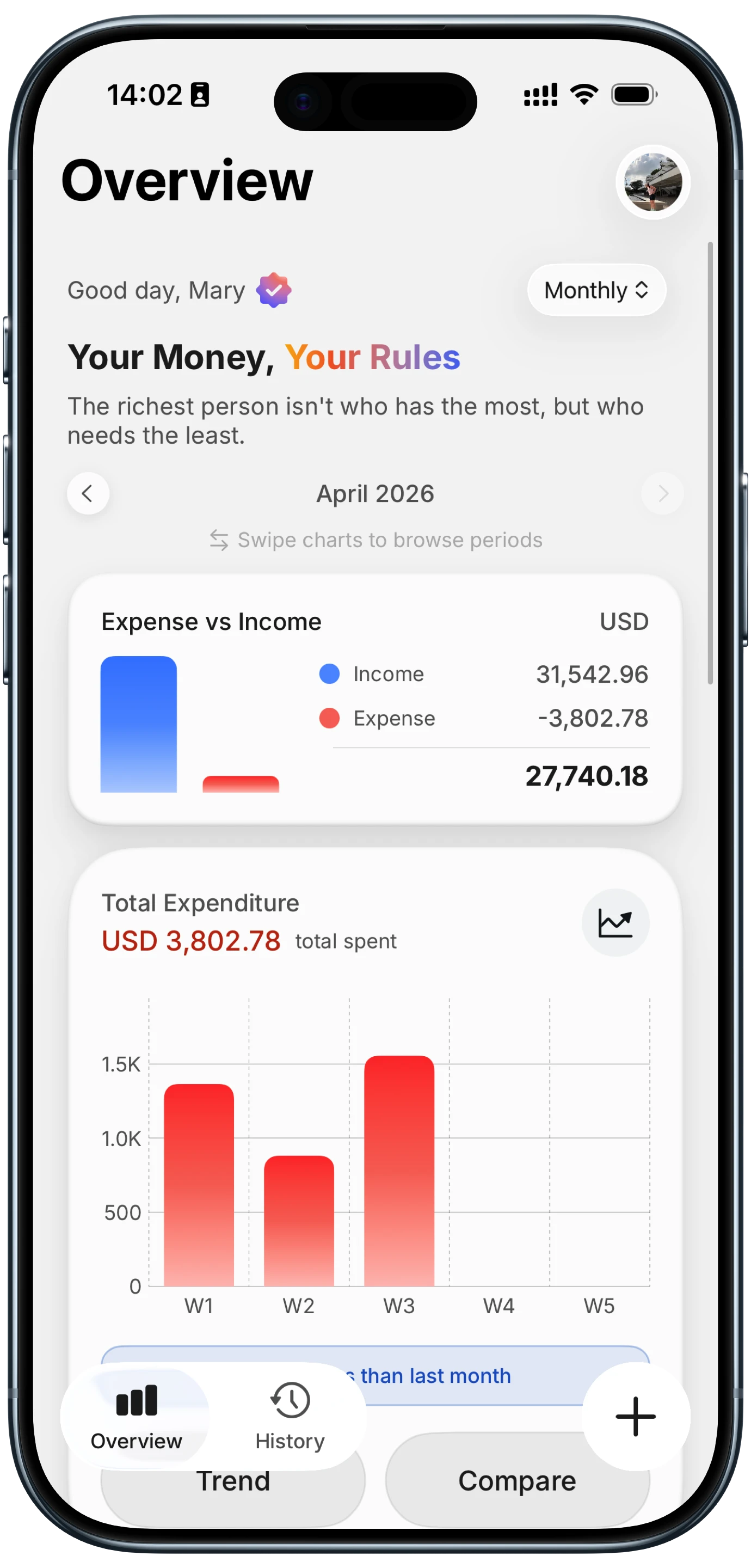
Cloud sync across devices. Both partners sign in with Apple Sign-In. Transactions sync across iPhones and iPads automatically. Both people see the same data in real time.
No bank connection needed. Neither partner shares login credentials with any third party. Expenses are logged manually, using whichever input method is fastest: Tap to Track for Apple Pay, voice input, receipt scanning, statement screenshots, or the Share Extension.
CSV export for sharing. If partners prefer separate Finny accounts, they can export their data as CSV files and combine them in a spreadsheet for household analysis. This is useful for the hybrid approach where some spending is tracked individually.
Same categories for consistent tracking. When both partners use the same category structure, their combined data tells a coherent story. Monthly reviews become a conversation about patterns, not a data reconciliation exercise.
| Feature | Honeydue | YNAB | Goodbudget | Monarch | Finny |
|---|---|---|---|---|---|
| Price | Free | $14.99/mo | Free / $10/mo | $8.33/mo | a low monthly price |
| Built-in couple features | Yes | Shared budget | Shared envelopes | Shared household | Cloud sync |
| Bank linking required | Yes | Optional | No | Yes | No |
| AI input (voice, receipt, text) | No | No | No | No | Yes |
| Offline tracking | No | Limited | Yes | No | Yes |
| Privacy controls | Yes | No | No | No | N/A (no bank link) |
For a broader comparison of tracking apps, see our guide on the best money tracker app in 2026.
Setting Up a Couple Tracking System That Lasts
The best system is the one both partners will use for more than two weeks. Here is a practical setup that minimizes friction.
Step 1: Agree on What to Track
Not every purchase needs to be in the shared system. Start with the categories that matter most:
- Rent or mortgage
- Groceries and household supplies
- Dining out
- Utilities and subscriptions
- Transportation
- Childcare or pet care
Individual purchases like personal clothing, hobbies, or gifts for each other can stay private. This reduces the tracking burden and avoids the "why did you spend $40 at the bookstore?" conversations.
Step 2: Choose One Input Method Each
The fastest path to consistency is matching the input method to each partner's habits. Maybe one partner loves voice input and logs expenses while walking the dog. The other prefers scanning receipts at the end of the day.
Finny's five input methods (Tap to Track, voice, receipt scanning, statement import, and Share Extension) mean each partner can track in the way that feels least like work. For a detailed breakdown of each method, see our guide on logging expenses without typing.
Step 3: Set a Weekly Review
Pick a time each week, 15 minutes on Sunday evening works for most couples, to review the shared expenses together. Look for:
- Categories that are over or under budget
- Transactions that need recategorization
- Upcoming large expenses to plan for
- Patterns worth discussing (eating out frequency, subscription creep)
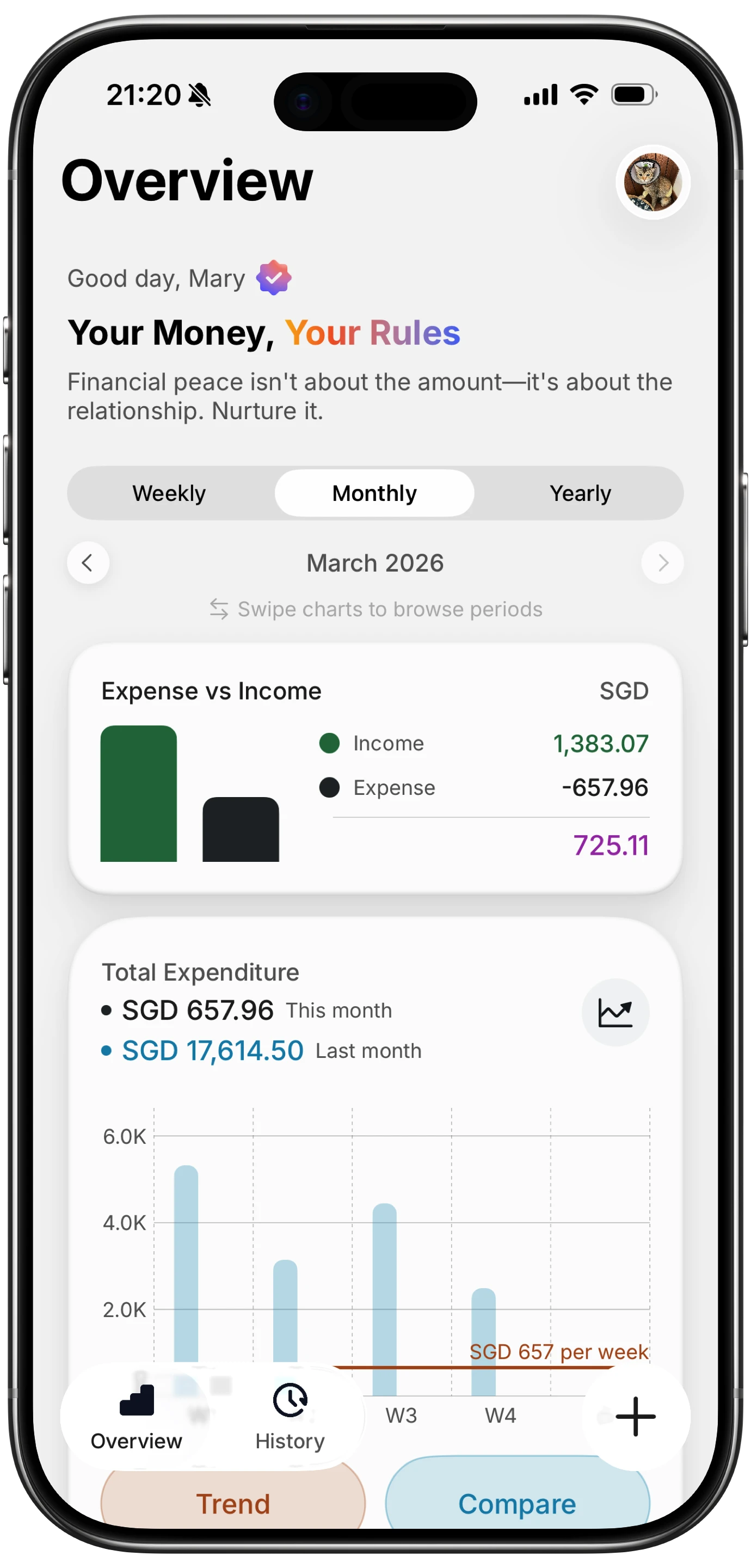
This weekly review replaces the need for constant monitoring. Neither partner needs to check the app daily, as long as both log their expenses consistently and review together weekly.
Step 4: Automate What You Can
The fewer manual steps, the higher the compliance rate. Use Tap to Track for all contactless payments. Set up the Share Extension so receipt photos can be sent to Finny in two taps. These small automations remove the moments where one partner thinks "I will log it later" and then forgets.
Handling Common Couple Tracking Challenges
"My partner will not use the app."
This is the most common failure point. The solution is to reduce their burden to near zero. If one partner handles weekly review and categorization, the other only needs to log transactions, which takes seconds with voice input or Tap to Track. Make the ask as small as possible.
"We argue about spending categories."
Agree on broad categories rather than granular ones. "Food" is better than "Groceries / Restaurants / Coffee / Snacks" when you are starting out. You can add specificity later once the habit is established.
"We have different financial goals."
Tracking is not the same as budgeting. Start with visibility. Once both partners can see where money goes, goal-setting conversations become grounded in data rather than feelings. The numbers provide a neutral reference point.
"One of us earns significantly more."
Tracking does not need to address income disparity. Focus on shared expenses and let each partner manage their personal spending independently. The AI expense tracking approach reduces the burden equally regardless of who earns what.
Frequently Asked Questions
Do both partners need their own Finny account?
You can share one account via Apple Sign-In, with transactions syncing across both devices. Alternatively, each partner can have their own account and share data via CSV export. The shared account approach is simpler for most couples.
Can we track expenses in different currencies as a couple?
Yes. Finny supports over 150 currencies with Unified Currency View. If one partner travels for work or you live in different countries temporarily, each person can log in their local currency while totals convert to your shared default currency. See our guide on offline expense tracking for more on tracking away from home.
Is our financial data private if we do not link bank accounts?
Yes. Without bank linking, no third party has access to your financial accounts. Finny stores transaction data that you manually input, synced via Apple Sign-In. Your bank credentials never leave your bank's app.
How is Finny different from Honeydue for couples?
Honeydue is purpose-built for couples with features like partner invitations and transaction chat. Finny offers faster input methods (AI voice, receipt scanning, Tap to Track), lower cost (a low monthly price vs. optional tips), offline tracking, and no requirement to link bank accounts. The trade-off is that Finny does not have built-in couple chat or partner-specific privacy toggles.
Start Tracking Together
Financial visibility is the foundation of money conversations that strengthen a relationship instead of straining it. You do not need a complex app or linked bank accounts. You need a shared habit, supported by a tool that makes logging fast enough that both partners will actually do it.
Download Finny and set up shared expense tracking in under five minutes, no bank connections required.