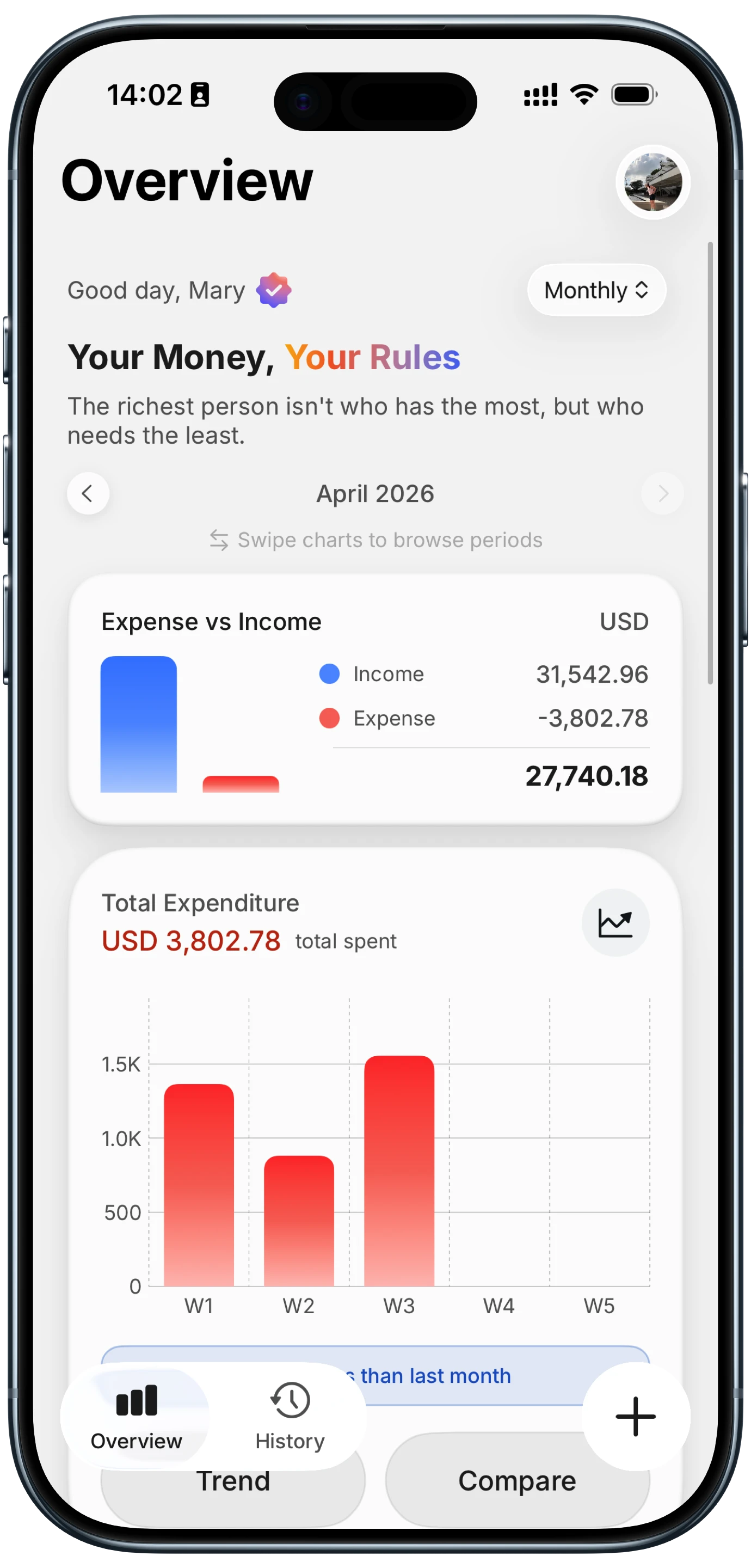
Best Way to Track Expenses in 2026: Apps, Spreadsheets, or Pen and Paper?
Everyone who tries to manage their money eventually faces the same question: what is the best way to track expenses? The answer depends on more than just features. It depends on your daily routine, privacy preferences, how many transactions you make, and how much time you are willing to spend on data entry.
In 2026, the options range from a notebook and pen to AI-powered apps that parse your voice and scan your receipts. Each method has real strengths and real limitations. This guide compares them side by side so you can choose the approach that fits your life, not just the one with the best marketing. For a broader overview of tracking tools, see our best money tracker apps in 2026 guide.
The Four Main Expense Tracking Methods
Before comparing, it helps to define what each method actually involves day to day.
Pen and paper: Write each purchase in a notebook with the date, description, and amount. Tally totals by category at the end of the week or month.
Spreadsheets: Enter expenses into Excel, Google Sheets, or a similar tool. Use columns for date, amount, category, and notes. Build formulas for totals and charts for analysis.
Bank-linked apps: Connect your bank accounts, credit cards, and payment apps. Transactions import automatically. The app categorizes them, and you review.
AI-assisted manual apps: Log expenses by typing natural language, speaking aloud, or scanning receipts. AI parses the details, suggests categories, and you confirm.
Each method sits on a spectrum between effort and automation, and between privacy and convenience.
Side-by-Side Comparison
| Feature | Pen & Paper | Spreadsheet | Bank-Linked App | AI Manual App |
|---|---|---|---|---|
| Time per entry | 15-20 sec | 20-30 sec | 0 sec (auto) | 3-5 sec |
| Setup time | None | 30-60 min | 10-15 min | 2-5 min |
| Cost | $0 | $0 | $0-15/mo | $0-2/mo |
| Catches cash purchases | Yes | Yes | No | Yes |
| Automatic categorization | No | No | Yes (often wrong) | Yes (you confirm) |
| Offline support | Yes | Partial | No | Varies |
| Privacy | Full | Full | Low (bank access) | High (no bank link) |
| Analytics and charts | Manual | DIY formulas | Built-in | Built-in |
| Multi-currency | Manual math | Formula-based | Limited | Varies |
| Risk of quitting | High | High | Low | Low |
The table highlights a key trade-off. Pen and paper and spreadsheets give you full control and privacy but demand more effort per entry. Bank-linked apps minimize effort but sacrifice privacy and miss cash. AI-assisted apps try to split the difference: low effort, no bank access required, and you stay in control of every entry.
Pen and Paper: The Analog Approach
Writing down expenses by hand is the oldest tracking method, and it still works for people who prefer physical tools.
What it looks like in practice: You carry a small pocket notebook. After each purchase, you write the date, a short description, and the amount. At the end of each week, you add up spending by category. Some people use a simple ledger format with columns ruled by hand.
Strengths: Zero cost, no technology required, full privacy, and the physical act of writing reinforces awareness. There is something about handwriting a number that makes it feel more real than tapping a screen.
Limitations: No automatic totals. No charts or trend analysis. Easy to lose. Difficult to search for past entries. Category totals require manual addition, which is tedious and error-prone with dozens of transactions. Travel and multi-currency tracking require manual conversion math.
Best for: People who make fewer than five purchases per day, prefer analog tools, and do not need long-term trend analysis. Also a good starting point for anyone who has never tracked expenses before and wants to try it with zero commitment.
Spreadsheets: The DIY Digital Method
Spreadsheets offer more power than pen and paper while remaining fully under your control.
What it looks like in practice: You create a workbook with columns for date, merchant, amount, category, and notes. You enter each expense manually, either in real time on your phone or in a batch at the end of the day. Formulas handle category totals, and pivot tables or charts show spending trends.
Strengths: Completely customizable. You can build any analysis you want: monthly comparisons, category breakdowns, rolling averages, budget variance reports. Free with Google Sheets. Full data ownership and portability.
Limitations: Mobile data entry is slow and frustrating. Small screens and tiny cells make spreadsheets impractical for real-time logging. The setup requires spreadsheet knowledge, and maintaining formulas adds friction. No receipt scanning, no voice input, no AI assistance. The drop-off rate is high because the process feels like work.
Best for: People comfortable with formulas and data analysis, those who track on a laptop rather than a phone, and anyone who wants complete control over their data structure. If you enjoy building systems, spreadsheets are satisfying. If you do not, they become a chore within two weeks.
Bank-Linked Apps: Automatic but Not Private
Bank-linked apps represent the lowest-effort approach. You connect your accounts once, and transactions flow in automatically.
Monarch Money
Monarch connects to thousands of banks and financial institutions. Transactions import automatically and are categorized using AI. You review, correct miscategorizations, and analyze spending through built-in reports.
Strengths: Near-zero daily effort. Good for households with shared budgets. Clean interface with strong reporting. Investment and net worth tracking alongside expenses.
Limitations: Costs $14.99 per month or $99.99 per year. Requires bank credentials. Cash and peer-to-peer payments are missed. Categorization accuracy varies, and corrections still require manual review. Transaction import can lag 1 to 3 days behind actual spending.
Copilot Money
Copilot is an iOS-focused finance tracker with automatic bank syncing, clean design, and AI-powered categorization.
Strengths: Beautiful interface. Strong automatic categorization that learns your patterns. Subscription tracking and spending trend analysis.
Limitations: iOS only. Costs $14.99 per month or $99 per year. Requires bank connection. No AI-assisted manual input. Not available on Android.
YNAB (You Need A Budget)
YNAB combines bank importing with zero-based budgeting methodology. Every dollar gets assigned a job before you spend it.
Strengths: Proven budgeting methodology. Strong community and educational resources. Works on all platforms. Import and manual entry both supported.
Limitations: Costs $14.99 per month or $99 per year. The learning curve is steeper than other apps. While manual entry is available, it uses traditional form fields rather than AI-assisted input. The zero-based approach requires more upfront planning than simple tracking.
Privacy Considerations
Bank-linked apps require sharing login credentials with third-party aggregators like Plaid or MX. Your transaction data passes through these services before reaching the app. While these aggregators use encryption, the reality is that your financial data exists on servers you do not control.
For people who prefer not to share bank credentials, or who live in regions where bank-linking is unreliable, bank-linked apps are not a practical option. This is where manual and AI-assisted methods become necessary. For more on privacy-first tracking, see our guide on tracking expenses without linking your bank.
AI-Assisted Manual Apps: Speed Without the Bank Connection
AI-assisted expense tracking represents the newest category. Instead of automating data import, these apps automate data entry. You provide the input (text, voice, or receipt photo), and AI handles the parsing.
What it looks like in practice: You type "groceries $52" or say "taxi to airport twenty-three dollars." The app extracts the amount, merchant, and category. You tap once to confirm. Receipt scanning works similarly: photograph the receipt, and AI reads the total, date, and merchant.
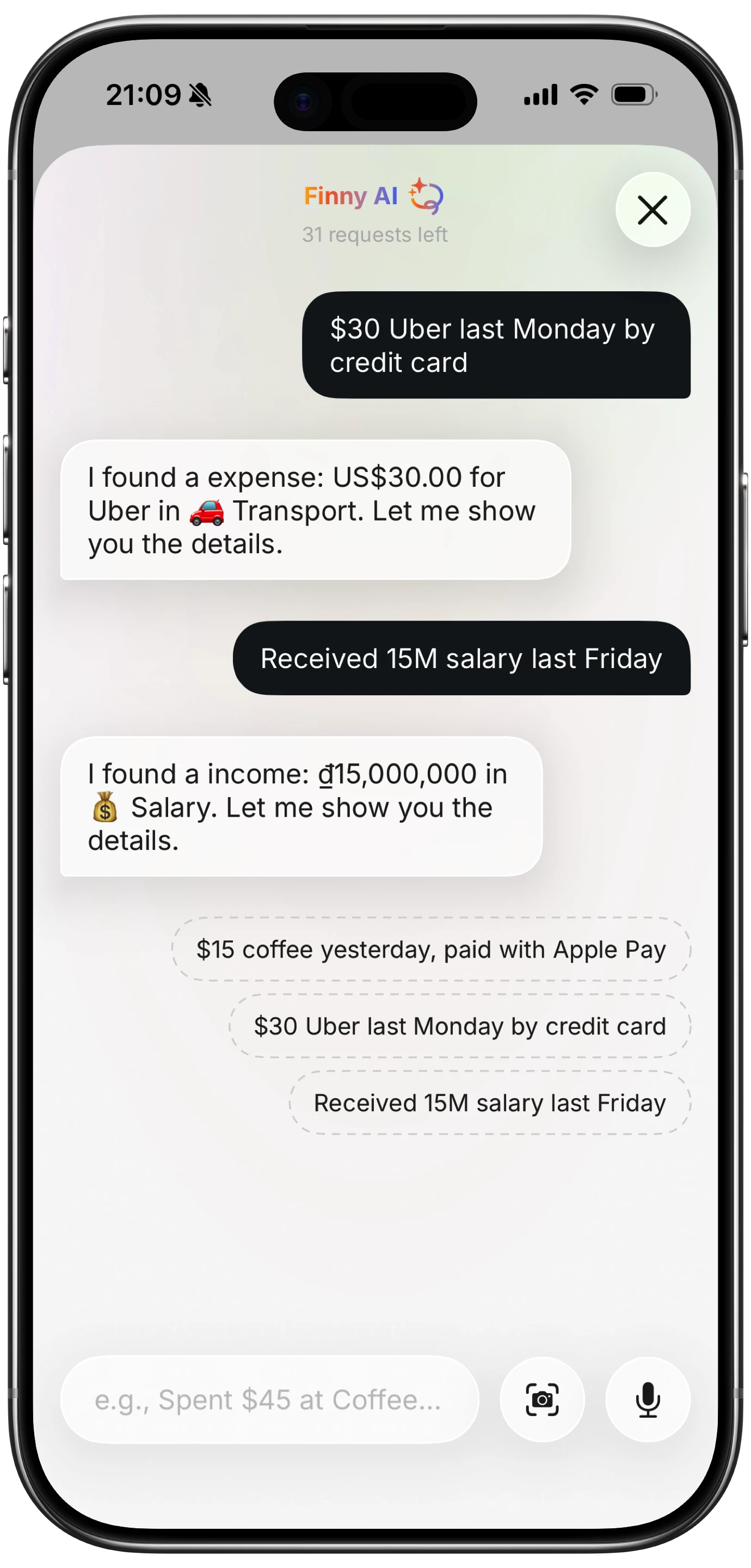
Finny app's AI chat feature
Strengths: Each entry takes 3 to 5 seconds. No bank connection required, so your financial credentials stay private. Catches cash transactions. Works offline with apps that support local storage. You maintain full control because every entry requires your confirmation.
Limitations: You still need to initiate each entry. AI categorization is not perfect and occasionally needs correction. Voice input accuracy drops in noisy environments. The habit of logging still requires building.
Finny: AI Input With Offline Support
Finny is built around three AI input methods: text parsing, voice input, and receipt scanning. Type, speak, or photograph your expenses, and Finny handles the rest. Every entry goes through a confirmation step, so nothing is saved without your review.
Key differentiators:
- No bank connection required: Your credentials stay with you.
- Offline-first: Log expenses without internet. Data syncs when you reconnect.
- 150+ currencies: Log in any currency without manual conversion. Useful for travelers and digital nomads.
- Free tier: Core tracking features are free. Pro costs a low monthly or yearly price.
For a detailed comparison of AI and manual tracking approaches, see our AI expense tracking vs manual guide.
How to Choose the Best Method for You
The best expense tracking method is the one you will actually use consistently. Here is a decision framework based on your priorities.
Choose pen and paper if: You prefer analog tools, make fewer than five purchases a day, and do not need trend analysis or long-term records.
Choose spreadsheets if: You enjoy building systems, are comfortable with formulas, and primarily track from a laptop or desktop computer.
Choose bank-linked apps if: You prioritize zero-effort logging, are comfortable sharing bank credentials, and primarily use cards and digital payments rather than cash.
Choose AI-assisted apps if: You want fast logging without bank connections, you make cash and card purchases, you travel internationally, or you value privacy and data ownership.
Many people combine methods. A common setup: use an AI-assisted app for daily logging, and export data to a spreadsheet monthly for deeper analysis. This gives you the speed of AI input with the customization of spreadsheets.
What Matters Most: Speed, Privacy, or Automation?
If you rank these three factors, the right method becomes clear.
Speed first: AI-assisted apps. Logging takes seconds, not minutes. The speed advantage compounds across hundreds of transactions per month.
Privacy first: Pen and paper, spreadsheets, or AI apps without bank connections. Anything that keeps your financial data off third-party servers.
Automation first: Bank-linked apps. Transactions appear without any action from you. The trade-off is privacy and the loss of cash tracking.
No single method is universally best. The right choice depends on your specific combination of priorities, and being honest about those priorities is more useful than reading feature comparison lists. For foundational guidance on managing your money, our budgeting for beginners guide covers the basics.
Common Questions About Tracking Expenses
What is the best way to track expenses in 2026?
The best method depends on your priorities. AI-assisted apps like Finny offer the fastest manual entry without bank connections. Bank-linked apps like Monarch Money automate imports but require sharing credentials. Spreadsheets work for people who want full customization. Pen and paper is the simplest starting point.
Is it better to track expenses manually or automatically?
Manual tracking builds more spending awareness because you see every transaction as it happens. Automatic tracking requires less effort but can feel passive. The most effective approach for many people is AI-assisted manual tracking, which combines speed with awareness.
How often should I track my expenses?
Daily, ideally in real time. Logging purchases as they happen is more accurate than trying to remember at the end of the day. If real-time logging is not possible, batch-entering at the end of each day is the next best option.
Can I track expenses for free?
Yes. Pen and paper costs nothing. Google Sheets is free. Several expense tracking apps offer free tiers, including Finny, which provides core AI-assisted tracking at no cost. Bank-linked apps with free tiers exist but are increasingly rare in 2026.
Do I need to link my bank account to track expenses?
No. Bank linking is one approach, but manual and AI-assisted methods work without it. Apps like Finny use text, voice, and receipt scanning to log expenses without any bank connection, which also means better privacy and the ability to track cash transactions.
Looking for a faster way to track expenses without sharing your bank info?
Download Finny to log spending with AI-powered text, voice, or receipt input. No bank connection, full offline support, 150+ currencies, and your financial data stays under your control.