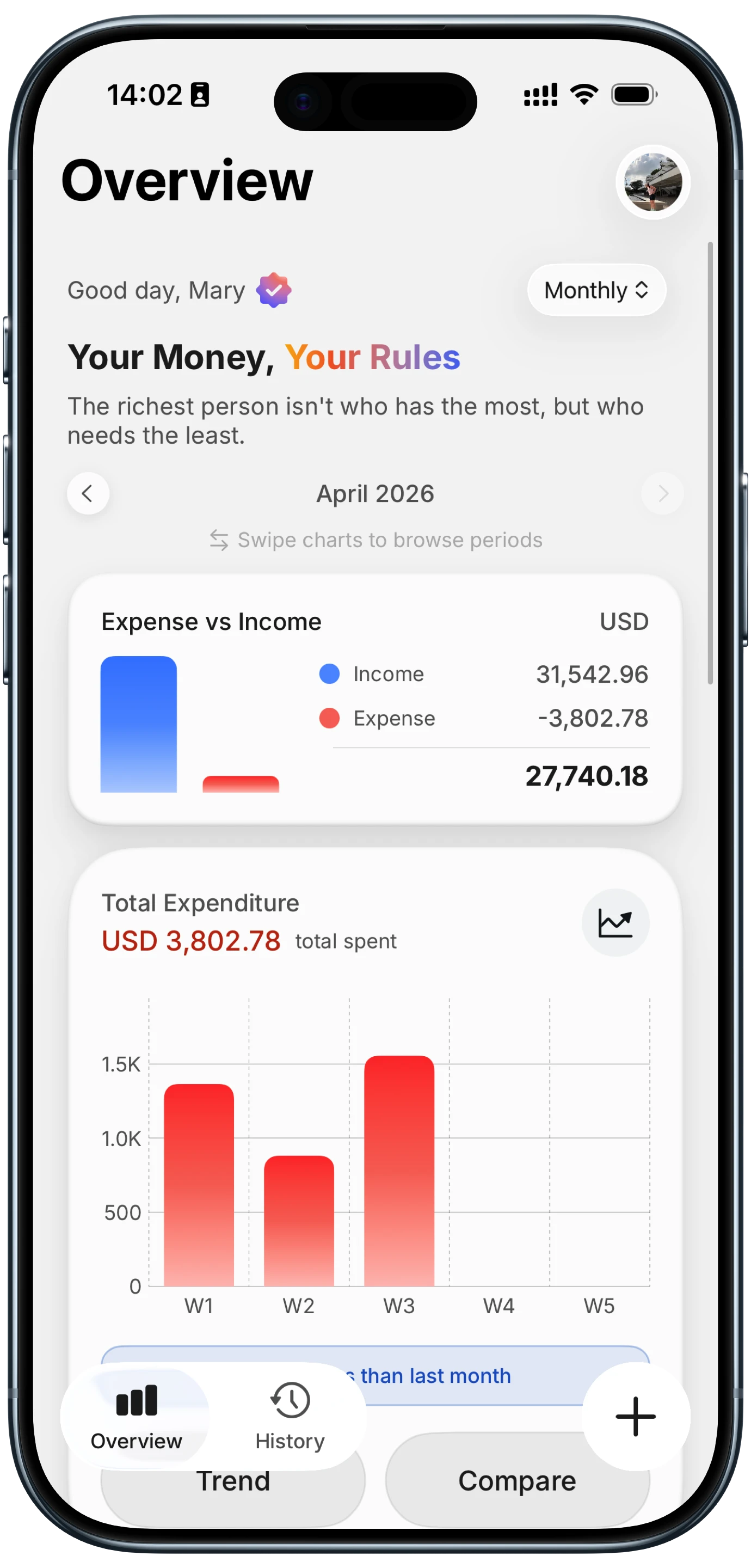
When to Quit Spreadsheet Budgeting (and When Not To)
You opened your budget sheet last weekend and felt the familiar resistance. The receipts pile keeps growing, the formulas you wrote in 2023 still mostly work, and the categories are personal in a way no app understands. But you also have not logged anything in eleven days. The question is no longer whether your sheet is good. The question is whether you still use it.
This is an honest spreadsheet vs budgeting app breakdown for people who have tracked money in Google Sheets, Excel, or Notion for months or years. We will not pretend an app replaces every use case. Spreadsheets are still the most powerful financial tool a non-accountant has. But they have a real cost, and that cost shows up most in mobile capture and consistency. If you are searching whether to switch from sheets to an app, the answer is not yes or no. It depends on how you actually use it day to day.
For a wider view of the landscape, see our roundup of the best AI budget apps for 2026.
What spreadsheets are still genuinely better at
A spreadsheet is the only tool that gives you total control over your data model. You decide what a category is, how a rollover works, whether last month's grocery overflow rolls into this month's dining envelope or stays where it was. You can model a five-year forecast with custom assumptions. You can write a formula that nobody else has thought of. None of that is hype. It is a real advantage if you use it.
Spreadsheets also win on:
- No subscription fee. Google Sheets is free. Excel is a one-time or already-bundled cost. Numbers ships with macOS.
- Forever offline. A local file does not require an internet connection or a vendor staying in business. If a budgeting startup shuts down, your data leaves with them. Mint did exactly this in 2024. A spreadsheet you saved in 2018 still opens today.
- Zero privacy risk. No bank login, no cloud sync if you do not want one, no third party reading your transaction history.
- Accountant-ready. A tax preparer or bookkeeper can open your file. Most cannot import from your budgeting app.
- Custom math. Sinking funds, irregular income smoothing, debt snowball with interest, FIRE projections. If you can describe it, you can build it.
If those points describe how you actually work with your sheet, the rest of this post might just confirm that you should keep going. The problem is that most people who started a budget spreadsheet do not actually use any of those advantages. They use a basic income-minus-expenses table and then stop opening it.
Where spreadsheets fail in real life
The honest weakness of a spreadsheet is the input layer. You buy coffee, you tap your card, and now you owe the spreadsheet a row. That row will not write itself. You can wait until Sunday and reconcile from your bank statement, but most people stop doing that within a month. The friction is small per transaction and large per month.
Specifically, sheets struggle with:
- Mobile capture. Typing a transaction on a phone keyboard into a Google Sheet on cellular is slow. You will not do it at the register.
- Receipt processing. No native OCR. You either type the total or skip it.
- Categorization. Every row needs a manual category, or a fragile dropdown that breaks if you add a new merchant.
- Charts that update. Pivot tables work, but they require setup and maintenance every time your structure changes.
- Partner visibility. Sharing a sheet works technically, but partners rarely log into a spreadsheet to add their lunch.
- Streaks and habit reinforcement. A sheet does not remind you, congratulate you, or show you a clean weekly summary unless you build that yourself.
This is the gap that AI expense tracking is built to fill. We covered the broader shift in why manual expense tracking is dead in 2026, and the head to head in AI expense tracking vs manual.
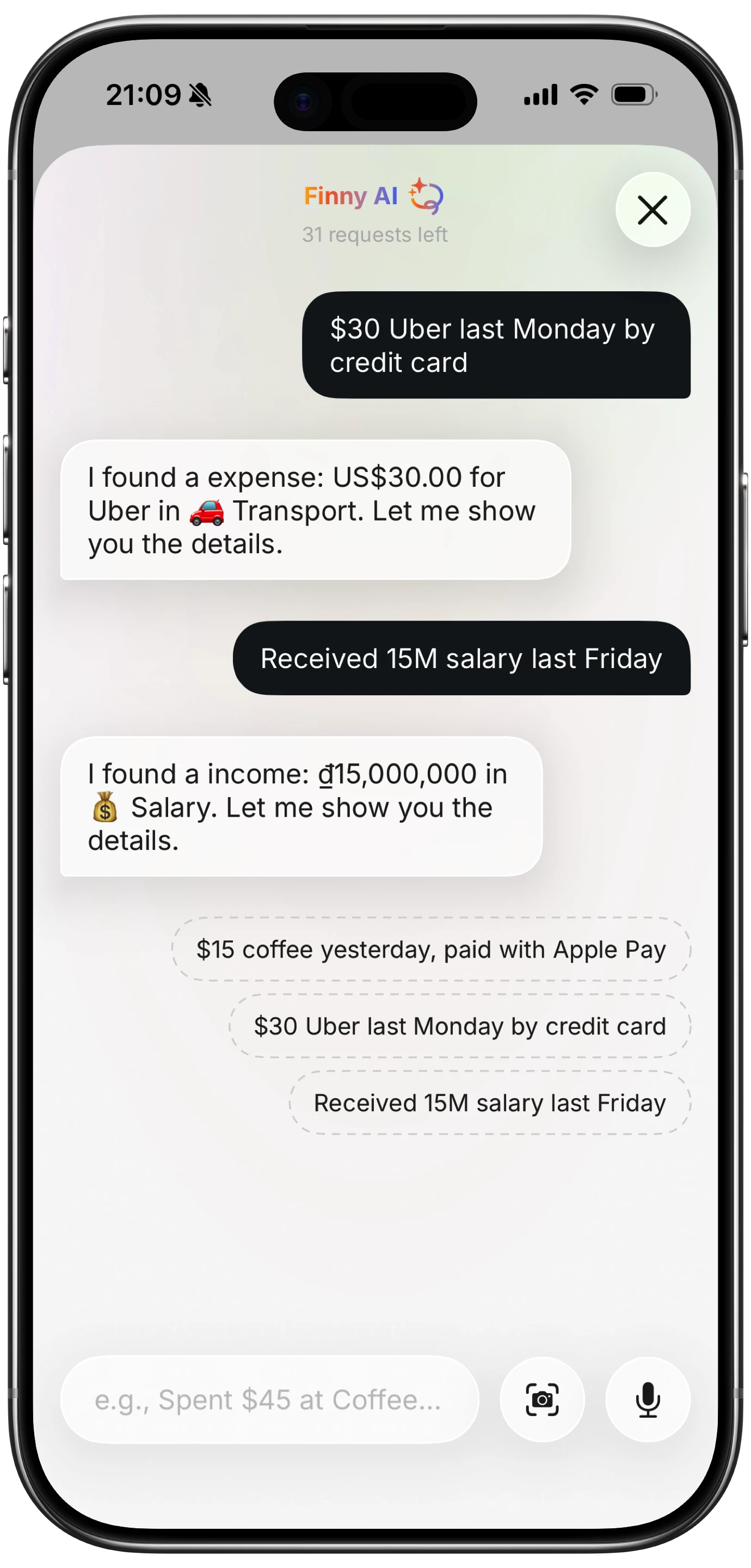
Finny app's AI chat feature
Spreadsheet vs budgeting app: side by side
| Factor | Spreadsheet (Sheets, Excel, Notion) | Dedicated budgeting app |
|---|---|---|
| Setup time | Hours to days | Minutes |
| Cost | Free or near free | $0 to $14 per month |
| Mobile entry speed | Slow, error prone | Fast, often under 5 seconds |
| Receipt capture | Manual typing only | Photo OCR, often batch |
| Auto categorization | None unless scripted | Built in |
| Custom forecasts | Unlimited | Limited to app features |
| Charts | Manual setup | Auto generated |
| Partner sharing | Possible, awkward | Native shared budgets in some apps |
| Offline use | Always (local file) | Depends on app |
| Privacy | Maximum if local only | Varies; bank linked apps share most data |
| Data export | You own the file | Depends, look for CSV |
| Accountant friendly | Yes | Usually not |
| Lifespan | Decades | Until the company exists |
| Habit reinforcement | None built in | Streaks, summaries, reminders |
There is no universal winner in that table. There is only a winner for your situation.
When to quit your spreadsheet
Quit, or at least demote, your spreadsheet when one or more of these is true:
- You have stopped opening it. This is the loudest signal. A budget you do not maintain is worse than no budget, because it gives a false sense of control. If your last entry is more than three weeks old and you are not on vacation, the system is not working.
- You log more than 100 transactions a month. Manual entry at that volume is a part time job. Most people quietly give up around the 60 to 80 mark.
- Mobile capture is most of your spending. If you tap to pay for coffee, lunch, ride shares, and groceries, you need to log at the moment of spending, not on Sunday night. Phones beat laptops here.
- A partner needs visibility. Shared spreadsheets technically work and practically do not. One person ends up doing all the data entry and resenting it.
- You are using it as a glorified ledger. If your sheet is just date, merchant, amount, category, with no custom forecasting, you are doing manual data entry without using any of the spreadsheet's actual power. An app does this better.
- Receipts pile up. Physical receipts in a drawer or a photo roll full of unprocessed snaps means OCR would save you real time.
If two or more apply, the friction has crossed the line. See our practical breakdown in how to track expenses for the day to day workflow.
When to keep your spreadsheet
Keep it, with no apology, when:
- You enjoy the system. Some people genuinely like building and maintaining their sheet. That is a legitimate hobby and a legitimate budgeting method. Do not let an app reviewer talk you out of something that works.
- You have a custom forecasting model. Long horizon FIRE projections, irregular freelance income smoothing, multi entity household accounting, real estate cap rate modeling. No general purpose budgeting app does these.
- You handle small business books. Apps designed for personal finance do not produce the structure your accountant wants. Stay in sheets, or move to dedicated bookkeeping software.
- Privacy is non negotiable and the sheet stays local. A local Excel or Numbers file with no cloud sync is the most private option short of paper.
- You are at low transaction volume. Under 30 entries a month, manual entry is fine. The friction is small enough to absorb.
The hybrid budget system most people actually need
The honest answer for a large group of readers is not either or. It is both.
Use an app for daily capture: speed, mobile, receipts, categorization. Once a month, export the data and pull it into your spreadsheet for analysis, forecasting, or whatever custom work you already do. This is what we mean by a hybrid budget system. You stop fighting your spreadsheet for input. You stop hoping an app will replicate your forecasting model.
The setup looks like this:
- Capture in the app, every day. Tap, voice note, or receipt photo. Whatever takes under five seconds.
- Let the app categorize. Trust automatic categorization for 80 percent of cases and correct the rest. We covered the tradeoffs in automatic expense categorization.
- Export monthly to CSV. First of the month, dump the previous month's transactions into your spreadsheet.
- Run your custom analysis there. Forecasts, sinking funds, household splits, whatever you already built.
- Archive. Keep both the app history and the spreadsheet ledger. You have a backup either way.
Finny's CSV export is one tap, which is why this hybrid setup works without fighting the tool. You get fast capture in the app and full control in the sheet. We are not pretending the app replaces your forecasting workbook. It just removes the data entry tax that was killing your spreadsheet habit.
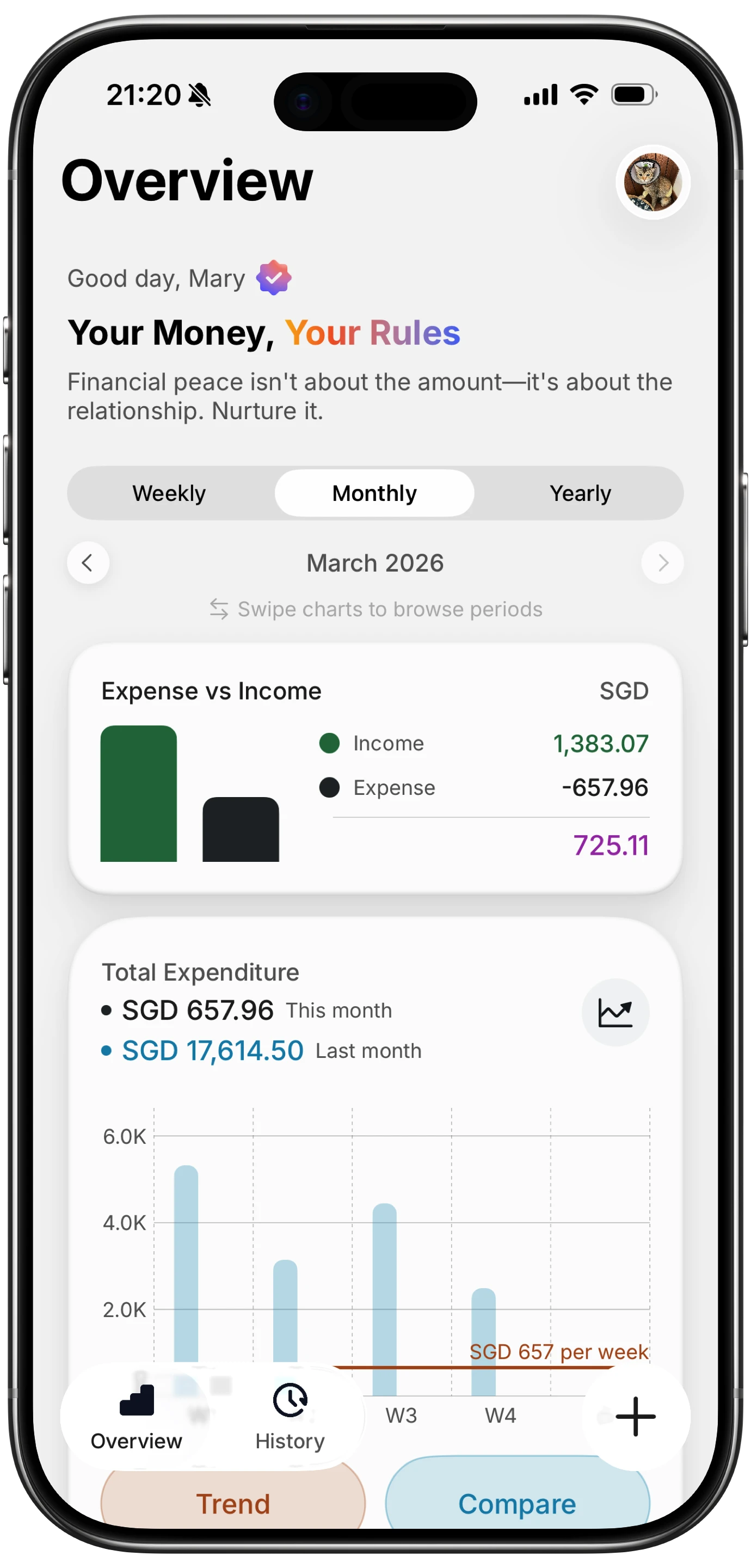
Finny app's Overview feature
What about Excel vs budget app specifically
The Excel vs budget app debate usually surfaces among people who already own Microsoft 365 and like Power Query. If you are doing serious modeling in Excel, you are not the audience for a switch. You are the audience for a hybrid setup. Use the app to feed Excel cleaner data than your bank statement gives you, then keep modeling.
If you are using Excel just because you opened it once in 2019 and never replaced it, you are paying the same friction tax as Google Sheets users. The app version of your problem is the same.
For a deeper look at input methods and what actually saves time, see the best way to track expenses.
How to choose
- Stay in spreadsheets if you genuinely use them, enjoy them, or need custom modeling no app provides.
- Switch to an app if you have stopped opening the sheet, you log most spending on mobile, or your partner needs in.
- Run a hybrid system if you want fast capture and your existing forecasting model. Most readers fit here.
The worst outcome is a half maintained spreadsheet that gives you the illusion of a budget. That is not a tool. That is guilt.
Common Questions About Spreadsheet vs Budgeting App
Is Excel better than a budgeting app?
Excel is better for custom modeling, accountant readiness, and total privacy when stored locally. A budgeting app is better for daily capture, receipt OCR, and habit reinforcement. The honest answer is that they solve different problems. Most people who claim Excel is better are using less than ten percent of its capability and would benefit from an app for input, with Excel kept for analysis.
Should I switch from Google Sheets to a budgeting app?
Switch if you have stopped opening the sheet, if you log most spending on your phone, or if a partner needs visibility. Keep Google Sheets if you have a custom forecasting model, you genuinely enjoy maintaining it, or your transaction volume is low enough that manual entry is not a friction problem. A hybrid setup with monthly CSV export is often the best fit.
What is a hybrid budget system?
A hybrid budget system uses an app for daily transaction capture and a spreadsheet for monthly analysis. The app handles the friction heavy part: mobile entry, receipt scanning, automatic categorization. The spreadsheet handles the parts apps do poorly: custom forecasts, complex household math, accountant ready exports. You move data between them with a CSV export, usually once a month.
Will I lose my historical data if I switch?
Not if you plan it. Keep your spreadsheet as the historical archive and start the app from a clean date, usually the first of a month. If you want unified history, manually enter the last few months into the app or import via CSV if it supports it. Most users do not need to migrate years of history. The point of switching is to log future spending more reliably.
Are budgeting apps safe compared to spreadsheets?
A local spreadsheet stored only on your device is the most private option available. Cloud synced sheets share data with the cloud provider. Bank linked budgeting apps share the most data because they hold credentials to read your accounts. Apps that do not require bank connections and store data locally on your device sit closer to the spreadsheet end of the privacy spectrum.
Ready to track expenses with less friction?
Download Finny to log expenses using AI, receipts, or text. No bank connections, offline support, and full control over your financial data. Export to CSV anytime so your spreadsheet stays in the loop.