You track every coffee, every grocery run, every $4 impulse purchase. You know exactly where your money goes each month. But do you know if you are actually building wealth?
Expense tracking answers: "Where did the money go?" Net worth tracking answers: "Am I getting richer?" These are different questions with different implications. The first monitors cash flow. The second measures financial progress.
This guide explains why shifting focus from expense tracking to net worth monitoring changes how you think about money, how to set up effective net worth tracking, and when daily expense tracking helps versus when it becomes a distraction. For the basics of net worth calculation, see what is net worth.
The Limits of Expense Tracking
Expense tracking has clear value. It reveals spending patterns, identifies waste, and creates awareness. But it has limitations:
It Measures Activity, Not Progress
Knowing you spent $450 on groceries tells you about your behavior. It does not tell you whether your financial position improved or declined. You could spend $450 on groceries and:
- Grow net worth by $2,000 (high savings rate month)
- Shrink net worth by $5,000 (market decline in investments)
- Stay flat (income matched total spending)
The grocery spending is the same in all scenarios, but the outcomes are completely different.
It Creates Micro-Optimization Traps
Obsessive expense tracking leads to optimizing the wrong things:
- Debating $5 purchases while ignoring investment allocation
- Feeling guilty about a $50 dinner while sitting on $100K in low-yield savings
- Tracking spending on coffee while neglecting career advancement that would 10x the impact
The effort-to-impact ratio of tracking small expenses often does not justify the attention.
It Ignores the Asset Side
Expense tracking is liability-focused. It monitors money leaving. Net worth tracking includes both sides:
| Expense Tracking | Net Worth Tracking |
|---|---|
| Cash out | Cash in and out |
| Spending behavior | Complete financial picture |
| Monthly view | Long-term trajectory |
| "Did I overspend?" | "Am I building wealth?" |
Someone who overspends their grocery budget but maxes retirement contributions is probably in better shape than someone who tracks every penny but invests nothing.
What Net Worth Tracking Reveals
Net worth is simple: Assets minus Liabilities.
| Assets | Liabilities |
|---|---|
| Cash and savings | Credit card debt |
| Investment accounts | Student loans |
| Retirement accounts | Car loans |
| Real estate equity | Mortgage balance |
| Vehicle value | Other debts |
| Business equity |
Net worth tracking shows:
Wealth Trajectory
Is your net worth growing, shrinking, or flat over time? This single trend line tells you more about financial health than any monthly expense breakdown.
- Consistent growth: You are building wealth
- Flat: You are treading water
- Declining: Something needs to change
Where Wealth Actually Lives
Breaking down net worth by component reveals allocation:
| Person A | Person B |
|---|---|
| $50K retirement | $100K home equity |
| $30K investments | $20K retirement |
| $10K cash | $30K cash |
| $5K vehicle | $15K vehicle |
| Net worth: $95K | Net worth: $165K |
Person B has higher net worth but less liquid assets and more concentration in real estate. Neither is wrong, but they represent different strategies and risks.
Real Progress Rate
Track net worth monthly and calculate your actual wealth-building rate:
- January: $150,000
- December: $175,000
- Annual increase: $25,000
- Monthly rate: ~$2,083
This is your true savings rate, accounting for investment gains, debt paydown, and appreciation, not just income minus expenses.
How to Track Net Worth Effectively
Step 1: List All Assets
Cash and liquid savings:
- Checking accounts
- Savings accounts
- Money market accounts
Investments:
- Brokerage accounts
- Retirement accounts (401k, IRA, Roth)
- HSA (if invested)
- Individual stocks or crypto (if any)
Real property:
- Home equity (market value minus mortgage)
- Vehicle values (realistic resale, not original price)
- Other real assets
Other:
- Business ownership stake
- Receivables owed to you
- Cash value of life insurance (if applicable)
Step 2: List All Liabilities
Consumer debt:
- Credit card balances
- Personal loans
- Buy-now-pay-later balances
Major loans:
- Mortgage balance
- Student loans
- Auto loans
- Home equity loans
Other obligations:
- Tax liabilities owed
- Money borrowed from family
Step 3: Calculate Net Worth
Sum assets. Sum liabilities. Subtract.
Example:
| Assets | Value |
|---|---|
| Checking + Savings | $15,000 |
| 401k | $85,000 |
| Roth IRA | $35,000 |
| Brokerage | $20,000 |
| Home equity | $60,000 |
| Car | $12,000 |
| Total Assets | $227,000 |
| Liabilities | Value |
|---|---|
| Mortgage | $190,000 |
| Student loans | $25,000 |
| Credit cards | $3,000 |
| Car loan | $8,000 |
| Total Liabilities | $226,000 |
Net Worth: $227,000 - $226,000 = $1,000
This person has significant assets but nearly matching liabilities. The focus should be debt reduction to accelerate net worth growth.
Step 4: Update Monthly
Set a recurring date (first of month, payday, etc.) to update values:
- Check account balances
- Update investment values
- Adjust real estate estimates annually (use Zillow or similar)
- Update vehicle values annually
- Record debt balances
Track changes month-over-month to see trajectory.
Tools for Net Worth Tracking
Monarch Money
Monarch offers comprehensive net worth tracking with account aggregation.
Strengths:
- Automatic account syncing
- Clean net worth dashboard
- Historical trend charts
- Goal tracking
Limitations:
- Subscription required ($99/year)
- Requires bank linking
Personal Capital (Empower)
Empower's free tools focus heavily on investment and net worth tracking.
Strengths:
- Free investment tracking
- Net worth trends
- Retirement planning tools
- Investment fee analyzer
Limitations:
- Wealth management upsells
- Requires account linking
- Less expense tracking focus
YNAB
YNAB includes net worth reporting alongside its budgeting features.
Strengths:
- Combines budgeting and net worth
- Tracking accounts for assets
- Age of money metric
- Active community
Limitations:
- $99/year
- Net worth secondary to budgeting
- Steeper learning curve
Spreadsheet
A simple spreadsheet works perfectly for net worth tracking.
Strengths:
- Completely free
- Full customization
- No privacy concerns
- Simple to maintain
Limitations:
- Manual data entry
- No automation
- Requires discipline
Finny for Expense Tracking
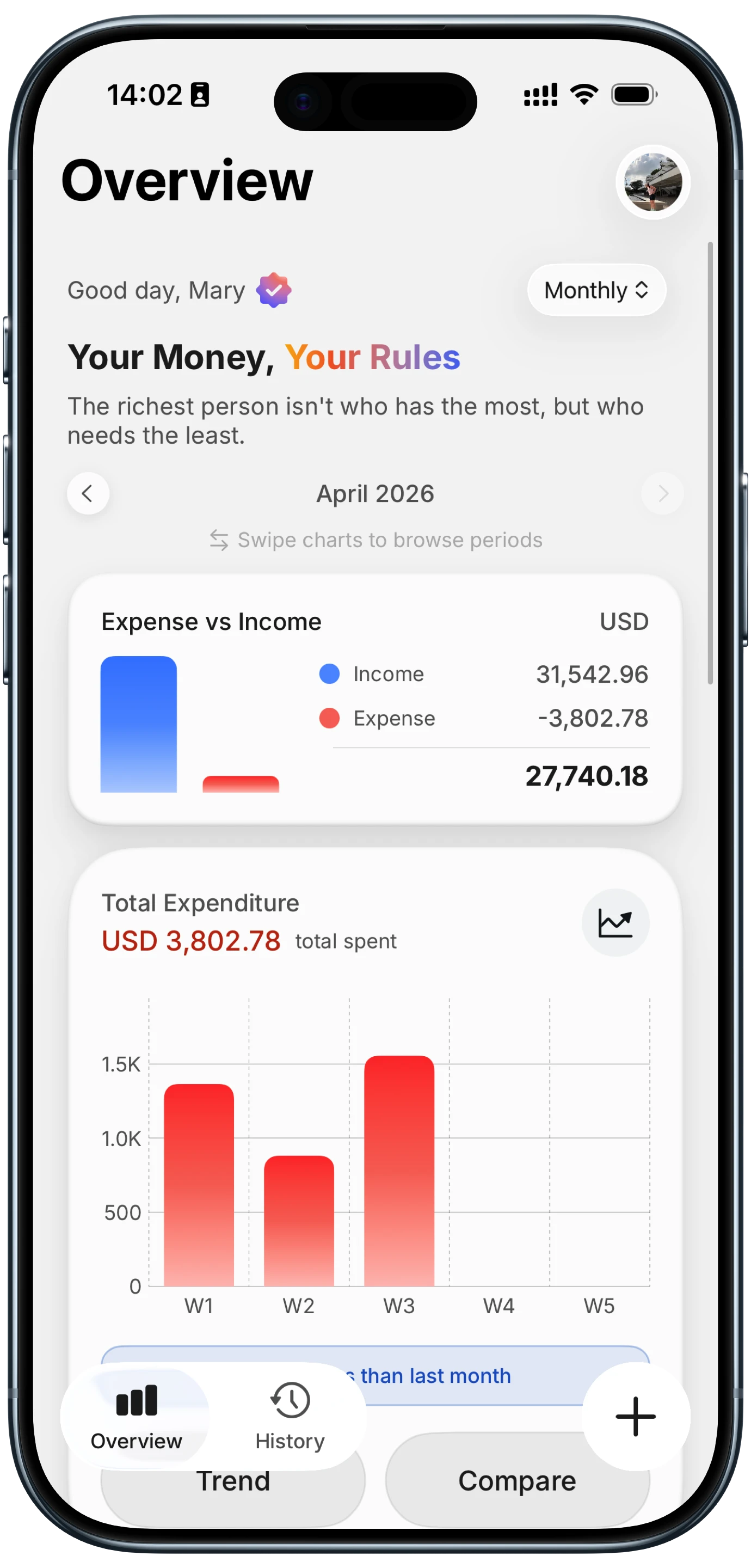
While Finny focuses on expense tracking rather than net worth, it provides the cash flow visibility that feeds into net worth calculations.
Use case: Track daily expenses with Finny for behavioral awareness, while maintaining a separate net worth tracker for wealth monitoring. For tools that visualize your cash flow over time, see our guide to the best cash flow tracking apps in 2026.
Net Worth Targets by Age
Benchmarks help contextualize your progress. These are guidelines, not requirements:
| Age | Net Worth Target | Notes |
|---|---|---|
| 25 | 0.5x annual salary | Early career, debt payoff phase |
| 30 | 1x annual salary | Should be positive, building momentum |
| 35 | 2x annual salary | Career growth should accelerate savings |
| 40 | 3-4x annual salary | Peak earning years |
| 50 | 5-6x annual salary | Retirement in sight |
| 60 | 7-8x annual salary | Nearing financial independence |
These assume steady careers and reasonable spending. Individual circumstances vary widely. The important thing is trajectory, not hitting exact numbers.
When Expense Tracking Still Matters
Net worth focus does not mean abandoning expense tracking entirely. Expense tracking remains valuable for:
Diagnostic Purposes
When net worth is not growing as expected, expense tracking reveals where money leaks:
- "I thought I was saving $1,000/month, but actually only $400"
- "Subscriptions grew to $300/month without noticing"
- "Dining spending tripled after switching jobs"
Track expenses intensively during diagnostic phases, then relax once patterns are understood.
Behavior Change Periods
When actively working to change spending habits, close tracking creates awareness and accountability:
- Paying off debt
- Increasing savings rate
- Reducing lifestyle after income drop
Once new habits are established, reduce tracking intensity.
Variable Income Situations
Freelancers and entrepreneurs with unpredictable income benefit from ongoing expense tracking to manage cash flow. See budgeting for beginners for cash flow approaches.
Travel and Transitions
During travel or major life transitions, expense patterns change. Tracking helps understand new normal spending.
For general tracking approaches, see our best money tracker apps in 2026 guide.
Building the Right Monitoring System
For Most People: Monthly Net Worth, Occasional Expense Review
Track net worth monthly:
- Update all account balances
- Calculate total net worth
- Note monthly change
- Review 12-month trend
Track expenses during specific periods:
- When net worth growth disappoints
- When changing jobs or locations
- When actively cutting spending
- Quarterly review for awareness
For High Net Worth: Net Worth Focus, Minimal Expense Tracking
Once net worth exceeds 5-10 years of expenses, expense tracking becomes less relevant. Investment performance and allocation matter more than whether you spent $50 or $70 on groceries.
Focus shifts to:
- Asset allocation
- Investment performance
- Tax optimization
- Estate planning
For Early Career: Heavy Expense Tracking Transitioning to Net Worth
Early in career, expense tracking builds foundational habits. As income grows and patterns stabilize, gradually shift focus to net worth.
Years 1-3: Track expenses closely to establish patterns Years 3-5: Reduce expense tracking, start monthly net worth Years 5+: Net worth primary metric, occasional expense review
The Bottom Line
Expense tracking answers "Where did the money go?" Net worth tracking answers "Am I building wealth?" Both questions matter, but net worth tracking provides the more important signal for long-term financial success.
Shifting focus from daily expenses to monthly net worth changes your financial mindset:
- From scarcity (watching every dollar leave) to abundance (watching wealth grow)
- From activity (spending behavior) to outcome (financial progress)
- From micro (individual purchases) to macro (complete financial picture)
This does not mean ignoring expenses. It means putting them in proper context as inputs to the more important metric: whether you are actually getting richer over time.
Track your net worth monthly. Update all accounts. Calculate the total. Watch the trend. That single number tells you more about your financial health than any expense report ever could.
Common Questions About Net Worth Tracking
How often should I calculate net worth?
Monthly tracking provides good visibility without excessive effort. Some people track quarterly, which is sufficient but provides less granular trend data. Avoid more frequent than monthly; short-term fluctuations add noise without insight.
Should I include my car in net worth?
Yes, but use realistic values. Check Kelley Blue Book or similar for actual resale value, not what you paid or what you owe. Cars depreciate, so values should decrease each year.
How do I handle home value fluctuations?
Update home value annually using Zillow, Redfin estimates, or comparable sales. Monthly fluctuations are noise. The equity that matters is current value minus mortgage balance.
What if my net worth is negative?
Negative net worth (more debt than assets) is common early in life, especially with student loans. Track progress toward zero, then positive territory. The rate of improvement matters more than the current number.
Should I track "soft" assets like potential inheritance?
No. Track only assets you control and could liquidate if needed. Inheritance, expected bonuses, and potential windfalls should not be counted until realized.
Ready to track your complete financial picture?
Download Finny to maintain clear expense visibility as part of your wealth-building system. Understanding cash flow supports net worth growth through informed spending decisions.