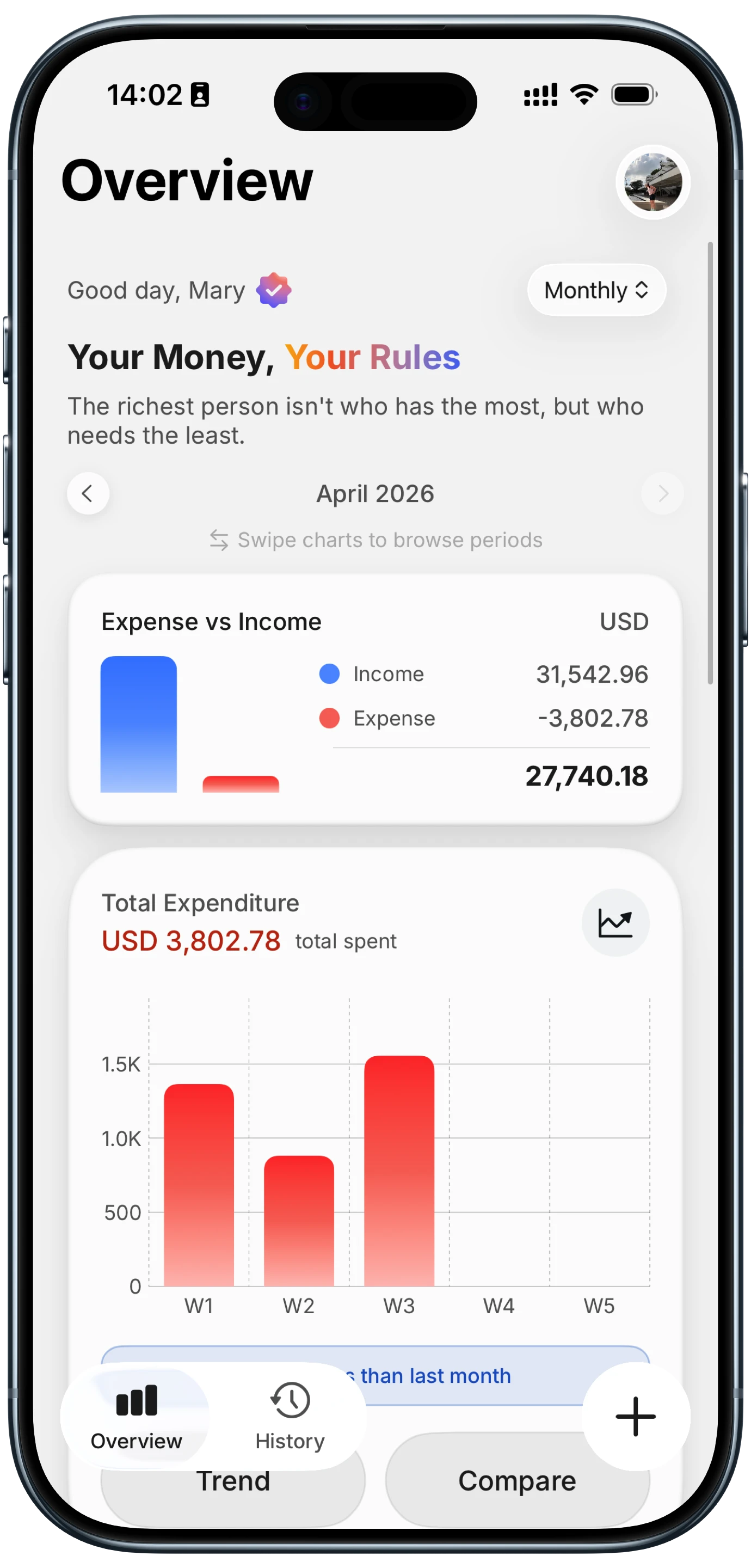
Income tells you what flows in. Spending tells you what flows out. But neither tells you where you actually stand financially. Two people earning the same salary can have dramatically different financial positions: one building wealth, the other sinking into debt.
Net worth answers the question income and spending cannot: "If I added up everything I own and subtracted everything I owe, what would be left?" It is the single best measure of financial health, yet most people never calculate it.
This guide explains what net worth is, how to calculate yours, and how daily expense tracking connects to building wealth over time. For foundational budgeting skills, see our budgeting for beginners guide.
What Is Net Worth
Net worth is your total assets minus your total liabilities.
Net Worth = Assets - Liabilities
- Assets: Everything you own that has monetary value
- Liabilities: Everything you owe to others
If your assets total $150,000 and your liabilities total $80,000, your net worth is $70,000. If assets are $50,000 and liabilities are $120,000, your net worth is negative $70,000.
Net worth can be positive, zero, or negative. Many young adults have negative net worth due to student loans exceeding their accumulated assets. This is not necessarily alarming if the trajectory is improving.
Why Net Worth Matters
Measures True Financial Position
Income is misleading. Someone earning $200,000 but spending $220,000 is financially worse off than someone earning $60,000 and spending $40,000. Net worth captures the cumulative result of all financial decisions over time.
Tracks Progress Over Time
Monthly income and spending fluctuate. Net worth shows the trend. Are you building wealth or depleting it? Quarterly net worth tracking reveals whether your financial life is moving in the right direction.
Enables Goal Setting
"I want to be financially secure" is vague. "I want a net worth of $500,000 by age 50" is specific and measurable. Net worth provides concrete milestones for financial planning. For a closer look at why this single number matters more than day-to-day budgeting, read our take on why net worth is the only metric that matters.
Reveals Hidden Problems
You might feel fine because bills are paid and money is in checking. But if credit card balances are growing, or retirement accounts are being raided, net worth declines even when monthly cash flow seems okay.
How to Calculate Your Net Worth
Step 1: List All Assets
Assets are things you own that have monetary value. Include:
Liquid Assets (easily converted to cash)
- Checking accounts
- Savings accounts
- Money market accounts
- Cash on hand
Investment Assets
- Retirement accounts (401k, IRA, Roth IRA)
- Brokerage accounts
- Stocks, bonds, mutual funds
- Cryptocurrency holdings
- HSA (Health Savings Account)
Property Assets
- Home equity (current value minus mortgage balance)
- Vehicles (current resale value, not purchase price)
- Valuable personal property (jewelry, art, collectibles)
- Business ownership equity
Other Assets
- Cash value of life insurance
- Money owed to you (only if collection is certain)
Be conservative with valuations. Use current market value for investments. For vehicles, use resale value not what you paid. For homes, use recent comparable sales or a conservative estimate.
Example Asset Calculation:
| Asset | Value |
|---|---|
| Checking account | $3,500 |
| Savings account | $15,000 |
| 401(k) | $45,000 |
| Roth IRA | $12,000 |
| Home value | $280,000 |
| Car resale value | $8,000 |
| Total Assets | $363,500 |
Step 2: List All Liabilities
Liabilities are debts you owe to others. Include:
Secured Debt
- Mortgage balance
- Auto loan balance
- Home equity loan/HELOC
Unsecured Debt
- Credit card balances
- Personal loans
- Student loans
- Medical debt
Other Liabilities
- Money you owe to family/friends
- Unpaid taxes
- Outstanding bills
List current balances, not original loan amounts.
Example Liability Calculation:
| Liability | Balance |
|---|---|
| Mortgage | $220,000 |
| Auto loan | $12,000 |
| Student loans | $35,000 |
| Credit card debt | $4,500 |
| Total Liabilities | $271,500 |
Step 3: Calculate Net Worth
Subtract liabilities from assets.
Example:
- Total Assets: $363,500
- Total Liabilities: $271,500
- Net Worth: $92,000
This person has $92,000 more in assets than they owe. Their financial position is positive but heavily influenced by home equity.
How Daily Spending Affects Net Worth
Net worth changes through four mechanisms:
- Income exceeds spending: Cash increases, assets grow
- Spending exceeds income: Cash decreases, possibly debt increases
- Asset values change: Investments rise or fall, home values shift
- Debt is paid down: Liabilities decrease
You cannot control market returns. You can control the gap between income and spending. This is where daily expense tracking connects to net worth.
The Savings Rate Connection
Your savings rate is (Income - Spending) / Income.
If you earn $5,000 monthly and spend $4,000, your savings rate is 20%. That $1,000 monthly surplus either:
- Increases cash assets
- Gets invested (increasing investment assets)
- Pays down debt (decreasing liabilities)
All three improve net worth. An expense tracker like Finny shows exactly where your money goes, revealing opportunities to widen the gap between income and spending.
Small Daily Decisions Compound
$10 daily on coffee and snacks equals $300 monthly or $3,600 yearly. Over 10 years at 7% investment returns, that is approximately $50,000 in potential net worth.
Tracking daily spending makes these numbers visible. You see the true cost of habits not in daily terms but in their impact on wealth building.
Spending Patterns Reveal Priorities
Your expense categories show where money actually goes versus where you think it goes. If net worth is not growing despite decent income, spending data reveals why. Common culprits:
- Dining out exceeding grocery spending
- Subscription creep (services you forgot about)
- Lifestyle inflation matching every raise
- Impulse purchases in "miscellaneous" categories
Net Worth Benchmarks by Age
While everyone's situation differs, general benchmarks help gauge progress:
| Age | Net Worth Target |
|---|---|
| 25 | $0 - $25,000 |
| 30 | 0.5x annual salary |
| 35 | 1x annual salary |
| 40 | 2x annual salary |
| 45 | 3x annual salary |
| 50 | 4x annual salary |
| 55 | 5x annual salary |
| 60 | 6x annual salary |
| 65 | 7-8x annual salary |
These assume you want to maintain your lifestyle in retirement. Someone earning $75,000 at age 40 should have around $150,000 in net worth. Someone earning $100,000 at age 50 should have around $400,000.
Being below these targets is common but worth addressing. Being significantly above suggests you are building wealth effectively.
Tracking Net Worth Over Time
Monthly or Quarterly Updates
Calculate net worth at regular intervals. Monthly is ideal for active tracking. Quarterly works if monthly feels tedious.
Use the same method each time for consistency. Record the date, total assets, total liabilities, and net worth.
Create a Simple Tracker
A spreadsheet works well:
| Date | Assets | Liabilities | Net Worth | Change |
|---|---|---|---|---|
| Jan 1 | $363,500 | $271,500 | $92,000 | - |
| Apr 1 | $375,000 | $268,000 | $107,000 | +$15,000 |
| Jul 1 | $368,000 | $264,500 | $103,500 | -$3,500 |
| Oct 1 | $382,000 | $261,000 | $121,000 | +$17,500 |
The "Change" column shows progress. Quarterly changes might be negative due to market fluctuations. Annual trends should be positive if you are managing money well.
Separate Real Progress from Market Moves
Investment accounts fluctuate. A market drop might reduce your net worth despite excellent financial behavior. Track separately:
- Controllable progress: Debt paid down, cash saved
- Market movement: Investment gains or losses
If controllable progress is positive, you are doing well even when markets decline.
Strategies to Increase Net Worth
Increase the Gap Between Income and Spending
The most reliable way to build net worth. Either earn more, spend less, or both. Daily expense tracking helps identify spending reductions. Career development helps income growth.
Pay Down High-Interest Debt
Credit card debt at 20% interest drains net worth. Every $1,000 paid off adds $1,000 to net worth AND stops $200 annual interest drain. Prioritize high-interest debt aggressively.
Maximize Tax-Advantaged Accounts
401(k), IRA, and HSA contributions grow tax-advantaged. Employer matches are free money. Contribute enough to get the full match at minimum.
Avoid Lifestyle Inflation
When income rises, the temptation is spending more. Directing raises to savings instead accelerates net worth. Even directing half of each raise to savings makes significant difference over time.
Invest Consistently
Money sitting in checking loses purchasing power to inflation. Appropriate investments grow over time. Even modest regular contributions compound significantly over decades.
Common Net Worth Mistakes
Counting Non-Liquid Assets Too Generously
Your furniture, clothing, and electronics have minimal resale value. Most personal property should not be counted unless you would actually sell it.
Ignoring Liabilities
People often calculate assets but forget to subtract debts. Net worth requires both sides of the equation.
Checking Too Frequently
Daily net worth checks cause anxiety over normal market fluctuations. Monthly or quarterly is sufficient for tracking trends.
Comparing to Others
Social media shows assets (cars, homes, vacations) but not liabilities or income. Someone displaying wealth may have negative net worth funded by debt. Compare to your past self, not others.
Neglecting Retirement Accounts
Money in 401(k) and IRA accounts is yours even though you cannot easily access it. Include retirement savings in net worth calculations.
Net Worth and Other Financial Metrics
Net Worth vs Income
Income measures flow. Net worth measures accumulation. High income with high spending produces low net worth. Modest income with disciplined spending can produce substantial net worth.
Net Worth vs Credit Score
Credit scores measure creditworthiness, not wealth. Someone with $1 million net worth but no credit history might have a low score. Someone deeply in debt might have a high score from regular payments.
Net Worth vs Cash Flow
Monthly cash flow measures income minus expenses over a given period. Positive cash flow builds net worth over time. Negative cash flow depletes it. Cash flow is the engine; net worth is the result.
The Bottom Line
Net worth is your total assets minus total liabilities. It is the most comprehensive measure of financial health because it captures everything you own and everything you owe in a single number.
Calculate net worth by listing all assets and all liabilities, then subtracting. Track quarterly or monthly to see trends. The number matters less than the direction: is it growing over time?
Daily expense tracking connects to net worth through savings rate. The gap between income and spending determines how fast net worth grows. Tracking spending reveals where money goes and creates opportunities to widen that gap.
Whether your current net worth is positive or negative, the goal is consistent improvement. Small daily spending decisions compound into large net worth differences over years and decades.
Common Questions About Net Worth
What is net worth in simple terms?
Net worth is everything you own minus everything you owe. If your assets (home, savings, investments) total $300,000 and your debts total $200,000, your net worth is $100,000.
Is it okay to have negative net worth?
Negative net worth is common early in life, especially with student loans. It becomes concerning if the number is not improving over time. The goal is moving toward positive and growing.
How often should I calculate net worth?
Monthly or quarterly works well for most people. More frequently causes anxiety over normal fluctuations. Less frequently misses important trends.
Does my home count in net worth?
Yes, but use equity (home value minus mortgage balance), not total home value. A $300,000 home with a $250,000 mortgage adds $50,000 to net worth, not $300,000.
How does daily spending affect net worth?
Every dollar not spent can become savings or debt payoff, both of which increase net worth. Daily expense tracking reveals spending patterns and creates opportunities to redirect money toward wealth building.
Ready to understand how your daily spending affects your financial position?
Download Finny to track expenses, see where your money goes, and identify opportunities to build wealth. Clear spending data connects daily decisions to long-term financial goals.