You have probably seen your credit score mentioned when applying for a credit card, renting an apartment, or shopping for a car loan. The number follows you through most financial decisions, yet many people are unsure what it actually measures or how to influence it.
A credit score is a three-digit number that reflects how likely you are to repay borrowed money on time. Lenders, landlords, and even some employers use it to evaluate financial reliability. Understanding how it works gives you the ability to improve it deliberately rather than hoping for the best.
This guide breaks down how credit scores are calculated, what the score ranges mean, how to raise yours, and which common myths to ignore. For a broader look at managing your finances, see our complete personal finance guide.
How a Credit Score Is Calculated
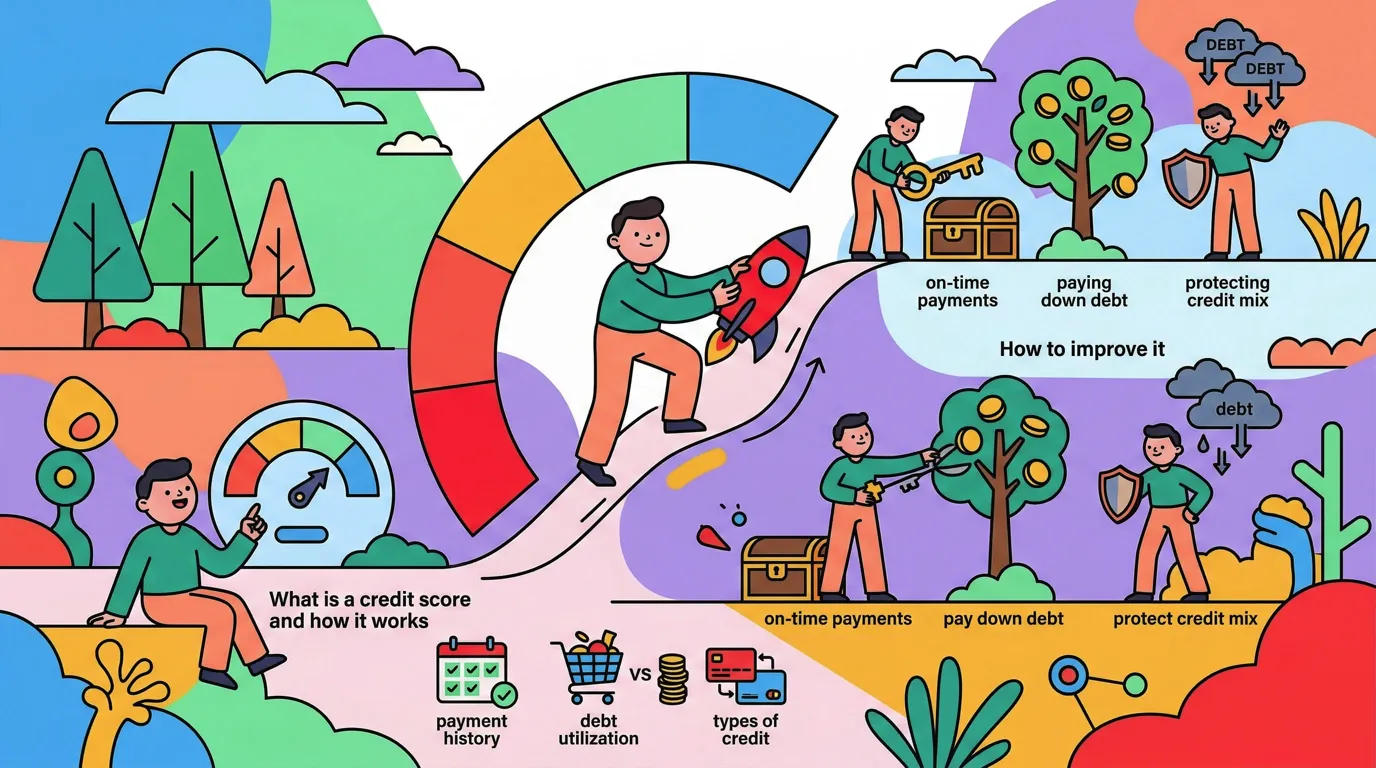
Credit scores are generated by scoring models, the most common being FICO and VantageScore. While the exact algorithms differ slightly, both models weigh five core factors. Here is how FICO breaks them down:
| Factor | Weight | What It Measures |
|---|---|---|
| Payment history | 35% | Whether you pay bills on time |
| Credit utilization | 30% | How much of your available credit you use |
| Length of credit history | 15% | How long your accounts have been open |
| Credit mix | 10% | Variety of account types (cards, loans, mortgage) |
| New credit inquiries | 10% | How often you apply for new credit |
These five factors account for your entire score. Some carry far more weight than others, which means your improvement efforts should be prioritized accordingly.
Payment History: 35%
This is the single largest factor. Lenders want to know one thing above all else: do you pay on time? A single missed payment can drop your score significantly, and late payments stay on your credit report for up to seven years.
Payment history includes credit cards, installment loans, mortgages, and even some utility or medical bills if they go to collections. The more recent a missed payment, the more damage it causes.
The simplest way to protect this factor is to set up automatic minimum payments on every account. You can always pay more than the minimum, but automating the baseline prevents accidental misses.
Credit Utilization: 30%
Credit utilization is the percentage of your available credit that you are currently using. If you have a credit card with a $10,000 limit and a $3,000 balance, your utilization is 30%.
Most experts recommend keeping utilization below 30%, and below 10% is considered ideal. This applies both per card and across all your revolving credit accounts. For a deeper look at how this metric is calculated and strategies to manage it, see our guide on credit utilization ratio.
Utilization resets each billing cycle, so it does not carry a long memory like payment history. If your utilization is high this month, paying it down will improve your score relatively quickly.
Tracking your daily spending plays a direct role here. When you know how much you are spending in real time, you can keep balances low before the statement closing date. An expense tracking app like Finny helps you monitor spending against your credit limits so utilization never creeps up unnoticed.
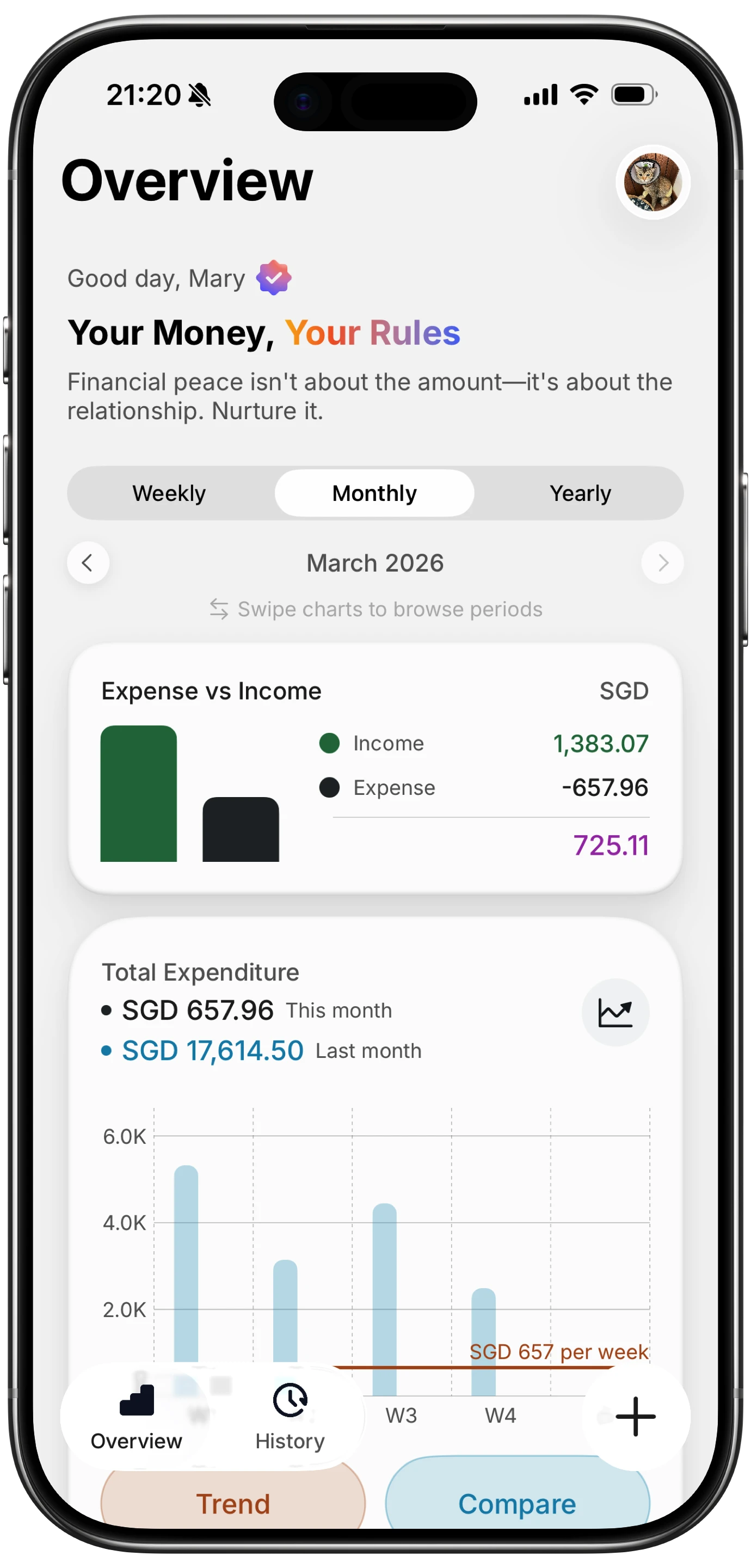
Finny app's Overview feature
Length of Credit History: 15%
This factor considers the average age of all your accounts, the age of your oldest account, and the age of your newest account. Longer history generally means a higher score.
This is why financial advisors often suggest keeping old credit cards open even if you no longer use them regularly. Closing your oldest card shortens your average account age and can lower your score.
If you are young or new to credit, this factor simply needs time. There is no shortcut, but you can avoid hurting it by not opening unnecessary new accounts.
Credit Mix: 10%
Scoring models like to see that you can handle different types of credit: revolving credit (credit cards), installment loans (car loans, student loans), and mortgages. A diverse mix suggests broader financial experience.
This does not mean you should take out loans you do not need just to diversify. It is a minor factor, and responsible use of whatever accounts you have matters more than variety for its own sake.
New Credit Inquiries: 10%
Every time you apply for credit, the lender performs a hard inquiry on your report. Each hard inquiry can lower your score by a few points and stays on your report for two years.
However, scoring models recognize rate shopping. If you apply for multiple auto loans or mortgages within a 14 to 45 day window (depending on the model), they count as a single inquiry. This allows you to compare rates without penalty.
Soft inquiries, like checking your own score or pre-qualification checks, do not affect your score at all.
Credit Score Ranges and What They Mean
Credit scores typically range from 300 to 850. Here is how lenders generally interpret them:
| Score Range | Rating | What to Expect |
|---|---|---|
| 800-850 | Exceptional | Best rates and terms available |
| 740-799 | Very Good | Qualifies for most premium offers |
| 670-739 | Good | Approved for most credit products |
| 580-669 | Fair | May face higher interest rates |
| 300-579 | Poor | Limited options, may require secured cards |
The difference between score ranges is not just approval or denial. It translates directly into money. A borrower with a 760 score might get a mortgage rate 0.5% to 1% lower than someone at 660. On a $300,000 mortgage over 30 years, that difference can mean tens of thousands of dollars in additional interest.
How to Improve Your Credit Score
Improving your score is not complicated, but it does require consistency. Here are the most effective strategies, ordered by impact:
1. Pay Every Bill on Time
Since payment history is 35% of your score, this is the highest-leverage habit. Set up autopay for at least the minimum payment on all accounts. Then review your spending regularly to ensure you can cover the full balance.
Tracking your expenses helps here. When you log spending throughout the month, you know exactly what your credit card balance will be before the bill arrives. No surprises means no missed payments.
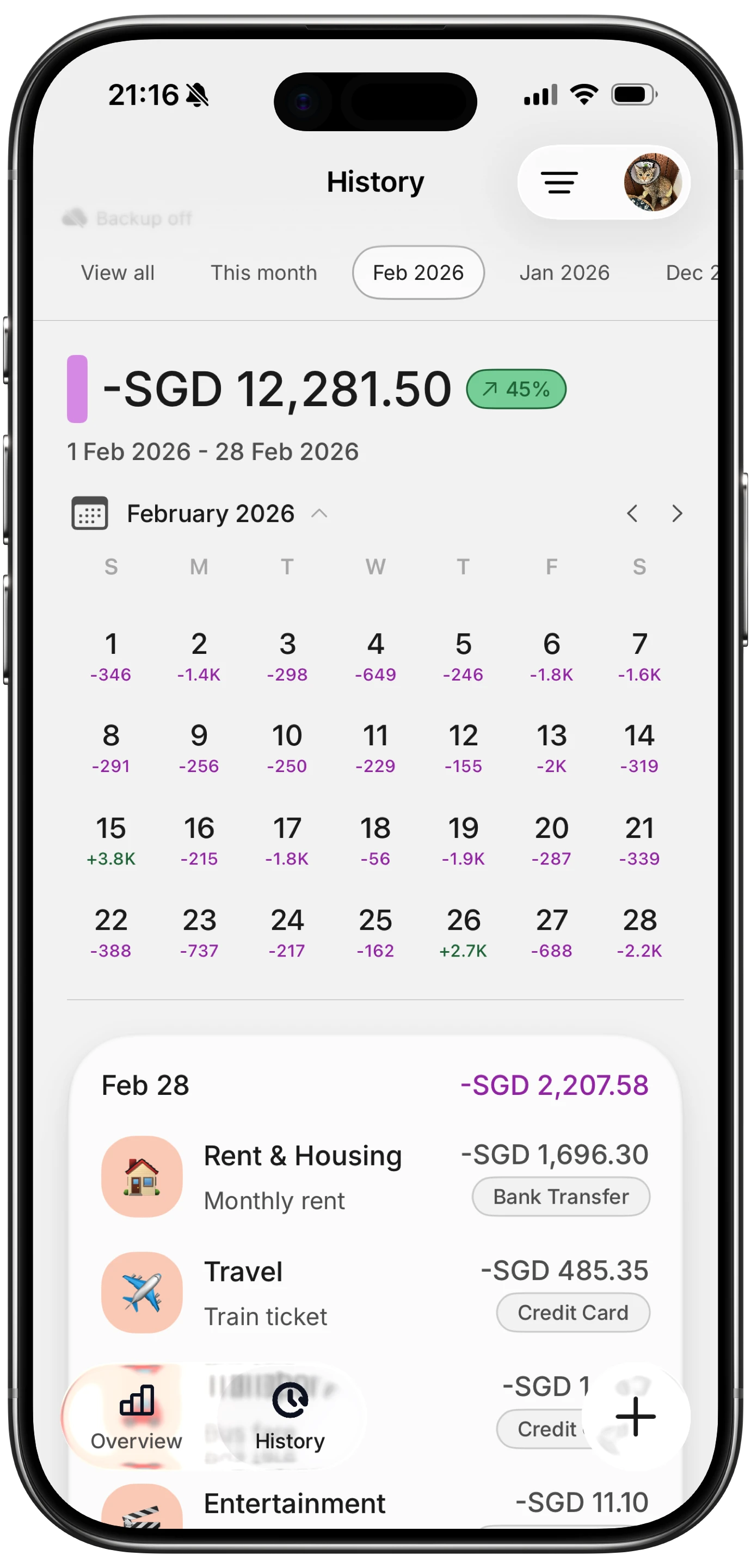
Finny app's History calendar feature
2. Keep Utilization Low
Pay down credit card balances before the statement closing date, not just the due date. Your utilization is reported to credit bureaus based on your statement balance, so paying early shows a lower number.
If you struggle to keep utilization under control, daily expense tracking is one of the most practical solutions. By logging every purchase, you maintain a running total of what you owe. Finny lets you track spending in real time through text, voice, or receipt scanning, so you always know where you stand against your credit limits.
3. Keep Old Accounts Open
Unless a card has an annual fee you cannot justify, keep it open. Use it for a small recurring purchase (like a streaming subscription) and set it to autopay. This maintains your credit history length and keeps the account active.
4. Limit New Applications
Only apply for credit when you genuinely need it. Each application creates a hard inquiry and lowers your average account age. Space out applications and do your rate shopping within a short window.
5. Dispute Errors on Your Report
Check your credit report at least once a year through AnnualCreditReport.com. Errors are more common than people expect. Incorrect late payments, accounts that are not yours, or outdated balances can all drag your score down. Disputing and correcting these can produce quick improvements.
6. Become an Authorized User
If a family member has a long-standing credit card with perfect payment history, being added as an authorized user can boost your score. Their account history gets added to your report. You do not even need to use the card.
Common Credit Score Myths
Misinformation about credit scores is widespread. Here are the most persistent myths and the reality behind them.
Myth: Checking Your Own Score Hurts It
Checking your own credit score is a soft inquiry. It has zero effect on your score. You can check it daily if you want. Only hard inquiries from lender applications affect your score.
Myth: Carrying a Balance Improves Your Score
You do not need to carry a balance or pay interest to build credit. Paying your statement in full each month is the best approach. It keeps utilization low and avoids interest charges entirely.
Myth: Closing a Credit Card Improves Your Score
Closing a card reduces your total available credit (increasing utilization) and can shorten your credit history. Both hurt your score. Unless the card has a fee you cannot justify, keeping it open is usually better.
Myth: Income Affects Your Credit Score
Your income, savings, and employment status are not factors in your credit score. A person earning $40,000 with perfect payment habits can have a higher score than someone earning $400,000 who misses payments.
Myth: You Only Have One Credit Score
You actually have multiple credit scores. FICO alone has several versions, and VantageScore is a separate model. Different lenders may pull different scores. Small variations between them are normal and not a cause for concern.
How Tracking Spending Supports a Better Credit Score
Two of the five credit score factors, payment history and credit utilization, are directly influenced by how well you manage daily spending. Together, they account for 65% of your score.
When you track expenses consistently, you gain two advantages:
You avoid overspending on credit. Knowing exactly how much you have spent this month prevents credit card balances from growing beyond what you can pay in full. This keeps utilization low and ensures you can always cover the minimum payment.
You catch problems early. If spending starts trending higher in a particular category, you can adjust before it becomes a missed payment or maxed-out card. Reactive budgeting is too slow for credit score management. You need real-time awareness.
This is where a lightweight expense tracker adds genuine value. Rather than logging into your bank app and guessing at pending transactions, you maintain your own running record. Finny works offline and does not require bank connections, so your spending data stays private while giving you the visibility you need to keep credit card balances in check.
For more on building consistent tracking habits, see our guide on how to track daily spending.
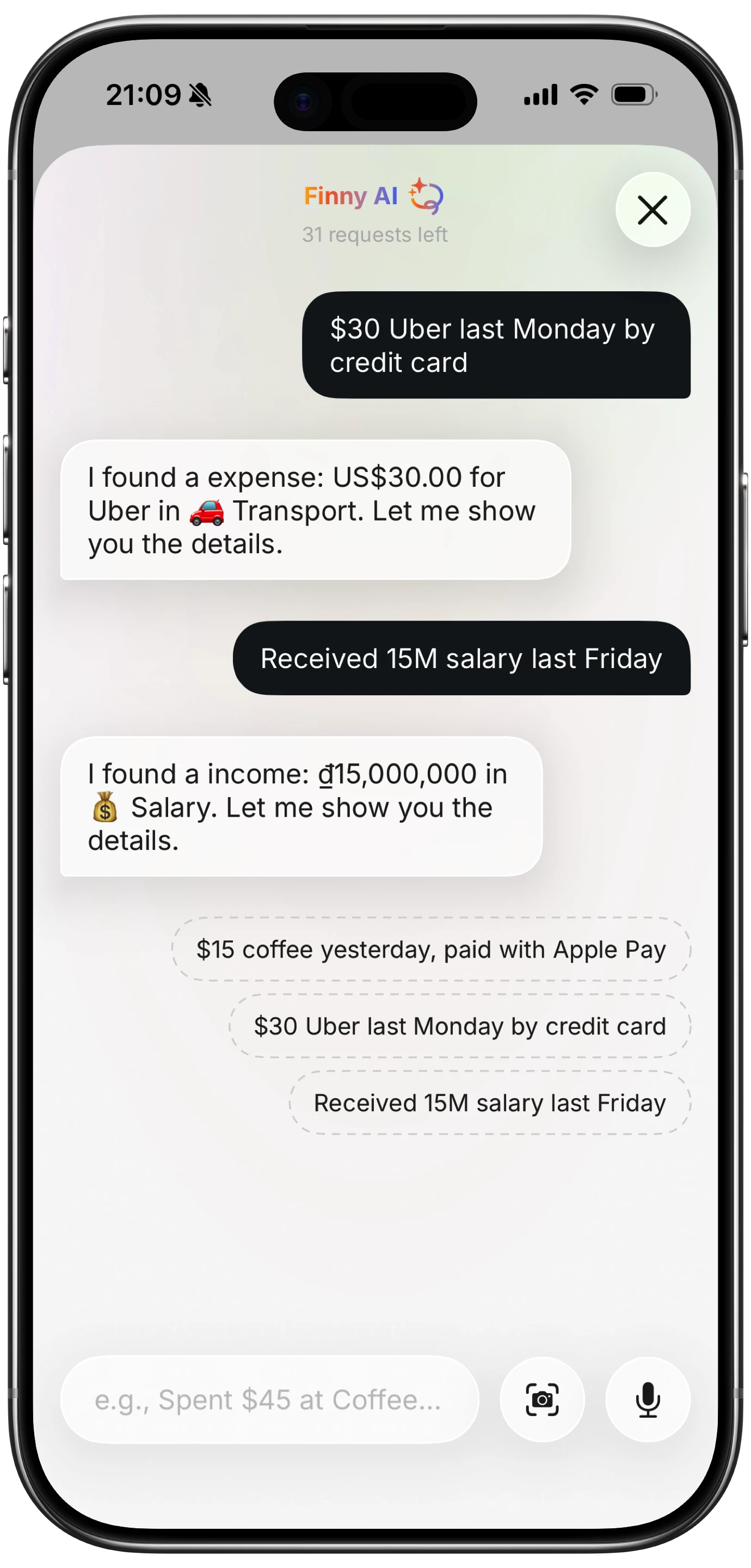
Finny app's AI chat feature
The Bottom Line
Your credit score is built on five factors, but two of them, payment history and utilization, make up 65% of the equation. The most effective way to improve your score is straightforward: pay on time and keep balances low. Everything else is secondary.
There are no shortcuts. Building strong credit takes consistent habits over months and years. But the payoff is substantial: lower interest rates, better loan terms, and more financial options when you need them.
The connection between daily spending awareness and credit health is often overlooked. When you know where your money goes each day, you naturally avoid the two biggest score killers: missed payments and high utilization. Tracking spending is not just a budgeting exercise. It is a credit-building strategy.
For tips on controlling spending habits that affect your credit, see our guide on how to stop overspending.
Common Questions About Credit Scores
What is a good credit score?
A score of 670 or above is generally considered good. Scores above 740 are very good, and above 800 is exceptional. Most lenders offer their best rates and terms to borrowers with scores of 740 or higher.
How long does it take to improve a credit score?
It depends on what is dragging your score down. Reducing high utilization can improve your score within one to two billing cycles. Recovering from a missed payment takes longer, typically six to twelve months of on-time payments to see meaningful improvement.
Does paying rent build credit?
Traditional credit scoring models do not include rent payments by default. However, some services report rent payments to credit bureaus, and newer scoring models like VantageScore 4.0 can factor them in. Check with your landlord or a rent-reporting service if this matters to you.
How often should I check my credit score?
Check your full credit report at least once a year for errors. You can monitor your score more frequently through free services offered by many banks and credit card companies. Regular monitoring helps you catch issues early.
Can I get a credit score with no credit history?
You need at least one account reported to a credit bureau for six months to generate a FICO score. If you are starting from zero, a secured credit card or becoming an authorized user on someone else's account are the fastest ways to establish history.
Ready to keep your spending in check and protect your credit score?
Download Finny to track expenses in real time, monitor spending by category, and stay ahead of your credit card balances. No bank connections required, just clear visibility into where your money goes.