How to Stop Overspending: 10 Proven Strategies
You check your bank account and the number is lower than expected. Again. You know you have not made any big purchases, yet the money is gone. The culprit is rarely a single expense. It is dozens of small, unplanned purchases that felt harmless in the moment but added up quietly over the week. If this sounds familiar, our walkthrough on why you cannot account for $300 every month shows how to find exactly where it is going.
How to stop overspending is not about willpower. Willpower is a limited resource that depletes throughout the day. The people who consistently spend within their means do not have more discipline. They have better systems. This guide covers 10 strategies that address the root causes of overspending, from the psychology behind it to practical tools that make controlled spending the default. If most of your overspending happens on your phone, our guide to using iPhone Focus and Screen Time against impulse buys shows the settings to change.
If you do not currently track your spending, start there. Our guide on how to track expenses walks through the process step by step.
Why People Overspend: The Psychology
Before fixing overspending, it helps to understand why it happens. Overspending is rarely about being bad with money. It is driven by predictable psychological patterns.
Emotional spending. Stress, boredom, sadness, and even excitement trigger spending as a coping mechanism. Retail therapy provides a brief dopamine hit that temporarily masks the underlying emotion.
Present bias. Humans are wired to value immediate rewards over future benefits. Buying something now feels concrete. Saving for retirement feels abstract. This bias makes spending the path of least resistance.
Social comparison. Seeing what friends, colleagues, or influencers buy creates pressure to match their lifestyle. This effect is amplified by social media, where spending is visible but income and debt are not.
Decision fatigue. After a long day of making decisions at work and at home, your ability to resist impulse purchases drops. This is why most unnecessary spending happens in the evening or late at night.
Anchoring. Sales and discounts make purchases feel like savings. A $100 item marked down to $60 feels like you saved $40, even though you spent $60 on something you may not need.
Understanding these patterns does not eliminate them, but it makes them easier to recognize in the moment. That recognition is the first step toward changing behavior.
1. Track Every Expense for 30 Days
You cannot fix what you cannot see. Before making any changes to your spending habits, track every purchase for a full month. Every coffee, every subscription charge, every vending machine snack.
Most people are surprised by the results. Categories they thought were small (convenience store stops, app purchases, delivery fees) often total hundreds of dollars, a pattern sometimes called the latte factor. This data gives you a clear picture of where overspending actually happens, which is often not where you assume.
Use whatever tracking method reduces friction. A notebook works, but an expense tracking app is faster and provides automatic categorization and analytics. For a comparison of approaches, see our guide on AI expense tracking vs manual methods.
2. Identify Your Spending Triggers
Once you have a month of data, look for patterns beyond just categories. Ask:
- What time of day do most impulse purchases happen?
- What emotional state were you in? (Stressed, bored, celebrating?)
- Where were you? (At home scrolling your phone, in a store, at a social event?)
- Were you alone or with others?
These patterns reveal your personal triggers. Someone who overspends on food delivery every evening after work has a different problem than someone who overspends on clothes during weekend shopping trips. The strategies that work are different for each pattern.
3. Implement the 24-Hour Rule
For any non-essential purchase over a set threshold (start with $30 to $50), wait 24 hours before buying. Add the item to a wish list or shopping cart, but do not check out.
The 24-hour rule works because it interrupts the impulse cycle. Most impulse purchases are driven by a temporary emotional state. After a day, the urgency fades. Research suggests that a significant portion of people who wait 24 hours decide not to buy the item. A related approach is the 30-day rule, which applies a longer waiting period to bigger purchases for even stronger results.
This strategy costs nothing, requires no tools, and works immediately. The only requirement is the initial commitment to pause before purchasing.
4. Use a Budget with Category Limits
A budget without limits is just a record. To stop overspending, you need specific dollar amounts for each category, and a plan for what happens when you reach them.
The envelope method is particularly effective for overspending because it creates hard limits. When the envelope (physical or digital) for dining out is empty, dining out stops until the next month. There is no ambiguity.
If strict envelopes feel too rigid, start with limits on your top three overspending categories. Leave other categories flexible while you build the habit. Our guide on how to budget money covers several methods and helps you pick the right one. For real-time visibility on those limits, see our Live Activities for budget tracking on iPhone guide for setups that surface category progress on the Lock Screen and Dynamic Island.
5. Remove Saved Payment Information
Online shopping becomes dangerously easy when your credit card is saved in every browser and app. Removing saved payment information adds a friction step: you have to get up, find your card, and type the number.
That small barrier is surprisingly effective. It gives your rational brain time to override the impulse. The few seconds it takes to enter a card number are enough to ask, "Do I actually need this?"
Similarly, unsubscribe from retail email lists and unfollow brands on social media. Every marketing email and targeted ad is designed to trigger a purchase. Reducing exposure reduces temptation.
6. Automate Savings Before Spending
If money is in your checking account, you will spend it. This is not a character flaw. It is human nature combined with how our financial system works.
Once you have spending under control, redirect the surplus into savings. Our guide on how to save money fast covers 12 strategies that pair well with the habits below. Set up automatic transfers on payday:
- Emergency fund contribution goes to a separate savings account.
- Retirement contribution goes to your 401(k) or IRA.
- Any other savings goals go to dedicated accounts.
What remains in your checking account is what you have available to spend. This approach, sometimes called "pay yourself first," removes the temptation to skip savings when spending feels urgent. It turns saving into a default rather than a decision.
7. Switch to Cash for Problem Categories
Digital payments are invisible. Tapping a card or clicking "buy" does not activate the same pain response in your brain as handing over physical money. Research in consumer psychology has consistently shown that people spend more with cards than with cash.
For your top one or two overspending categories, try using cash for one month. Withdraw a fixed amount at the beginning of the month and use only that cash for those purchases. When the cash runs out, you stop.
This method is inconvenient by design. The inconvenience is the mechanism that makes it work.
8. Audit Subscriptions Quarterly
Subscription creep is one of the most common forms of overspending because each individual charge is small and automatic. A $10 streaming service here, a $15 software subscription there. Over time, these stack up to $100, $200, or more per month.
Every three months, review your subscriptions:
- List every recurring charge on your credit card and bank statements.
- For each subscription, ask: "Did I actively use this in the past 30 days?"
- Cancel anything you have not used recently.
- For services you use occasionally, check if there is a free tier or a pay-per-use alternative.
Most people find at least $30 to $50 in subscriptions they forgot about or no longer use. For a detailed walkthrough, see our post on how to stop subscription creep.
9. Plan Purchases in Advance
Unplanned purchases are the primary driver of overspending. Planned purchases, even for discretionary items, rarely cause budget problems because they are accounted for in advance.
Build a simple planning habit:
- Groceries. Make a list before going to the store. Buy only what is on the list.
- Clothing. Decide at the beginning of each season what you need. Shop with that list.
- Gifts. Set a yearly gift budget and allocate amounts per person before occasions arise.
- Electronics and big purchases. Research for at least a week before buying. Compare prices. Wait for genuine sales, not manufactured urgency.
Planning does not eliminate spending. It eliminates the unplanned spending that causes regret and budget overruns.
10. Review Your Finances Weekly
A weekly financial check-in takes 15 minutes and prevents overspending from going unnoticed. During this review:
- Check your spending against budget limits for each category.
- Review any large or unusual purchases from the week.
- Assess how much budget remains for the rest of the month.
- Adjust upcoming plans if a category is running low.
Weekly reviews catch overspending early, when small adjustments can fix it. Monthly reviews, by contrast, often reveal problems after the damage is done and the money is already spent.
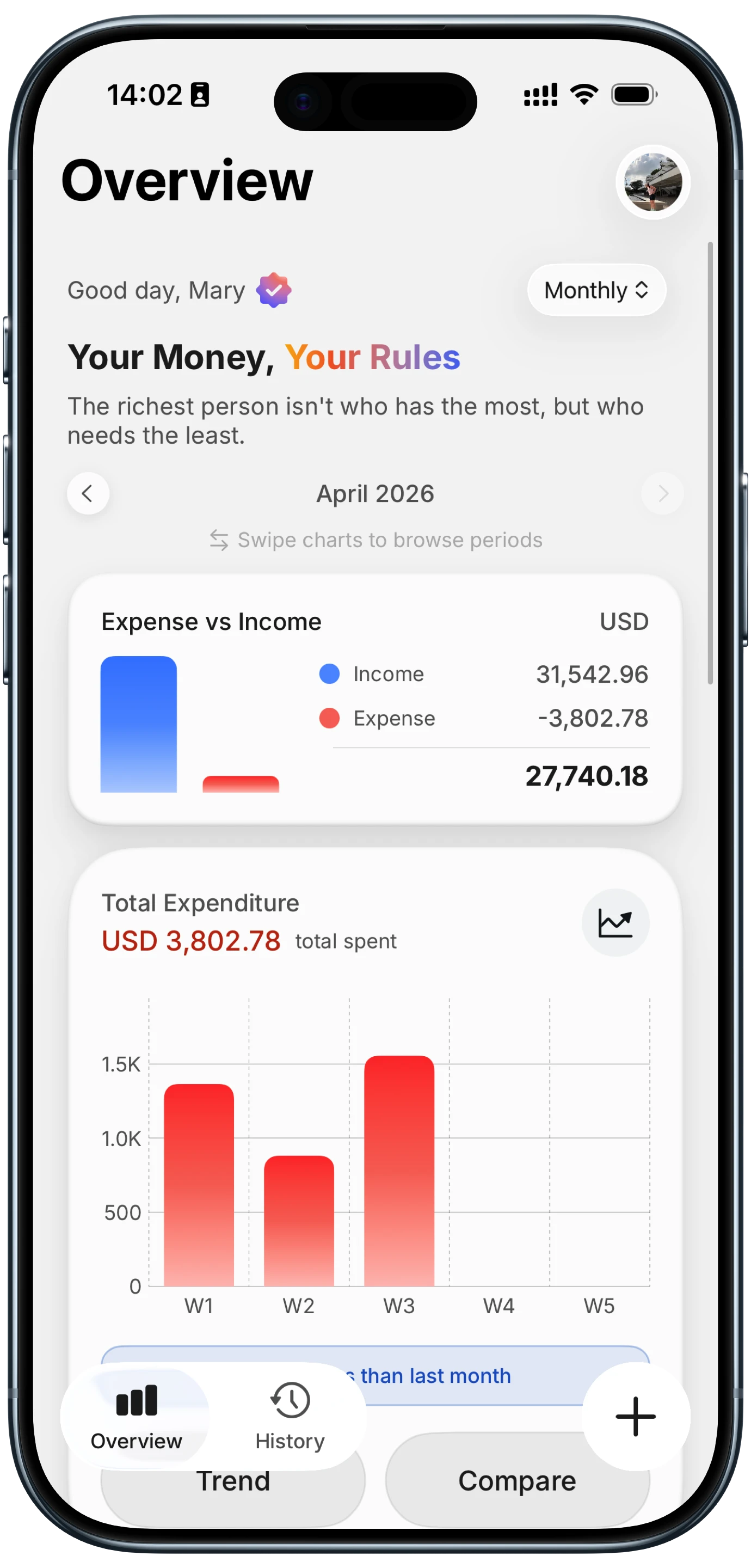
Apps with spending analytics make this review faster. Rather than manually adding up transactions, you see category totals, trends, and comparisons at a glance. Finny provides visual spending analytics that show exactly where your money goes each week and month, making these reviews quick and actionable.
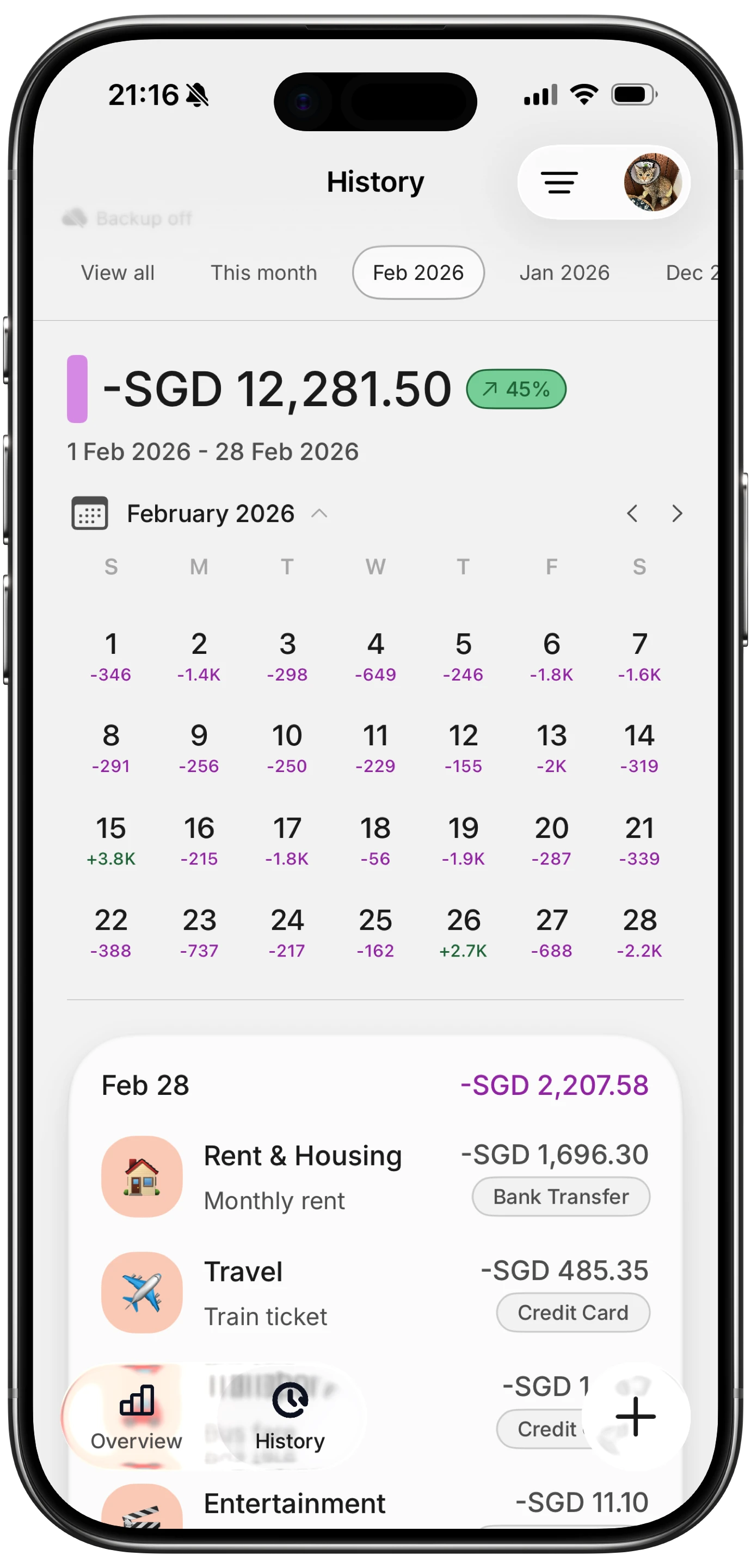
Finny app's History calendar feature
How Tracking Tools Help Control Overspending
YNAB (You Need A Budget)
YNAB enforces zero-based budgeting, which means every dollar is assigned before you spend it. When a category runs out, the app shows you clearly. This structure is effective for overspenders who need hard boundaries. The cost is $14.99 per month.
PocketGuard
PocketGuard calculates your "In My Pocket" number: what you can safely spend after bills, goals, and necessities. Seeing one number instead of a complex budget can simplify spending decisions. It requires bank connections to work.
Finny
Finny reduces the friction of tracking, which is the foundation of every strategy in this list. AI-powered voice and text input makes logging purchases fast enough to do in the moment. Receipt scanning captures details automatically. Offline support means you can track anywhere. And because Finny does not require bank connections, your financial data stays on your terms.
Common Questions About Overspending
Why do I keep overspending even with a budget?
Usually because the budget does not address the underlying triggers. A budget is a plan, but overspending is a behavior. Combine your budget with specific strategies like the 24-hour rule, removing saved payment info, and identifying emotional triggers.
How do I stop spending money on things I do not need?
Start with the 24-hour rule for non-essential purchases. Track every expense for a month to identify patterns. Remove temptation by unsubscribing from marketing emails and unfollowing brands. Replace the shopping habit with an activity that fulfills the same emotional need.
Is overspending a sign of a bigger problem?
Occasional overspending is normal. Consistent overspending that causes financial stress, debt accumulation, or anxiety may indicate emotional spending patterns worth exploring. If spending feels compulsive or out of control, consider speaking with a financial therapist or counselor.
How long does it take to break overspending habits?
Behavior research suggests that habits take an average of two to three months to change, not the often-cited 21 days. Be patient with yourself. Focus on building systems (automatic savings, tracking, weekly reviews) rather than relying on motivation alone.
What is the best app to stop overspending?
The best app is one you actually use consistently. Look for low-friction tracking, clear spending analytics, and category-based budgeting. Apps that work offline and do not require bank connections give you more control. Our best money tracker apps in 2026 guide covers the top options in detail.
Ready to take control of your spending?
Download Finny to track expenses in seconds with AI-powered input. No bank connections, full offline support, and spending analytics that show you exactly where your money goes.