Most people keep their savings in whatever account their bank gave them when they signed up. That account likely earns somewhere between 0.01% and 0.10% APY, which means a $10,000 balance generates roughly one dollar per year in interest. Meanwhile, other accounts offer 10 to 50 times that rate for doing exactly the same thing: holding your money.
A high-yield savings account (HYSA) is a savings account that pays a significantly higher interest rate than a traditional bank savings account. It functions the same way, your money sits there earning interest, but the rate difference means your cash actually grows. If you are building an emergency fund or saving toward a specific goal, where you park that money matters.
This guide covers what high-yield savings accounts are, how they differ from regular savings, what rates look like in 2026, the pros and cons, and how to choose one that fits your situation.
What Is a High-Yield Savings Account
A high-yield savings account is a deposit account, typically offered by online banks and credit unions, that pays an annual percentage yield (APY) well above the national average for savings accounts. The account works like any other savings account: you deposit money, earn interest on your balance, and withdraw when needed.
The "high-yield" label is relative. It simply means the rate is substantially higher than what traditional brick-and-mortar banks offer. In practice, the difference comes down to overhead. Online banks do not maintain branch networks, so they pass those savings to customers through better rates.
Key features of a high-yield savings account:
- Higher APY: Typically 4% to 5% in the current rate environment, compared to 0.01% to 0.10% at traditional banks
- FDIC or NCUA insured: Your deposits are protected up to $250,000, just like any other bank account
- No or low fees: Most high-yield accounts have no monthly maintenance fees
- Easy access: Funds can be transferred to your checking account, usually within one to two business days
- No fixed term: Unlike CDs, you can withdraw anytime without penalty
High-Yield Savings vs Regular Savings
The mechanics are identical. Both are savings accounts. Both are insured. Both let you deposit and withdraw. The difference is the rate, and over time that difference compounds.
| Feature | Traditional Savings | High-Yield Savings |
|---|---|---|
| Typical APY (2026) | 0.01% - 0.10% | 4.00% - 5.00% |
| Monthly fees | Often $5-$12 | Usually $0 |
| Branch access | Yes | Rarely |
| FDIC/NCUA insured | Yes | Yes |
| Mobile app | Varies | Standard |
| Transfer speed | Instant (same bank) | 1-2 business days |
| Minimum balance | Often required | Usually $0 |
To put the rate difference in perspective:
- $10,000 at 0.05% APY earns $5 per year
- $10,000 at 4.50% APY earns $450 per year
That is $445 in lost earnings every year for keeping money in a traditional savings account. Over five years, assuming the rate holds, the gap widens to over $2,200.
The tradeoff is access speed. With a traditional savings account at your primary bank, you can transfer money to checking instantly. With a high-yield account at a different institution, transfers typically take one to two business days. For emergency funds, this delay is rarely a problem. For money you need within hours, it can be.
The 2026 Rate Landscape
Interest rates on high-yield savings accounts are tied closely to the federal funds rate set by the Federal Reserve. After a series of rate cuts in late 2024 and into 2025, rates have settled into a lower range than the peaks seen in 2023 and early 2024.
As of early 2026, competitive high-yield savings accounts offer between 4.00% and 5.00% APY. This is still historically strong. For context, rates hovered near zero for most of the 2010s.
A few things to keep in mind about the current environment:
- Rates can change at any time. High-yield savings rates are variable. Your bank can adjust them up or down, often in response to Fed policy changes.
- Promotional rates expire. Some banks advertise high introductory rates that drop after a few months. Always check whether a rate is standard or promotional.
- Rate shopping has diminishing returns. The difference between 4.30% and 4.50% on a $10,000 balance is $20 per year. Do not move your money constantly chasing the highest rate.
For a deeper look at how falling rates affect your savings strategy, see our analysis on falling interest rates in 2026.
Pros and Cons of High-Yield Savings Accounts
Advantages
Meaningful interest earnings. At current rates, a high-yield savings account turns idle cash into a passive income stream. A $20,000 emergency fund earning 4.50% generates $900 annually with zero effort.
Safety. FDIC or NCUA insurance protects up to $250,000 per depositor, per institution. Your money is as safe as it would be in any bank account.
Liquidity. Unlike CDs, bonds, or investment accounts, you can access your money at any time without penalties or market risk.
No fees. Most high-yield accounts have eliminated monthly fees, minimum balance requirements, and other charges that eat into returns at traditional banks.
Psychological separation. Keeping savings in a separate institution, away from your everyday checking account, adds a layer of friction that discourages impulsive spending.
Disadvantages
Variable rates. The rate you open with is not guaranteed. It will fluctuate with market conditions. If the Fed cuts rates, your APY will follow.
Transfer delays. Moving money between your high-yield savings and an external checking account takes one to two business days. This is not ideal if you need cash immediately.
No branch access. Most high-yield accounts are with online-only banks. If you prefer in-person banking, this is a limitation.
Inflation risk. Even at 4.50%, your returns may not outpace inflation in every period. A high-yield savings account preserves purchasing power better than a traditional savings account, but it is not an investment vehicle.
Rate chasing temptation. Constantly moving money to whichever bank offers the highest rate creates unnecessary work and potential tax complications from 1099-INT forms at multiple institutions.
How to Choose a High-Yield Savings Account
Not all high-yield accounts are equal. Here is what to evaluate:
1. Check the APY and Whether It Is Promotional
Look for the standard rate, not a teaser. Some banks offer 5.50% for three months, then drop to 3.80%. Read the fine print.
2. Confirm Insurance Coverage
Verify the bank is FDIC insured (for banks) or NCUA insured (for credit unions). This is non-negotiable. Your deposits should be protected up to $250,000.
3. Review Fees and Minimums
The best high-yield accounts have no monthly fees and no minimum balance requirements. If an account charges a $5 monthly fee, that erases a meaningful portion of your interest earnings on smaller balances.
4. Evaluate Transfer Options
Check how you can move money in and out. Look for:
- ACH transfers to external accounts
- Mobile check deposit
- Direct deposit capability
- Wire transfer availability (for urgent needs)
5. Assess the Mobile Experience
Since most high-yield accounts are managed online, the bank's app matters. Look for an app that is reliable, easy to navigate, and allows you to manage transfers and check balances without frustration.
6. Consider Multiple Accounts for Multiple Goals
Some banks let you create sub-accounts or "buckets" within a single high-yield savings account. This is useful if you want to separate your emergency fund from a vacation fund or a sinking fund without opening accounts at multiple institutions.
Finny app's History calendar feature
Tracking Savings Contributions as Transactions
Opening a high-yield savings account is the easy part. The harder part is consistently contributing to it and knowing whether you are on track.
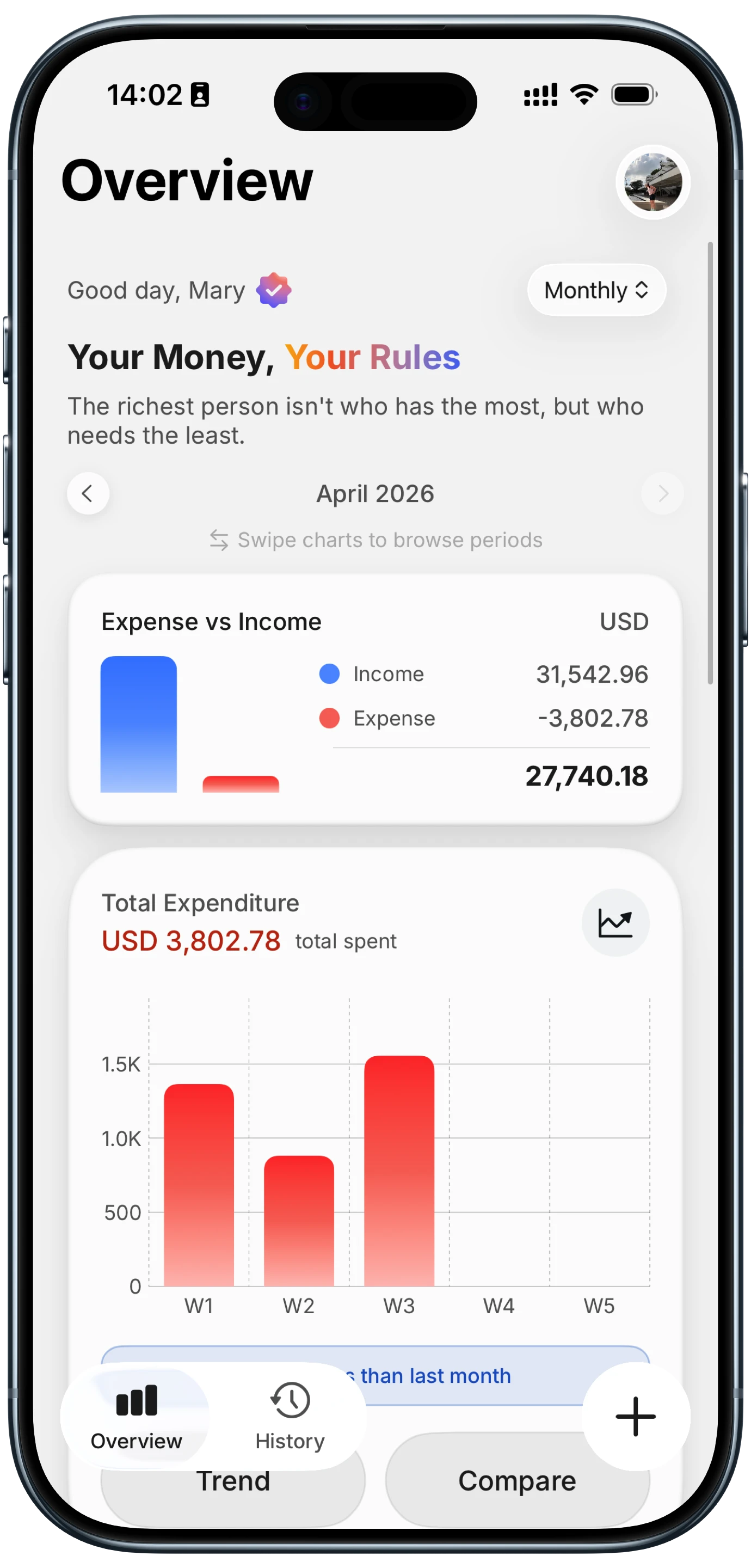
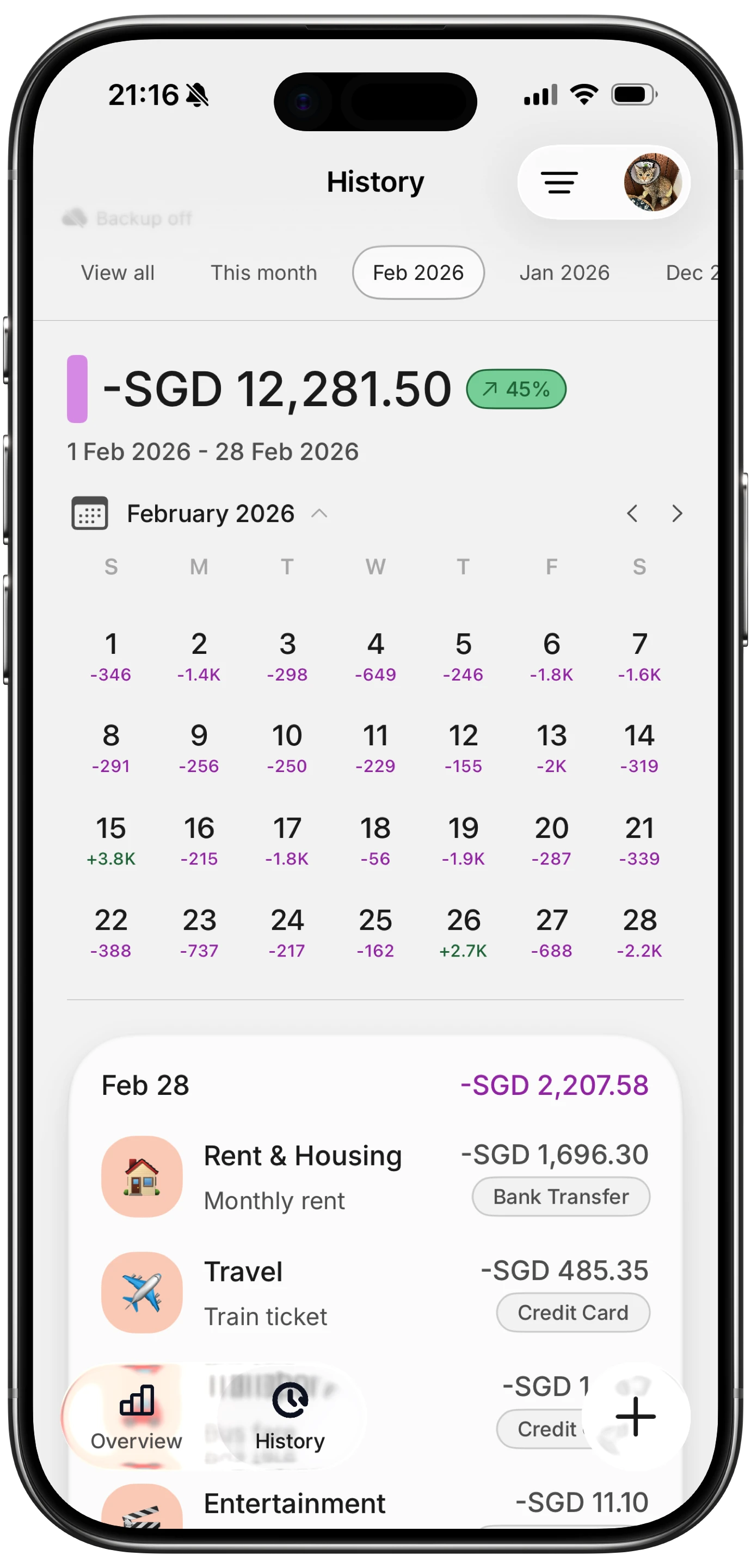
One practical approach is to treat your savings contributions like any other transaction. When you transfer $500 to your high-yield savings account, log it in your expense tracker. This makes your savings activity visible alongside your regular spending, so you can see exactly how much you are setting aside each month.
Here is why this matters:
Visibility creates accountability. If your savings transfers show up in your transaction history, you notice when you skip a month. If they live in a separate banking app you rarely open, missed contributions are easy to overlook.
You can track progress toward goals. By categorizing savings contributions, whether for an emergency fund, a down payment, or a vacation, you can see cumulative progress over time. A category labeled "Emergency Fund" that shows $500 per month for six months tells you exactly where you stand.
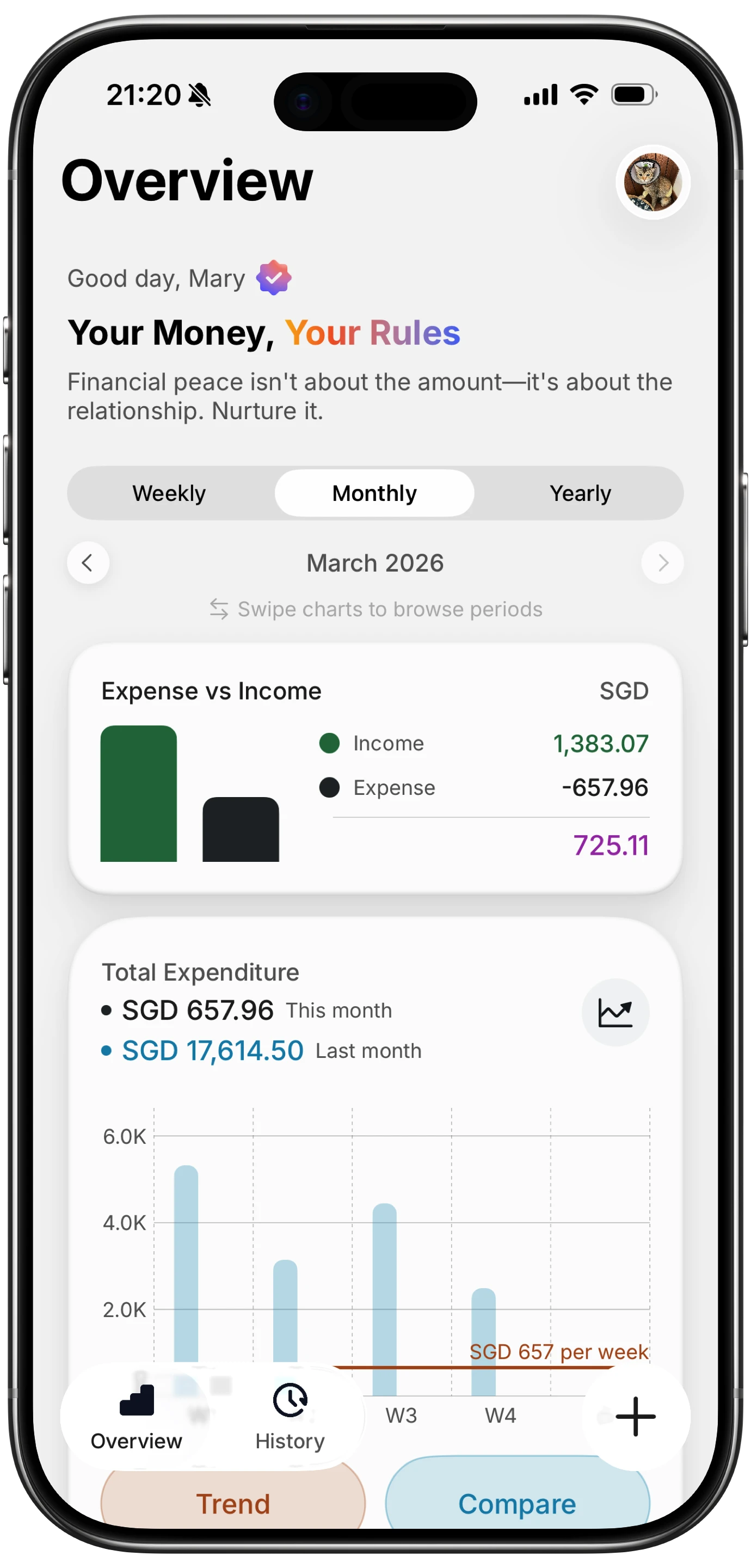
It reveals your true savings rate. Your savings rate is not just what is left over after spending. It is an intentional allocation. Tracking contributions as transactions lets you calculate your actual savings rate: total savings contributions divided by total income.
Finny app's Overview feature
In Finny, you can create custom categories for different savings goals and log each contribution. Your spending analytics then show savings trends alongside spending trends, giving you a complete picture of where your money goes. This is especially useful when you have multiple savings goals running in parallel, like an emergency fund in one high-yield account and a travel fund in another.
For a step-by-step approach to building your emergency savings, see our guide on how to build an emergency fund.
How Much Should You Keep in a High-Yield Savings Account
A high-yield savings account is ideal for money you need to keep safe and accessible. This typically includes:
Emergency fund. Three to six months of essential expenses. This is the most common and most important use case. A high-yield account earns interest while keeping the money liquid for genuine emergencies.
Short-term savings goals. Money you plan to spend within the next one to three years: a vacation, a car down payment, a wedding, or a home repair fund. These amounts are too large to leave in checking but too soon-needed to invest in the stock market.
Cash buffer. Some people keep one to two months of expenses as a buffer beyond their emergency fund. This covers timing gaps between paychecks and irregular expenses.
Money you will not need for five or more years is generally better off invested, where it has the potential to earn higher returns despite short-term volatility. A high-yield savings account is for the money you cannot afford to lose.
Common Mistakes to Avoid
Ignoring Rate Changes
Your high-yield savings rate will change over time. Check it quarterly. If your bank has dropped significantly below competitors, it may be worth switching, but only if the difference is meaningful on your balance.
Keeping Too Much Cash
Earning 4.50% is better than 0.05%, but it still underperforms long-term investment returns of 7% to 10% historically. Do not let the comfort of a high-yield account keep you from investing money you will not need for years.
Forgetting About Taxes
Interest earned in a high-yield savings account is taxable income. You will receive a 1099-INT if you earn more than $10 in interest. Factor this into your expectations, especially on larger balances.
Not Automating Contributions
The most effective savings strategy is one you do not have to think about. Set up automatic transfers from your checking account to your high-yield savings on payday. If you rely on manual transfers, life will get in the way.
The Bottom Line
A high-yield savings account is one of the simplest financial upgrades you can make. It takes the money you are already saving and makes it work harder, without adding risk, complexity, or lock-in periods. In the current rate environment, the difference between a traditional savings account and a high-yield one can amount to hundreds of dollars per year on a modest balance.
The key is not just opening the account but building a consistent contribution habit and tracking your progress. Treating savings transfers as logged transactions, alongside your regular spending, keeps your goals visible and your savings rate honest.
Common Questions About High-Yield Savings Accounts
What is a high-yield savings account in simple terms?
A high-yield savings account is a bank account that pays a much higher interest rate than a traditional savings account. It works the same way: you deposit money, earn interest, and withdraw when needed. The higher rate means your money grows faster while staying safe and accessible.
Are high-yield savings accounts safe?
Yes. High-yield savings accounts at FDIC-insured banks or NCUA-insured credit unions protect your deposits up to $250,000. This is the same insurance that covers traditional bank accounts. Your money is not at risk.
How much interest will I earn on $10,000 in a high-yield savings account?
At a 4.50% APY, a $10,000 balance earns approximately $450 in one year. At a traditional savings rate of 0.05%, the same balance earns about $5. The exact amount depends on the current rate and whether interest compounds daily or monthly.
Can I lose money in a high-yield savings account?
You cannot lose your deposited principal in an FDIC or NCUA insured account. However, if inflation exceeds your interest rate, the purchasing power of your money may decline over time. This is true of all savings accounts, not unique to high-yield ones.
How often do high-yield savings rates change?
Rates are variable and can change at any time. Banks typically adjust rates in response to Federal Reserve policy changes. You might see your rate shift several times per year. Always check whether an advertised rate is standard or a limited-time promotional offer.
Should I have multiple high-yield savings accounts?
Multiple accounts can help if you want to separate savings goals, like keeping an emergency fund apart from a vacation fund. Some banks offer sub-accounts or buckets within a single account, which achieves the same separation without the hassle of managing accounts at different institutions.
Ready to track your savings alongside your spending?
Download Finny to log savings contributions, categorize them by goal, and see your full financial picture in one place. No bank connections required, just clear visibility into where your money goes.