Credit card offers advertise a 24.99% APR. Your savings account promises a 4.50% APY. Both numbers describe interest rates, but they are not the same thing. Confusing the two can lead you to underestimate what you owe on debt or overestimate what you earn on savings.
APR vs APY is one of the most practical distinctions in personal finance, yet most people treat the two terms as interchangeable. Understanding the difference comes down to one concept: compounding. This guide breaks down both terms with real numbers, explains when each one matters, and shows how logging interest payments as expenses gives you a complete picture of borrowing costs. For a broader look at managing your money, see our complete guide to personal finance.
What Is APR
APR stands for Annual Percentage Rate. It represents the yearly cost of borrowing money, expressed as a simple percentage. APR does not account for compounding within the year. It tells you the base rate a lender charges, plus certain fees, spread evenly across twelve months.
If a credit card has a 24% APR, the monthly rate is 2% (24 divided by 12). If a personal loan has an 8% APR, the monthly rate is roughly 0.67%. Lenders are required by the Truth in Lending Act to disclose APR so borrowers can compare loan products on a standardized basis.
APR appears most often in:
- Credit cards: The rate applied to carried balances
- Mortgages: The cost of the loan including origination fees
- Auto loans: The interest rate on your car financing
- Personal loans: The annual rate on unsecured borrowing
- Student loans: Both federal and private loan rates
The simplicity of APR makes it useful for comparison shopping. When two credit cards show 19.99% APR and 24.99% APR, you know which one charges less, at least before compounding enters the picture.
What Is APY
APY stands for Annual Percentage Yield. Unlike APR, APY includes the effect of compounding. It tells you what you actually earn (or owe) over a full year when interest is calculated on previously accumulated interest.
Banks use APY when advertising savings accounts, certificates of deposit, and money market accounts. A savings account offering 4.50% APY will yield slightly more than a simple 4.50% annual rate because the interest compounds, typically daily or monthly.
APY appears most often in:
- Savings accounts: High-yield and traditional
- Certificates of deposit (CDs): Fixed-term deposits
- Money market accounts: Higher-balance savings vehicles
- Some investment products: Bond yields and similar instruments
The Truth in Savings Act requires banks to disclose APY so consumers can compare deposit products accurately. This is the mirror image of APR disclosure for loans: one protects borrowers, the other protects savers.
How Compounding Creates the Difference
The core distinction between APR and APY is compounding. APR assumes interest is calculated once per year. APY reflects interest being calculated multiple times per year, with each calculation building on the previous balance.
Here is the formula that connects them:
APY = (1 + r/n)^n - 1
Where r is the nominal annual rate (APR expressed as a decimal) and n is the number of compounding periods per year.
A Savings Example
Suppose you deposit $10,000 in a savings account with a 5% nominal rate that compounds monthly.
- APR (nominal rate): 5.00%
- Monthly rate: 5% / 12 = 0.4167%
- APY: (1 + 0.05/12)^12 - 1 = 5.116%
After one year, your balance would be $10,511.62, not $10,500. That extra $11.62 comes from earning interest on interest each month. The gap seems small on $10,000, but it grows significantly with larger balances and longer time horizons.
A Credit Card Example
Now consider a credit card with a 24% APR that compounds daily.
- APR: 24.00%
- Daily rate: 24% / 365 = 0.0658%
- Effective APY: (1 + 0.24/365)^365 - 1 = 27.11%
If you carry a $5,000 balance for a full year without making payments, you would owe roughly $6,355 rather than $6,200. The effective annual cost is 27.11%, not 24%. Credit card companies advertise the lower APR number, but the compounding effect means you pay more than that headline rate suggests.
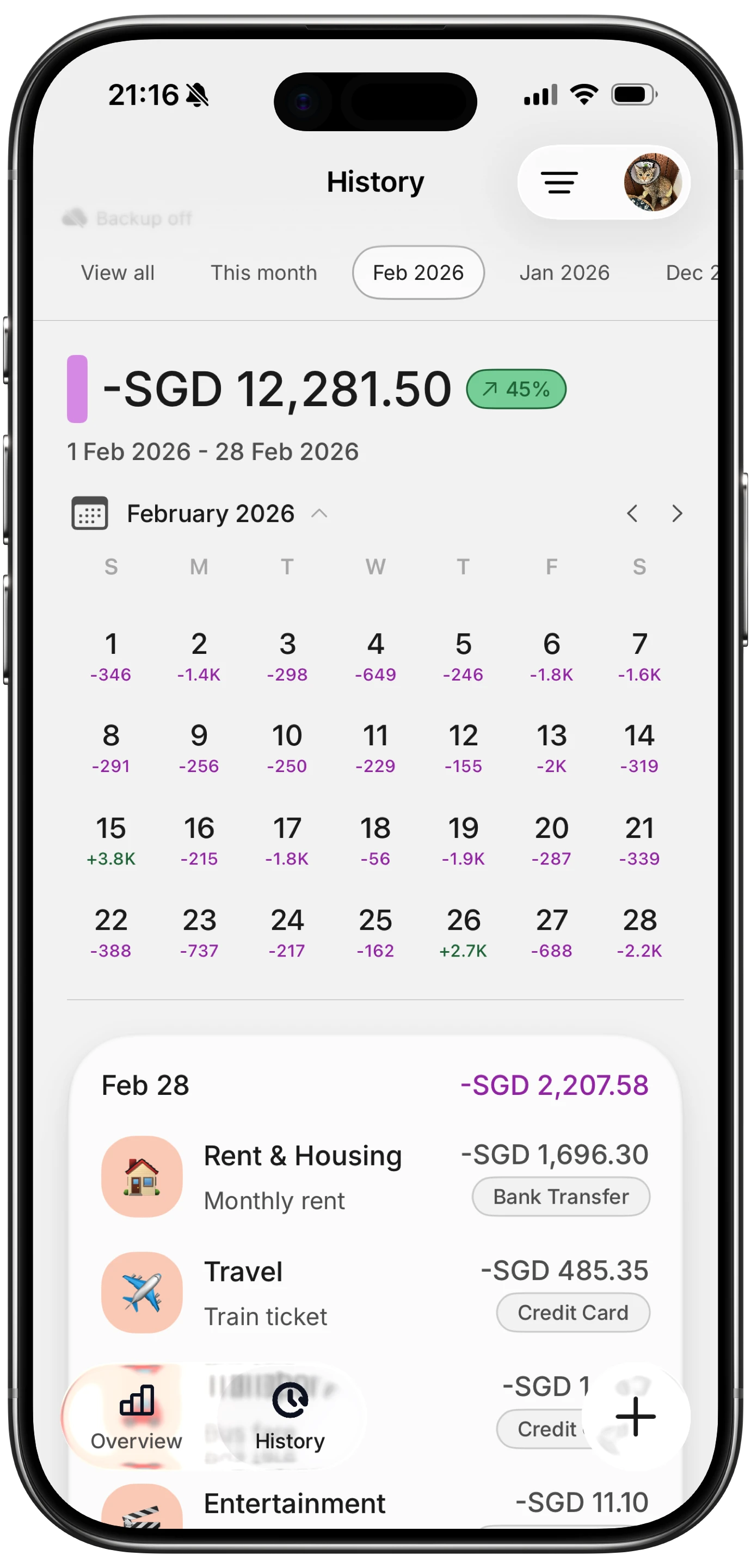
Finny app's History calendar feature
APR vs APY: Side-by-Side Comparison
| Feature | APR | APY |
|---|---|---|
| Stands for | Annual Percentage Rate | Annual Percentage Yield |
| Includes compounding | No | Yes |
| Typically used for | Loans and credit cards | Savings and deposits |
| Required disclosure | Truth in Lending Act | Truth in Savings Act |
| Which is higher | Lower than effective rate | Higher than nominal rate |
| Best for comparing | Borrowing costs | Savings returns |
The key takeaway: when you borrow, lenders show APR (the lower-looking number). When you save, banks show APY (the higher-looking number). Both practices are legal and standardized, but they work in the institution's favor from a marketing perspective.
When APR Matters Most
APR is the number to focus on when you are taking on debt. Here are the situations where APR drives your decisions.
Choosing a Credit Card
Credit card APRs typically range from 16% to 30%. If you carry a balance month to month, even a few percentage points matter. A $5,000 balance at 20% APR costs roughly $83 per month in interest. At 28% APR, that jumps to $117 per month. Over a year, the difference is about $400.
If you pay your balance in full each month, APR is irrelevant because you never incur interest charges. For strategies on controlling spending and avoiding carried balances, see our guide on how to stop overspending.
Comparing Mortgage Offers
Mortgage APR includes not just the interest rate but also origination fees, discount points, and certain closing costs. Two lenders might offer the same 6.5% interest rate, but if one charges $3,000 more in fees, its APR will be higher. Always compare mortgage APR, not just the base interest rate.
Evaluating Personal and Auto Loans
For installment loans with fixed payment schedules, APR gives you a reliable comparison metric. A 36-month auto loan at 7% APR will cost less in total interest than the same loan at 9% APR, assuming identical terms.
When APY Matters Most
APY is the number to watch when your money is earning interest.
Picking a Savings Account
High-yield savings accounts currently offer APYs ranging from 4% to 5%. The difference between 4.00% APY and 4.50% APY on a $20,000 emergency fund is $100 per year. That adds up over time, especially as your savings grow.
For more on building your savings, see our guide on how to build an emergency fund.
Comparing CD Rates
CDs lock your money for a fixed term in exchange for a guaranteed rate. Because early withdrawal penalties apply, choosing the right APY upfront matters. A 12-month CD at 4.75% APY beats one at 4.50% APY by $25 per $10,000 deposited.
Understanding Compound Interest Over Time
The power of APY becomes dramatic over longer periods. A $10,000 investment earning 7% APY (compounded monthly) grows to:
- 5 years: $14,176
- 10 years: $20,097
- 20 years: $40,387
- 30 years: $81,165
The same $10,000 at a simple 7% annual rate (no compounding) would only reach $31,000 after 30 years. That $50,000 gap is entirely the result of compounding. For a deeper look at how this works, see our guide on compound interest definitions and formulas.
How to Compare APR and APY Across Products
When you encounter interest rates from different sources, convert everything to the same measure before comparing.
Converting APR to APY
Use the formula: APY = (1 + APR/n)^n - 1
For a credit card with 22% APR compounding daily: APY = (1 + 0.22/365)^365 - 1 = 24.60%
Converting APY to APR
Use the reverse formula: APR = n x [(1 + APY)^(1/n) - 1]
For a savings account with 4.50% APY compounding monthly: APR = 12 x [(1 + 0.045)^(1/12) - 1] = 4.41%
Practical Rules of Thumb
- For daily compounding, APY is roughly 0.5 to 3 percentage points higher than APR, depending on the rate
- For monthly compounding, the gap is slightly smaller
- At low rates (under 5%), the difference between APR and APY is modest
- At high rates (above 20%), the difference becomes significant
Tracking Interest Payments as Expenses
Most people know their loan APR but have no idea how much they actually pay in interest each month. This is where expense tracking changes the picture.
Interest charges on credit cards, student loans, auto loans, and mortgages are real costs that reduce your available income. Logging them as expenses alongside groceries, rent, and utilities reveals the true weight of debt in your budget.
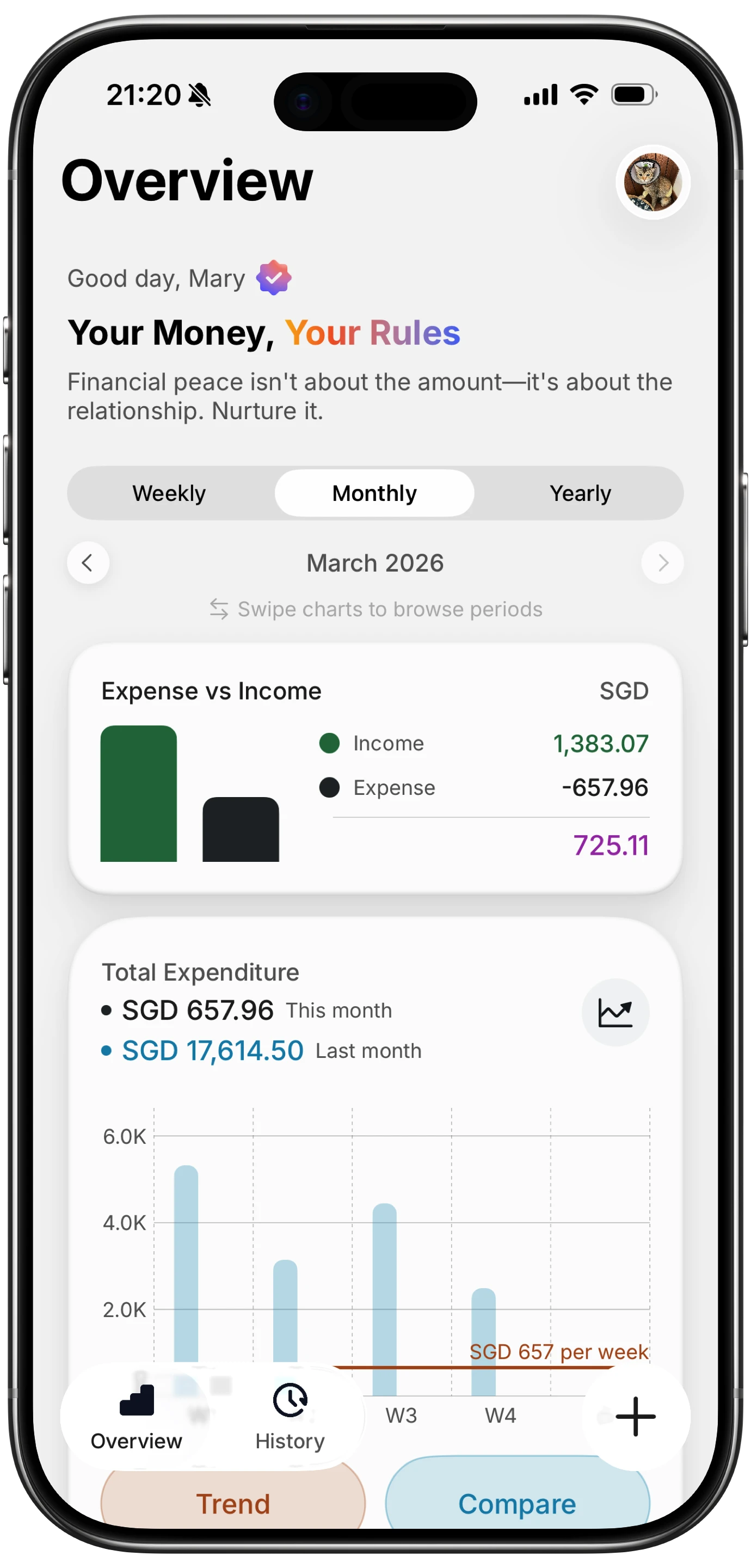
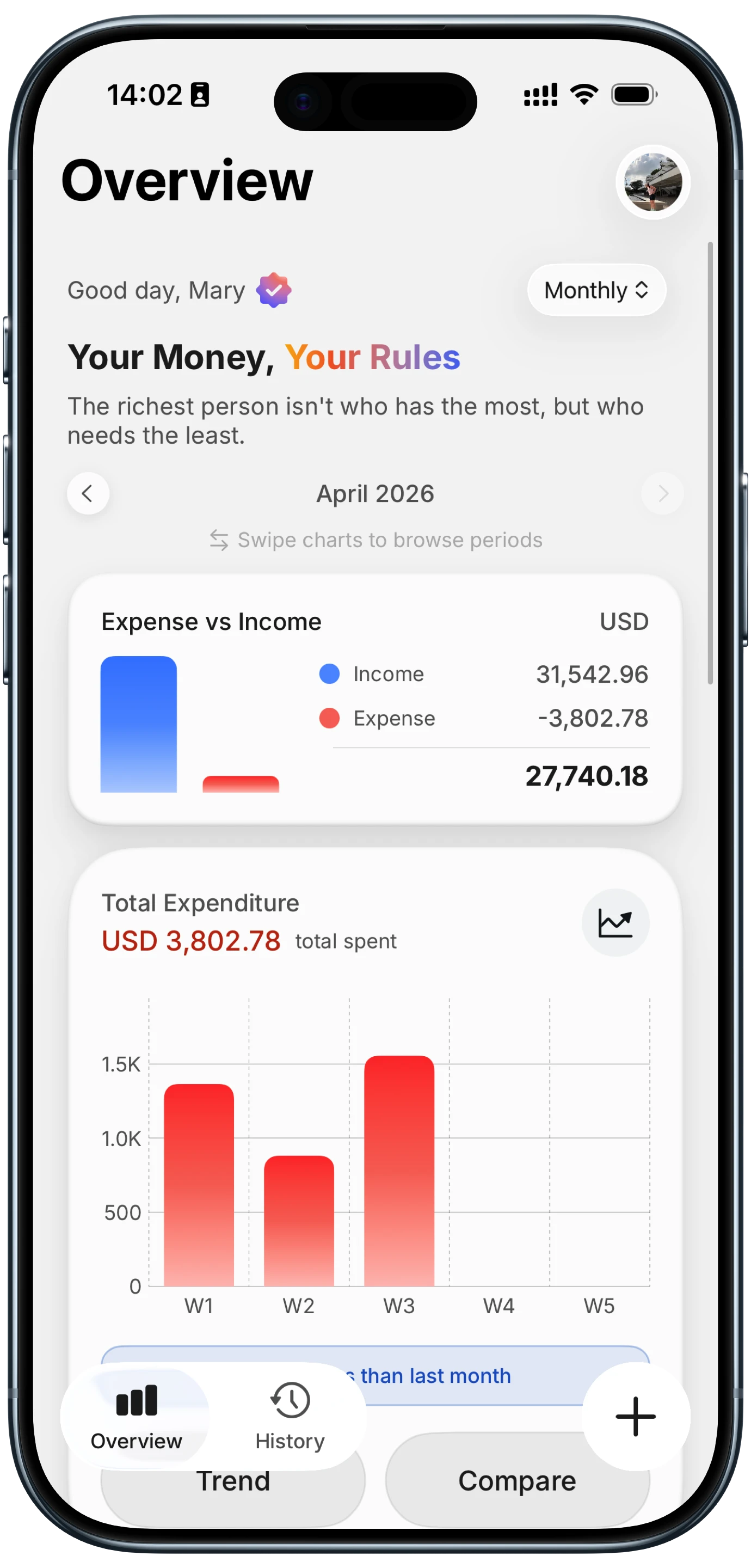
Finny app's Overview feature
Why This Matters
Consider someone with:
- A mortgage at 6.5% APR ($1,200/month payment, roughly $850 of which is interest initially)
- A car loan at 7% APR ($450/month payment, roughly $145 in interest)
- Credit card debt at 24% APR ($200/month in interest charges)
That is $1,195 per month going to interest alone. Without tracking these as expenses, this person might think their monthly spending is lower than it actually is. They see the loan payments but do not isolate the interest portion, which is money that builds no equity and buys nothing tangible.
How to Track Interest in Finny
Using Finny, you can create a category for interest expenses and log each month's interest charges. Over time, your spending analytics will show exactly how much of your income goes to interest. This visibility often motivates faster debt payoff because the cost becomes concrete rather than abstract.
You can log interest charges quickly using text input. Type something like "credit card interest $187" and let the AI categorize it. This takes seconds and builds a clear record over time.
The Bottom Line
APR tells you the base annual cost of borrowing without compounding. APY tells you the effective annual return (or cost) with compounding included. Lenders advertise APR because it looks lower. Banks advertise APY because it looks higher. Neither is dishonest, but understanding the distinction protects you from misleading comparisons.
For borrowing decisions, compare APR across similar loan products. For savings decisions, compare APY. When the compounding frequency differs between products, convert to the same measure before deciding.
Most importantly, do not stop at knowing your rates. Track what you actually pay in interest each month. The percentage on your loan agreement is theoretical. The dollars leaving your account are real. Logging interest as an expense alongside your other spending gives you the full picture of what debt costs and how aggressively to pay it down.
Common Questions About APR vs APY
What is the difference between APR and APY in simple terms?
APR is the annual interest rate without compounding. APY is the annual rate with compounding included. APY is always equal to or higher than APR for the same nominal rate. Lenders use APR for loans, and banks use APY for savings accounts.
Why do credit cards use APR instead of APY?
Credit card companies are required by the Truth in Lending Act to disclose APR. Since APR does not include compounding, it appears lower than the effective annual cost. If a card has a 24% APR with daily compounding, the true annual cost (APY) is about 27%. Showing APR is legally compliant but benefits the lender's marketing.
Does APR or APY matter more for savings accounts?
APY matters more for savings because it reflects what you actually earn. A savings account advertising 4.50% APY will pay you exactly that over a year, assuming you leave the balance untouched. The underlying APR would be slightly lower, around 4.41% with monthly compounding.
How can I calculate the real cost of my credit card debt?
Take your credit card's APR and convert it to APY using the formula: APY = (1 + APR/365)^365 - 1. For a 24% APR card, the real annual cost is about 27.11%. Then multiply your average balance by this rate to estimate your yearly interest expense. Tracking these charges monthly in an expense app makes the cost visible and actionable.
Is a higher APY always better for savings?
A higher APY means more interest earned, so yes, it is generally better for savings. However, check for conditions like minimum balance requirements, introductory rate periods, or withdrawal limits. A 5% APY that requires a $25,000 minimum balance may not suit everyone. Compare the full terms, not just the headline rate.
Ready to see exactly what your debt costs each month?
Download Finny to log interest payments alongside everyday expenses. With AI-assisted input and clear spending analytics, you get a complete picture of where your money goes, including the hidden cost of borrowing.