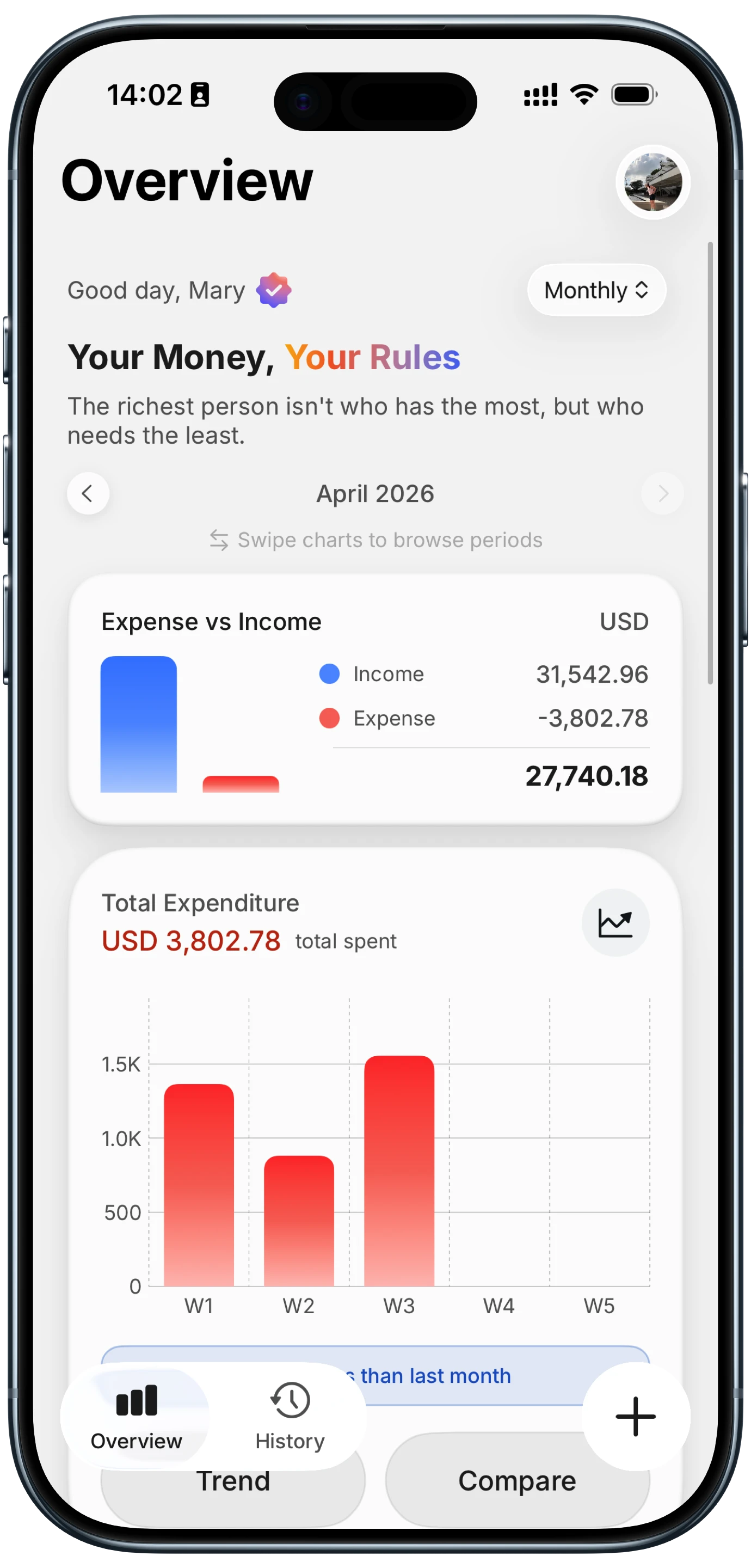
You earned $5,000 last month. You also spent $5,200. On paper, you have a solid income. In practice, you went backward. This is the gap between income and cash flow, and it is the number that actually determines whether your finances are improving or quietly deteriorating.
Cash flow is the difference between money coming in and money going out over a given period. It is a concept borrowed from business finance, but it applies just as directly to personal money management. Understanding yours is the first step toward making better financial decisions. For a broader look at managing your finances, see our complete guide to personal finance.
What Is Cash Flow in Personal Finance
Personal cash flow measures the net movement of money through your accounts during a specific time frame, usually a month. It is calculated with a simple formula:
Cash Flow = Total Income - Total Expenses
If you earn $4,500 after taxes and spend $3,800, your cash flow is positive $700. That $700 is money available for saving, investing, or paying down debt. If you earn the same $4,500 but spend $4,900, your cash flow is negative $400. You covered the gap with savings, credit, or borrowed money.
The concept is straightforward, but most people never calculate it. They focus on income alone and assume that earning more will solve their financial problems. It often does not, because spending tends to rise alongside income. This pattern, sometimes called lifestyle inflation, is why high earners can still live paycheck to paycheck.
Positive vs Negative Cash Flow
Positive Cash Flow
Positive cash flow means you spend less than you earn. The surplus gives you options:
- Build an emergency fund for unexpected expenses
- Pay down debt faster than the minimum payments require
- Invest for long-term goals like retirement or a home
- Create sinking funds for planned irregular expenses
Positive cash flow does not require a high income. Someone earning $3,500 with $3,000 in expenses has better cash flow than someone earning $8,000 with $7,800 in expenses. The first person has $500 in monthly flexibility. The second has $200.
Negative Cash Flow
Negative cash flow means you spend more than you earn. The shortfall has to come from somewhere:
- Drawing down savings
- Using credit cards
- Taking on new debt
- Skipping bills or payments
Occasional negative cash flow happens. A car repair or medical bill can push a single month into the red. The problem is sustained negative cash flow, where spending exceeds income month after month. This erodes savings and accumulates debt, often without the person realizing how quickly the situation is worsening.
For strategies on curbing excess spending, see our guide on how to stop overspending.
Why Cash Flow Matters More Than Income
Income is one number. Cash flow is the relationship between two numbers. That relationship tells you far more about financial health than income alone.
Income Can Be Misleading
A $90,000 salary sounds comfortable. But after taxes, retirement contributions, health insurance, a mortgage, two car payments, childcare, and student loans, the actual money available for daily life might be surprisingly thin. Gross income tells you what your employer pays. Cash flow tells you what you actually have to work with.
Cash Flow Reveals Patterns
Tracking cash flow over several months reveals trends that a single income figure cannot. You might notice:
- Certain months are consistently negative (holidays, back-to-school, insurance renewals)
- Your cash flow improved after canceling unused subscriptions
- A side income source barely covers the expenses it creates
- Small daily purchases add up to a significant monthly drain
Cash Flow Drives Wealth Building
Wealth is not built by earning money. It is built by keeping and growing money. A person with modest income and consistently positive cash flow will, over time, accumulate more wealth than a high earner with consistently negative or zero cash flow. The math is straightforward: you can only save and invest what you do not spend.
How to Calculate Your Personal Cash Flow
Calculating cash flow requires two things: knowing what comes in and knowing what goes out. Most people have a reasonable handle on the first part. The second is where things get unclear.
Step 1: Add Up All Income Sources
Include everything that puts money into your accounts during the month:
- Net salary or wages (after tax)
- Freelance or side income
- Investment dividends or interest
- Rental income
- Government benefits
- Any other recurring income
Use after-tax, take-home amounts. Gross income overstates what you actually receive.
Step 2: Add Up All Expenses
This is the harder part. Expenses fall into three categories:
Fixed expenses stay roughly the same each month:
- Rent or mortgage
- Insurance premiums
- Loan payments
- Subscriptions
Variable expenses change month to month:
- Groceries
- Utilities
- Transportation (gas, transit)
- Dining out
- Entertainment
Irregular expenses occur less frequently:
- Car maintenance
- Medical copays
- Annual subscriptions
- Gifts
- Travel
The irregular category is where most people underestimate. A $1,200 car repair and $800 in holiday gifts might only happen once a year, but they add $167 per month to your true average spending.
Step 3: Subtract Expenses from Income
The result is your monthly cash flow. If the number is positive, you have a surplus. If it is negative, you have a deficit. If it is close to zero, you are living right at your means with no margin for error.
| Category | Monthly Amount |
|---|---|
| Take-home income | $4,500 |
| Fixed expenses | -$2,100 |
| Variable expenses | -$1,200 |
| Irregular expenses (averaged) | -$400 |
| Cash flow | $800 |
This $800 is the real number that matters. It is what you can direct toward your financial goals each month.
Why Daily Expense Tracking Reveals Your Real Cash Flow
The calculation above works in theory. In practice, most people cannot accurately estimate their variable and irregular expenses from memory. Studies consistently show that people underestimate their spending by 20-40%.
This is where daily expense tracking changes the picture.
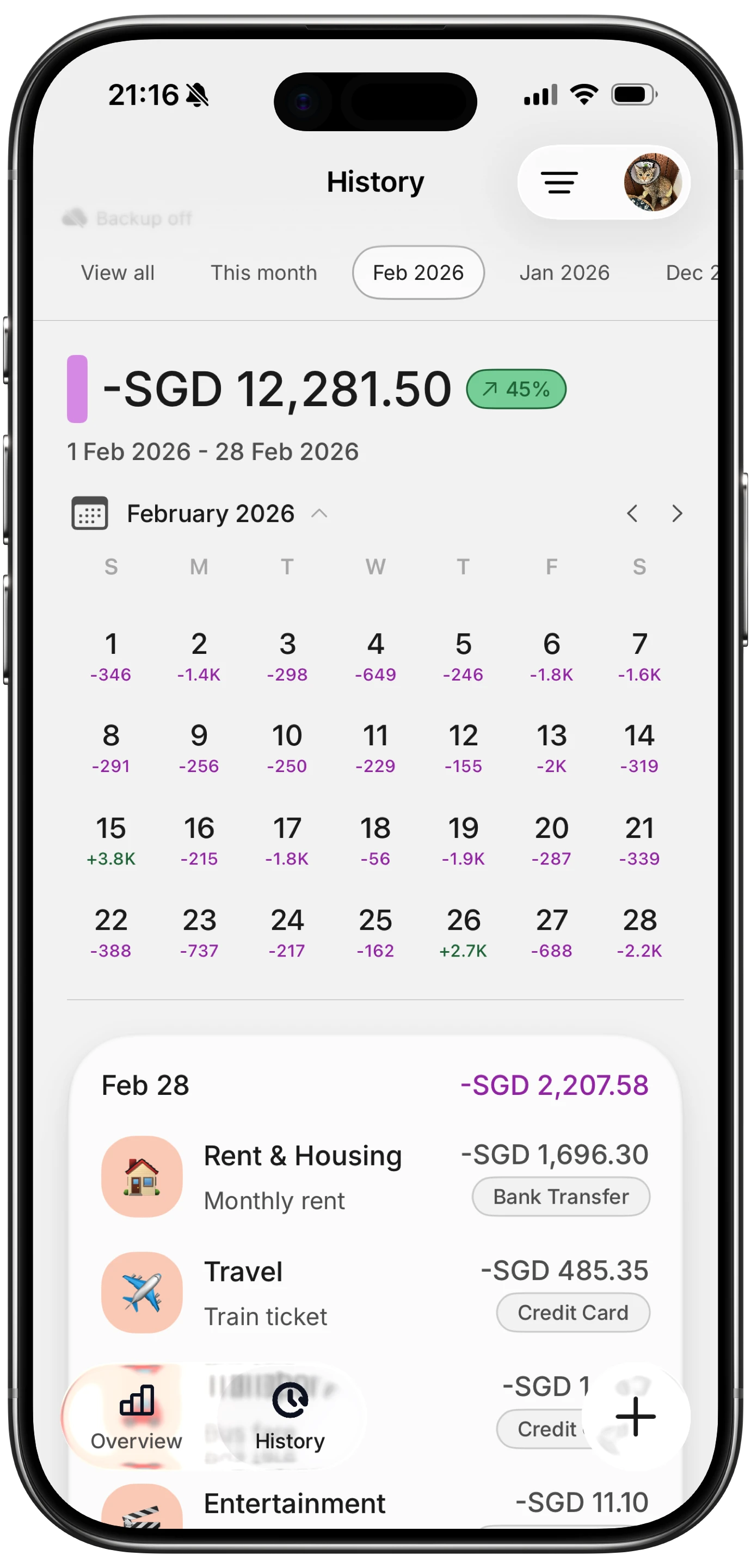
Finny app's History calendar feature
The Memory Gap
You remember paying rent. You remember your car payment. You probably do not remember the $4.50 coffee, the $12 lunch, the $8 app subscription you forgot about, or the $35 impulse buy at the store. These small transactions are easy to overlook individually, but they compound into hundreds of dollars each month.
Tracking Closes the Gap
When you log expenses daily, you capture everything. After a full month, you have an accurate picture of where your money went, not an estimate or a guess. This accurate picture often surprises people. Common realizations include:
- Food spending (groceries plus dining out) is 30-50% higher than expected
- Subscriptions add up to more than anticipated
- "Small" purchases account for a significant portion of total spending
- Certain categories vary wildly from month to month
From Tracking to Cash Flow Awareness
Once you have a month of tracked expenses, calculating cash flow becomes straightforward. You have real data instead of estimates. After two or three months, you can identify your average cash flow and spot the categories where spending is highest.
Finny makes this process low-friction. You can log expenses through text, voice, or receipt scanning, so capturing transactions takes seconds rather than minutes. The goal is to make daily tracking easy enough that you actually do it consistently.
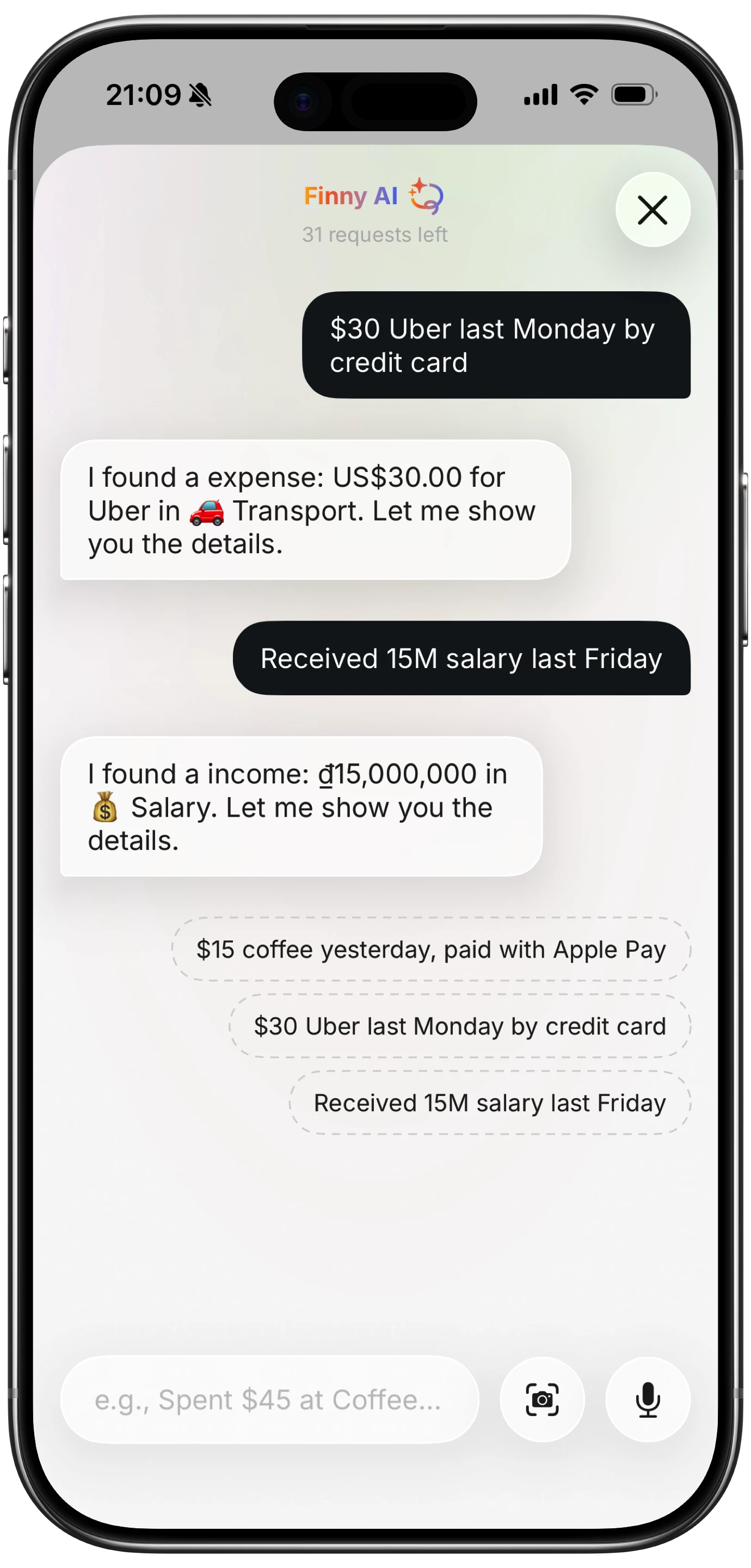
Finny app's AI chat feature
For a deeper look at building a daily tracking habit, see our guide on how to track daily spending. If you want an app purpose-built for monitoring cash flow, our roundup of the best cash flow tracking apps in 2026 compares the top options.
How to Improve Your Cash Flow
Once you know your cash flow number, you can work on improving it. The options fall into two categories: increasing income or decreasing expenses. Most people have more immediate control over the second.
Reduce Variable Expenses
Variable expenses are the most flexible part of your budget. Look for areas where small changes create meaningful savings:
- Cook at home more often and reduce dining out
- Switch to a cheaper phone plan
- Cancel subscriptions you do not actively use
- Use a grocery list to avoid impulse purchases
- Batch errands to save on transportation costs
Smooth Out Irregular Expenses
Irregular expenses cause cash flow spikes that can push otherwise healthy months into negative territory. Setting up sinking funds for predictable irregular costs (insurance, maintenance, gifts) converts large occasional expenses into small monthly contributions, keeping your cash flow more stable.
Increase Income Strategically
Additional income improves cash flow only if the new earnings are not absorbed by new spending. A side job that nets $500 per month improves cash flow by $500 only if your expenses stay the same. If the extra work leads to more convenience spending, the net improvement shrinks.
Automate the Surplus
Once you have positive cash flow, automate what happens with it. Set up automatic transfers to savings or investment accounts on payday. If the surplus leaves your checking account before you can spend it, your cash flow improvement translates directly into wealth building.
Cash Flow and Budgeting: How They Connect
A budget is a plan for your cash flow. It allocates your income to specific categories before you spend it, giving every dollar a purpose. Cash flow tracking tells you what actually happened. Budgeting tells you what you intended to happen.
The two work best together. Your budget sets targets. Your expense tracking measures reality. The gap between the two shows where adjustments are needed.
You do not need a complex budgeting system to benefit from cash flow awareness. Even a simple approach, like the 50/30/20 rule (50% needs, 30% wants, 20% savings), gives structure to your cash flow. The key is tracking well enough to know whether you are following the plan.
For budgeting methods that pair well with cash flow tracking, see our guide on budgeting for beginners.
The Bottom Line
Cash flow is the single most important number in personal finance. It tells you whether your financial situation is improving or declining, regardless of how much you earn. A high income with negative cash flow leads to debt. A modest income with positive cash flow leads to savings, investments, and financial stability.
Calculating your cash flow requires knowing what you spend, and knowing what you spend requires tracking it. The gap between estimated and actual spending is where most people lose control of their finances. Daily expense tracking, even with a simple app, closes that gap and gives you the data to make informed decisions.
You do not need to track every penny forever. But tracking consistently for a few months reveals your real cash flow, highlights the spending categories that matter most, and gives you a foundation for building a budget that actually works.
Common Questions About Cash Flow
What is personal cash flow in simple terms?
Personal cash flow is the money left over after subtracting all your expenses from your total income. Positive cash flow means you have money to save or invest. Negative cash flow means you are spending more than you earn and covering the gap with savings or debt.
How often should I calculate my cash flow?
Monthly is the most practical frequency. Weekly is too granular to show meaningful patterns, and quarterly is too slow to catch problems early. Review your cash flow at the end of each month using your tracked expenses.
Is cash flow the same as savings?
Not exactly. Cash flow is the surplus (or deficit) for a given period. Savings is where that surplus goes. Positive cash flow enables savings, but only if you intentionally direct the surplus rather than letting it get spent.
Can I have a high income and negative cash flow?
Yes. This is more common than most people realize. High earners often have high fixed expenses (mortgage, car payments, private school) that consume most of their income. Cash flow depends on the gap between income and spending, not income alone.
What is a good cash flow percentage?
Aiming to keep at least 15-20% of your take-home income as positive cash flow is a solid target. This means if you earn $5,000 after taxes, your expenses should stay at or below $4,000-$4,250, leaving $750-$1,000 for savings and investments.
Ready to see your real cash flow?
Download Finny to track daily expenses with AI-assisted input, receipt scanning, and visual analytics. No bank connections required, full offline support, and complete control over your financial data. Start tracking today and know exactly where your money goes.