Most budgeting advice sounds reasonable until you try to follow it. Track every cent. Cut out all luxuries. Save half your income. The instructions are either too rigid or too vague, and most people quit within a few weeks.
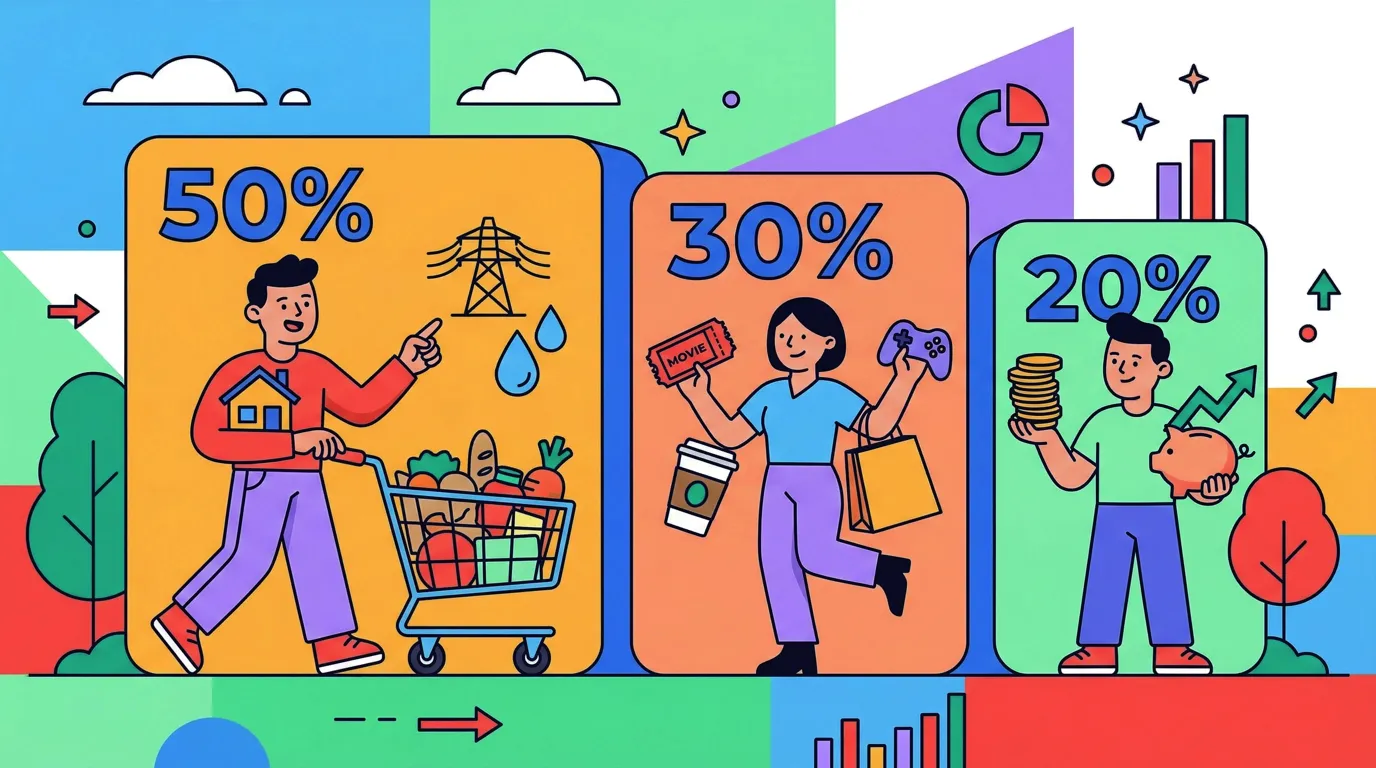
The 50/30/20 rule offers a different approach. Instead of micromanaging every dollar, you split your after-tax income into three broad categories: 50% for needs, 30% for wants, and 20% for savings and debt repayment. It is one of the most widely recommended budgeting frameworks because it balances structure with flexibility.
This guide explains how the 50/30/20 rule works, how to calculate your own split, who it suits best, and where it falls short. If you are new to managing money, our budgeting for beginners guide covers the fundamentals before diving into specific methods.
What Is the 50/30/20 Rule
The 50/30/20 rule is a percentage-based budgeting method that divides your after-tax income into three spending categories. It was popularized by Senator Elizabeth Warren and her daughter Amelia Warren Tyagi in the 2005 book "All Your Worth: The Ultimate Lifetime Money Plan." The idea is simple: rather than assigning every dollar to a line item, you work with three broad buckets.
- 50% Needs: Essential expenses you cannot avoid
- 30% Wants: Non-essential spending that improves quality of life
- 20% Savings and debt repayment: Building financial security
The appeal is its simplicity. You do not need a spreadsheet with forty categories. You need three numbers and the discipline to stay within them.
How to Calculate Your 50/30/20 Split
Start with your after-tax income. This is your take-home pay after federal and state taxes, Social Security, and Medicare are deducted. If you are salaried, check your pay stub for the net amount. If you are self-employed, subtract estimated taxes from gross revenue.
Here is how the math works for a monthly take-home pay of $4,000:
| Category | Percentage | Monthly Amount |
|---|---|---|
| Needs | 50% | $2,000 |
| Wants | 30% | $1,200 |
| Savings/Debt | 20% | $800 |
For a household earning $6,000 after tax:
| Category | Percentage | Monthly Amount |
|---|---|---|
| Needs | 50% | $3,000 |
| Wants | 30% | $1,800 |
| Savings/Debt | 20% | $1,200 |
The calculation itself is straightforward — or you can skip the math entirely and use our 50/30/20 Budget Calculator to see your exact allocation based on your income. The harder part is categorizing your actual spending correctly.
What Counts as Needs, Wants, and Savings
This is where most people get stuck. The line between needs and wants is not always obvious, and being honest about it determines whether the framework works.
Needs (50%)
Needs are expenses required for basic living and obligations you cannot skip without serious consequences:
- Rent or mortgage payments
- Utilities (electricity, water, gas, internet)
- Groceries (basic food, not dining out)
- Health insurance and medical costs
- Minimum debt payments (credit cards, student loans)
- Transportation to work (car payment, gas, public transit)
- Childcare required for employment
- Basic phone plan
The key test: if you did not pay this, would there be a legal, health, or safety consequence? If yes, it is a need.
Wants (30%)
Wants are everything you enjoy but could technically live without:
- Dining out and takeout
- Streaming subscriptions
- Gym memberships
- Hobbies and entertainment
- Clothing beyond basics
- Vacations and travel
- Upgraded phone plans or devices
- Home decor
Wants are not bad. They make life enjoyable. The 50/30/20 rule explicitly protects space for them, which is one reason it is more sustainable than austerity-focused budgets.
Savings and Debt Repayment (20%)
This category builds your financial future:
- Emergency fund contributions
- Retirement account deposits (beyond employer match)
- Extra debt payments above the minimum
- Sinking fund contributions for future goals
- Investment contributions
Note that minimum debt payments fall under needs, not savings. The 20% covers additional payments aimed at reducing debt faster.
How to Apply the 50/30/20 Rule in Practice
Knowing the percentages is one thing. Actually tracking whether you are hitting them requires some method of monitoring your spending.
Step 1: Review Your Current Spending
Before adjusting anything, figure out where your money currently goes. Pull up the last two to three months of expenses and sort them into the three categories. You might discover your needs already consume 65% of income, leaving little room for the ideal split.
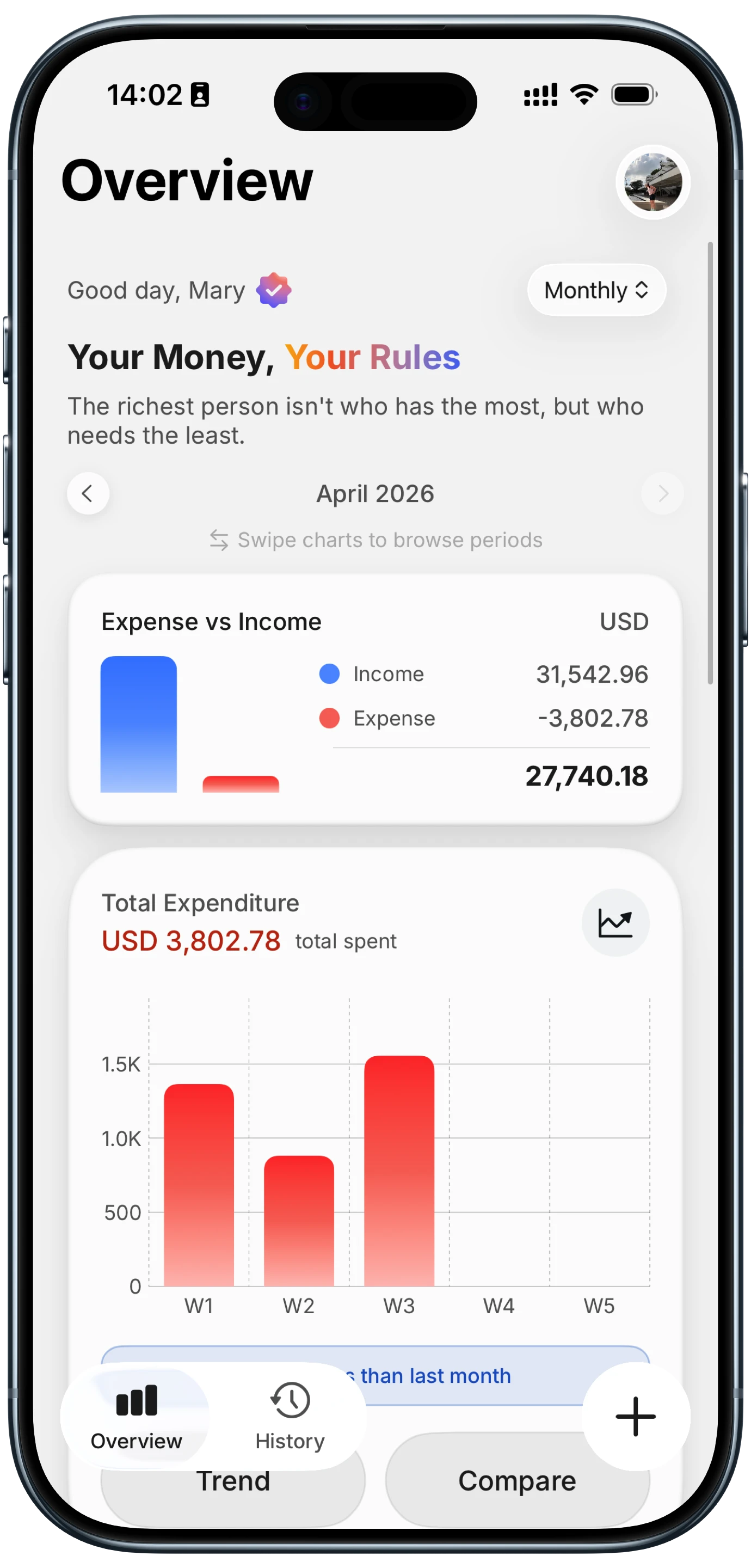
An expense tracking app makes this step significantly easier. If you have been logging spending in Finny, review your history and category totals to see your actual percentages. The AI-assisted input means most transactions are already categorized, saving you the manual sorting effort.
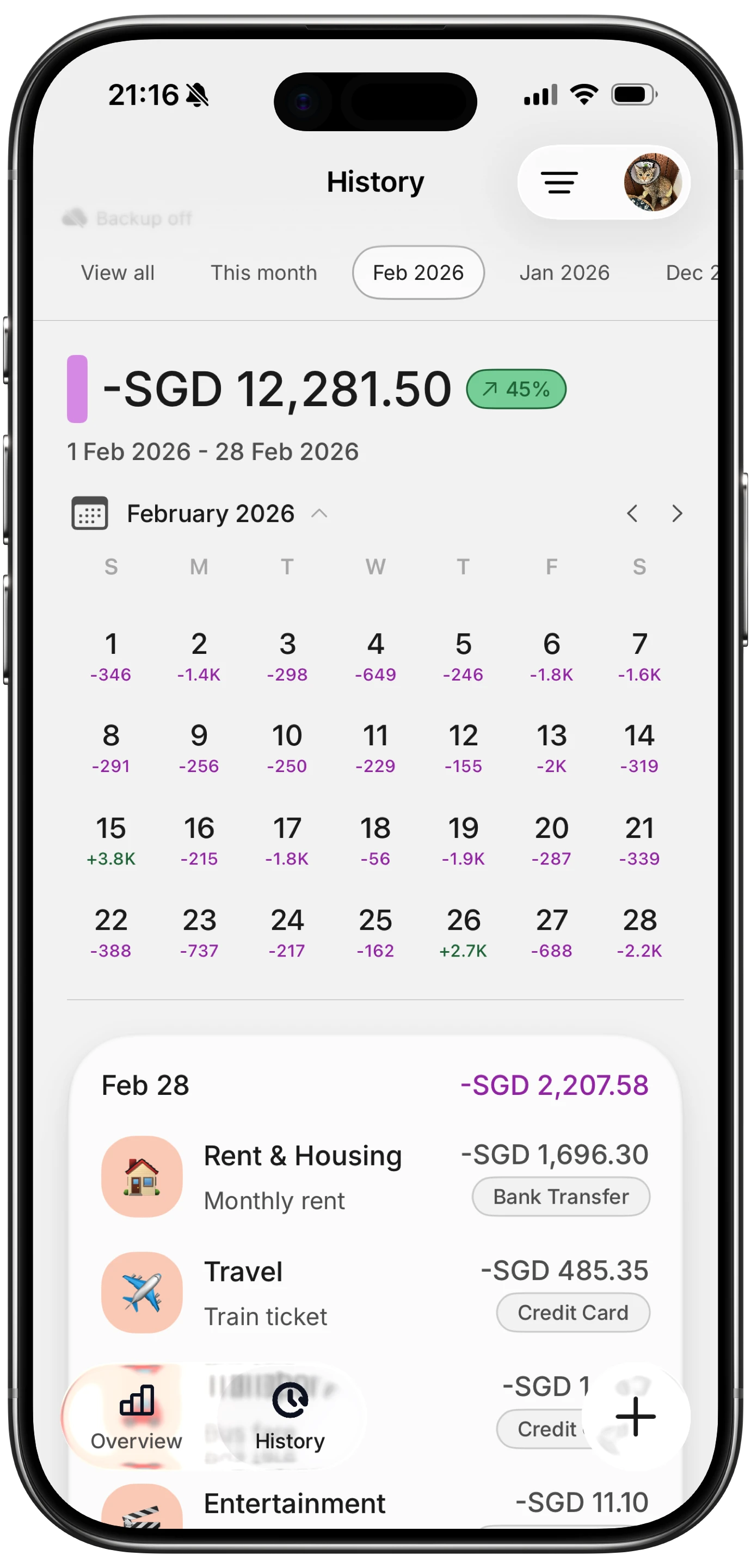
Finny app's History calendar feature
Step 2: Adjust Your Categories
If your current split is far from 50/30/20, do not try to fix everything at once. Focus on the biggest gap first.
- If needs exceed 50%, look for ways to reduce fixed costs (refinance, downgrade plans, find cheaper insurance)
- If wants exceed 30%, identify subscriptions or habits you can trim
- If savings are below 20%, automate a transfer on payday and increase it by 1% each month
Step 3: Track Monthly
At the end of each month, check your three percentages. You do not need to hit them perfectly every time. The goal is a trend in the right direction. For a detailed walkthrough on building a tracking habit, see our guide on how to track expenses.
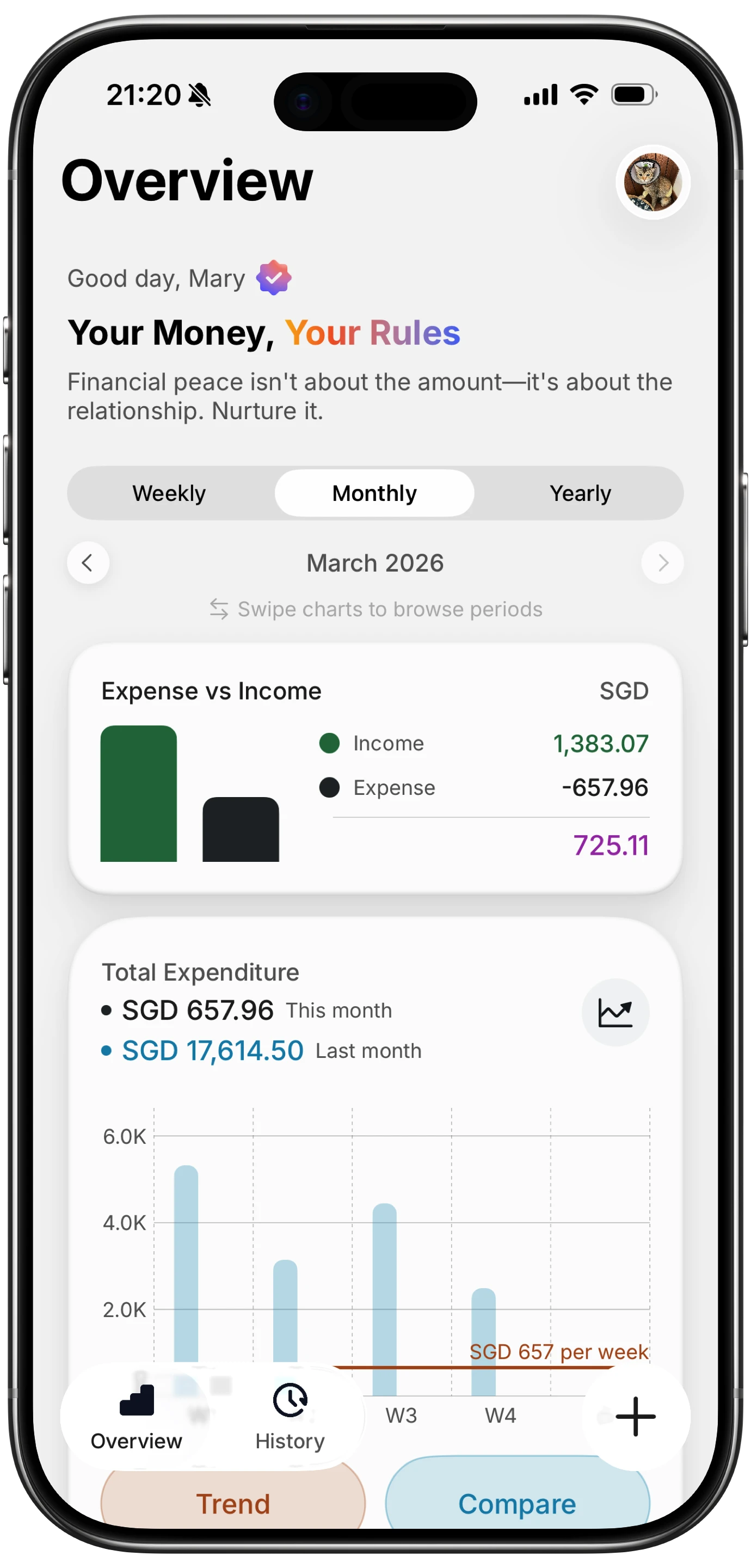
Finny app's Overview feature
Step 4: Reassess When Income Changes
A raise, a job change, or a move to a new city all shift the equation. Recalculate your targets whenever your after-tax income changes by more than 10%.
Pros of the 50/30/20 Rule
Simplicity
Three categories are easier to manage than thirty. You spend less time budgeting and more time living within your budget.
Built-in Balance
Unlike extreme frugality methods, the 50/30/20 rule acknowledges that spending on wants is part of a healthy financial life. This makes it sustainable over years, not just weeks.
Adaptable to Income Changes
Because it uses percentages rather than fixed dollar amounts, the framework scales automatically. A raise means more money in every category, not just discretionary spending.
Low Barrier to Entry
You do not need specialized software, accounting knowledge, or hours of setup. Anyone can start with a calculator and a list of recent expenses.
Cons and Limitations
Not Realistic for High-Cost Areas
If you live in a city where rent alone takes 40% of your income, the 50% needs cap may be impossible. In San Francisco, New York, or London, housing costs can push needs well beyond 50% regardless of how frugal you are elsewhere.
Too Loose for Aggressive Goals
If you want to pay off $50,000 in student loans within two years or retire early, 20% toward savings may not be enough. People pursuing financial independence often save 40% to 60% of their income, which requires a different framework.
Ignores Income Level
The rule treats all incomes the same, but someone earning $30,000 has fundamentally different constraints than someone earning $100,000. At lower incomes, needs may naturally consume 70% or more, making the 50% target unrealistic without structural changes.
Oversimplifies Complex Situations
Irregular income, variable expenses, multiple debt obligations, and household financial dynamics all add complexity that three categories cannot fully capture. For people who need more granular control, zero-based budgeting assigns every dollar a specific purpose.
Who the 50/30/20 Rule Works Best For
This framework is a strong fit if you:
- Are new to budgeting and want a simple starting point
- Have a stable, predictable income
- Live in an area where housing costs are manageable
- Want structure without rigidity
- Have tried detailed budgets before and found them exhausting
It is less ideal if you:
- Have very high or very low income relative to your cost of living
- Are pursuing aggressive debt payoff or early retirement
- Have highly irregular income (freelancers, seasonal workers)
- Need detailed category tracking for business or tax purposes
How Expense Tracking Helps You Stick to the Rule
The 50/30/20 rule is easy to understand but requires consistent tracking to follow. Without knowing where your money goes, you are guessing at your percentages.
Categorize as You Spend
Rather than sorting three months of bank statements at the end of a quarter, log expenses as they happen. Apps with AI-assisted input reduce the friction here. In Finny, you can type, speak, or scan a receipt, and the app suggests a category. You confirm, and the transaction is logged in seconds. This works offline too, so travel or spotty connections do not break your tracking habit.
Review Weekly, Not Just Monthly
A quick weekly check keeps you aware of trends before they become problems. If your wants spending is at 25% halfway through the month, you know to pace yourself. If needs are running low, you have breathing room.
Handle Multiple Currencies
If you travel or have expenses in different currencies, tracking becomes more complex. Multi-currency support in your expense tracker keeps conversions accurate without manual calculation. This is especially useful for people who live in one country but have financial obligations in another. For a broader look at tracking tools, see our roundup of the best money tracker apps in 2026.
Keep Your Data Private
Some budgeting apps require bank connections to automatically import transactions. While convenient, this means sharing login credentials with third parties. Privacy-first expense trackers let you maintain the same spending visibility without linking sensitive accounts. You log what you choose, your data stays on your device, and no bank access is required.
Variations of the 50/30/20 Rule
The original percentages are a starting point, not a law. Many people adjust them to fit their situation:
- 60/20/20: For people in expensive cities where needs genuinely require more
- 50/20/30: Same categories, but prioritizing savings over wants
- 80/20: A simplified version where 80% covers all spending and 20% goes to savings
- 50/30/20 with sub-categories: Keeping the three buckets but breaking wants into "fun" and "comfort," or splitting savings into "emergency" and "retirement"
The best version is the one you actually follow. If 50/30/20 feels too tight in one area, adjust the percentages rather than abandoning budgeting entirely.
The Bottom Line
The 50/30/20 rule gives you a clear, manageable framework for dividing your income. It will not solve every financial challenge, but it removes the most common obstacle to budgeting: not knowing where to start.
Calculate your after-tax income, sort your spending into needs, wants, and savings, and compare your current reality to the 50/30/20 target. The gap between where you are and where you want to be becomes your action plan.
Pair the framework with consistent expense tracking, and the percentages stop being theoretical. They become something you can measure, adjust, and improve month over month.
Common Questions About the 50/30/20 Rule
What is the 50/30/20 rule in simple terms?
The 50/30/20 rule is a budgeting method that divides your after-tax income into three categories: 50% for needs (rent, groceries, insurance), 30% for wants (dining out, entertainment, hobbies), and 20% for savings and debt repayment. It provides a simple framework for balancing essential spending with financial goals.
How do I know if an expense is a need or a want?
Ask whether skipping the expense would create a legal, health, or safety consequence. Rent is a need. A streaming subscription is a want. Some expenses blur the line, like a car payment that could be lower with a cheaper vehicle. Be honest with yourself, and when in doubt, classify it as a want.
What if my needs already take more than 50% of my income?
This is common, especially in high-cost areas. You have two options: reduce needs (move to a cheaper area, refinance, switch insurance) or adjust the percentages to something realistic, like 60/20/20. The framework is a guideline, not a rigid rule. Working toward 50% is more productive than abandoning the method because you cannot hit it immediately.
Is the 50/30/20 rule good for paying off debt?
It works for moderate debt levels. The 20% savings category includes extra debt payments beyond minimums. For aggressive debt payoff, you may want to temporarily shift to 50/20/30 or even 50/10/40, prioritizing debt elimination over wants. Once the debt is cleared, return to the standard split.
Can I use the 50/30/20 rule with irregular income?
Yes, but it requires averaging. Calculate your average monthly income over the past six to twelve months and apply the percentages to that figure. In high-earning months, put the surplus into savings. In low-earning months, reduce wants spending to maintain the balance.
Ready to see where your money actually goes?
Download Finny to log expenses with AI-assisted input, track your needs, wants, and savings percentages, and stay on budget without linking your bank accounts. Offline support, multi-currency tracking, and full data privacy included.