College finances are unlike anything else. Your income is irregular: a part-time campus job one month, a financial aid disbursement the next, maybe a freelance gig over break. Your expenses shift constantly between textbooks, dining plans, rent, and the occasional concert ticket. Most budgeting apps were designed for people with steady paychecks and predictable bills. Students need something different.
The best student budget app is free (or nearly free), simple enough to use between classes, works without handing over bank credentials, and handles the unpredictable income patterns that define college life. We compared five apps that meet these criteria and ranked them based on real student needs.
For a broader comparison of free tools, see our roundup of the best free expense tracker apps in 2026. If you are specifically looking for budgeting-focused options, our best free budgeting apps guide covers more ground.
What College Students Actually Need in a Budget App
Before diving into specific apps, it helps to understand why generic budgeting advice fails students:
Irregular income is the norm. Most budgeting methods assume a consistent monthly paycheck. Students might receive $3,000 in financial aid in September, earn $400 from a part-time job in October, and have zero income in December. A useful student budget app handles variable income without forcing you into a rigid monthly framework.
Privacy matters more than automation. Many students are uncomfortable linking bank accounts to third-party apps. Some do not even have a traditional bank account, relying on prepaid cards or cash from parents. An app that works without bank credentials removes a significant barrier.
Simplicity beats features. You do not need investment tracking, net worth calculations, or bill negotiation. You need to know how much you have, how much you have spent, and how much is left until your next deposit. Everything else is noise.
Offline access is essential. Campus Wi-Fi is unreliable. International students may not have consistent data plans. A budget app that requires a connection to log a $4 coffee is a budget app that will not get used.
Quick Comparison Table
| App | Price | Free Tier | Offline | Bank Required | Best For |
|---|---|---|---|---|---|
| Finny | Free / low-cost Pro | Unlimited tracking, categories, charts, 150+ currencies | Yes | No | Overall best for students |
| Goodbudget | Free / $10/mo Plus | 20 envelopes, 1 account, 2-device sync | Partial | No | Envelope budgeting |
| YNAB | Free for students / $14.99/mo | Full features (student year) | No | Yes (optional) | Zero-based budgeting |
| DailyBean | Free / $1.67/mo | Basic tracking, charts | Yes | No | Minimalist logging |
| PocketGuard | Free / $6.25/mo | Basic budgeting, bank sync | No | Yes | "Safe to spend" number |
The Best Budget Apps for College Students
Finny: Best Overall Budget App for Students
Finny's free tier is remarkably generous for a student budget. You get unlimited manual transaction logging, custom income and expense categories, multi-currency support across 150+ currencies, and visual charts showing your spending breakdown. There is no trial period. The free plan works indefinitely.
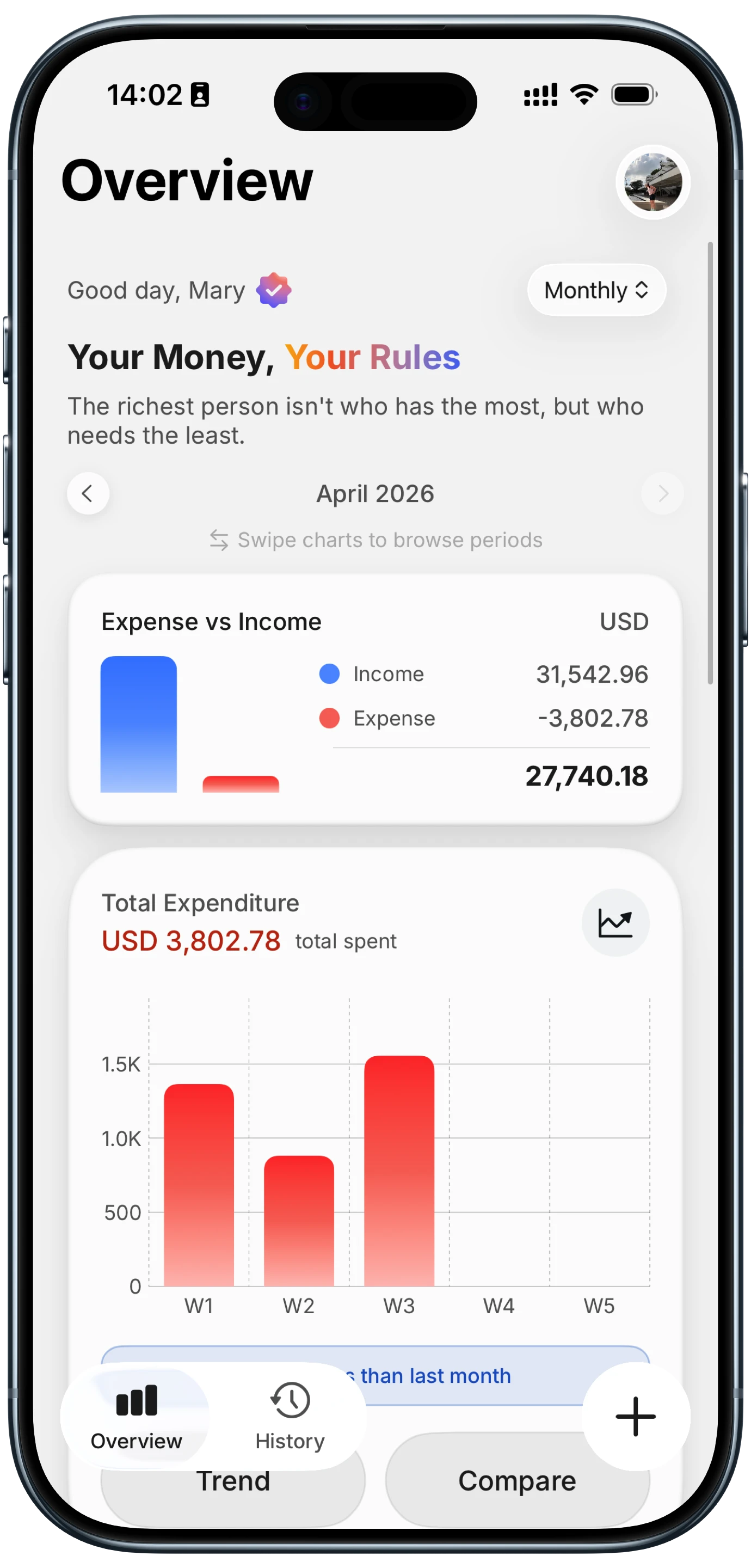
What makes Finny particularly good for students is the combination of simplicity and flexibility. Logging an expense takes a few seconds. Categories are fully customizable, so you can create ones that match student life: textbooks, dining hall, campus events, transportation, coffee. The dashboard shows net income alongside spending trends, which is exactly the "how much is left" visibility that students need.
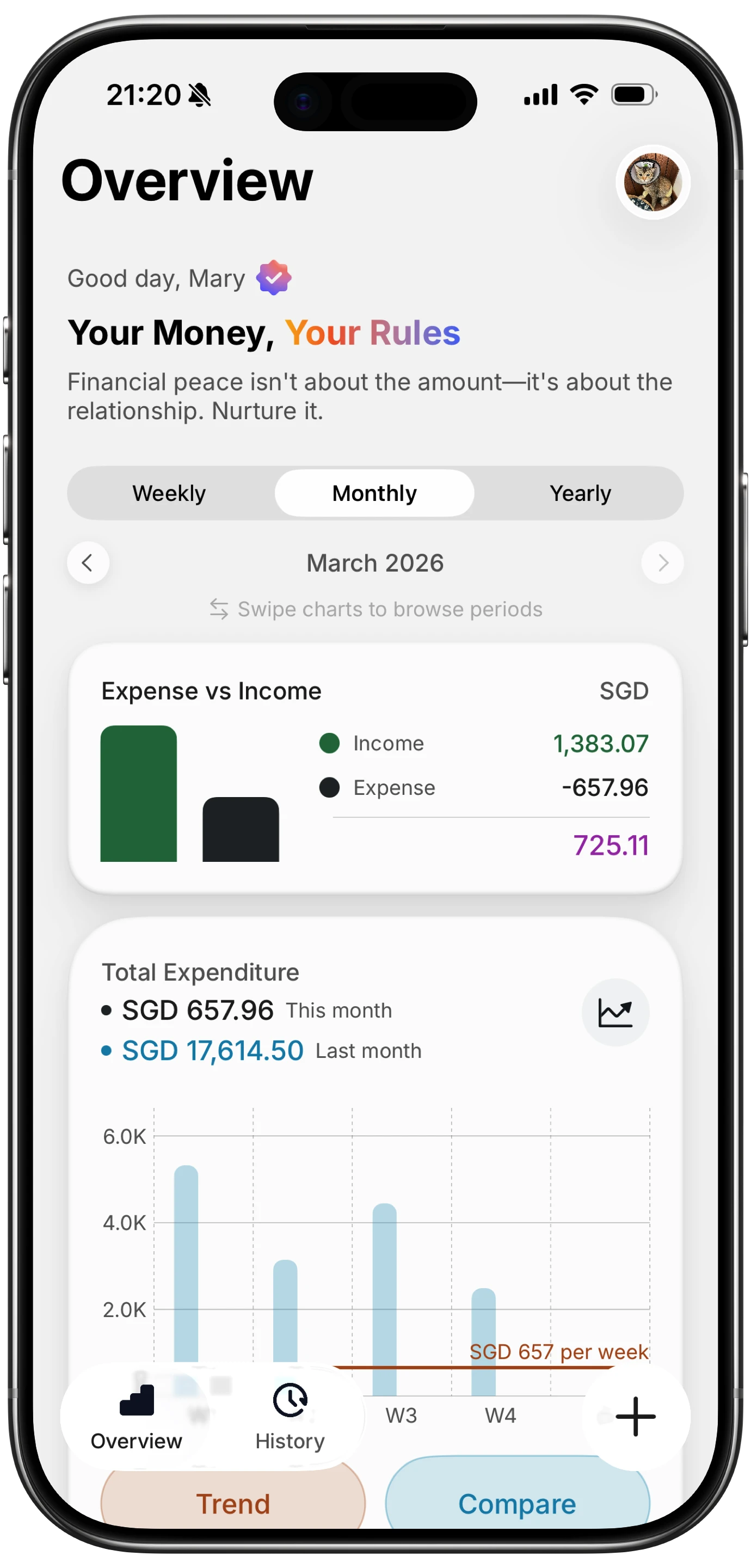
Finny app's Overview feature
The app works fully offline, which matters when you are in a lecture hall, a library basement, or a campus building with poor signal. Transactions sync when you reconnect. No bank connection is ever required, so students who prefer to keep their financial accounts private can use Finny without hesitation.
For students who want extra power, Finny Pro at a low monthly price unlocks AI input via text, voice, and receipt scanning. You can snap a photo of a grocery receipt or just say "lunch twelve fifty at the dining hall" and the app logs it automatically. At that price, it costs less than a single coffee per month. For more on AI-assisted tracking, see our AI receipt scanner guide.
Best for: Students who want a free, private, offline-capable expense tracker with room to grow.
Goodbudget: Best for Envelope Budgeting
Goodbudget brings the classic envelope budgeting method to your phone. You create virtual envelopes for each spending category (groceries, entertainment, transportation) and fill them with your available money. When an envelope is empty, you stop spending in that category.
This system works well for students because it creates clear boundaries. If you put $150 in your dining out envelope for the month and it hits zero on the 20th, you know to cook at home for the rest of the month. There is no ambiguity about whether you can afford something.
The free tier gives you 20 envelopes, one account, and sync across two devices. That is enough for most students. Goodbudget Plus at $10 per month adds unlimited envelopes, more accounts, and full transaction history, but the free version covers basic needs.
The main limitation for students is that Goodbudget's envelope system assumes you know how much money you have at the start of each period. With irregular income, you may need to adjust envelopes frequently. The app also has limited offline functionality and no AI features.
Best for: Students who want a structured, envelope-based approach to spending limits.
YNAB: Best for Students Ready to Learn Serious Budgeting
YNAB (You Need a Budget) offers all college students a free year through its College Program. You verify enrollment with a student ID, transcript, or tuition statement, and get full access to every feature for 365 days. Undergraduate, graduate, part-time, and international students all qualify.
The zero-based budgeting philosophy means every dollar gets assigned a purpose before you spend it. This is powerful but requires more effort than simpler apps. YNAB has a learning curve, and some students find the setup process overwhelming during an already busy semester.
After the free year, YNAB costs $14.99 per month (with a 10% student continuation discount). That is a significant expense for a college budget. If you plan to continue budgeting after graduation, the habits you build during the free year can pay for themselves. If you just need basic expense tracking, YNAB is more than most students need.
YNAB works best with a bank connection for automatic transaction imports, though you can use it with manual entry only. It does not work offline, which is a notable limitation for campus use. For a look at how YNAB compares in the broader market, see our best expense tracker apps comparison.
Best for: Motivated students willing to invest time in learning a comprehensive budgeting system.
DailyBean: Best for Minimalist Daily Logging
DailyBean combines mood journaling with simple expense tracking in a visual, icon-driven interface. It is designed for quick daily check-ins, not detailed financial analysis. You log expenses with a few taps, see them on a calendar, and get basic weekly and monthly summaries.
The appeal for students is the low friction. DailyBean does not try to be a full budgeting system. It is closer to a spending diary. If the idea of setting up categories, budgets, and envelopes feels like too much, DailyBean lets you start tracking with minimal setup.
The app works offline, requires no bank connection, and has a generous free tier. The premium unlock removes ads and adds more customization for around $1.67 per month.
The tradeoff is limited financial depth. There are no budget targets, no recurring transaction tracking, and no multi-currency support. DailyBean is a starting point, not a destination. Students who want more detailed insights will eventually outgrow it.
Best for: Students who want the simplest possible way to start tracking daily spending.
PocketGuard: Best for "How Much Can I Spend" Clarity
PocketGuard's signature feature is the "In My Pocket" number: the amount you can safely spend after accounting for bills, subscriptions, and savings goals. For students who just want a single number telling them whether they can afford dinner out tonight, this is genuinely useful.
The app connects to your bank and automatically categorizes transactions. The free tier includes basic budgeting with bank sync. PocketGuard Plus at $6.25 per month adds detailed analytics and a lifetime purchase option.
The downside for students is the bank connection requirement. PocketGuard does not function without linking at least one financial account. It also requires an internet connection, so offline logging is not possible. And at $6.25 per month for the full feature set, it is more expensive than alternatives that offer comparable features.
Best for: Students with bank accounts who want a single "safe to spend" number.
Budgeting Tips Specifically for College Students
Start with tracking, not budgeting
Most students fail at budgeting because they try to create a perfect budget before understanding their spending patterns. Track every expense for two to four weeks first. Then look at where your money actually goes. Your budget should reflect reality, not aspirations.
Handle irregular income with a buffer
Instead of budgeting based on expected monthly income, budget based on the money you currently have. When a financial aid check arrives, divide it by the number of months until the next one. That monthly amount is your budget. Set aside the rest and transfer it to yourself monthly, or use an app like Finny to track the running balance.
Create student-specific categories
Generic categories like "food" and "entertainment" are too broad. Split them into categories that match student life:
- Dining hall vs. eating out: These have very different costs and frequency
- Textbooks vs. supplies: Textbooks are a semester expense, supplies are ongoing
- Campus activities vs. off-campus fun: Helps identify where social spending concentrates
- Transportation: Gas, rideshares, public transit, campus parking
Use the 50/30/20 rule loosely
The traditional 50/30/20 split (needs/wants/savings) does not map perfectly to student budgets where tuition and housing consume most of your resources. A modified version: cover needs first, set aside a small emergency fund (even $25 per month adds up), and spend the remainder on wants. The habit of separating needs from wants matters more than hitting exact percentages.
Automate what you can
If you have recurring expenses like a phone bill, streaming service, or gym membership, set them up as recurring transactions in your budget app. This prevents surprises and gives you a clearer picture of your discretionary spending each month. Finny's recurring transactions feature handles this automatically with daily, weekly, monthly, or yearly rules.
How to Get Started Today
You do not need to overhaul your finances in one sitting. Here is a practical starting sequence:
- Download a free app. Finny, Goodbudget, or DailyBean all work without payment
- Track for one week. Log every purchase, no matter how small
- Review your first week. Look for patterns and surprises
- Set two or three spending limits. Focus on categories where you overspend
- Continue tracking. The habit matters more than perfection
Most students who track expenses consistently for a month discover at least $50 to $100 in spending they did not realize was happening. That alone can cover a textbook, a month of groceries, or the start of an emergency fund. If you want a deeper look at options tailored specifically to campus life, see our guide to the best budget app for college students.
Frequently Asked Questions
What is the best free budget app for college students?
Finny offers the most complete free tier for students: unlimited tracking, custom categories, multi-currency support, offline access, and visual charts. Goodbudget is a strong alternative if you prefer envelope budgeting, with 20 free envelopes and two-device sync. YNAB gives a full free year to verified college students, making it temporarily free with the most features.
Do I need to connect my bank account to use a budget app?
No. Finny, Goodbudget, DailyBean, and Bobby all work without bank connections. Manual entry takes a few seconds per transaction and gives you full control over your data. Some students actually prefer manual entry because the act of logging each purchase increases spending awareness. For more on this approach, see our guide to tracking expenses without linking your bank.
Is YNAB really free for students?
Yes. YNAB offers a free 365-day trial for all enrolled college students, including undergraduate, graduate, part-time, and international students. You verify with a student ID, transcript, or tuition statement. After the free year, YNAB costs $14.99 per month with a 10% student discount. You cannot renew the free year, even if you are still enrolled.
How much should a college student budget for monthly expenses?
This varies enormously by location and living situation. Students living on campus with a meal plan might need $200 to $400 per month for personal expenses. Off-campus students in moderate cost-of-living areas might need $800 to $1,500 for rent, groceries, and utilities combined. The most useful approach is to track your actual spending for a month before setting any targets.
Can I use a budget app if I mostly use cash?
Absolutely. Apps like Finny and DailyBean work entirely through manual entry, making them ideal for cash-based spending. Log the expense immediately after paying to avoid forgetting. Some students find that cash-only spending combined with manual tracking creates stronger awareness of where money goes, since every transaction requires a conscious action both to spend and to record.