AI Receipt Scanner: Best Apps That Actually Read Your Receipts
Most receipt scanner apps promise to read your receipts and log your expenses automatically. In practice, many struggle with faded thermal paper, handwritten tips, or receipts from smaller merchants. You end up correcting more fields than the app got right, which defeats the purpose.
An AI receipt scanner goes beyond basic optical character recognition by using language models to understand receipt structure, not just read individual characters. The difference matters: OCR reads text, but AI understands that the number at the bottom is a total, the text at the top is a merchant name, and the date format varies by country.
This guide compares the leading receipt scanning approaches in 2026, explains the technology behind them, and identifies which apps actually deliver on their promises. For a broader look at tracking tools, see our best money tracker apps in 2026 guide.
OCR vs AI-Powered Receipt Scanning
Understanding the technical difference between these two approaches helps explain why some apps work better than others.
Traditional OCR (Optical Character Recognition)
OCR converts images of text into machine-readable characters. It identifies letters and numbers in a photo, but it does not understand what those characters mean. A traditional OCR system reading a receipt sees a collection of text strings, not a structured document.
How it works: The app photographs the receipt, identifies text regions, converts each character to a digital equivalent, and outputs raw text. A separate set of rules then tries to find the total, date, and merchant name by looking for patterns like dollar signs, date formats, and text placement.
Strengths: Fast, works offline on most devices, handles clean printed text reliably.
Weaknesses: Struggles with unusual receipt layouts. Cannot handle handwritten text. Breaks when the receipt format does not match expected patterns. Requires rigid template matching, which fails for merchants with non-standard receipt designs.
AI-Powered Scanning
AI-powered receipt scanning uses machine learning models trained on thousands of receipt formats. Instead of matching templates, the AI model understands receipt structure contextually. It knows that the largest number near the bottom is likely the total, that text near the top is usually the merchant name, and that items are listed between these elements.
How it works: The app photographs the receipt, and a language model (often a vision-language model) processes the entire image holistically. Rather than reading character by character, it interprets the receipt as a document with semantic meaning.
Strengths: Handles varied receipt formats, including international ones. Better accuracy with messy, faded, or partially damaged receipts. Can extract line items, tax amounts, and tips even when formatting is unusual.
Weaknesses: May require cloud processing for best accuracy (larger models run on servers, not phones). Processing time can be slightly longer than basic OCR. Still imperfect with heavily damaged or handwritten receipts.
Side-by-Side Comparison
| Capability | Traditional OCR | AI-Powered Scanning |
|---|---|---|
| Clean printed receipts | High accuracy | High accuracy |
| Faded thermal paper | Low accuracy | Medium-High accuracy |
| Handwritten additions | Fails | Partial accuracy |
| Non-standard layouts | Low accuracy | High accuracy |
| International receipts | Low accuracy | Medium-High accuracy |
| Speed | Very fast | Fast |
| Offline capability | Yes | Depends on app |
| Line item extraction | Basic | Detailed |
Best AI Receipt Scanner Apps Compared
| Feature | Expensify | Wave | Smart Receipts | Finny |
|---|---|---|---|---|
| Scanning Method | AI (SmartScan) | Basic OCR | Basic OCR | AI-powered |
| Batch Scanning | No | No | No | Yes (up to 5) |
| Free Scans | 25/month | Unlimited | Unlimited | Unlimited |
| Offline Scanning | Partial | No | Yes | Yes |
| AI Categorization | Yes | Basic | Manual | Yes |
| Bank Connection Required | Optional | Yes | No | No |
| Best For | Business expense reports | Small business accounting | Tax documentation | Personal budget tracking |
Expensify
Expensify's SmartScan is one of the earliest and most widely used AI receipt scanning features. It processes receipt images on Expensify's servers using their proprietary AI model, extracting merchant, date, total, and currency.
Accuracy: Expensify handles standard retail receipts well. Its strength is in business expense reporting, where receipts tend to follow predictable formats. For restaurant receipts with tips, it performs reasonably but may require you to enter the tip amount separately.
Speed: SmartScan takes a few seconds for most receipts, though complex images can take longer. Results appear in your expense report after processing.
Limitations: The free tier limits you to 25 SmartScans per month. Beyond that, plans start at $5/month per user. The app is designed for corporate expense workflows, so the interface can feel heavy for personal use. Receipt images are uploaded to Expensify's servers for processing, which is a privacy consideration. One receipt per scan, no batch option.
Wave
Wave's receipt scanning is a secondary feature within its free accounting platform. You photograph a receipt, and Wave extracts basic information to match against your bank transactions.
Accuracy: Wave's scanning is functional for simple receipts but relies on basic OCR rather than advanced AI. It works best when combined with bank-linked transaction data, which provides additional context for matching.
Speed: Processing is quick for basic receipts. Complex or faded receipts may produce incomplete results.
Limitations: Wave requires bank connections for full functionality. Receipt scanning feeds into business accounting workflows, not personal budgeting. The scanning accuracy is lower than dedicated AI solutions because it is not the product's primary focus. Wave was acquired by H&R Block, which may affect data handling policies.
Smart Receipts
Smart Receipts is an open-source receipt tracking app designed for expense reporting and tax documentation. It focuses on organizing and exporting receipt images rather than AI-powered parsing.
Accuracy: Smart Receipts relies on basic OCR in its free tier, with limited AI features in the paid version. The app's strength is not in scanning accuracy but in its organization and export capabilities.
Speed: Scanning is fast since processing is minimal. You often need to manually enter or correct key fields after scanning.
Limitations: No batch scanning. Limited AI categorization. The interface feels utilitarian compared to newer apps. It is primarily a documentation tool rather than a budget tracker. No spending analysis or budgeting features.
Finny: AI Scanning With Batch Support and Privacy
Finny combines AI-powered receipt parsing with features that address the most common frustrations with receipt scanning apps: batch support, offline capability, and privacy-first design.
Batch scanning: Finny lets you photograph up to five receipts at once. This matters because receipt scanning in practice is rarely one receipt at a time. You come home from shopping, empty your pockets, and have three to five receipts to process. Scanning them individually, waiting for each to process, and confirming one by one is tedious. Finny's batch mode handles all of them in a single workflow.
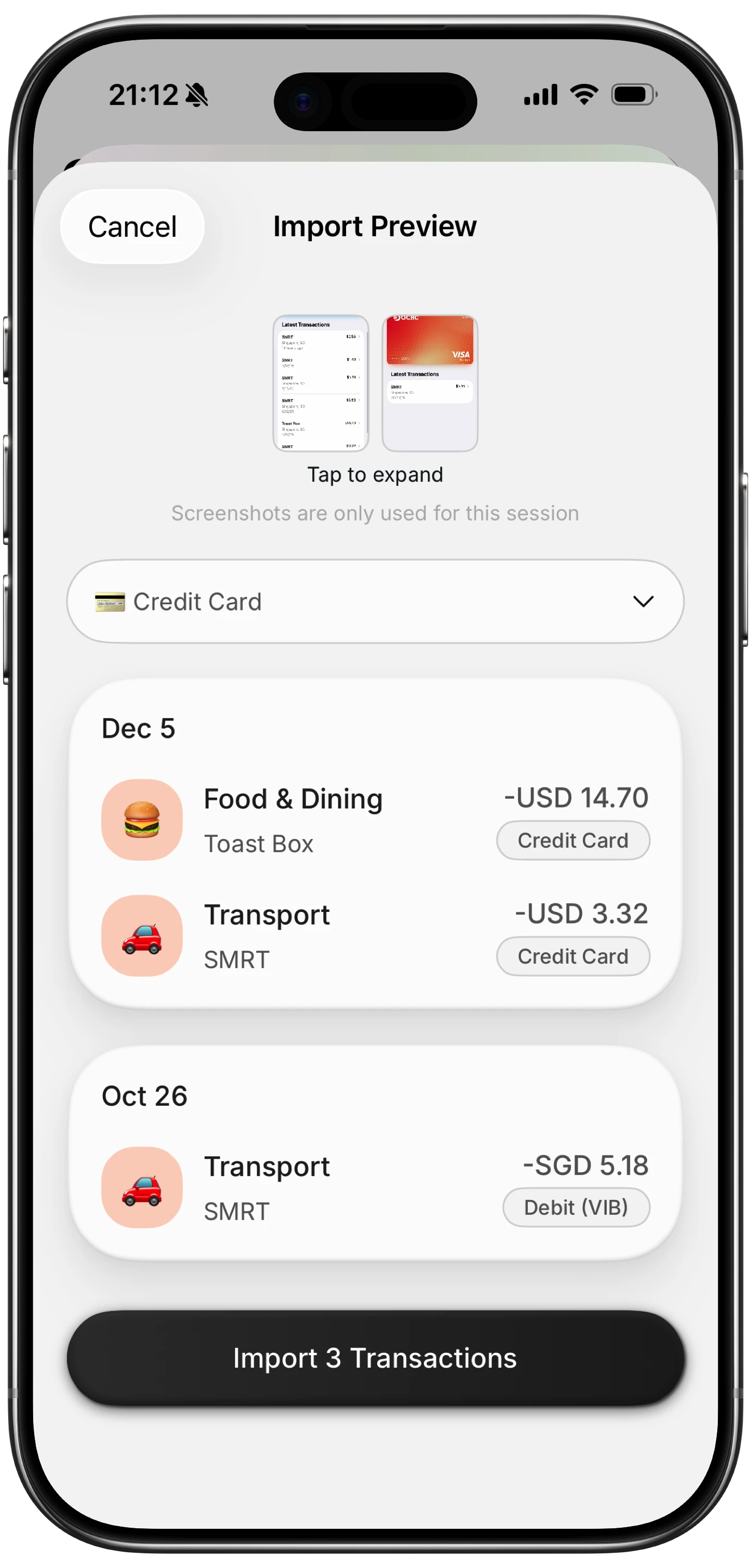
Finny app's screenshot import feature
AI parsing: Finny's AI extracts merchant name, date, total, and category from each receipt image. After scanning, you see all parsed results on a review screen where you can confirm or edit any field before saving.
Offline support: Receipt scanning works without an internet connection. This is useful when traveling, when mobile data is expensive, or when you simply prefer that your receipt images stay on your device.
Privacy: No bank connections required. Receipt data is processed with your privacy in mind, and your financial information stays under your control. For more on why this matters, see our guide on finance app security and privacy.
What Affects Receipt Scanning Accuracy
Regardless of which app you use, certain factors consistently affect how well receipt scanning works.
Receipt Condition
Thermal paper, used by most retailers, begins fading within weeks of purchase. A receipt scanned on the day of purchase will produce significantly better results than one scanned a month later. Crumpled, folded, or torn receipts also reduce accuracy. The fix is simple: scan receipts the same day you receive them.
Lighting and Image Quality
A well-lit, flat receipt photographed straight-on produces the best results. Shadows, glare, and angles introduce noise that even AI models struggle to interpret. Natural daylight or a bright indoor light works best. Avoid photographing receipts on dark surfaces that reduce contrast.
Receipt Format and Language
Standard US and European retail receipts are well-represented in training data for most AI models. Receipts from smaller merchants, handwritten invoices, or receipts in less common languages may produce lower accuracy. Multi-currency support varies by app. For travelers dealing with receipts in different currencies, see our guide on multi-currency expense tracking for digital nomads.
Tips and Handwritten Additions
Many restaurant receipts include a handwritten tip line. Most OCR systems cannot read handwriting reliably. AI-powered systems are better but still inconsistent. If accuracy matters for tipped transactions, manually entering the total after tip is the safest approach.
Building an Effective Receipt Scanning Workflow
Getting value from a receipt scanner app requires building it into your routine. Here is a practical workflow:
- Collect receipts in one place. Keep a pocket in your wallet or a small envelope in your bag for paper receipts. The goal is to not lose them before scanning.
- Scan daily or every other day. Set a brief time, perhaps after dinner, to scan any receipts you have collected. Do not let them pile up for weeks.
- Use batch scanning when available. If your app supports it, scan all collected receipts at once rather than one at a time. This cuts total processing time significantly.
- Review parsed data before saving. Always check that the AI got the total, date, and merchant right. Correct errors immediately so the AI can learn from them.
- Combine with text or voice input. Not every purchase comes with a receipt. For cash transactions or digital payments, use text or voice input as a complement. Our guide on AI expense tracking versus manual methods covers how to combine these approaches.
When Receipt Scanning Is Not Worth It
Receipt scanning is valuable, but it is not always the best approach.
Very small purchases: If you buy a $2 coffee and get a receipt, it may be faster to type "coffee $2" than to photograph, process, and confirm a scan. Text input wins for simple, low-value transactions.
Digital purchases: Online orders, subscriptions, and app purchases do not produce paper receipts. For these, text or voice entry, or bank-linked auto-import, is more practical.
Recurring expenses: Your rent, utilities, and subscriptions are the same each month. Setting these up as recurring entries is more efficient than scanning a bill each time.
Receipt scanning works best for in-person purchases at physical stores, especially when receipts include multiple items or when you want a documented record for tax or reimbursement purposes. If automating receipt capture is your priority, check out our roundup of the best apps to track receipts automatically in 2026. For a full comparison of receipt scanning apps, see our best receipt scanner apps to track spending in 2026 guide. And if you want a single app that scans receipts for your budget end-to-end, our dedicated breakdown covers what to look for.
The Bottom Line
The gap between basic OCR and AI-powered receipt scanning is significant in 2026. AI models understand receipt structure, handle varied formats, and produce fewer errors that need correction. But even the best AI scanner is not perfect, especially with faded paper, handwritten tips, or unfamiliar merchant formats.
The most practical approach is to choose an app that combines AI accuracy with a clear review step. Scan your receipts, check the parsed results, correct any errors, and save. If privacy matters to you, look for apps that avoid bank connections and offer offline scanning.
For personal budget tracking with batch scanning, AI parsing, and no bank connections, Finny covers the use case that most receipt scanner apps miss. For business expense reporting with team features, Expensify remains the standard choice.
Common Questions About AI Receipt Scanners
What is the best AI receipt scanner app in 2026?
For personal budgeting with privacy, Finny offers batch scanning (up to five receipts at once), AI parsing, and offline support without bank connections. For business expense reporting, Expensify provides SmartScan with accounting integrations and team workflows.
How does AI receipt scanning differ from regular OCR?
Traditional OCR reads individual characters from an image. AI-powered scanning uses language models to understand receipt structure, identifying totals, merchant names, dates, and line items contextually. AI handles varied formats and messy receipts more reliably than template-based OCR.
Can I scan receipts for budget tracking without an internet connection?
Yes. Some apps, including Finny and Smart Receipts, support offline receipt scanning. This is useful when traveling or when you prefer to keep receipt images on your device rather than uploading them to cloud servers.
How many receipts can I scan at once?
Most receipt scanner apps process one receipt per scan. Finny supports batch scanning of up to five receipts at once, which reduces total processing time when you have multiple receipts to log.
Ready to scan receipts that actually get read correctly?
Download Finny to scan up to five receipts at once with AI-powered parsing. No bank connection required, works offline, and your data stays under your control.