How to Manage Personal Finances: Complete Beginner Guide
Money touches every part of your life: where you live, what you eat, how you spend your time, and how much stress you carry. Yet most people never receive any formal education on how to handle it. You finish school, start earning, and figure it out by trial and error, often learning the hard way through overdraft fees, mounting credit card balances, or the sinking feeling of having no savings when something breaks.
Manage personal finances is a broad topic, but the fundamentals are surprisingly simple. You need to know what you earn, control what you spend, save for the unexpected, and pay down debt strategically. This guide covers each area in practical terms, without jargon or complicated theory. It is designed for people who are starting from scratch or want to rebuild their financial foundation.
For a focused look at creating your first budget, see our budgeting for beginners guide.
What Personal Finance Management Actually Involves
Personal finance management is the process of making deliberate decisions about your money. It covers four core areas:
- Earning. Your income from all sources: salary, side work, investments, benefits.
- Spending. Everything you pay for, from rent to coffee.
- Saving. Money set aside for future needs and goals.
- Debt management. Paying down what you owe efficiently.
Most personal finance guide content focuses on one of these areas in isolation. But they are interconnected. Your spending determines how much you can save. Your debt payments reduce how much you have available to spend. Your income sets the ceiling for everything else. Effective money management means coordinating all four areas, not optimizing one while ignoring the others.
Step 1: Know Your Numbers
Before you can manage your finances, you need to know where you stand. This means calculating two things:
Your Monthly Income
Add up all sources of after-tax income:
- Salary or wages (net pay, not gross)
- Side income or freelance work
- Investment dividends or interest
- Government benefits or support
- Any other regular income
If your income varies, calculate the average of the last three months. For a more conservative approach, use the lowest month from the past quarter.
Your Monthly Expenses
Review the last three months of bank and credit card statements. Categorize every transaction and calculate the monthly average for each category. Common categories include:
| Category | Typical Range |
|---|---|
| Housing (rent/mortgage) | 25-35% of income |
| Food (groceries + dining) | 10-15% of income |
| Transportation | 10-15% of income |
| Utilities and phone | 5-10% of income |
| Insurance | 5-10% of income |
| Debt payments | Varies |
| Entertainment | 5-10% of income |
| Personal and miscellaneous | 5-10% of income |
The difference between your income and expenses is your margin. If the number is positive, you have room to save and invest. If it is negative, you are going into debt each month and need to make changes.
Your Net Worth
Net worth is what you own minus what you owe:
Assets: Savings accounts, investments, retirement accounts, property value, valuable possessions.
Liabilities: Credit card balances, student loans, car loans, mortgage balance, personal loans.
You do not need a high net worth to start managing your finances. Even a negative net worth (which is common for people with student loans) is a valid starting point. The goal is to know the number and move it in the right direction over time.
Step 2: Build a Budget
A budget is the steering wheel of your finances. Without one, money flows wherever habit and impulse direct it.
Choosing a Budgeting Method
There are several proven approaches. The right one depends on your personality and financial situation.
50/30/20 rule. Divide after-tax income into 50% needs, 30% wants, and 20% savings and debt repayment. You can plug in your income with our 50/30/20 Budget Calculator to see exactly how much goes to each category. This is the simplest method and works well for people with stable incomes and moderate expenses.
Zero-based budgeting. Assign every dollar of income to a specific category so that income minus budgeted amounts equals zero. This provides maximum control but requires more time. See our zero-based budgeting guide for a detailed walkthrough.
Envelope method. Allocate cash (physical or digital) into category-specific envelopes. When an envelope is empty, spending in that category stops. This works well for people who struggle with specific overspending categories.
For a detailed comparison of these methods, including a side-by-side table, read our guide on how to budget money.
Setting Up Your Budget
- Start with your monthly income figure.
- List fixed expenses first: rent, loan payments, insurance, subscriptions.
- Set limits for variable categories: groceries, dining, entertainment, personal.
- Allocate money toward savings goals: emergency fund, retirement, other targets.
- Assign remaining money to debt payoff or additional savings.
Review your budget against actual spending each week. Adjust category amounts monthly until the plan reflects your real life, not an idealized version of it.
Step 3: Track Your Spending
A budget without tracking is a guess. Tracking turns your budget into an actionable tool by showing you whether your actual spending matches your plan.
Why Tracking Matters
When you track expenses, you gain:
- Real-time awareness. You know at any point in the month how much you have spent and how much remains.
- Pattern recognition. Over time, you spot trends: weeks when spending spikes, categories that consistently run over budget, seasonal changes in expenses.
- Accountability. The act of recording a purchase makes you more mindful of the decision.
Tracking Methods
Manual tracking with a notebook or spreadsheet gives you full control but requires consistent effort. It works if you have few daily transactions and enjoy the process.
Bank statement reviews capture digital transactions automatically but miss cash purchases, lack real-time visibility, and often have vague descriptions that make categorization difficult.
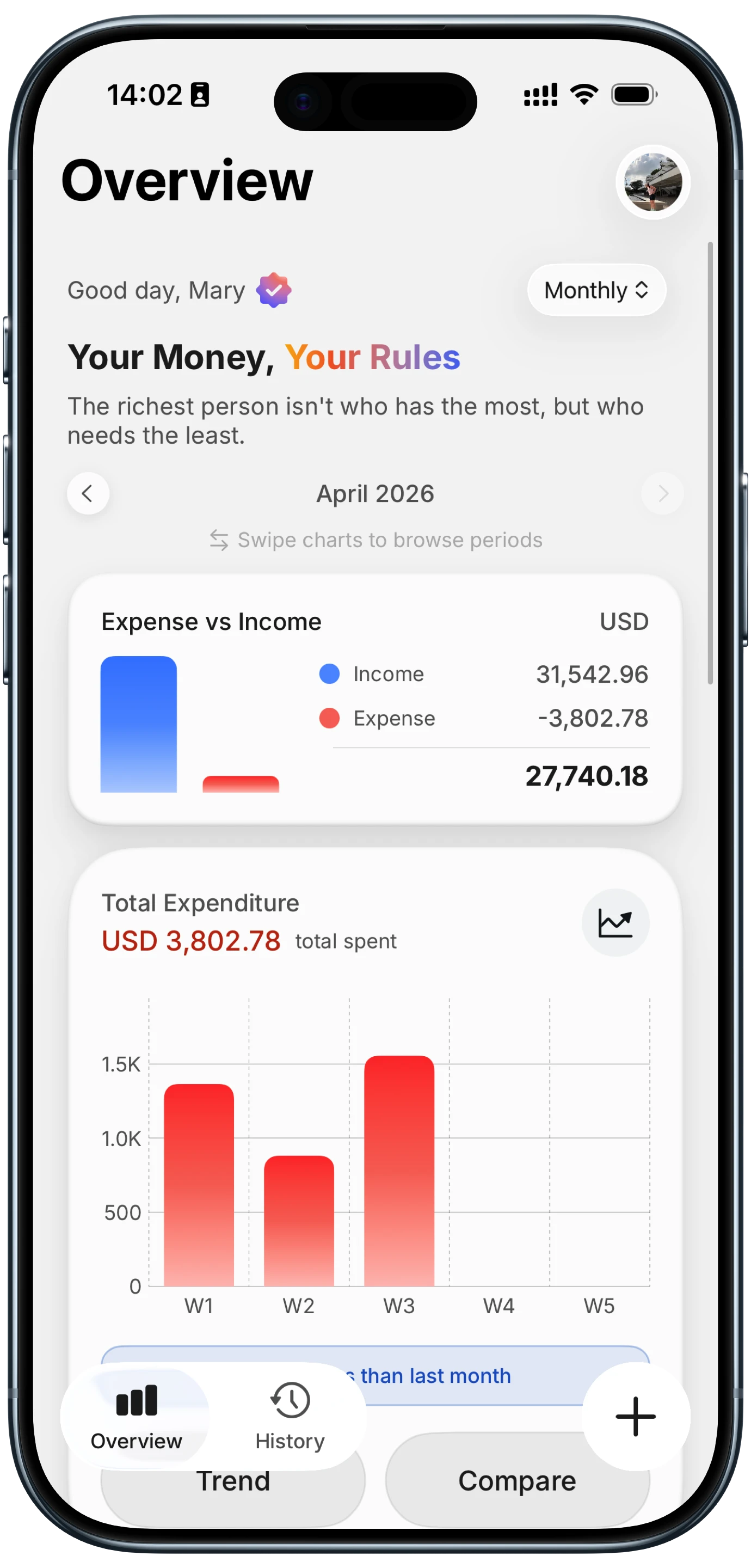
Expense tracking apps offer the best combination of accuracy and convenience. Apps that use AI-powered input (voice, text, receipt scanning) reduce the time cost of logging each transaction. Finny, for example, lets you log an expense in seconds through voice or text, categorizes it with AI assistance, and works offline so you can track purchases anywhere.
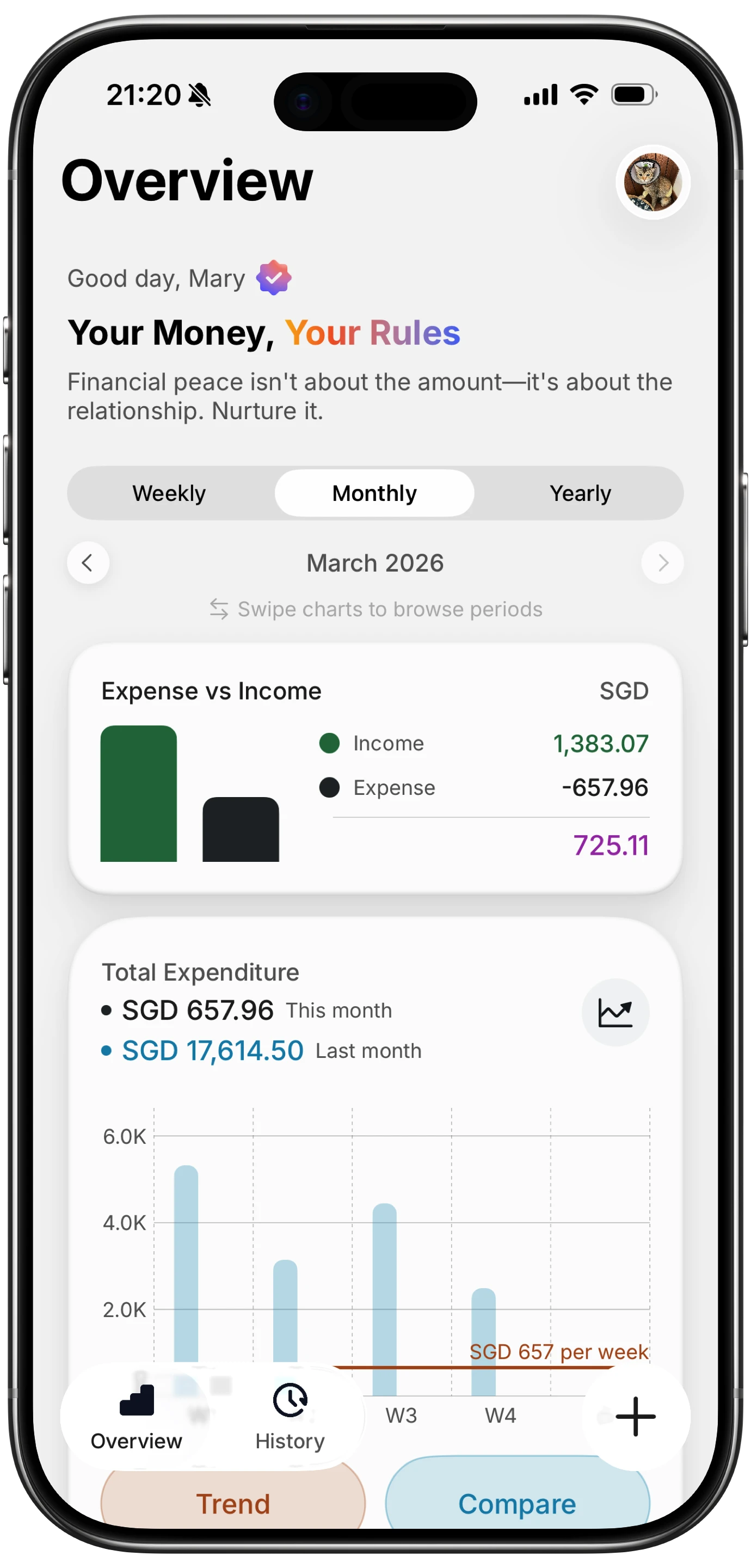
Finny app's Overview feature
For a step-by-step approach, read our guide on how to track expenses.
Building a Tracking Habit
- Log expenses immediately after each purchase.
- Use the fastest input method available to reduce friction.
- Review your tracked spending every Sunday for 10 to 15 minutes.
- Do not aim for perfection. An approximate record is far better than no record.
Step 4: Build an Emergency Fund
An emergency fund is money set aside for unexpected expenses: car repairs, medical bills, job loss, appliance replacements. Without one, any surprise expense forces you into debt, which sets back your entire financial plan.
How Much to Save
- Starter goal: $1,000. This covers most common emergencies and prevents credit card debt for small surprises.
- Intermediate goal: One month of essential expenses. This provides a cushion for short-term income disruptions.
- Full goal: Three to six months of essential expenses. This protects against job loss and major unexpected costs.
Not sure which target is right for you? Our Emergency Fund Calculator can help you set a personalized goal based on your monthly expenses.
How to Build It
- Calculate your monthly essential expenses (rent, food, utilities, insurance, minimum debt payments).
- Set a target based on where you are financially.
- Automate a weekly or monthly transfer to a separate savings account.
- Direct any windfalls (tax refunds, bonuses, gifts) toward the fund until you reach your target.
Keep your emergency fund in a high-yield savings account. It should be accessible within a few days but not so easy to access that you dip into it for non-emergencies.
Step 5: Manage and Pay Down Debt
Not all debt is equal. Understanding the difference helps you prioritize.
Types of Debt
High-interest debt (credit cards, payday loans, personal loans above 10% APR) costs you significantly over time and should be paid down aggressively.
Moderate-interest debt (car loans, private student loans) should be paid on schedule with extra payments when possible.
Low-interest debt (federal student loans, mortgages below 5%) costs less over time and may not need aggressive payoff if you can earn more by investing the difference.
Debt Payoff Strategies
Debt avalanche. Pay minimums on everything, then put all extra money toward the debt with the highest interest rate. This saves the most money in total interest paid.
Debt snowball. Pay minimums on everything, then put all extra money toward the smallest balance first. This provides psychological wins as debts disappear one by one, which helps maintain motivation.
Both methods work. The avalanche is mathematically optimal. The snowball is psychologically easier. Choose the one you will actually stick with. For a detailed comparison, see our guide on debt snowball vs avalanche.
Avoiding New Debt
While paying down existing debt:
- Stop using credit cards for purchases you cannot pay off immediately.
- Build your emergency fund simultaneously (even small amounts) so that unexpected expenses do not force new borrowing.
- Avoid taking on new loans for wants (vacations, electronics, furniture) until existing debt is under control.
Step 6: Start Saving for Goals
Once you have a budget, an emergency fund in progress, and a debt payoff plan, you can start directing money toward other goals.
Short-Term Goals (Under 2 Years)
Examples: vacation, new laptop, moving expenses, wedding.
Keep this money in a savings account or money market account. Do not invest it. The timeline is too short to recover from market dips.
Medium-Term Goals (2 to 10 Years)
Examples: down payment on a house, starting a business, career change fund.
Consider a mix of savings and conservative investments (bonds, CDs, index funds with lower volatility).
Long-Term Goals (10+ Years)
Examples: retirement, children's education, financial independence.
Invest in diversified, low-cost index funds or target-date retirement funds. Time is your biggest advantage. Starting early, even with small amounts, produces significant results through compound growth.
Retirement Savings Priority
If your employer offers a 401(k) match, contribute enough to get the full match. This is effectively a 100% return on your money and should be the first savings priority after basic emergency savings.
After the employer match, consider a Roth IRA (if you qualify) for tax-free growth. Then increase 401(k) contributions toward the annual maximum as your budget allows.
Tools That Help You Manage Personal Finances
Monarch Money
Monarch Money is a comprehensive financial management platform that covers budgeting, investment tracking, and net worth monitoring. It connects to bank accounts, provides detailed reports, and offers shared access for couples. It is well-suited for people who want a full-featured financial dashboard. The cost is $9.99 per month.
PocketGuard
PocketGuard simplifies budgeting by showing you one number: how much you can safely spend today. It connects to bank accounts and categorizes transactions automatically. It works best for people who want a simple spending view rather than detailed category management.
Goodbudget
Goodbudget uses virtual envelopes for category-based budgeting. It is manual by design, which appeals to people who want control without bank connections. The free tier covers basic needs with 20 envelopes.
Finny
Finny focuses on making expense tracking fast and private. AI-powered input through voice, text, and receipt scanning lets you log purchases in seconds. The app supports over 150 currencies, works offline, and does not require bank connections. Spending analytics help you see patterns and make informed decisions. Finny is free for core features, with Pro available at a low monthly or yearly price.
Putting It All Together: A Monthly Routine
Managing personal finances is not a one-time event. It is a set of habits repeated consistently.
Weekly (15 minutes):
- Review the past week's spending against your budget.
- Check progress on savings goals.
- Log any expenses you missed.
Monthly (30 minutes):
- Compare total spending to total income.
- Adjust budget categories based on actual patterns.
- Make extra debt payments if budget allows.
- Transfer money to savings goals.
- Review and cancel unused subscriptions.
Quarterly (1 hour):
- Calculate and review your net worth.
- Assess progress on financial goals.
- Review insurance coverage and bills for potential savings.
- Adjust your financial plan for any life changes.
Annually (2 hours):
- Set or update financial goals for the year.
- Review investment allocations.
- Check credit report for errors.
- Adjust tax withholding if needed.
- Plan for irregular expenses (holidays, vacations, annual bills).
Common Questions About Managing Personal Finances
Where do I start if I have never managed my money?
Start with two things: calculate your monthly income and track every expense for 30 days. These two numbers give you the foundation for every financial decision. From there, build a simple budget using the 50/30/20 method and set up a starter emergency fund of $1,000.
How much of my income should I save?
Aim for 20% as a long-term target. If that is not possible now, start with whatever you can, even $25 per week. The habit matters more than the amount. Increase your savings rate by 1-2% every few months as you adjust your spending.
Should I pay off debt or save first?
Do both simultaneously. Build a starter emergency fund ($1,000) while making minimum debt payments. Then focus extra money on high-interest debt while maintaining the emergency fund. Once high-interest debt is gone, accelerate savings.
What is the best personal finance app?
The best app depends on what you need most. For detailed budgeting, Monarch Money is strong. For simple spending awareness, PocketGuard works. For private, offline-capable expense tracking, Finny is a good fit. See our best money tracker apps in 2026 guide for a full comparison.
How long does it take to get finances under control?
Most people see meaningful improvement within three to six months of consistent tracking and budgeting. Building a full emergency fund and paying off significant debt typically takes one to three years. Financial management is a lifelong practice, but the first few months produce the most dramatic changes.
Ready to take the first step toward managing your money?
Download Finny to start tracking expenses with AI-powered voice, text, and receipt input. No bank connections, full offline support, and clear spending analytics to help you understand where your money goes.