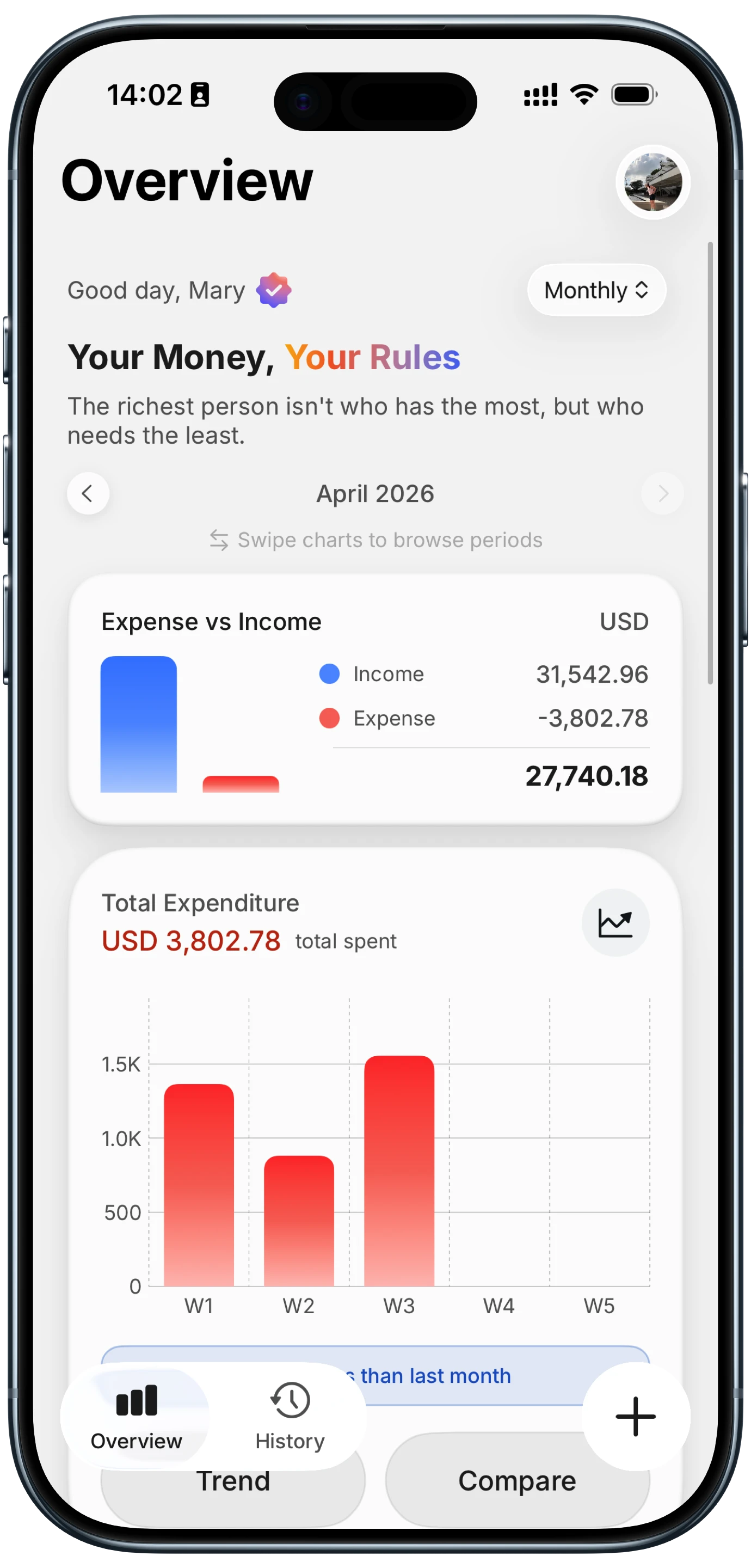
Managing money used to mean balancing a checkbook or reviewing bank statements once a month. In 2026, a good money manager app can track every expense in seconds, build visual budgets, monitor net worth, and even analyze spending patterns with AI.
The challenge is choosing the right one. Some apps focus purely on expense tracking. Others combine budgeting, investing, and financial planning into one dashboard. A few are free, but most charge monthly subscriptions ranging from $2 to $15.
This guide compares the best money manager apps available today across three categories: expense tracking, budgeting, and wealth management. We tested each one and compared pricing, features, and real-world usability. For a focused look at expense tracking specifically, see our best expense tracker apps in 2026 comparison, and for a holistic view of full money-management tools, our best money management apps in 2026 breakdown.
What Makes a Good Money Manager App?
Before diving into recommendations, here is what separates useful money manager apps from the rest:
Low-friction input. If logging a transaction takes more than a few seconds, you will stop doing it within a week. The best apps minimize taps through AI, automation, or bank syncing.
Clear visualization. Numbers alone are hard to interpret. Charts, spending breakdowns, and trend lines turn raw data into actionable insights. For a deeper look at what good analytics looks like, read our financial analytics guide.
Reasonable pricing. Paying $15/month to track spending can feel counterproductive when you are trying to save money. The best apps balance features with affordability.
Reliability. The app should work when you need it, including on airplanes, in foreign countries, and during internet outages. Offline support matters more than most people realize until they need it.
Privacy. Not everyone wants to hand their bank credentials to a third-party app. The best money managers offer choices about how much financial data you share.
Quick Comparison Table
| App | Focus | Monthly Price | AI Input | Offline | Bank Sync | Multi-Currency |
|---|---|---|---|---|---|---|
| Finny | Expense tracking | Free / Optional | Text, voice, photo, chat | Yes | No | 150+ currencies |
| YNAB | Zero-based budgeting | $14.99 | No | No | Yes | Manual rates |
| Monarch Money | All-in-one finance | $14.99 | No | No | Yes | Limited |
| Copilot | Apple finance dashboard | $13 | Limited | No | Yes | Yes |
| PocketGuard | Spending limits | $12.99 | No | No | Yes | No |
| Goodbudget | Envelope budgeting | Free / $10 | No | Partial | No | No |
| Wallet by BudgetBakers | Multi-platform tracking | Free / $5.49 | No | Yes | Optional | Yes |
| Spendee | Visual expense tracking | Free / $2.99 | No | Partial | Optional | Yes |
| Empower | Wealth management | Free | No | No | Yes | No |
Best Money Manager Apps for Expense Tracking
Finny: Best AI-Powered Expense Tracker
Finny is designed around the idea that logging expenses should take less effort than the purchase itself. It delivers on this through multiple AI input methods that eliminate the tedious forms most finance apps rely on.
Type "coffee $4.50 Starbucks" and the app extracts the amount, category, and merchant automatically. Speak your expense by voice for hands-free logging. Scan receipts with the camera, or use Batch Snap and Log to process up to five receipt photos at once. You can even import statement screenshots for bulk transaction entry.
The standout feature for Apple Pay users is Tap to Track. Every Apple Pay transaction gets captured the moment it happens through Shortcuts and NFC. You pay for something and the expense appears in Finny before you pocket your phone.
Multi-currency support is where Finny really differentiates. The Unified Currency View preserves each transaction in its original currency while auto-converting daily and monthly totals to your default currency. For anyone who travels, works remotely across borders, or manages money in multiple currencies, this solves a problem most apps either ignore or handle poorly.
The app works fully offline and never requires bank connections. Your data stays on your device unless you opt into cloud backup via Apple Sign-In. At a low monthly or yearly price, Finny is one of the most affordable premium options on this list. The free tier includes unlimited manual tracking, custom categories, charts, and 150+ currency support.
Pricing: Free tier available. Pro at a low monthly or yearly price.
Best for: Anyone who wants fast, private expense tracking with AI assistance and multi-currency support.
Spendee: Best for Visual Spending Overviews
Spendee focuses on making your spending data look good. The interface uses color-coded categories, clean charts, and timeline views that make it easy to spot trends at a glance.
The free tier covers basic expense tracking with manual entry. The Premium plan at $2.99/month adds bank connections, shared wallets for couples or roommates, and multi-currency support. Spendee works on both iOS and Android.
The app supports multiple wallets for separating personal and business expenses. Cash wallet support means you can track non-digital purchases alongside card transactions. Spendee lacks AI input and advanced budgeting tools, prioritizing visual clarity over depth.
Pricing: Free tier available. Premium at $2.99/month or $22.99/year.
Best for: Visual thinkers who want a clean, attractive spending overview.
Wallet by BudgetBakers: Best Cross-Platform Tracker
Wallet by BudgetBakers runs on iOS, Android, and web, with full sync across all platforms. This cross-platform coverage is increasingly rare as many finance apps go Apple-only.
The free tier includes manual expense tracking, budgets, and reports. Premium adds bank connections, export options, and advanced analytics. Bank syncing covers over 50 countries, making Wallet one of the more internationally friendly options. The app supports multiple currencies, planned payments for recurring bills, and location-based tracking. The interface is functional if not as polished as some competitors.
Pricing: Free tier available. Premium at $5.49/month or $34.99/year.
Best for: Users on Android, or anyone who needs access across multiple platforms.
Best Money Manager Apps for Budgeting
YNAB: Best for Zero-Based Budgeting
YNAB (You Need a Budget) has been teaching zero-based budgeting since 2004. The core principle: assign every dollar a job before you spend it. Instead of looking backward at where money went, YNAB forces you to plan forward.
Bank syncing imports transactions, but YNAB still asks you to review and categorize each one. This intentional friction keeps you engaged with your spending decisions. The educational content, community forums, and structured methodology genuinely teach people how to budget rather than just providing a tracking tool.
Goal tracking lets you save for specific targets like vacations, emergency funds, or debt payoff. Age of Money tells you how long dollars sit in your account before being spent, encouraging a buffer between earning and spending.
At $14.99/month ($109/year), YNAB is among the most expensive personal finance apps. There is a 34-day free trial and free access for college students. The app does not work offline and has limited multi-currency support. For a broader look at budgeting approaches, see our guide on how to manage personal finances.
Pricing: $14.99/month or $109/year. 34-day free trial.
Best for: People who want a proven budgeting system that changes spending behavior, not just tracks it.
PocketGuard: Best for Avoiding Overspending
PocketGuard's signature feature is the "In My Pocket" calculation: a real-time number showing how much you can safely spend right now after accounting for bills, savings goals, and necessities. For chronic overspenders, this simple number is more useful than any pie chart.
Bank syncing handles transaction import and auto-categorization. Bill detection identifies recurring charges. The interface is clean and focused on answering one question: can I afford this?
PocketGuard has raised prices significantly. The Plus plan now costs $12.99/month ($74.99/year), and the free version has been discontinued. This is a steep increase from just a few years ago when annual plans were under $35.
The app does not support offline use or multi-currency tracking. It is US-focused and best suited for users with straightforward, single-currency finances.
Pricing: $12.99/month or $74.99/year.
Best for: Overspenders who need a clear daily spending limit.
Goodbudget: Best Free Budget System
Goodbudget uses envelope budgeting, a method where you divide income into virtual "envelopes" for each spending category. When an envelope is empty, you stop spending in that category or redistribute from another.
The free plan includes 20 envelopes, one account, and basic reporting. This is enough for most people to run a complete budget. The Plus plan ($10/month) adds unlimited envelopes, multiple accounts, debt tracking, and priority support.
Goodbudget does not connect to banks. All transactions are manually entered, which requires more effort but means your financial data stays private. The app syncs between household members, making it solid for couples managing shared budgets. If you are exploring how couples can track expenses together, Goodbudget is worth considering.
No AI input, limited analytics, and no multi-currency support. Goodbudget is intentionally simple.
Pricing: Free tier available. Plus at $10/month or $80/year.
Best for: Users who want structured, visual budgeting without bank connections or subscription fees.
Best Money Manager Apps for Wealth Management
Monarch Money: Best All-in-One Financial Dashboard
Monarch Money combines budgeting, expense tracking, investment monitoring, and net worth tracking in a single polished interface. It covers more financial ground than any other app on this list.
Bank syncing pulls in transactions from checking, savings, credit cards, loans, and investment accounts. Budget vs. actual tracking shows where you stand in each category. Cash flow projections help with planning. Net worth tracking charts your financial progress over time.
Joint access lets couples or household members share one subscription. Both partners see the same data, which eliminates the "separate spreadsheets" problem many couples face.
Monarch costs $14.99/month ($99.99/year). A 7-day free trial is available. There is no permanent free tier. The app requires bank connections for most functionality and does not work offline.
Pricing: $14.99/month or $99.99/year.
Best for: Users who want one app to manage budgeting, tracking, investing, and net worth.
Copilot: Best Apple-Native Finance Dashboard
Copilot is designed exclusively for Apple devices, and it shows. The interface follows iOS design patterns closely, making it feel native in a way cross-platform apps rarely achieve.
Bank syncing, budgeting, spending analysis, investment tracking, and net worth monitoring are all included. Basic AI features help with transaction categorization. Multi-currency support handles international accounts. At $13/month ($95/year), a 1-month free trial lets you evaluate whether the polish justifies the premium. Apple devices only.
Pricing: $13/month or $95/year.
Best for: Apple users who want a beautifully designed, comprehensive finance app.
Empower: Best Free Investment Tracker
Empower (formerly Personal Capital) offers a free financial dashboard focused on investment analysis, net worth tracking, and retirement planning. The investment checkup tool analyzes your portfolio's allocation, fees, and performance against benchmarks.
The retirement planner models different scenarios based on your savings rate, investment mix, and target retirement age. Cash flow tracking and basic budgeting are included but less developed than dedicated budgeting apps. Empower monetizes through wealth management services (starting at 0.89% of managed assets). The free dashboard is genuinely useful on its own. Bank syncing is required, with no offline mode or multi-currency support.
Pricing: Free dashboard. Wealth management starts at 0.89% of assets under management.
Best for: Users focused on investment tracking, retirement planning, and net worth monitoring.
How to Choose the Right Money Manager App
The "best" app depends on what you actually need:
If you want fast, private expense tracking: Finny's AI input and offline-first design make it the fastest way to log expenses without sharing bank credentials. The a low monthly price price point is hard to beat when competitors charge $10-15.
If you want to learn budgeting: YNAB's zero-based method and educational resources teach financial discipline, not just data tracking. The high price is an investment in building lasting habits.
If you want everything in one place: Monarch Money covers budgeting, tracking, investing, and net worth in a single subscription. It is the most comprehensive single-app solution.
If you want to spend nothing: Goodbudget's free tier handles envelope budgeting effectively. Empower's free dashboard covers investments and net worth. Finny's free tier handles expense tracking with unlimited entries and multi-currency support.
If you manage money across currencies: Finny is the clear winner with 150+ currencies and a Unified Currency View that preserves original transaction currencies while converting totals. Most competitors either lack multi-currency support entirely or handle it poorly.
For more detailed strategies on managing your finances, explore our personal finance management guide. If analytics and visualizations matter to you, see our financial analytics overview.
FAQ
What is the best free money manager app in 2026?
It depends on your focus. For expense tracking, Finny's free tier offers unlimited manual tracking, custom categories, charts, and 150+ currency support. For envelope budgeting, Goodbudget gives you 20 free envelopes. For investment tracking and net worth, Empower's free dashboard is the strongest. No single free app covers all three equally well.
Do I need to connect my bank account to use a money manager app?
No. Apps like Finny and Goodbudget work entirely without bank connections. Finny uses AI input (text, voice, receipt scanning) to make manual tracking fast, while Goodbudget relies on traditional manual entry. Bank syncing adds convenience but also introduces privacy and security considerations. Learn more about tracking approaches in our guide on how to track expenses.
How much should I pay for a budgeting app?
Most premium budgeting apps charge between $7 and $15 per month. Whether that is worthwhile depends on the value you get. YNAB users often report saving significantly more than the subscription cost through better spending habits. At the other end, Finny Pro at a low monthly price provides AI-powered tracking at a fraction of what competitors charge. If you are just starting out, try free tiers first before committing to a paid plan.
What is the difference between an expense tracker and a budgeting app?
Expense trackers record what you have already spent, giving you a clear picture of where money goes. Budgeting apps plan where money should go before you spend it. Many modern money manager apps combine both functions. Finny and Spendee lean toward tracking. YNAB and Goodbudget focus on budgeting. Monarch Money and Copilot try to do everything. Choose based on whether you need to understand your spending (tracker) or control it (budgeter).
Can money manager apps help with investing?
Some can. Monarch Money and Copilot include investment tracking and portfolio analysis. Empower offers the most detailed investment tools, including fee analysis and retirement projections. Expense-focused apps like Finny, YNAB, and Goodbudget do not cover investments. If investment tracking is a priority, look for apps that sync with brokerage accounts. For a broader view, see our financial analytics guide.