A spending tracker app does one thing well: it shows you where your money goes each day. That sounds simple, but most finance apps bury this basic function under budgeting frameworks, investment dashboards, and account syncing. If you just want to log what you spend and see clear totals, you need something focused.
The best spending trackers in 2026 prioritize speed above everything else. Logging a purchase should take seconds, not minutes. The apps on this list were chosen specifically for how fast and simple they make daily tracking.
This is not a list of full budgeting suites. If you want comprehensive budget tools, check out the best expense tracker apps in 2026. This guide focuses on apps built for people who want to track daily spending with minimal effort. For tips on reviewing your numbers once they are logged, see our guide on how to compare monthly spending.
What Makes a Great Spending Tracker
Spending trackers are not the same as budgeting apps. A budgeting app tells you what you should spend. A spending tracker tells you what you did spend. The best ones make that recording process nearly invisible.
Seasonal spending is a different problem, since purchases fragment across eight weeks and bank feeds lag behind. For that, see our guide to the best apps to track holiday spending.
We evaluated each app on these criteria:
- Logging speed: How many seconds from opening the app to a saved transaction
- Daily focus: Does the app surface daily spending totals without extra taps
- Simplicity: Can you start tracking within a minute of downloading
- Offline support: Does it work without a network connection
- Price: What daily tracking costs per month
- Privacy: Whether linking a bank account is required
Quick Comparison Table
| App | Price | Logging Speed | Offline | Daily View | Bank Required | AI Input |
|---|---|---|---|---|---|---|
| Finny | a low monthly price | Instant (Tap to Track) | Yes | Yes | No | Text, voice, photo |
| Spending Tracker | Free | Fast | Yes | Yes | No | No |
| PocketGuard | $12.99/mo | Auto-synced | No | Yes | Yes | No |
| Spendee | Free/$1.25/mo | Fast | Partial | Yes | Optional | No |
| Goodbudget | Free/$10/mo | Moderate | Partial | No | No | No |
| DailyBean | Free/$1.67/mo | Fast | Yes | Yes | No | No |
| Copilot | $13/mo | Auto-synced | No | Yes | Yes | Limited |
| Wallet by BudgetBakers | Free/$4.49/mo | Moderate | Yes | Yes | Optional | No |
The Best Spending Tracker Apps in 2026
Finny: Best for Fast Daily Tracking
Finny was designed around a single question: how do you make expense logging faster than the purchase itself? The answer is Tap to Track. When you pay with Apple Pay, a Shortcuts automation fires and logs the transaction in Finny instantly. You never open the app, type a number, or pick a category. It just happens.
For everything else, Finny offers AI input through text, voice, and receipt scanning. Type "coffee 4.50" and the AI fills in the amount, category, and date. You can also scan up to five receipts at once with Batch Snap and Log, which is useful if you collect paper receipts throughout the day and want to log them all at the end.
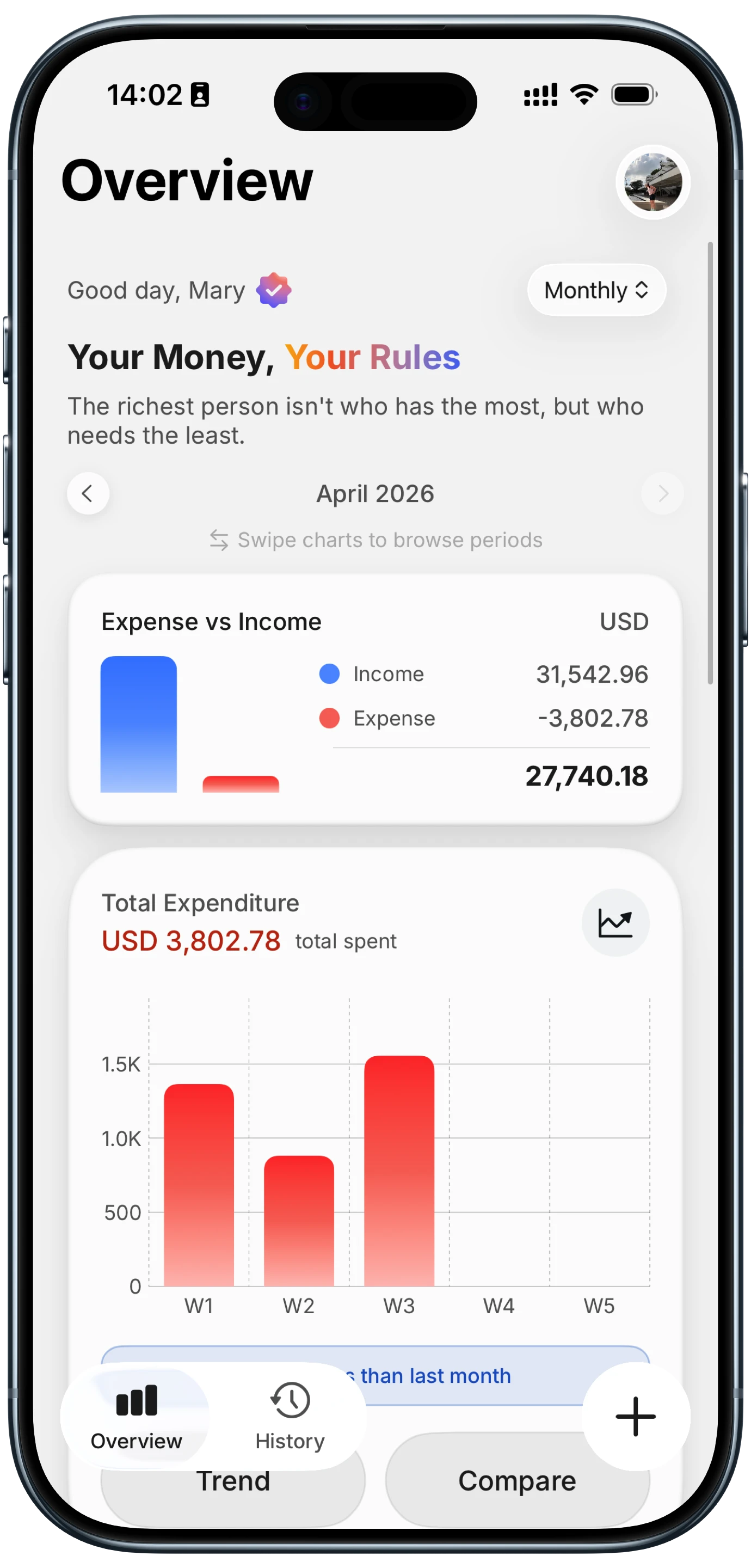
The daily spending view is front and center. You see today's total the moment you open the app, broken down by category. Weekly and monthly views are one swipe away. The app works fully offline, which matters if you track spending while commuting or traveling in areas with spotty signal.
Finny does not require bank connections. Your data stays on-device with optional cloud backup through Apple Sign-In. At a low monthly price, it is significantly cheaper than most alternatives on this list.
Pricing: Free tier with unlimited manual tracking. Pro at a low monthly or yearly price.
Best for: People who want the fastest possible way to track daily spending without connecting bank accounts.
Spending Tracker: Best Free Option for Simple Logging
Spending Tracker has been a reliable, no-frills option for years. It does exactly what the name says. You open the app, tap a category, enter an amount, and save. There is no budget framework, no bank syncing, and no account setup required.
The interface is intentionally basic. Categories are displayed as large buttons on the home screen, so logging a purchase takes three taps at most. You get daily, weekly, monthly, and yearly summaries with simple charts.
The free version covers most needs. The premium version adds features like recurring transactions and data export, but the core tracking experience is fully functional without paying. The main limitation is the lack of any AI or automation, so every entry is manual.
Pricing: Free with optional premium upgrade.
Best for: Users who want a dead-simple tracker with no learning curve.
PocketGuard: Best for Automatic Tracking via Bank Sync
PocketGuard connects to your bank accounts and automatically imports every transaction. Its signature "In My Pocket" metric tells you how much money you have left to spend after accounting for bills, goals, and necessities.
For spending tracking specifically, PocketGuard excels at showing you where money went without manual effort. Transactions are categorized automatically, and the daily spending view is clear and easy to read. The downside is that everything depends on bank syncing, so there is no offline tracking.
The price is steep for a spending tracker at $12.99 per month. The free version limits you to one linked account, which is not enough for most people. If you prefer tracking without linking bank accounts, this is not the right choice. For a privacy-focused alternative, see our guide on how to track expenses.
Pricing: Free tier (1 account) or $12.99/month.
Best for: People who want fully automatic tracking and do not mind connecting bank accounts.
Spendee: Best for Visual Spending Breakdowns
Spendee focuses on making your spending data look good. Charts and visualizations are the centerpiece, with colorful category breakdowns that make patterns obvious at a glance. The app supports manual entry and optional bank sync.
Daily logging is quick. You choose a wallet, tap the plus button, select a category, and enter the amount. Shared wallets let couples or roommates track spending together. The free version is functional for basic tracking, and the premium tier starts at just $1.25 per month, making it one of the more affordable options.
The main drawback is that offline support is limited. Transactions entered offline may not sync reliably, which can cause duplicates or missed entries when you reconnect.
Pricing: Free or from $1.25/month for premium.
Best for: Visual learners who want attractive charts and spending breakdowns.
Goodbudget: Best for Envelope-Style Tracking
Goodbudget uses the digital envelope method. You allocate money to virtual envelopes at the start of each period, then subtract from them as you spend. It is more of a budgeting tool than a pure spending tracker, but the envelope approach naturally keeps daily spending visible.
Logging a purchase means selecting an envelope and entering the amount. The free version gives you 10 envelopes, which works for basic categories like food, transport, and entertainment. Premium unlocks unlimited envelopes, debt tracking, and transaction history beyond one year.
Goodbudget does not connect to banks. All entries are manual, which appeals to people who want to stay mindful of every purchase. The tradeoff is speed. Picking an envelope and entering details takes more time than apps optimized purely for logging.
Pricing: Free (10 envelopes) or $10/month.
Best for: People who like the envelope budgeting method and want to track spending within that framework.
Copilot: Best for Apple Ecosystem Users Who Want Bank Sync
Copilot is an Apple-only app with a polished design and strong bank syncing. It automatically imports transactions and categorizes them, with a daily timeline view that shows spending as it happens. The interface is smooth and the data visualizations are well designed.
For spending tracking, Copilot is convenient if you want everything automated. Transactions appear shortly after they post to your bank, and the app handles recurring payments and subscription detection well. Limited receipt scanning was added recently, though it is not as full-featured as dedicated scanning tools.
The main drawback is cost. At $13 per month (or $95 per year), Copilot is expensive for what amounts to automated spending tracking. It also requires bank connections and does not work offline. There is no Android or web version. For a deeper look at receipt scanning alternatives, see our AI receipt scanner comparison.
Pricing: $13/month or $95/year.
Best for: iPhone users who want polished automatic tracking and do not mind the premium price.
Wallet by BudgetBakers: Best for Multi-Account Tracking
Wallet by BudgetBakers supports manual entry and optional bank sync across multiple accounts. You can track spending from cash, credit cards, and bank accounts all in one place with separate wallets for each.
The daily view shows transactions across all wallets or filtered by a single one. Category breakdowns and spending trends are available on both free and paid tiers. The app works offline for manual entries.
The interface can feel cluttered compared to simpler trackers. There are many features packed in, and the settings take time to configure. But once set up, it handles multi-account daily tracking well.
Pricing: Free tier or $4.49/month for premium.
Best for: People who track spending across multiple payment methods and accounts.
DailyBean: Best for Minimal, Aesthetic Tracking
DailyBean takes a different approach to spending tracking. Instead of spreadsheet-style lists, it uses a calendar-based view where each day shows a simple emoji or icon representing your spending mood. Tap a day to see the details.
Logging is fast and the design is intentionally minimal. The app works offline and does not require bank connections. It appeals to users who find traditional finance apps overwhelming and want something lighter.
The free version covers basic tracking. Premium adds features like CSV export and more customization. The limitation is that DailyBean offers no automation, no AI, and limited reporting compared to the other apps on this list.
Pricing: Free or $1.67/month for premium.
Best for: Users who want a calm, minimal tracking experience without financial complexity.
How to Choose the Right Spending Tracker
The decision comes down to two questions.
First, do you want manual or automatic tracking? If you prefer bank sync, PocketGuard or Copilot will handle it. If you want privacy and control, Finny, Goodbudget, or Spending Tracker keep everything on your device. If you want both options, Spendee and Wallet by BudgetBakers offer manual and sync modes.
Second, how much do you want to spend on tracking your spending? Apps like YNAB ($14.99/month) and Copilot ($13/month) charge premium prices. Finny delivers AI-powered tracking for a low monthly price. Spending Tracker and Goodbudget offer functional free tiers. The price difference is significant over a year.
For more guidance on building a daily tracking habit, check out our tips on how to track daily spending.
Frequently Asked Questions
What is the best free spending tracker app?
Spending Tracker and Goodbudget both offer solid free tiers for basic daily tracking. Finny also provides free unlimited manual tracking with custom categories, charts, and support for over 150 currencies. The free tier is genuinely useful on its own.
Do I need to link my bank account to track spending?
No. Several apps on this list work without bank connections. Finny, Spending Tracker, Goodbudget, and DailyBean all support fully manual entry. Finny goes further by offering AI-assisted input and Tap to Track for Apple Pay, so you get automation without sharing bank credentials.
What is the difference between a spending tracker and a budgeting app?
A spending tracker records what you spend and shows you totals and trends. A budgeting app adds a planning layer on top, telling you how much you should spend in each category. Some apps do both, but if your primary goal is awareness of daily spending, a focused tracker is usually simpler and faster to use.
How much should a spending tracker app cost?
Many quality spending trackers are free or under $5 per month. Premium apps like Copilot ($13/month) and YNAB ($14.99/month) charge more because they bundle budgeting and investment features. If you only need spending tracking, you do not need to pay that much. Finny offers AI-powered tracking at a low monthly price, which is among the lowest for an app with automation features.
Can I track spending in multiple currencies?
Most basic trackers only support one currency. Finny supports over 150 currencies with its Unified Currency View, which keeps each transaction in the original currency while converting daily and monthly totals to your default. This is especially useful for travelers or anyone who spends in more than one currency regularly.