If you travel for work, your problem is not whether you stayed under budget on the trip. Your problem is whether the receipts you collected on day one are still legible and exportable on day fourteen, when you sit down to file an expense report. Different audience, different problem.
This is the business-travel-specific guide. For leisure trips and personal budgets, see our travel budget app comparison. The best business travel expense tracker apps in 2026 solve a narrower set of needs: reimbursement-quality receipt capture, per-mile and per-diem tracking, multi-currency that survives a manager review, and clean export to whatever expense system your company uses.
What Business Travel Expense Tracking Actually Requires
Personal travel apps optimize for fast logging and a clean trip total. Business travel apps optimize for survivability under audit. The bar is different.
Specifically, a business traveler needs:
- Receipt images preserved at decent resolution, ideally with OCR text alongside. A blurry photo of a faded thermal receipt loses you the deduction.
- Mileage tracking if you drive between client sites. The IRS standard mileage rate is the deduction lever; logged miles are the proof.
- Per diem support if your company or client pays a flat daily allowance. Your tracker should let you flag per-diem-eligible expenses separately.
- Multi-currency with locked exchange rates. When the conversion rate when you paid (not when the report is approved) is what matters for reimbursement.
- Export to PDF, CSV, or your company's expense system. Concur, Expensify, Brex, Ramp. Or at minimum a clean CSV your finance team can import.
- Separation of business from personal spending in the same trip. The hotel breakfast reimbursable, the gift shop snacks not.
For broader context on receipt-scanning workflows, see our batch receipt scanning guide.
Quick Comparison Table
| App | Price | OCR Receipts | Mileage | Per Diem | Export | Bank Required |
|---|---|---|---|---|---|---|
| Expensify | Free / $5+/mo | Yes (SmartScan) | Yes | Yes | Many integrations | Optional |
| Zoho Expense | Free / $5/user/mo | Yes | Yes | Yes | CSV, PDF, NetSuite | Optional |
| Concur Expense | Enterprise | Yes | Yes | Yes | SAP integrations | Yes |
| Ramp / Brex | Free with card | Yes | Yes | Yes | Native expense | Yes (their card) |
| Shoeboxed | $18+/mo | Yes (mail-in too) | Limited | No | CSV, PDF | No |
| Finny | a low monthly price | Yes (batch up to 5) | Manual | Manual flag | CSV | No |
Pricing reflects April 2026 published rates. Enterprise tools (Concur) usually require a sales conversation.
The Best Business Travel Expense Tracker Apps in 2026
Expensify: Best All-Around for Independent Business Travelers
Expensify is the closest thing to an industry standard for business expense reports. SmartScan reads a receipt photo in seconds, extracts merchant, amount, date, and category, and queues it for the next report. Mileage tracking is built in, with GPS logging or manual entry. Per diem is supported through company policies.
The export story is the strongest in this category. Expensify integrates with QuickBooks, Xero, NetSuite, Workday, and most major accounting tools. Reports go to approvers as PDF or live web links. For freelancers billing clients, the report-to-invoice flow is clean.
Pricing starts free for individuals with up to 25 SmartScans per month and scales by team. Most independent business travelers use the $5/mo individual plan.
Best for: independent consultants, freelancers billing clients, and small-team business travelers who need report-grade output.
Zoho Expense: Best for Companies Already on Zoho
If your team uses Zoho Books, Zoho CRM, or Zoho One, Zoho Expense slots in with no setup. OCR scanning, mileage tracking, multi-currency support, and per diem rules are all standard. The interface is more workmanlike than Expensify's but the integration with the broader Zoho suite is the selling point.
Pricing is $5 per user per month for the standard plan, with a free tier limited to three users. The mobile app is solid; the web admin is where most policy work happens.
Best for: small businesses already using Zoho's other products.
SAP Concur: Best for Large Enterprises
Concur is the de facto standard for enterprise T&E (travel and expense). If you work for a Fortune 500 company, you probably already use it. Receipt capture, mileage, per diem, multi-currency, approval workflows, and policy enforcement are all robust. Integrations with SAP, Oracle, and most enterprise HR systems are native.
The downside is that Concur is not for individuals. There is no public consumer pricing; sign-up requires a sales conversation, and configuration is enterprise-grade complex. If your employer uses Concur, you do not choose; you use what they configured.
Best for: mid-market and enterprise companies that already rely on SAP or need approval workflows at scale.
Ramp and Brex: Best for Card-Based Tracking
Ramp and Brex are corporate cards with expense management built in. Every transaction on the card flows directly into the expense system. Receipt-matching is automated through OCR and email parsing. Policy enforcement is real-time, including category limits and per-trip caps.
The catch is the card. You only get the expense management if you (or your company) uses their card for business spending. For companies issuing cards to traveling employees, this is the cleanest workflow available. For individuals who do not have access to a corporate card, this is not your tool.
Best for: companies issuing corporate cards and willing to switch their card program.
Shoeboxed: Best for Heavy Receipt Volume
Shoeboxed combines mobile receipt scanning with a mail-in service: physical receipts go in a pre-paid envelope, get digitized, and appear in your account. Useful if you collect receipts faster than you can photograph them, or if you have a backlog from a multi-week trip.
Mileage tracking is limited compared to Expensify. The export options are good but fewer integrations exist out of the box. Pricing starts at $18/mo, which is the most expensive option here.
Best for: business travelers with high receipt volume who do not want to deal with photographing each one.
Finny: Best Affordable Personal-Plus-Business Tracker
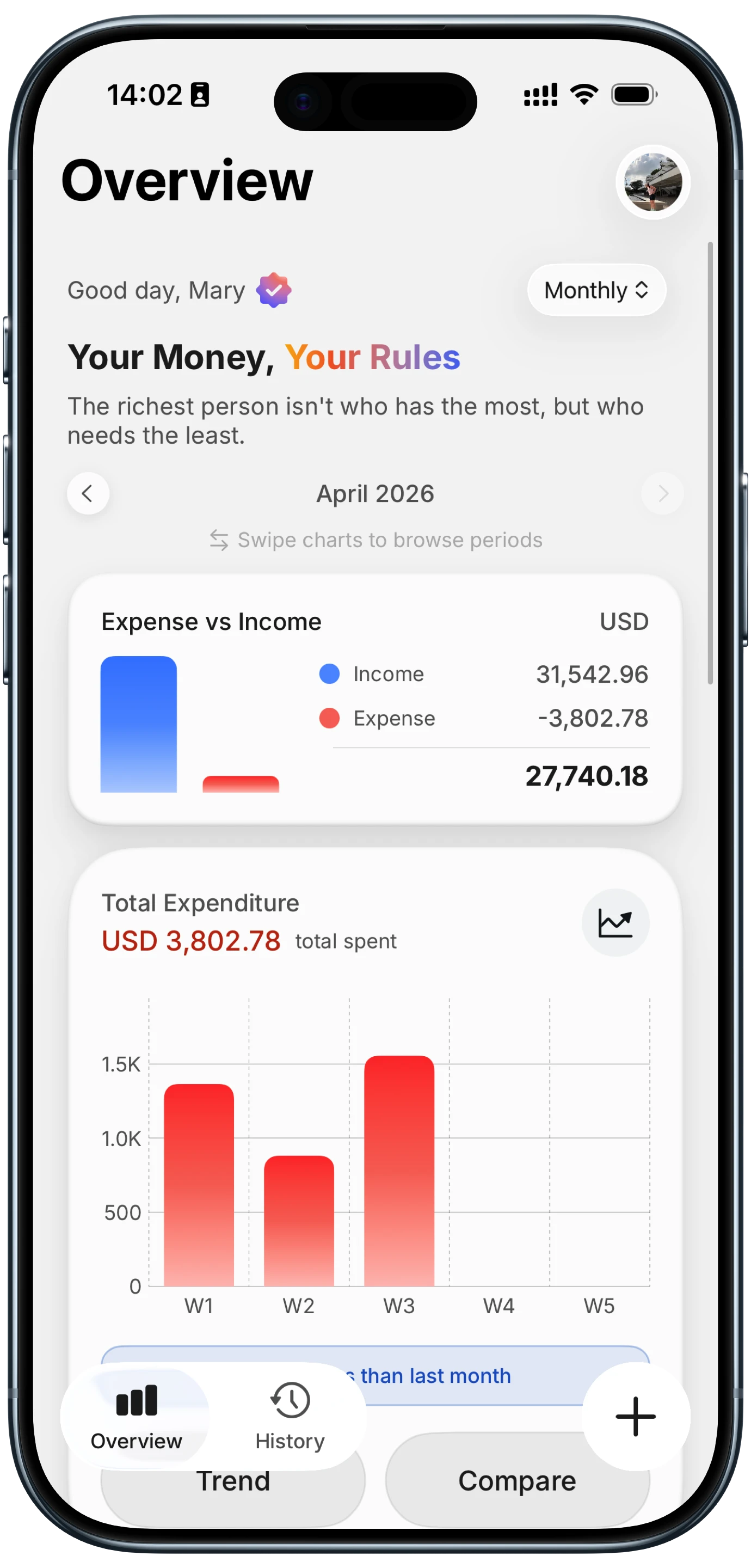
Finny is not built specifically for corporate T&E, but for solo business travelers who want one app that handles personal and business spending without an enterprise price tag, it works well. AI text input, voice input, and Snap and Log batch receipt scanning (up to 5 photos at once) handle daily logging. The Unified Currency View shows transactions in their original currency with totals in your home currency, which matters when reimbursement is in dollars but you paid in euros.
Custom categories let you create a "Reimbursable" tag and a "Per Diem" tag to separate trip line items. CSV export at trip end gives you clean data for your manual report. There is no built-in approval flow, no integration with Concur or QuickBooks, and no native mileage tracker. For a one-person business that wants a low monthly price and no bank login required, those tradeoffs are usually fine.
Best for: independent consultants, solopreneurs, and small-team travelers who file expense reports manually and want a single tool for personal and business spending.
How to Set Up a Tracker for Business Travel
A few practical setup choices that separate easy reimbursement from a painful month-end:
- Create dedicated categories. "Reimbursable Travel," "Per Diem," "Personal," and any client-billable categories. Most apps let you customize.
- Tag the trip. Most expense apps support trip or project tags. Use them so you can filter the trip out of your annual data.
- Photograph receipts at the point of payment. Thermal-paper receipts fade in days. Photograph at the table, not at the airport.
- Lock the exchange rate per receipt. If your app supports it, store the rate at time of payment. This is what your finance team will reconcile against.
- Export the report the same week you return. Memory degrades fast. Match receipts to card statements while the trip is still fresh.
For more on the multi-currency side, see tracking expenses across multiple currencies and best multi-currency expense tracker apps for 2026.
Common Questions
What is the best business travel expense tracker app?
For independent business travelers and small teams, Expensify is the most complete out-of-the-box choice with strong OCR, mileage tracking, and broad accounting integrations. For large enterprises, Concur is the standard. For companies willing to switch card programs, Ramp or Brex offer the cleanest end-to-end automation. For solopreneurs who file reports manually, a more affordable tool like Finny is often enough.
Can I use a personal expense tracker for business travel?
Yes, with caveats. A personal tracker works for solo business travelers if it supports custom categories, multi-currency with rate preservation, receipt scanning, and CSV export. You will not get approval workflows, integrations with company expense systems, or policy enforcement. For freelancers and one-person businesses, that is usually fine. For employees in larger companies, your finance team likely requires a specific tool.
How do I track mileage for business travel?
Apps like Expensify, Zoho Expense, and Concur include built-in mileage tracking with GPS logging. For trackers without it, log mileage manually after each drive (start odometer, end odometer, purpose). The IRS standard mileage rate updates each year and is the deduction value. Keep the log alongside your receipts in case of audit.
Do business expense apps work with company per diem rules?
The major expense management tools (Expensify, Zoho Expense, Concur) support per diem rules at the policy level. You set the daily allowance by location, and the app flags expenses above that for review. Personal trackers typically do not have this feature, so you would track per diem manually with a custom category.
Are receipts required for business expense reimbursement?
For most companies, yes, especially for amounts above $25 to $75 depending on policy. The IRS requires receipts for any business expense above $75 (with some exceptions for lodging, where receipts are required regardless of amount). Even when company policy allows lower thresholds, photograph everything; the marginal effort is small and the audit protection is real.
The Bottom Line
Business travel expense tracking is not the same problem as personal travel budgeting. The bar is reimbursement-grade output: clean receipts, accurate mileage, locked exchange rates, and exports your finance team will accept. Pick the tool that matches your situation: Expensify or Zoho for independent business travelers, Concur for enterprise, Ramp or Brex if you control the card program, and a more affordable personal tracker only if you file reports manually. For a broader look at how these tools stack up across the full reporting workflow, see our roundup of the best expense reporting apps.
Whichever tool you pick, the discipline matters more than the app: photograph receipts the moment you pay, tag every trip-related expense, and export the report the same week you return. The hardest part of business travel expense tracking is the gap between when you spend and when you file. Closing that gap is mostly a habit problem.