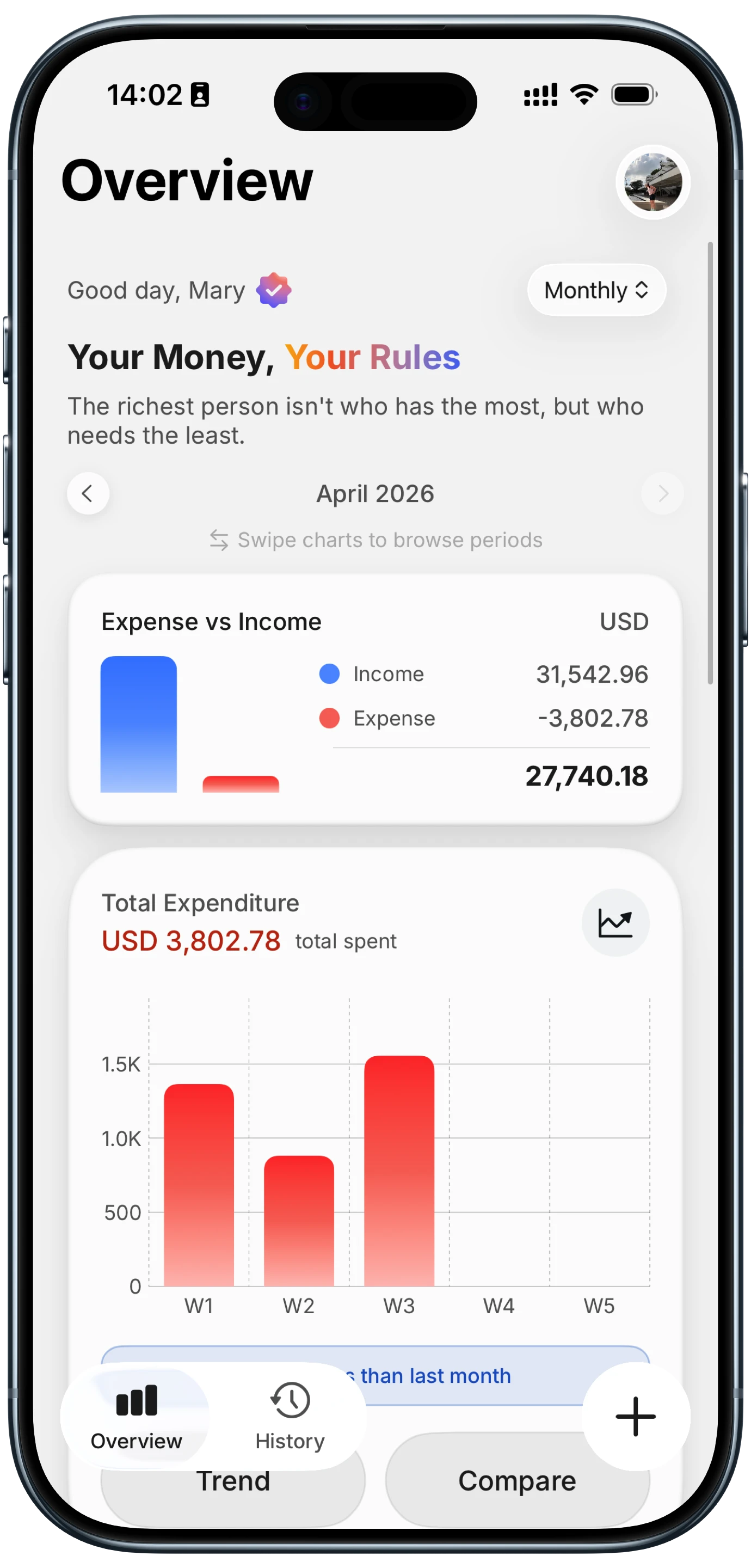
Most expense apps are built for a US audience first. They default to dollars, link to American banks, and treat the euro as an afterthought. If you live in Berlin, Madrid, or Lisbon, that creates real friction. If you cross borders inside the eurozone or earn in one currency and spend in another, the gap gets wider.
European users want apps that handle the euro natively, respect EU privacy law, and work with the banks they actually use. Travellers and remote workers also need apps that switch between EUR, GBP, CHF, and other currencies without breaking the totals. For the wider picture beyond the euro, see our roundup of the best budgeting apps in Europe.
This guide ranks the best expense tracking apps for euros in 2026. We focus on multi-currency support, GDPR posture, EU bank coverage, and how each app behaves when you spend across the eurozone or split your life between countries. For broader picks, see our best multi-currency expense tracker in 2026 guide.
What to Look For in a Euro Expense Tracker
Picking a euro-friendly tracker is not just about whether the app shows a euro symbol. Several details matter more for daily use.
Currency support. The app should treat EUR as a first-class currency, not a workaround. If you also handle GBP, CHF, SEK, NOK, DKK, or PLN, look for native support across all of them, not just euro plus dollars.
SEPA bank coverage. If you want bank syncing, the app needs aggregator coverage across SEPA countries. Most aggregators in Europe go through SaltEdge, Tink, or Yodlee. Coverage varies a lot by country, so check before you pay.
No-bank-link option. Plenty of European users prefer not to share bank credentials with third parties. PSD2 and open banking are safer than scraping, but many people still want a manual or AI-assisted entry path. That is also more GDPR-friendly by design, since less personal data leaves your device.
GDPR compliance. EU-based providers have GDPR baked in. Non-EU apps may still comply, but you should be able to find a clear privacy policy, a data processing agreement, and information on where your data is stored.
Language localization. A good euro tracker handles German, French, Spanish, Italian, Dutch, Polish, and Portuguese, plus the local number formats (commas as decimals, spaces as thousands separators).
Exchange rate accuracy. If you spend in EUR but travel in CHF or GBP, the app should fetch live rates and let you see both the original amount and the converted total.
Quick Comparison Table
| App | Price (EUR) | Multi-Currency | EU Bank Coverage | Offline | GDPR-friendly |
|---|---|---|---|---|---|
| Finny | ~€1.85/mo | Yes (150+) | No bank link | Yes | Yes |
| Spendee | ~€5.50/mo | Yes (150+) | Wide (SaltEdge) | No | Yes (EU-based) |
| Wallet by BudgetBakers | ~€4.49/mo | Yes (150+) | Widest (5,000+ banks) | Partial | Yes (EU-based) |
| Emma | ~€4.99/mo | Yes | UK + some EU | No | Yes |
| Money Lover | Free / ~€4/mo | Yes | Limited | Yes | Yes |
| Goodbudget | Free / ~€7/mo | Limited | None (manual) | Yes | Yes |
The Best Euro Expense Tracker Apps in 2026
Finny: Best for Multi-Currency Users in Europe
Finny is built around a feature that euro users with cross-border lives need most: the Unified Currency View. Every transaction stays in the currency you actually paid. A €12 lunch in Paris stays as 12 EUR. A 35 CHF dinner in Zurich stays as 35 CHF. A £20 train ticket in London stays as 20 GBP. Totals on your dashboard auto-convert to your default currency using daily exchange rates, so you keep both context and clarity.
Finny supports more than 150 currencies, including EUR, GBP, CHF, SEK, NOK, DKK, PLN, CZK, HUF, and RON. That covers eurozone members and the wider European map. If you split time between Germany and the UK, or you live in Sweden and travel to Spain, Finny tracks both halves of your life without forcing one currency to win.
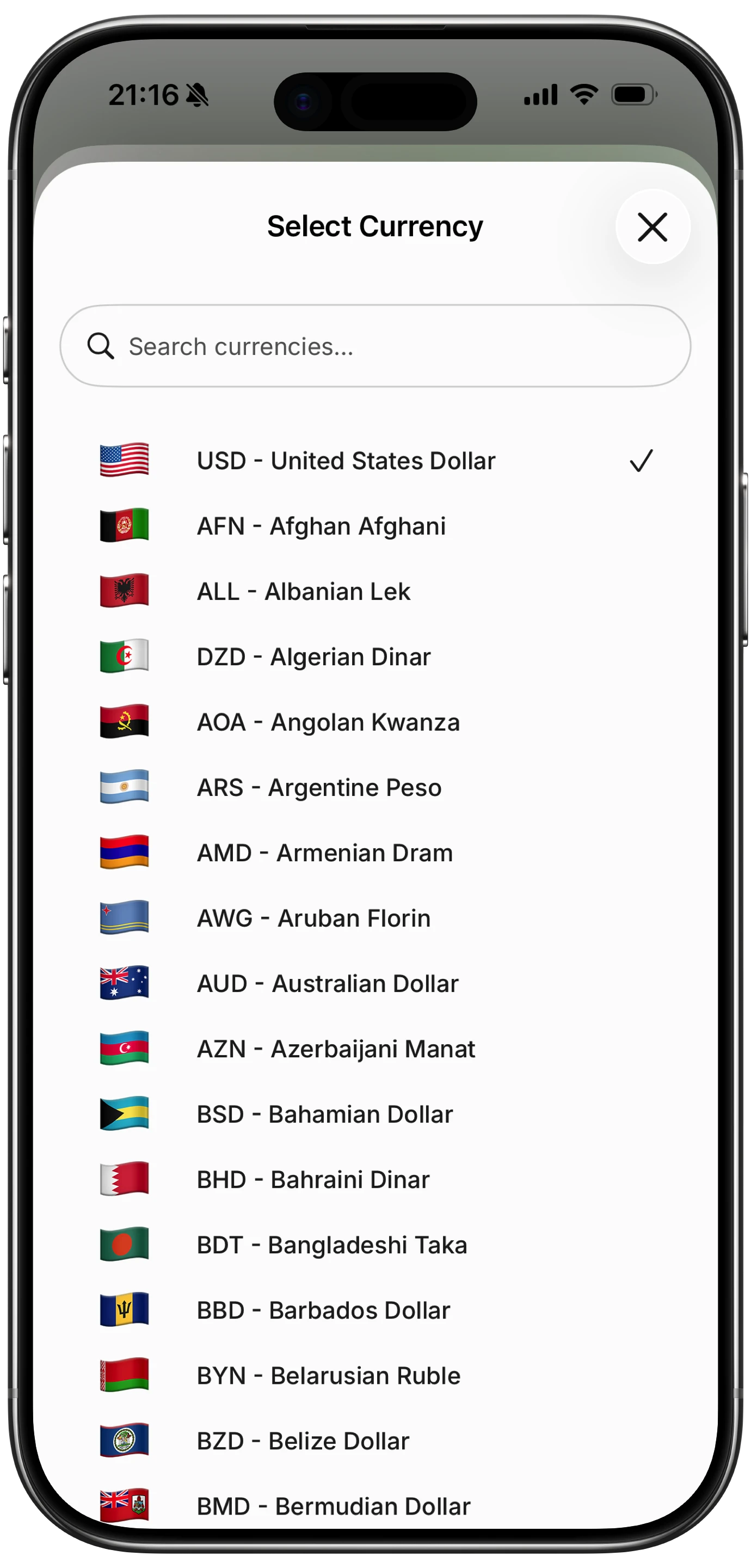
Finny app's multi-currency feature
There is no bank login required. Finny uses AI input and receipt scanning instead of PSD2 aggregators. Snap a German receipt and Finny extracts the amount in euros. Dictate "Uber 14 euro" and it logs the transaction. That is GDPR-friendlier by design, since your bank credentials never leave your device.
Pricing starts at a low monthly price, which converts to roughly €1.85 per month at current rates. That is below most European trackers, and the multi-currency feature is included rather than gated behind a premium tier. For more on this approach, see our guide on tracking expenses in multiple currencies.
Best for: Anyone living in Europe who handles more than one currency, values privacy, and wants effortless tracking without bank linking.
Spendee: Best for European Bank Linking
Spendee is a Czech-built app with strong reach across the EU. It uses SaltEdge for bank syncing, which gives it solid coverage in Germany, France, Spain, Italy, the Netherlands, Poland, and most other EU markets. If automatic transaction import is your priority and you trust open banking, Spendee is one of the most reliable choices.
Multi-currency is handled through wallets. Each wallet holds one currency, so a typical user might have one EUR wallet for daily life and a second wallet in GBP or USD for travel. A global overview converts everything to your home currency. The structure works, but it adds a step before each entry: you have to pick the right wallet first.
Premium runs around €5.50 per month and unlocks unlimited wallets, budgets, and shared accounts. Couples or roommates pooling expenses inside the eurozone find the shared wallet feature useful.
Spendee is GDPR-compliant by default as an EU company. The downside is no offline mode, which matters when you are travelling on a train through the Alps or sitting at a café with no signal.
Best for: Europeans who want bank syncing across the eurozone and do not mind paying premium for it.
Wallet by BudgetBakers: Best All-in-One European App
Wallet by BudgetBakers is the most established European budgeting app. Built in Prague, it has the widest EU bank coverage of any app on this list, syncing with more than 5,000 institutions across the EU and UK through SaltEdge. If you bank in two or three EU countries, Wallet usually handles all of them.
The app supports more than 150 currencies and lets you assign different currencies to different accounts. Reports roll up into your home currency. Beyond expense tracking, Wallet adds budgeting, debt tracking, recurring bill reminders, and shareable accounts for households.
Wallet is GDPR-compliant and PrivacyTrust-certified, which is rare. The company is upfront about EU data residency and PSD2 compliance. Premium runs around €4.49 per month, with an annual discount.
The trade-off is interface density. Wallet packs a lot in, and new users sometimes find it busy. If you want a clean, simple log, you may prefer Finny or Money Lover. If you want one app that holds your full European financial picture, Wallet earns its place.
Best for: Europeans who want full bank coverage, deep budgeting, and family sharing in one app.
Emma: Best for UK Euro Travelers
Emma started in the UK and has grown into one of the most polished personal finance apps in Europe. It connects to UK banks plus a growing number of European institutions, and supports multi-currency accounts well, which matters if you live in London but spend in euros on weekend trips.
Emma is strong at subscription tracking, net worth charts, and category insights. The interface is clean, and the onboarding is one of the smoothest in this list. Premium runs around €4.99 per month and unlocks custom categories, unlimited budgets, and offline export.
For UK users who travel into the eurozone often or who get paid in euros while based in London, Emma handles the EUR/GBP overlap better than US-built apps. It also fits Irish users well, given its native UK and Ireland coverage.
The limitation is depth of coverage outside the UK and Ireland. Continental European banks are supported, but the list is shorter than what Wallet by BudgetBakers offers.
Best for: UK and Irish users who travel inside the eurozone or hold both GBP and EUR accounts.
Money Lover: Best Free Euro Tracker
Money Lover offers one of the most generous free tiers in this category. You can track unlimited transactions, set budgets, and use the app in EUR or any other currency without paying. That makes it a good fit for students, early-career users, or anyone who wants a no-cost euro tracker.
Multi-currency is supported through wallets, similar to Spendee. You can hold a EUR wallet, a USD wallet, and a GBP wallet, with totals rolled up to your default. The free version covers most needs, while premium (~€4 per month) removes ads and unlocks linked bank accounts in selected EU markets.
Money Lover works offline, which is useful for travel inside and outside the eurozone. The interface is straightforward and the app is available in most European languages.
The weak spots are bank coverage outside a few EU countries and a less refined design than Wallet or Emma. For free euro tracking with manual entry, though, it is hard to beat. For a deeper look at no-bank-link options, see our multi-currency management guide.
Best for: Budget-conscious euro users who want a free, manual-friendly tracker.
Goodbudget: Best Envelope-Method for Multi-Currency Households
Goodbudget brings the envelope method into the app world. You assign euros to envelopes (groceries, rent, transport, eating out) at the start of the month, then log spending against each envelope. When an envelope hits zero, you stop spending in that category.
For households where two partners share finances across two currencies, Goodbudget works because envelopes can be set in different currencies. One partner can run a EUR envelope set, and the other can run a GBP envelope set, with shared visibility through the household sync feature.
Goodbudget is manual-only, with no bank linking. That keeps it GDPR-friendly and avoids the PSD2 setup. The free tier supports 20 envelopes and two devices, which is enough for many households. Plus runs about €7 per month.
The envelope method requires discipline, and the multi-currency support is shallow compared to Finny or Wallet. But for European couples who want a shared rules-based system, Goodbudget is a niche but useful pick. For couple-focused expense tools, see our digital nomad multi-currency expense tracker guide.
Best for: Multi-currency households who use envelope budgeting.
Multi-Currency vs Single-Euro Tracking: What to Pick
If your life happens entirely inside the eurozone, a single-currency tracker is fine. You earn in euros, spend in euros, and your bank statement is in euros. Apps like Wallet by BudgetBakers, Spendee, or even a basic free app cover everything.
If your life crosses borders, you need multi-currency from day one. That includes anyone who:
- Lives in the eurozone but travels to the UK, Switzerland, Sweden, or Denmark
- Earns in EUR but spends part of the year in the US, Canada, or Asia
- Holds bank accounts in two countries with different currencies
- Works remotely and gets paid in USD or GBP while based in an EU country
- Sends money home from one EU country to another
For these users, the right question is not "which app shows euros" but "which app preserves what I actually paid". Apps that silently convert every transaction to euros lose context. Apps that force you to switch wallets before each entry add friction. The cleaner approach is to log in the original currency and let the app aggregate to euros automatically.
Our multi-currency expense tracking guide for 2026 goes deeper on this distinction.
Privacy and GDPR for Euro Users
Privacy weighs more in Europe than in the US, and not just for legal reasons. GDPR requires apps to disclose what they collect, where it lives, who processes it, and how to delete it. That changes how you should compare expense apps.
Three things to check before signing up:
Where is the company based? EU companies are inside the GDPR perimeter by default. Non-EU companies can still comply, but the contract relationship is different. BudgetBakers and Spendee are Czech, Emma is UK-based, and Money Lover is Vietnamese with EU servers.
Is bank login required? Apps that link to your bank pull a lot of personal data through PSD2. That data is often handled by aggregators like SaltEdge or Tink. The pipeline is regulated and safe, but more parties touch your data. Apps without bank linking, like Finny and Goodbudget, keep that data out of the loop entirely.
How long is data retained? Look for a clear retention policy. Some apps keep transaction data indefinitely. Others let you export and delete on request, as GDPR requires.
If privacy is a top priority, lean toward EU-based apps with no bank link, or non-EU apps with strong privacy posture and on-device storage.
How to Track Expenses While Traveling Across the Eurozone
Travel inside the eurozone is easier than travel between EUR and other currencies, but you still want a system. Here is one that works:
- Pick a default currency. Set EUR as your home currency in the app, even if you live elsewhere, so eurozone trips do not convert.
- Log in original currency. When you cross into the UK or Switzerland, log in GBP or CHF. Do not pre-convert in your head.
- Use AI input or receipts where possible. Speech and receipt scanning are faster than typing, especially after a long travel day.
- Check your dashboard each evening. A two-minute review keeps the trip honest and catches missed entries.
- Tag by trip. Use a tag like "Lisbon-2026" or "Prague-Apr" so you can isolate the trip later.
- Sync before flights. If you use a cloud-synced app, force a sync before going offline. If your app works offline, you can skip this.
- Review on arrival home. Run a report in EUR to see total trip cost, then archive the trip tag.
This routine works whether you travel for one weekend or three months.
Common Questions
Which expense tracker app supports the euro best? Wallet by BudgetBakers and Spendee have the deepest European bank coverage. For multi-currency use without bank linking, Finny is among the most affordable and has the cleanest unified currency view. Pick based on whether you want bank sync or manual privacy-first tracking.
Do these apps work with European banks? Wallet by BudgetBakers and Spendee work with most major European banks through SaltEdge. Emma covers the UK and Ireland strongly, with growing EU support. Money Lover supports a smaller list of EU banks. Finny and Goodbudget do not link to banks at all, which some euro users prefer for GDPR reasons.
Are euro expense trackers GDPR compliant? EU-based apps like Wallet by BudgetBakers and Spendee are GDPR-compliant by default. Non-EU apps can still comply if they have proper data processing agreements and EU server options. Always read the privacy policy before linking accounts. Apps that do not require bank login generally have a smaller GDPR footprint.
Can I track expenses in euros and dollars at the same time? Yes, but the experience varies. Finny lets you log each transaction in its original currency and converts totals automatically, so EUR and USD transactions live side by side. Spendee, Wallet, and Money Lover use a wallet-per-currency model, which works but requires switching before each entry. Goodbudget supports envelopes in different currencies for households.
Conclusion
The best euro expense tracker depends on how your money moves. If you want maximum bank coverage inside Europe and full budgeting depth, Wallet by BudgetBakers is the safe pick. If you cross currencies often and want a privacy-first, low-cost option that preserves what you actually paid, Finny is the cleanest fit at about €1.85 per month with no bank login required.
Try Finny free and see if the Unified Currency View matches how you spend across the eurozone and beyond. Download from the App Store or visit getfinny.app to start.