You get home from a trip, open your bank statement, and every purchase abroad is a little bigger than you remember. That extra sliver on the coffee, the taxi, the hotel bar, it adds up fast. Most of the time the culprit is foreign transaction fees, a quiet surcharge that banks and card networks tack onto anything you buy outside your home country. On a two week trip, these fees can easily cost more than a nice dinner, and almost nobody notices until the money is already gone.
The good news: foreign transaction fees are one of the most avoidable travel costs there is. With the right card, a habit of declining one specific checkout trap, and a simple way to track what you spend across currencies, you can bring these fees close to zero. This guide walks through exactly how, with numbers you can verify and steps you can use on your next trip.
What Foreign Transaction Fees Are and What They Typically Cost
A foreign transaction fee is a charge your card issuer applies whenever a payment is processed outside your home country or in a currency other than your home currency. It usually shows up as a percentage of the purchase, added on top of the exchange rate.
For most US credit cards, foreign transaction fees run between 1 percent and 3 percent per purchase, with 3 percent being the common headline number and the 2026 average landing closer to 1.5 percent across all cards. The fee is often split into two parts: roughly 1 percent charged by the card network (Visa or Mastercard) and up to about 2 percent added by the bank that issued your card.
Three percent may not sound like much, but it applies to everything: meals, hotels, tours, souvenirs, transit, even online bookings billed in a foreign currency. Here is what that looks like in practice.
| Payment method | Typical foreign fee | How to avoid it |
|---|---|---|
| Standard credit card | 1 to 3 percent per purchase | Switch to a no foreign fee card |
| Debit card at a shop | 1 to 3 percent, sometimes plus a flat fee | Use a multi-currency card |
| DCC (pay in home currency) | 3 to 7 percent markup | Always pay in local currency |
| ATM withdrawal | Network fee plus operator fee | Use a fee-friendly card, decline conversion |
| Multi-currency card (Wise, Revolut) | Roughly 0.35 to 1 percent | Hold the local currency in advance |
The point is not that any single fee is huge. It is that they stack. A 3 percent card fee plus a bad conversion rate plus an ATM surcharge can quietly turn into 6 to 8 percent lost on your travel budget. If you want to see how those small percentages compound over a month abroad, our guide on how to track expenses in multiple currencies breaks it down.
Dynamic Currency Conversion: The Trap at Checkout
The single most expensive mistake travelers make is not choosing the wrong card. It is saying yes at the wrong screen. That screen is called dynamic currency conversion, or DCC.
Here is how it works. You hand over your card at a restaurant in Paris, or you tap at a shop in Tokyo, and the terminal recognizes that your card is foreign. Instead of just charging you in euros or yen, it offers to charge you in your home currency instead, showing a friendly "pay in USD" option with the exact dollar amount. It feels convenient, and that is the whole trick.
When you accept DCC, the merchant's payment provider does the currency conversion right there at the register, and they set the exchange rate. That rate is almost always worse than what your card would have used, with a markup that typically runs 3 to 4 percent and sometimes higher. At an ATM the DCC rate can be 3 to 7 percent worse than the real market rate. Worst of all, you often still pay your card's regular foreign transaction fee on top.
The rule is simple: always pay in the local currency. If a card reader or an ATM asks whether you want to be charged in your home currency or the local one, choose local every single time.
- At a card terminal, pick the option showing the local currency (euros in Europe, yen in Japan, baht in Thailand).
- At an ATM, decline any "conversion" or "guaranteed rate in your currency" prompt and choose "continue without conversion."
- Online, if a foreign site offers to bill you in your home currency, switch it back to the local currency at checkout when you can.
You have the right to refuse DCC, and refusing it costs you nothing. Declining it lets your own bank handle the conversion at the network rate, which is far closer to the real exchange rate.
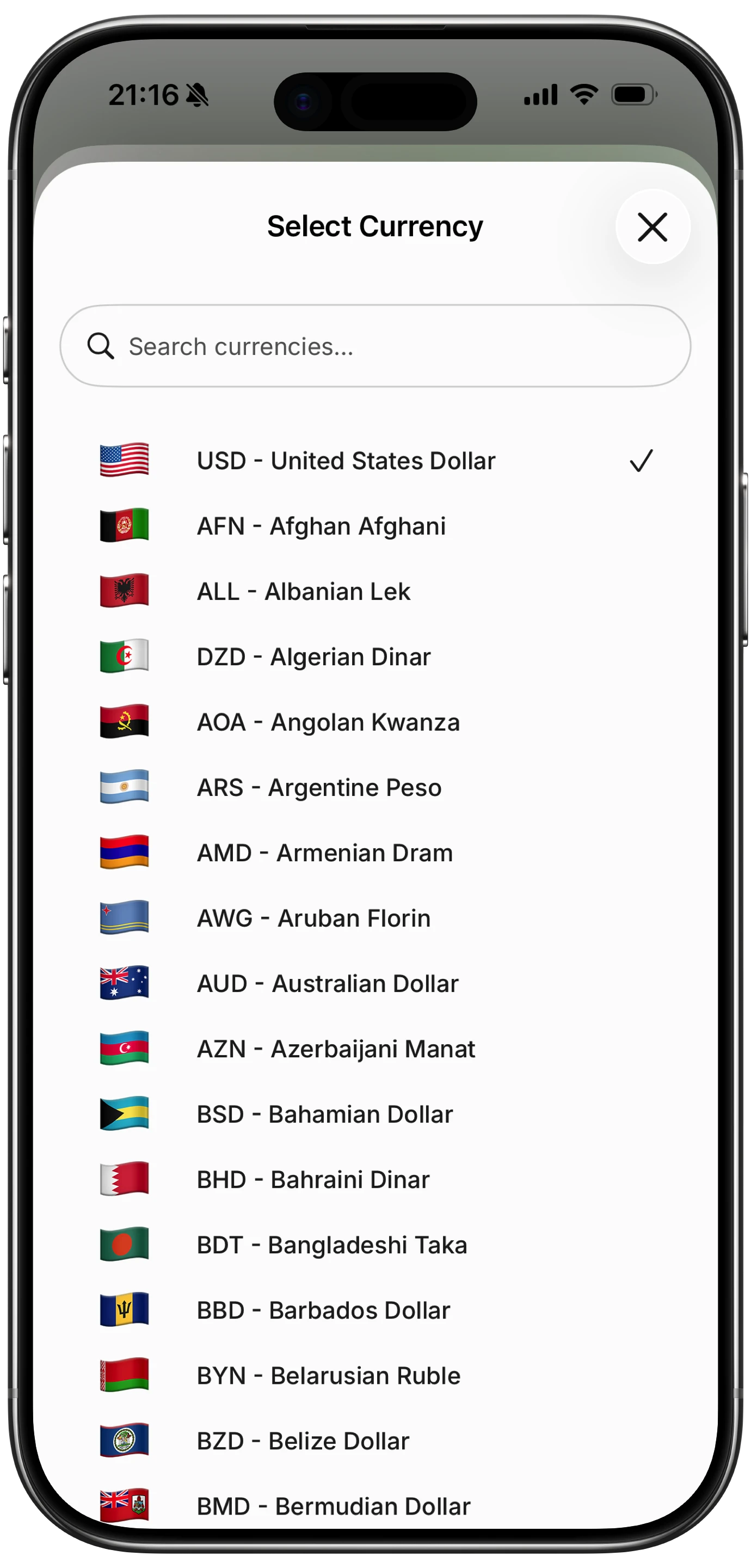
Finny app's multi-currency feature
Cards With No Foreign Transaction Fees
The cleanest way to erase card foreign transaction fees is to carry a card that simply does not charge them. A meaningful share of the market already qualifies: roughly a quarter of US credit card offers come with no foreign transaction fee at all.
Some issuers drop the fee across their entire lineup. Capital One, Discover, and USAA are well known for charging zero foreign transaction fees on their cards. Many travel rewards cards from other banks also waive the fee, which is part of why they are marketed to frequent flyers.
When you are choosing a card to travel with, check for these features:
- Zero foreign transaction fee, stated plainly in the card's terms.
- Wide network acceptance, meaning Visa or Mastercard rather than a card type that is rare abroad.
- Chip and contactless support, since tap to pay is standard across much of Europe and Asia.
- A strong fraud and travel notification system, so your card does not freeze on day one.
A quick tip before you leave: read the fee schedule for the exact card you plan to bring, not just the card family. Fees can differ between a bank's basic and premium products. If you are comparing options for a longer stay, our roundups of the best travel budget apps for 2026 and the best multi-currency expense tracker for 2026 pair well with a no-fee card.
Multi-Currency Accounts and Travel Cards (Wise and Revolut)
If you travel often, spend in several currencies, or live abroad, a dedicated multi-currency account can beat even a good no-fee credit card. The two most popular options in 2026 are Wise and Revolut. Both give you an account plus a debit card, and both let you hold and spend multiple currencies.
Wise lets you hold 40 or more currencies in one account and spend at the real mid-market exchange rate, the same rate you see on Google, with a small transparent conversion fee instead of a hidden markup. That fee typically starts around 0.35 percent for major currencies and rises for less common ones. The card has a one-time issue cost of around 9 US dollars and no monthly fee. A useful trick: if you hold a balance in the local currency before you spend, the payment pulls straight from that balance with no conversion fee at all.
Revolut works similarly, with an app-based account and a debit card that supports many currencies. Free plans exchange at strong rates during the week but can add a small markup (often around 1 percent) on weekends and holidays when currency markets are closed. Paid Revolut tiers raise the fee-free limits.
How they compare for a traveler:
| Feature | Wise | Revolut (Standard) |
|---|---|---|
| Currencies you can hold | 40 or more | Many, varies by region |
| Exchange rate | Mid-market, transparent fee | Mid-market on weekdays |
| Weekend markup | None | Around 1 percent |
| Card cost | One-time fee, no monthly | Free tier available |
| Best for | Predictable, low-cost FX | All-in-one app spenders |
The catch with any account like this is that you now have money moving through a second app, in several currencies, separate from your main bank. That is powerful, but it makes tracking harder, which is exactly the problem we solve later in this guide. For a deeper look at living across currencies, see our multi-currency expense tracker for digital nomads guide.
ATM and Cash Tips for Avoiding Fees Abroad
Cash still rules in plenty of places, and ATMs are where foreign fees can pile up the fastest. A single withdrawal can hit you with a network foreign fee, a fee from your own bank, an operator fee from the ATM owner, and a bad DCC rate if you are not careful.
Use these habits to keep cash cheap:
- Decline the ATM's conversion. When it offers a "guaranteed rate in your home currency," say no and choose to be charged in the local currency, just like at a shop.
- Withdraw larger amounts less often. Flat per-withdrawal fees hurt more when you take out small sums repeatedly. Fewer, bigger withdrawals spread that cost.
- Know your card's free ATM limit. Wise, for example, offers a monthly fee-free withdrawal allowance (around 250 US dollars in the US as of 2026) before charging roughly 1.95 percent plus a small flat fee on the excess. Revolut's standard plan caps free withdrawals at a set amount or number per month, then charges about 2 percent, and paid tiers raise that ceiling.
- Use bank-owned ATMs. Machines inside real bank branches tend to charge lower operator fees than the standalone ones in tourist areas, hotels, and airports.
- Keep a small local cash buffer for markets, taxis, and tips, so you are not forced into a bad ATM at a bad moment.
The theme running through all of this is the same as with card payments: refuse the convenient conversion, pay or withdraw in the local currency, and let your account handle the exchange.
How to Track Spending Across Currencies So Fees Do Not Surprise You
Avoiding fees is only half the job. The other half is seeing your spending clearly, so that a bad rate or a forgotten cash purchase does not sneak up on your statement weeks later. When your money is scattered across a credit card, a Wise balance, and a pocket full of local cash, a single running total is what keeps you honest.
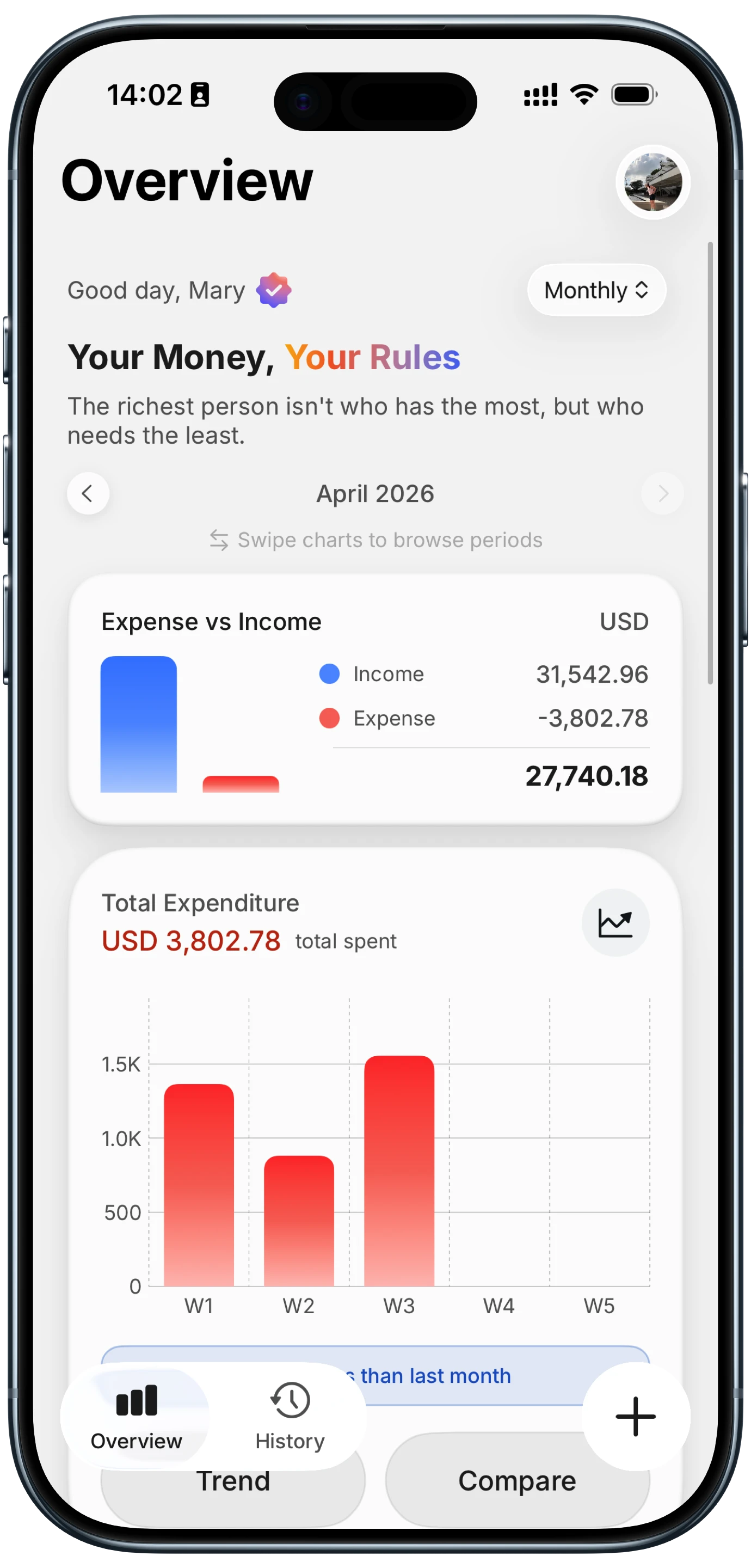
That is where a lightweight tracker earns its place. Finny is an AI-powered expense tracker for iPhone built for exactly this situation. It supports 150 or more currencies and works fully offline, so you can log a coffee in Lisbon or a tuk-tuk in Bangkok the moment you pay, even with no signal and no roaming data. There is no bank login required, and your data stays on your device.
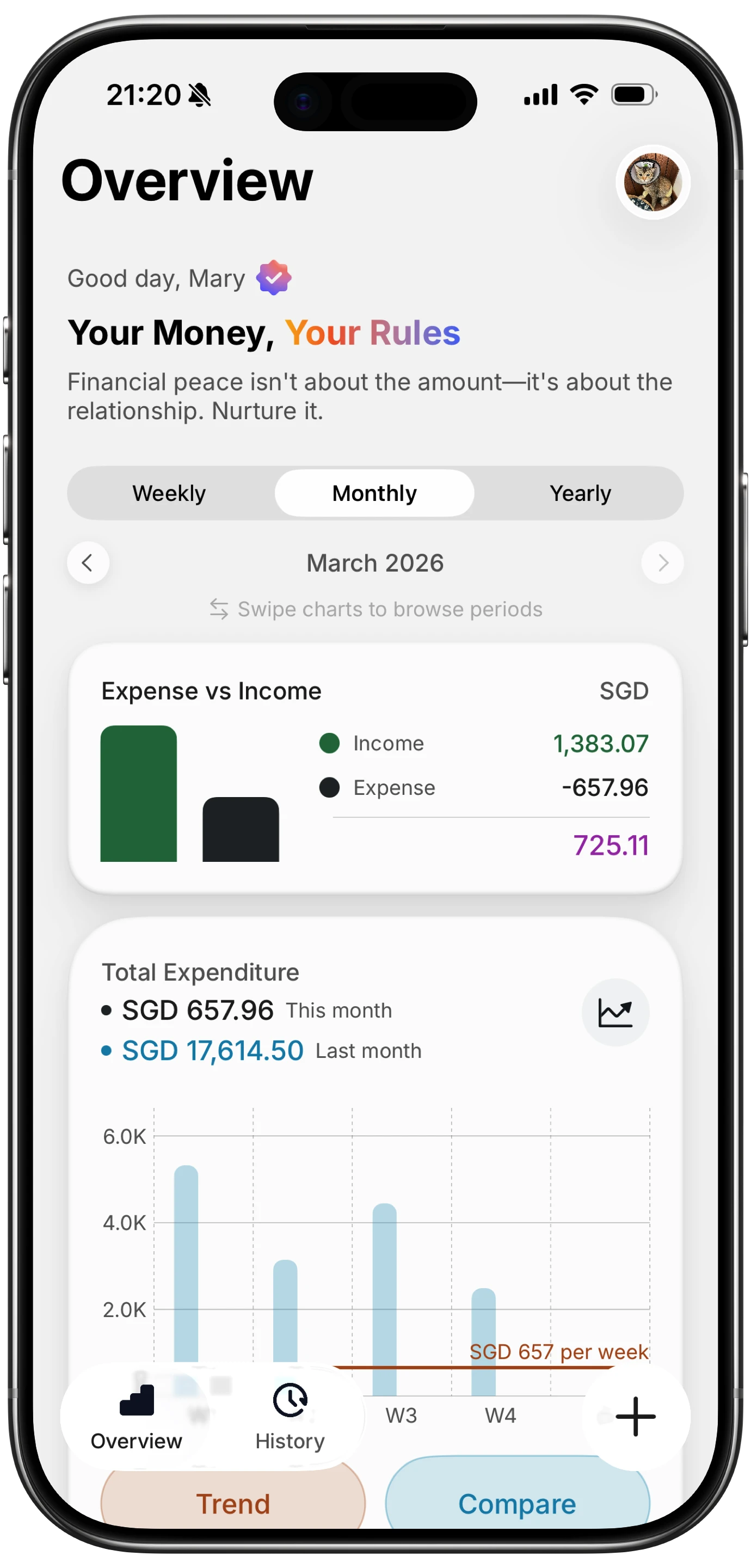
Finny app's Overview feature
Logging is meant to take seconds. Finny's free plan covers manual tracking, custom categories, spending charts, and those 150 plus currencies at no cost forever, plus one free AI credit to try the smart input. If you want the fastest logging, Finny Pro (1.99 US dollars per month or 17.99 US dollars per year) unlocks AI input where you type something like "coffee 5," speak it out loud, or snap a photo of the receipt, and it fills in the details for you to review before saving. Pro also adds Tap to Track, batch receipt scanning, and cloud sync across your devices.
The habit that saves you money is small: log each purchase in the currency you actually paid, watch the running total build, and reconcile it against your card and account balances when you get back on wifi. When the numbers match, hidden fees have nowhere to hide.
Frequently Asked Questions
What is the average foreign transaction fee?
For US credit cards, foreign transaction fees typically fall between 1 percent and 3 percent per purchase, with 3 percent being a common rate and the 2026 average across all cards sitting near 1.5 percent. Around a quarter of card offers charge no foreign transaction fee at all.
Should I pay in local currency or my home currency abroad?
Always choose the local currency. Being charged in your home currency triggers dynamic currency conversion, which adds a markup that often runs 3 to 4 percent or more on top of any regular fee. Paying in local currency lets your own bank do the conversion at a much fairer rate.
Do debit cards charge foreign transaction fees too?
Many do, often 1 to 3 percent and sometimes with an added flat fee per transaction. Multi-currency debit cards from providers like Wise and Revolut are designed to avoid most of that by using the mid-market rate with a small, transparent conversion fee.
Is Wise or Revolut better for avoiding fees while traveling?
Both are strong. Wise is known for predictable, low-cost conversions at the real mid-market rate with no weekend markup. Revolut is an all-in-one app that offers great weekday rates but can add a small markup on weekends unless you are on a paid plan. Pick based on how and where you spend.
How do I keep track of what I spend in different currencies?
Use an expense tracker that supports many currencies and works offline, so you can log spending the moment it happens. Finny handles 150 or more currencies, works with no data connection, and keeps everything on your device, which makes it easy to reconcile against your card and catch any surprise fees.
Conclusion
Foreign transaction fees feel unavoidable only because they are quiet. Once you know where they hide, they are easy to shut down. Carry a card that charges no foreign transaction fee, refuse dynamic currency conversion and always pay in the local currency, consider a multi-currency account like Wise or Revolut for frequent travel, and be smart about how you pull cash from ATMs. Do those four things and you keep almost all of that 3 percent in your own pocket.
Then close the loop by tracking what you spend, in the currency you spent it. Download Finny to log expenses across 150 plus currencies, online or off, and make sure the number on your statement matches the trip you actually took.