The expensive part of taxes is rarely the rate. It is the deductions you missed because you did not track the spending in time. The IRS will not call you to remind you about a $300 software subscription, a $1,200 home office setup, or 6,000 business miles you forgot to log. If you do not have the record, you do not have the deduction.
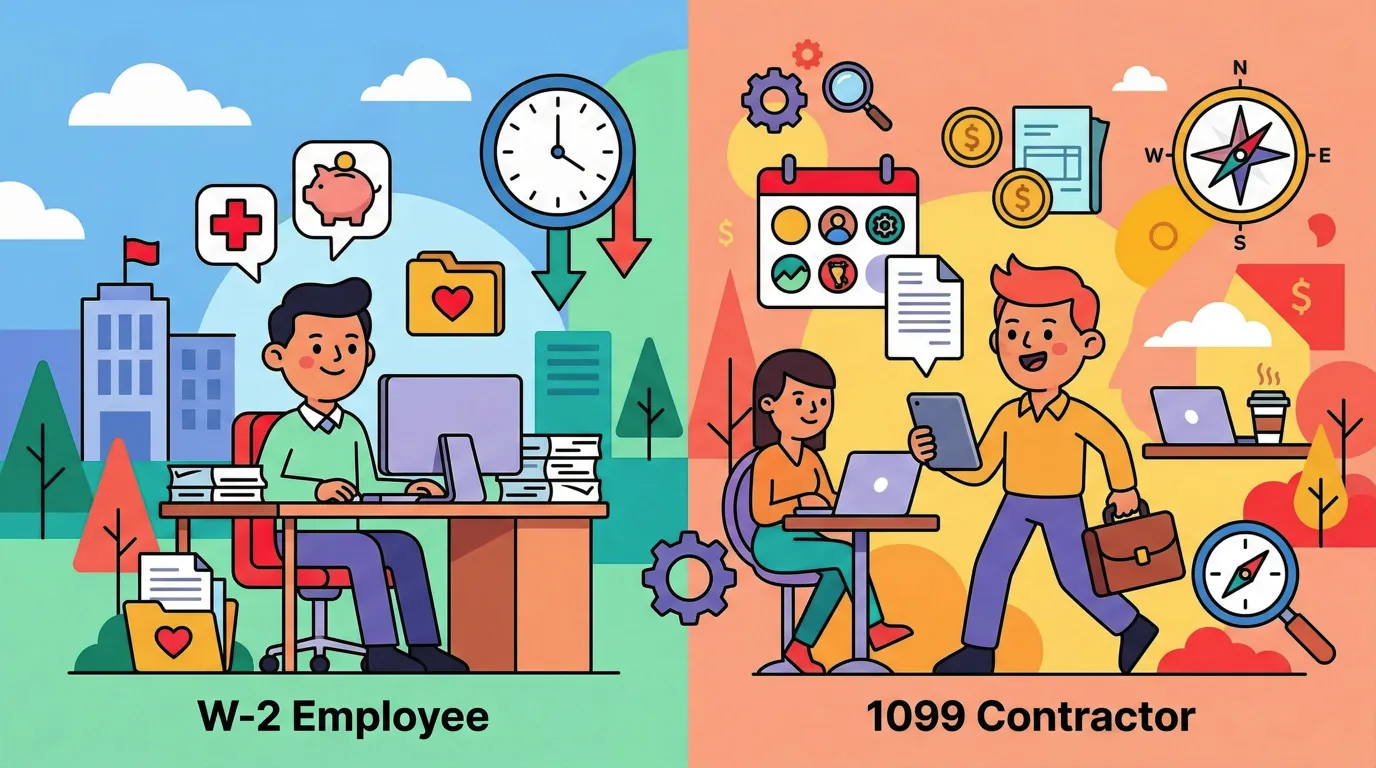
Learning how to track expenses for taxes is mostly about building a system that runs all year, not a scramble in March. This guide walks through the five-step process that works for freelancers, side-hustlers, and anyone with deductible business expenses. For the broader self-employment tax mechanics, see self-employment tax and quarterly payments for 2026 and our W-2 vs 1099 explainer.
Step 1: Set Up Tax-Bucket Categories on Day One
The most common reason expenses do not become deductions is bad categorization. The fix is to mirror the IRS Schedule C categories from the start, not to retroactively recategorize before April 15.
Common Schedule C buckets:
- Advertising (online ads, business cards, marketing)
- Car and truck expenses (mileage or actual costs)
- Contract labor (1099 contractors you hired)
- Insurance (business insurance, errors and omissions)
- Legal and professional services (lawyer, accountant, consultants)
- Office expense (general office supplies)
- Rent and lease (office rent, equipment leases)
- Repairs and maintenance
- Supplies (consumables for the business)
- Taxes and licenses (business licenses, permits)
- Travel (lodging, airfare, ground transport)
- Meals (50% deductible, business purpose required)
- Utilities (business phone, internet, etc.)
- Other expenses (anything not fitting above)
Plus home office as a separate calculation if you have a regular and exclusive workspace.
Set these up as custom categories in your tracker on day one. Every expense gets logged into one of these buckets, not a generic "Business" or "Misc."
Step 2: Capture Receipts the Moment You Spend
The IRS requires receipts for any business expense above $75 (with exceptions for lodging, where receipts are required regardless of amount). Below $75, receipts are not required but strongly recommended; they are cheap insurance during an audit.
The trick is capturing immediately, not at week-end:
- Photograph paper receipts at the table. Thermal receipts fade in days; an early photo lasts forever.
- Forward email receipts to a dedicated address. Most receipt apps support email capture for digital purchases (software subscriptions, online orders).
- Use batch scanning for stacks at the end of a travel day. Apps like Finny handle up to five receipts at once.
For the privacy-and-safety side of receipt scanning, see are receipt scanning apps safe.
Step 3: Log Mileage Daily, Not Annually
If you drive for business, mileage is usually one of the largest deductions available. The IRS standard mileage rate is updated annually; for the current rate, check the IRS standard mileage page.
What the IRS expects in a mileage log:
- Date of each trip
- Starting odometer reading (or starting location)
- Ending odometer reading (or destination)
- Total miles
- Business purpose (the meeting, the client, the errand)
The simplest method: a daily note in your phone with date, miles, and purpose. The cleaner method: an app with GPS-based automatic mileage tracking that distinguishes business from personal drives based on rules you train. Apps in this space include Hurdlr, MileIQ, and QuickBooks Self-Employed. For more on freelancer apps, see best tax-deductible expense tracker apps.
The wrong method: trying to reconstruct mileage in March from memory. The IRS does not accept estimates as documentation.
Step 4: Reconcile Monthly
Once a month, set 30 minutes to:
- Match your tracker against bank and card statements. Catch missing transactions while memory is fresh.
- Check that every expense has the right category. A misclassified expense is the same as a missed deduction.
- Verify receipts are attached to all transactions above $75.
- Flag anything ambiguous for an accountant review (mixed personal-and-business purchases, large or unusual expenses, anything you are not sure how to categorize).
Monthly reconciliation is the single highest-leverage habit in tax-expense tracking. It catches errors when they are easy to fix and prevents the year-end backlog that produces the most missed deductions.
Step 5: Quarterly Check-Ins
If you owe quarterly estimated taxes (most freelancers do), align your tracking review with the quarterly deadlines. Before each estimated payment:
- Total deductible expenses by category for the quarter.
- Calculate net business income (gross minus deductions).
- Estimate quarterly tax owed (income tax plus 15.3% self-employment tax on the net).
- Pay the estimate. Use IRS Direct Pay or EFTPS.
For the quarterly deadlines and safe-harbor rules, see self-employment tax and quarterly payments for 2026. For the full freelancer setup, see free business expense tracker apps for freelancers and how to track business expenses on iPhone.
What Your Accountant Actually Needs
If you work with an accountant or tax preparer, they typically need:
- A summary by Schedule C category (totals only, not every line item)
- Mileage log totals
- 1099-NEC forms received from clients
- 1099-K forms from payment platforms (Stripe, PayPal, Venmo for business)
- Receipts available for any expense flagged or above $75
- A list of equipment purchases above $2,500 (for depreciation decisions)
- Health insurance premiums paid as self-employed
- Retirement contributions to SEP IRA or Solo 401(k)
- Home office square footage (if claiming the deduction)
If you use TurboTax or another tax software, the same categorized totals flow into the software directly. Most modern trackers offer a CSV export that maps to Schedule C lines.
Common Mistakes to Avoid
- Mixing business and personal in the same account. Open a separate business checking account, even if you are a sole proprietor without an LLC.
- Trying to deduct meals fully. Business meals are 50% deductible (with documented business purpose), not 100%.
- Claiming home office without exclusive use. The space has to be used regularly and exclusively for business. A guest bedroom doubling as your office disqualifies it.
- Forgetting depreciation on big purchases. Equipment over a certain threshold may need to be depreciated over several years, not deducted in one.
- Skipping mileage on short trips. Five miles to the post office for business mail is still deductible; cumulative short trips often dwarf the long ones.
Common Questions
How do I track expenses for taxes if I am self-employed?
Set up Schedule C-style categories in your expense tracker (Advertising, Car expenses, Office, Supplies, Travel, Meals, etc.), photograph receipts at the moment of purchase, log mileage daily, and reconcile monthly. At quarter-end, total each category and use the numbers to estimate quarterly taxes. At year-end, export totals for your accountant or tax software.
Do I need to keep paper receipts for taxes?
No, digital photos count. The IRS accepts digital records as long as they are clear and accurate. Most tracker apps store receipt images alongside the transaction, which satisfies documentation requirements. Keep records for at least three years from the date you filed your return; six years if you might have substantially underreported income.
What expenses can I deduct as a freelancer?
Common deductions include home office, mileage for business driving, equipment and software, supplies, professional services, business travel, meals (50%), education that maintains skills, health insurance premiums (self-employed), retirement contributions, and a portion of phone and internet used for business. The exact list depends on your situation. Consult a tax professional for specifics.
When should I start tracking expenses for taxes?
The day you start earning self-employment income, even if it is a side gig that earns $300 in its first month. Habits are easier to build at the start than to retrofit later. If you are mid-year and have been tracking informally, start now and reconstruct earlier months from card statements, calendar entries, and email receipts.
Should I do my own taxes or hire an accountant?
For simple sole-proprietor situations with under $50,000 in self-employment income and a standard deduction picture, tax software (TurboTax Self-Employed, FreeTaxUSA, H&R Block) usually suffices. For more complex situations (multi-state work, significant deductions, business equipment depreciation, hiring contractors), an accountant typically pays for themselves through better deduction capture. The cost of an accountant is also a deductible business expense.
The Bottom Line
Tracking expenses for taxes is a year-round system, not a tax-season scramble. The five steps are simple: set up Schedule C categories on day one, capture receipts the moment you spend, log mileage daily, reconcile monthly, and review quarterly. The hardest part is consistency, not complexity.
The reward is real money: deductions you would have missed are worth roughly 25% to 35% of themselves in combined federal, state, and self-employment tax savings. A freelancer who logs $20,000 in deductible expenses keeps $5,000 to $7,000 they would have lost. The system pays for itself many times over.
This article is general information, not tax advice. Specific deduction questions and complex situations should go to a qualified tax professional.