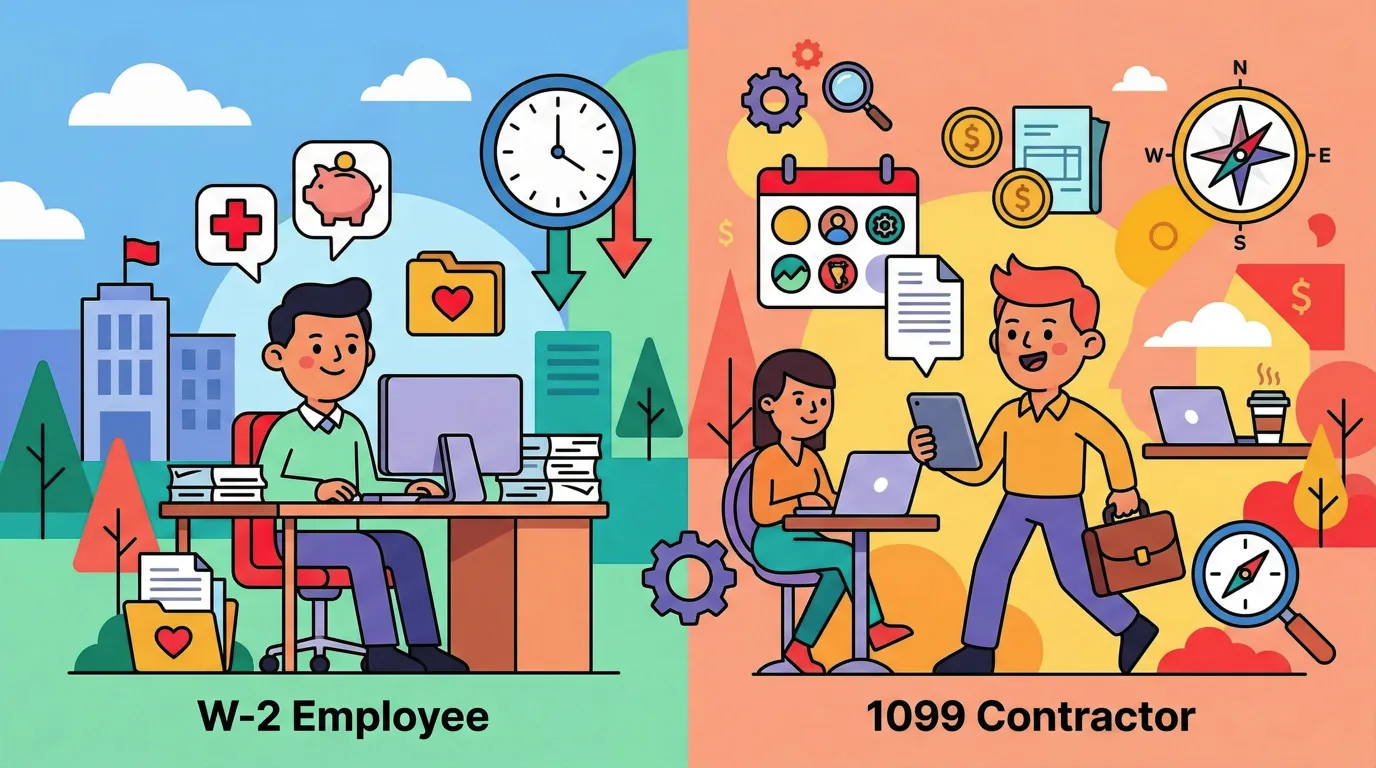
If you have read our overview on W-2 vs 1099 income, you know the headline number: 1099 contractors pay self-employment tax on top of regular income tax. This guide goes deeper on the part that catches most freelancers off guard, which is the mechanics of paying that tax. Specifically: how the 15.3% is actually calculated, when quarterly payments are due in 2026, what the safe-harbor rules say, and how to set aside money so April does not turn into a five-figure surprise.
The self-employment tax and quarterly payments topic is where the IRS hands out the most penalties to honest freelancers. The rules are not complicated, but they are unforgiving if ignored.
The 15.3% Rate, Decoded
Self-employment (SE) tax is the freelancer equivalent of FICA. It funds Social Security and Medicare. The combined rate is 15.3%, made up of two parts:
- 12.4% Social Security tax, applied up to the annual wage base
- 2.9% Medicare tax, with no upper limit
For 2026, the Social Security wage base is $184,500. Earnings above that figure are still subject to the 2.9% Medicare portion, plus an extra 0.9% Additional Medicare tax once your earnings exceed $200,000 (single) or $250,000 (married filing jointly).
The 92.35% Adjustment
The IRS does not apply the 15.3% to your full net earnings. It applies it to 92.35% of net earnings. The other 7.65% is treated as if it were the employer share that a W-2 employer would pay, so the math comes out closer to W-2 fairness.
A worked example for 2026:
- Gross 1099 income: $100,000
- Business deductions: -$20,000
- Net earnings: $80,000
- Multiplied by 92.35% = $73,880
- 15.3% SE tax: $11,304
You can deduct half of that ($5,652) as an above-the-line adjustment to income on your federal return. That deduction does not lower the SE tax itself, only the income tax you pay on top.
For the corresponding income-tax math (federal brackets applied to the same earnings), see our tax bracket guide.
When Quarterly Payments Are Due in 2026
The IRS expects you to pay tax as you earn it, not all at once on April 15. If you expect to owe $1,000 or more in tax for the year (after withholding), you generally need to make four estimated quarterly payments.
The 2026 deadlines:
| Quarter | Income earned | Payment due |
|---|---|---|
| Q1 | January 1 to March 31, 2026 | April 15, 2026 |
| Q2 | April 1 to May 31, 2026 | June 15, 2026 |
| Q3 | June 1 to August 31, 2026 | September 15, 2026 |
| Q4 | September 1 to December 31, 2026 | January 15, 2027 |
Note that the Q2 "quarter" is only two months long and Q3 is three months. The IRS calendar does not match calendar quarters, which trips up first-time filers. State estimated tax deadlines often line up with these federal dates but verify with your state revenue department.
You can pay through the IRS Direct Pay system, EFTPS, or by mailing a paper Form 1040-ES. Direct Pay is the easiest for most freelancers.
The Safe Harbor Rules
The IRS will not penalize you for underpaying quarterly taxes if you meet one of two safe harbor conditions:
- Pay at least 90% of the current year's tax liability through withholding plus estimated payments, or
- Pay at least 100% of last year's total tax (110% if last year's adjusted gross income was over $150,000)
The second rule is the easier one to plan for. If your 2025 total tax was $20,000 (and your AGI was below $150,000), making four equal payments of $5,000 each in 2026 protects you from underpayment penalties even if your 2026 income jumps significantly. You will still owe the difference in April, but no penalty.
This is important for freelancers whose income varies year to year. Use the prior-year safe harbor as a floor and adjust upward only if you know your current-year income will exceed it materially.
How Much to Set Aside Per Payment
A simple rule of thumb: set aside 25% to 30% of every payment you receive in a separate account, and pay quarterly from there.
Why this range:
- 15.3% covers SE tax (on 92.35% of net earnings, so a bit less in practice)
- Roughly 12% to 22% covers federal income tax depending on your bracket
- 0% to 10% covers state income tax depending on where you live
A freelancer in Texas (no state income tax) in the 22% federal bracket might set aside 28%. A freelancer in California in the 24% bracket might set aside 35%. Run a quick estimate with last year's effective rate to dial in your number.
The mistake most new freelancers make is treating gross income as spendable. A $5,000 invoice is closer to $3,500 in usable income after taxes. Spending the gross figure and scrambling to find tax money in April is the most common 1099 cash-flow disaster.
Tracking Income and Expenses Through the Year
Quarterly payments work best when your books are current. If you have to reconstruct three months of receipts the night before a deadline, you will either underpay or overpay, and both cost money.
A few habits that make this painless:
- Log income the day it arrives. Mark each invoice as paid, by client, with date and amount.
- Categorize expenses immediately. Home office, mileage, software, contractor fees. Tax-bucket categories save hours at filing time.
- Snap receipts at point of purchase. Paper receipts fade and get lost. A photo lasts.
- Review monthly. Twenty minutes at month-end keeps quarterly estimation realistic.
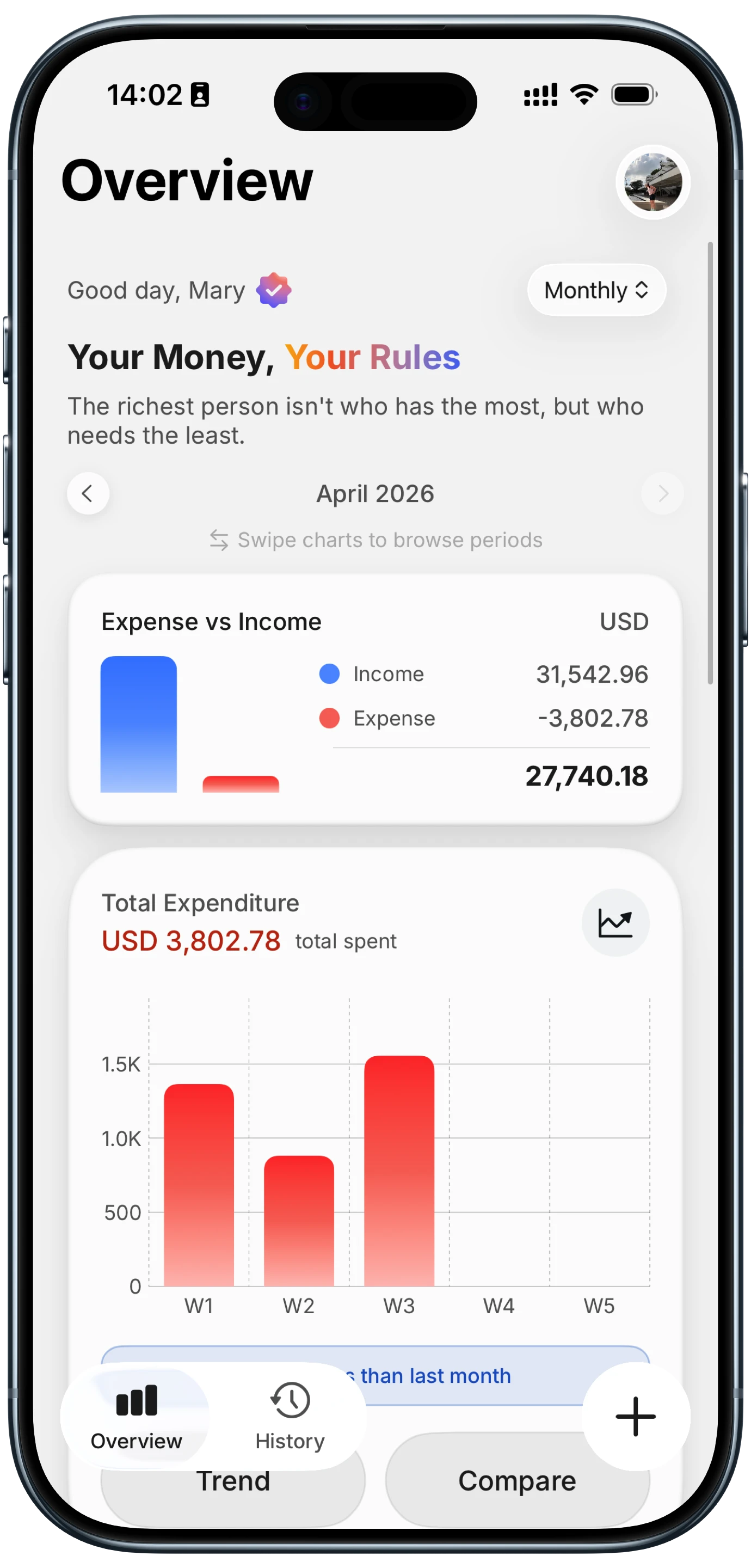
Finny is built for this workflow. AI text input ("75 office supplies"), receipt scanning with batch capture (up to 5 photos at once), custom categories matched to tax buckets, CSV export at quarter-end. It costs a low monthly price for Pro, no bank login required, which keeps client and personal data separate. For a deeper walk-through of the freelancer setup, see our free business expense tracker apps for freelancers guide and how to track business expenses on iPhone.
What Happens If You Underpay
If you fall short of the safe harbor and underpay a quarter, the IRS calculates an underpayment penalty as interest on the shortfall, accruing until you pay. The rate floats with the federal short-term rate plus 3%, so it is not catastrophic for small amounts but compounds quickly on larger balances.
If you realize mid-year that you are behind, increase your next quarterly payment to catch up. There is no benefit to waiting. The penalty calculation runs from the missed deadline, not from when you eventually file.
If you miss a deadline entirely, pay as soon as possible. The penalty is calculated per day of lateness, so paying late is still better than waiting for April.
Common Questions
What is the self-employment tax rate in 2026?
The combined self-employment tax rate is 15.3%, made up of 12.4% for Social Security (on earnings up to $184,500 in 2026) and 2.9% for Medicare (on all earnings, with an additional 0.9% above $200,000 for single filers). The tax applies to 92.35% of your net self-employment earnings, not the gross. You can deduct half of the SE tax as an adjustment to income on your federal return.
Do I have to pay quarterly taxes if I have a W-2 job and freelance on the side?
Possibly. You only need to pay quarterly if your total expected tax liability exceeds withholding by $1,000 or more. Many side-gig freelancers solve this by adjusting their W-4 withholding at the day job to cover the freelance side, which avoids quarterly estimated payments entirely. Talk to your tax professional or use IRS Form 1040-ES Worksheet to estimate.
What happens if I do not pay quarterly estimated taxes?
The IRS may charge an underpayment penalty, calculated as interest on the shortfall for each quarter you underpaid. The penalty rate floats with the federal short-term rate plus 3%. The amount is usually small for moderate shortfalls but adds up on larger balances. Filing on time and paying as much as you can each quarter is always better than ignoring the deadline.
Can I pay all my quarterly taxes at once at the start of the year?
Yes. There is no penalty for paying early or paying a full year's estimate in the first quarter. Some freelancers prefer this if they have a large January retainer or want to remove a recurring cash-flow worry. The IRS only checks that each quarter's minimum was met by the deadline, not that the payments were spread evenly.
What is the safe harbor for high earners?
If your prior-year adjusted gross income was over $150,000 ($75,000 for married filing separately), the safe harbor based on prior-year tax requires 110% of prior-year tax instead of 100%. The 90% of current-year tax rule remains the same. High earners with rising incomes should generally use the 110% prior-year approach for predictability.
The Bottom Line
Self-employment tax is the headline number freelancers worry about, but quarterly payments are where most freelancers actually get into trouble. The 15.3% on 92.35% of net earnings is fixed. The deadlines are fixed. The safe harbor rules are fixed. What is in your control is the habit of setting aside 25% to 30% of every payment as it arrives, tracking expenses to maximize deductions, and paying on time.
This guide is general information, not tax advice. Your specific situation, especially around state taxes and high-income rules, deserves a conversation with a qualified tax professional. For the broader background on how 1099 and W-2 income compare, see our W-2 vs 1099 explainer and our 1099 tax calculator guide.