Most people have a vague sense that they should be "saving more" or "spending less." But vague intentions rarely lead to real progress. Without a clear target, money decisions become reactive. You save when it feels right, spend when it feels fine, and end up unsure whether you are moving forward or standing still.
A financial goal changes that. It gives your money a purpose, a timeline, and a measurable outcome. Whether you want to pay off credit card debt, save for a home, or build a retirement fund, defining the goal is the first step toward reaching it.
This guide covers the types of financial goals, how to set them using the SMART framework, common goals at different life stages, and how to prioritize when you have several competing targets. For foundational budgeting concepts that support goal setting, see our guide on budgeting for beginners.
What Is a Financial Goal
A financial goal is a specific money target you set for yourself within a defined timeframe. It can be as straightforward as saving $500 for a car repair or as complex as accumulating $1 million for retirement over 30 years.
What separates a financial goal from a wish is structure. "I want to be rich" is a wish. "I want to save $20,000 for a house down payment within three years" is a goal. The difference matters because goals can be planned for, tracked, and achieved through consistent action.
Financial goals generally fall into three categories based on timeline: short-term, medium-term, and long-term.
Short-Term Financial Goals (Under 1 Year)
Short-term goals are targets you can reach within a few weeks to 12 months. They build momentum and create the habits that support bigger goals later.
Common short-term goals include:
- Building a starter emergency fund of $1,000 to cover unexpected expenses
- Paying off a specific credit card balance
- Saving for a planned purchase like a phone, appliance, or vacation
- Creating a monthly budget and sticking to it for three consecutive months
- Setting up sinking funds for predictable annual expenses
Short-term goals matter because they prove the system works. When you set a target, track your progress, and reach it, you build confidence for larger goals. For more on sinking funds as a short-term strategy, see our guide on what is a sinking fund.
Medium-Term Financial Goals (1 to 5 Years)
Medium-term goals require sustained effort over months or years. They often involve larger dollar amounts and more complex planning.
Examples of medium-term goals:
- Building a full emergency fund covering 3 to 6 months of living expenses
- Saving for a down payment on a home
- Paying off student loans or a car loan ahead of schedule
- Saving for a wedding or major life event
- Starting a side business with dedicated startup capital
- Building an investment portfolio with regular monthly contributions
These goals benefit from automation. Setting up automatic transfers on payday removes the temptation to spend the money elsewhere. The longer timeline also means you need to revisit and adjust contributions periodically as your income and expenses change.
For a detailed walkthrough on one of the most common medium-term goals, see our guide on how to build an emergency fund.
Long-Term Financial Goals (5+ Years)
Long-term goals shape your financial future. They require patience, consistency, and periodic reassessment as life circumstances evolve.
Common long-term goals include:
- Retirement savings through employer plans, IRAs, or brokerage accounts
- Paying off a mortgage early
- Saving for children's education through 529 plans or similar vehicles
- Achieving financial independence where investment income covers living expenses
- Building generational wealth through real estate or diversified investments
Long-term goals benefit from compounding. A $300 monthly investment earning 7% annually grows to roughly $122,000 in 20 years. Starting early matters far more than investing large amounts later. Time is the most powerful variable in long-term financial planning.
The SMART Framework for Financial Goals
Setting vague goals leads to vague results. The SMART framework provides structure that makes goals actionable and trackable.
Specific
Define exactly what you want to accomplish. "Save more money" is not specific. "Save $10,000 for a used car" is.
Measurable
Attach a number to your goal so you can track progress. If your goal is to reduce dining out, define what that means: "Spend no more than $200 per month on restaurants" is measurable. "Eat out less" is not.
Achievable
Your goal should stretch you but remain realistic given your income, expenses, and timeline. Saving $2,000 per month on a $4,000 salary while paying $1,500 in rent is not achievable. Saving $400 per month might be.
Relevant
The goal should align with your broader financial priorities. Saving for a luxury vacation while carrying high-interest credit card debt may not be the most relevant use of your money.
Time-Bound
Set a deadline. "Save $5,000" is open-ended. "Save $5,000 by December 2027" creates urgency and allows you to calculate the monthly contribution needed: roughly $278 per month over 18 months.
SMART goal example: "Save $6,000 for an emergency fund by contributing $500 per month for 12 months, starting in April 2026."
This goal is specific (emergency fund), measurable ($6,000), achievable (based on your budget analysis), relevant (financial security is a priority), and time-bound (12 months starting April).
Financial Goals by Life Stage
Your priorities shift as your circumstances change. Here is what goal setting typically looks like at different stages.
Early Career (20s)
- Build a starter emergency fund
- Pay down student loans strategically
- Start contributing to a retirement account, even small amounts
- Establish a basic budget and spending awareness
- Build credit responsibly
Established Career (30s and 40s)
- Maximize retirement contributions
- Save for a home or pay down a mortgage
- Start education savings for children
- Build multiple income streams
- Increase emergency fund to cover 6 months of expenses
Pre-Retirement (50s and 60s)
- Catch up on retirement contributions
- Pay off remaining debts
- Plan for healthcare costs in retirement
- Downsize expenses to match post-retirement income
- Establish estate planning basics
These are guidelines, not rules. A 25-year-old with no student debt might prioritize home savings. A 45-year-old starting a new career might focus on rebuilding an emergency fund. Your goals should reflect your actual situation, not a generic template.
How to Prioritize Multiple Financial Goals
Most people juggle several financial goals at once. The challenge is deciding where each dollar goes when everything feels important.
Step 1: List All Your Goals
Write down every financial goal you have, regardless of timeline or size. Getting them out of your head and onto paper (or into an app) is the first step.
Step 2: Rank by Urgency and Impact
Not all goals carry equal weight. Use this general priority order:
- Employer retirement match: If your employer matches contributions, contribute enough to get the full match. This is free money.
- High-interest debt: Credit card debt at 20%+ interest erodes every other goal. Eliminate it first.
- Starter emergency fund: Having $1,000 to $2,000 prevents small emergencies from becoming new debt.
- Essential sinking funds: Insurance premiums, car maintenance, and other unavoidable irregular expenses.
- Full emergency fund: Build to 3 to 6 months of expenses.
- Medium-term goals: Home down payment, car savings, education funds.
- Additional retirement savings: Beyond the employer match.
- Lifestyle goals: Vacations, upgrades, discretionary purchases.
Step 3: Allocate Percentages, Not Just Dollars
Instead of putting all available money toward one goal, split contributions across your top priorities. You might allocate 50% of available savings toward debt payoff, 30% toward an emergency fund, and 20% toward a sinking fund. This keeps multiple goals progressing simultaneously.
Step 4: Reassess Quarterly
Priorities change. A raise, a job loss, a new baby, or a paid-off debt all shift your allocation. Review your goals every three months and adjust contributions accordingly.
How Expense Tracking Reveals What You Can Allocate
You cannot set realistic financial goals without knowing where your money currently goes. This is where expense tracking becomes essential.
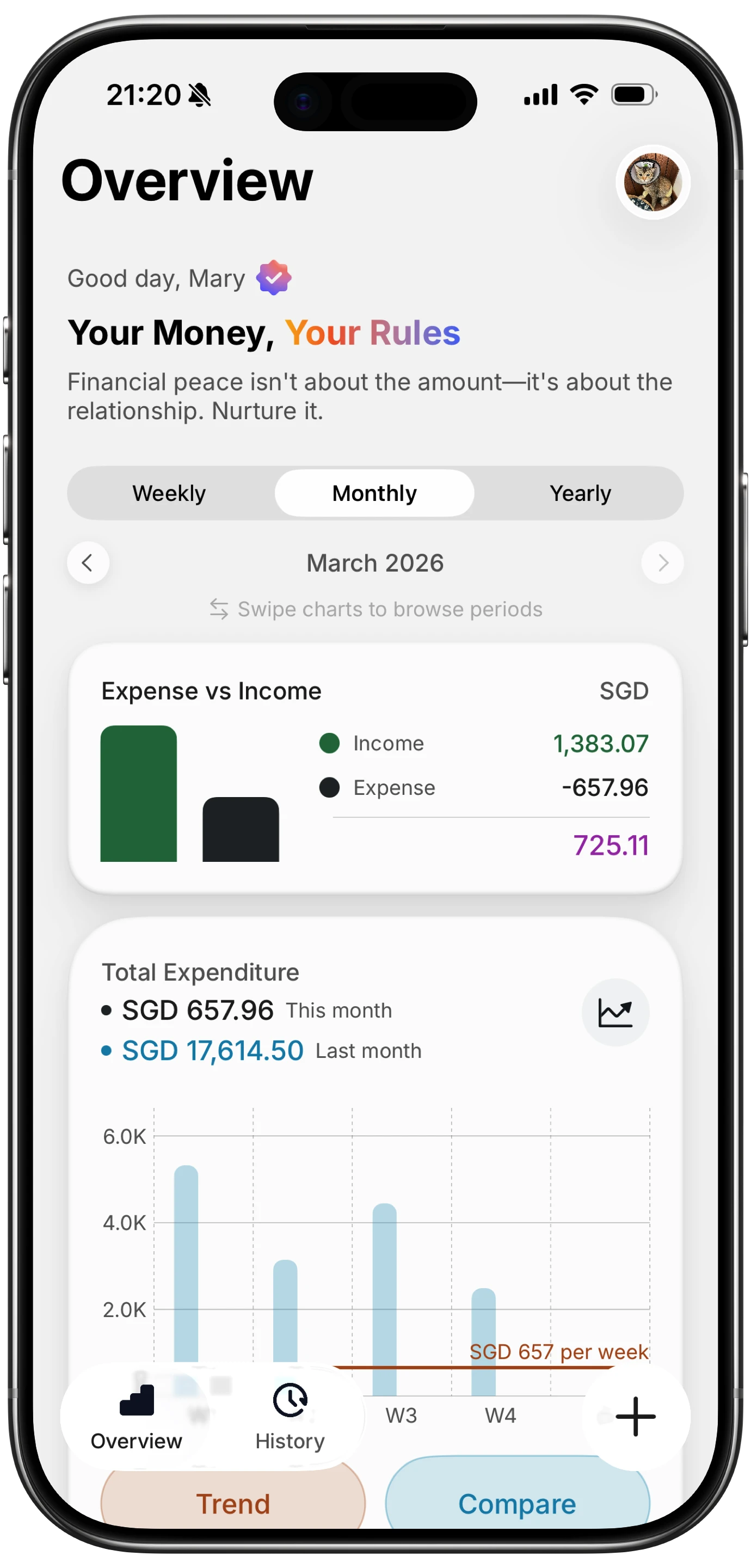
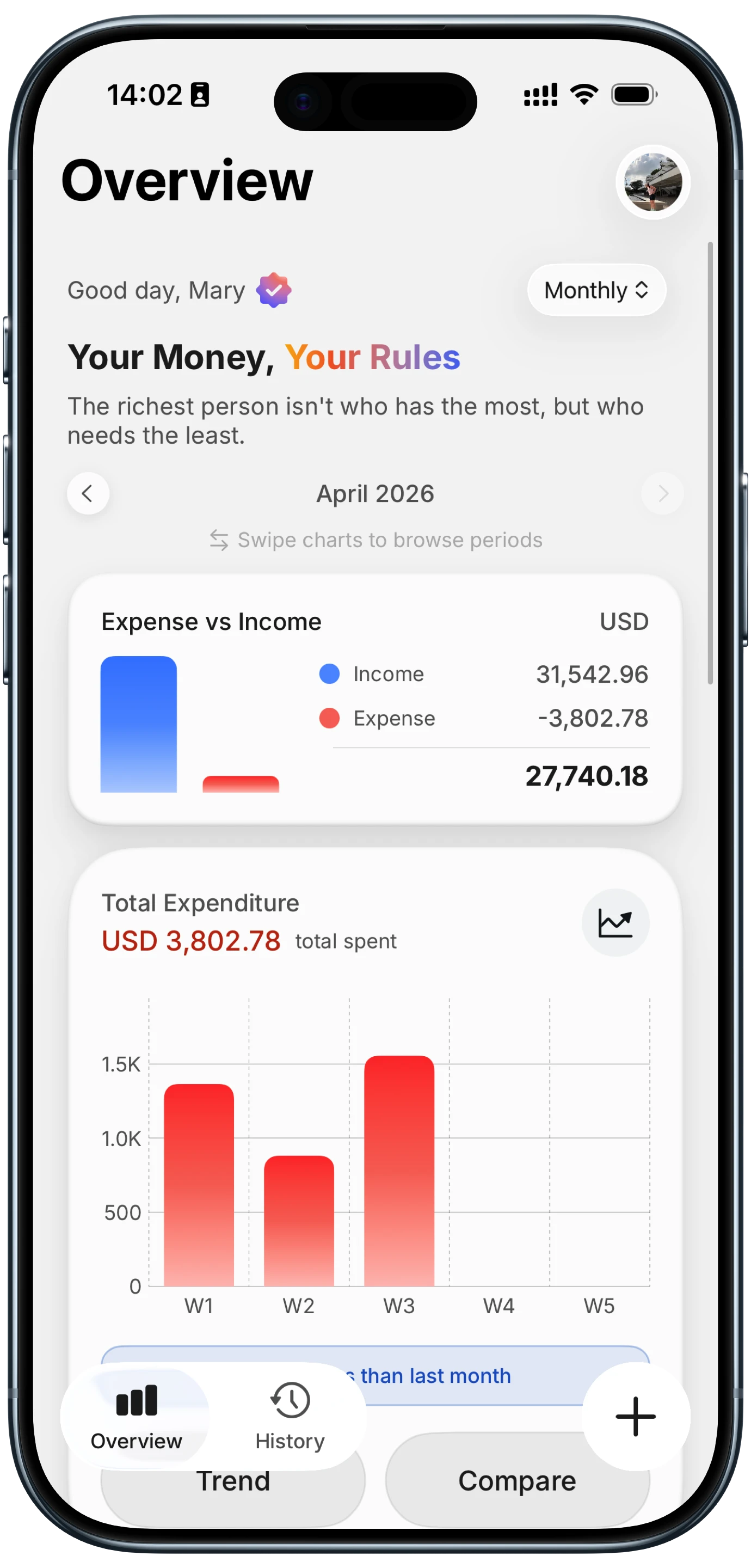
Finny app's Overview feature
Find Your Real Surplus
Most people overestimate how much spare money they have. Tracking expenses for even one month reveals the truth. When you see that $340 went to coffee shops, delivery fees, and impulse purchases, you can make an informed decision about how much is realistically available for goals.
Identify Cuts That Fund Goals
Expense data shows where reductions are possible without major lifestyle changes. Switching from a $15/month streaming service you rarely use frees $180 per year. Cooking two extra meals at home per week might save $100 monthly. These small shifts, visible through tracking, become the funding source for your goals.
Match Goals to Actual Capacity
If your expense tracking shows $400 per month in genuinely discretionary spending, you know your total goal funding capacity. Trying to allocate $600 toward goals when only $400 is available leads to frustration and abandoned plans.
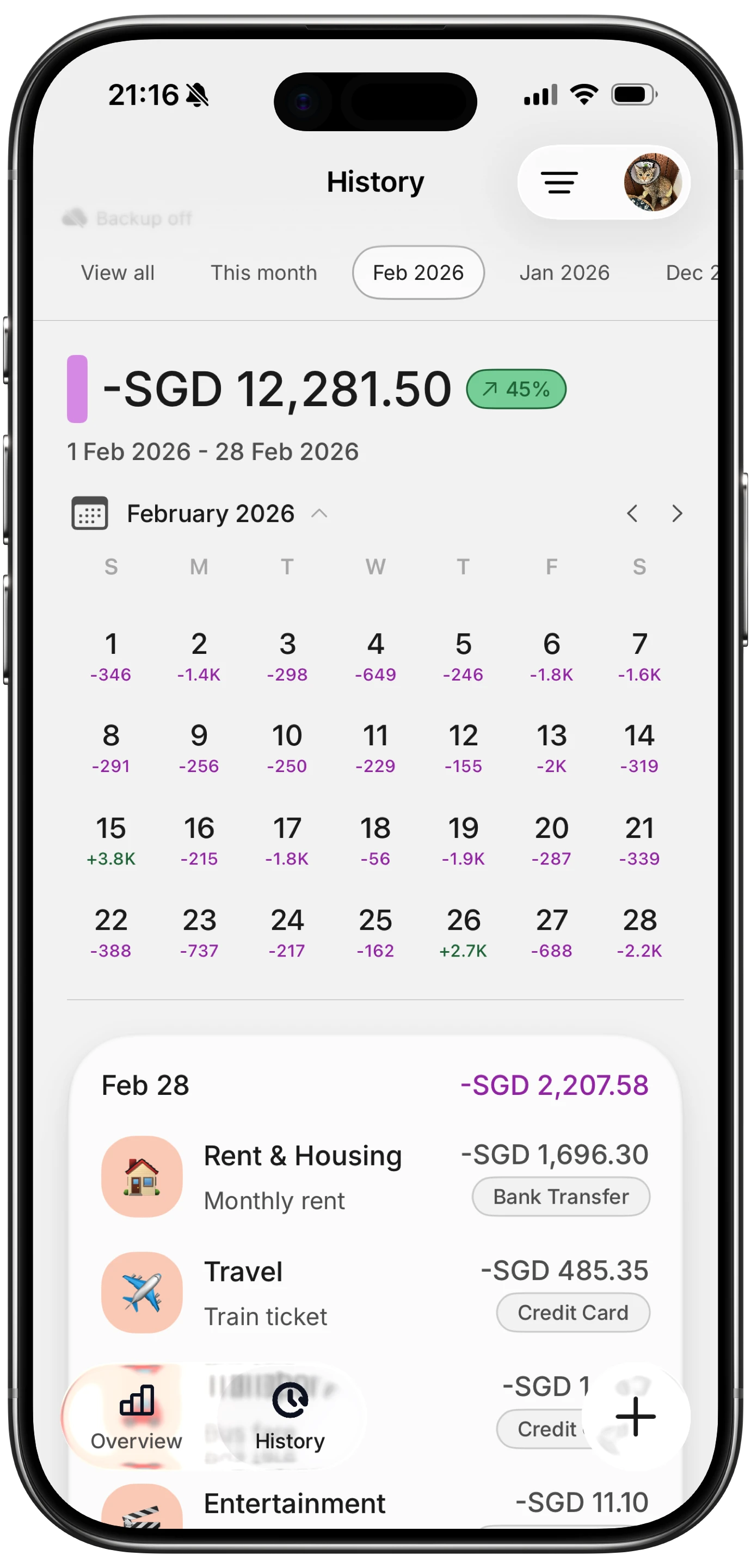
Finny app's History calendar feature
Finny makes this process practical. By logging expenses through text, voice, or receipt scanning, you build a clear picture of your spending patterns. The analytics dashboard shows category breakdowns that highlight exactly where your money goes and how much you can redirect toward financial goals. Because Finny works offline and does not require bank connections, you maintain full control over your data while building this visibility.
Tracking Progress Toward Financial Goals
Setting a goal is the beginning. Tracking progress keeps you motivated and on course.
Monthly check-ins: Review your contributions and compare them to your target pace. If you planned to save $500 per month and only saved $350, identify what happened and adjust.
Visual progress markers: Seeing a savings balance grow from $0 to $2,000 on its way to $6,000 reinforces the habit. Expense tracking apps with visual analytics make this tangible.
Celebrate milestones: When you hit 25%, 50%, and 75% of a goal, acknowledge it. Progress recognition sustains motivation over long timelines.
Adjust without abandoning: If a goal takes longer than planned, revise the timeline rather than quitting. A 15-month emergency fund is better than an abandoned 12-month plan.
The Bottom Line
A financial goal turns vague money anxiety into a concrete plan. By defining what you want, setting a timeline, and tracking your progress, you move from hoping things work out to making them work out.
Start with one goal. Make it SMART. Track your spending to understand what you can realistically contribute. Then build from there. For the full planning framework, see our personal financial planning guide. The people who reach their financial goals are not necessarily the ones who earn the most. They are the ones who plan deliberately and track consistently.
Common Questions About Financial Goals
What is a financial goal?
A financial goal is a specific money target with a defined amount, purpose, and timeline. Examples include saving $5,000 for an emergency fund in 12 months or paying off $8,000 in credit card debt within two years.
What are the three types of financial goals?
Financial goals are categorized by timeline: short-term (under 1 year), medium-term (1 to 5 years), and long-term (5+ years). Each type requires different strategies, with short-term goals focusing on quick wins and long-term goals benefiting from compounding growth.
How do I set a financial goal if I do not know my expenses?
Start by tracking your spending for 30 days. Use an expense tracking app to log every purchase. After one month, you will have a clear picture of your income, fixed costs, and discretionary spending, which tells you how much is available for goals.
How many financial goals should I have at once?
Most people can effectively manage 3 to 5 active goals simultaneously. Prioritize by urgency (high-interest debt first, then emergency fund, then longer-term targets) and split available money across them using percentage-based allocation.
What is the SMART framework for financial goals?
SMART stands for Specific, Measurable, Achievable, Relevant, and Time-bound. Instead of "save more money," a SMART goal would be "save $3,000 for a vacation by setting aside $250 per month for 12 months."
Ready to see where your money goes and set realistic financial goals?
Download Finny to track your expenses with AI-assisted input, review spending patterns with visual analytics, and understand exactly how much you can allocate toward every goal. No bank connections required, fully offline capable, and always in your control.