Quicken Simplifi Review 2026: Is It Worth It?
If you have been hunting for a budgeting app that does not feel like a spreadsheet with extra steps, Quicken Simplifi keeps showing up on the shortlist. It is mobile-first, cheaper than most of its rivals, and built around a "spending plan" instead of rigid envelopes. But cheaper is not the same as right for you.
This Quicken Simplifi review 2026 walks through what the app actually does, what it costs after the promo expires, how its budgeting model works, and whether bank syncing holds up day to day. We will also stack it against Monarch, YNAB, and Copilot so you can see where it wins and where it gives ground. By the end you will know if Simplifi is the budgeting app you keep, or the one you cancel after the trial.
What Is Quicken Simplifi?
Quicken Simplifi is a personal finance app from Quicken, the company behind the long-running desktop money software. Simplifi is the modern, cloud-based answer to that legacy product: no installs, no file management, just a phone app and a matching web dashboard.
The core idea is the spending plan. Instead of forcing you to assign every dollar a job before the month starts, Simplifi connects to your accounts, learns your recurring income and bills, and then shows you a single number: how much you have left to spend safely this month. It updates in real time as transactions land.
Around that central number sit a few supporting features:
- Watchlists: custom filters that track spending on anything you care about, like coffee, rideshares, or a specific merchant.
- Automatic categorization of transactions as they sync.
- Recurring detection for subscriptions and bills, so they are reserved before you spend.
- Reports for spending by category, income vs. expenses, and net worth over time.
It is genuinely mobile-first. The iPhone and Android apps are the main experience, and the web app mirrors them rather than the other way around. For people who do most of their money checking on a phone, that focus is the whole appeal.
Quicken Simplifi Review 2026: Pricing
Pricing is where Simplifi earns most of its attention, so let's be precise about it.
Simplifi is sold on annual billing only, and the rate you see depends heavily on whether a promo is running. As of mid-2026:
- Promotional rate: roughly $3.99/month, which comes to about $48 for the year when a discount is active.
- List price: $5.99/month billed annually, which is $71.88 per year.
There is no free tier. You cannot use Simplifi indefinitely without paying the way you can with EveryDollar or Finny. What you get instead is a 30-day money-back guarantee: pay up front, try it for a month, and request a refund if it is not a fit.
A few things to watch on the pricing:
- The promo is the hook, not the habit. That ~$48 first-year deal is common, but renewals can revert toward the $71.88 list price. Set a calendar reminder before your renewal date so the second year does not surprise you.
- Annual only means commitment. There is no month-to-month option, so you are effectively prepaying for a full year even at the promo rate.
- No card-free trial. The "trial" is really a refund window, so you do have to enter payment details first.
Even at the full $71.88 list price, Simplifi undercuts Monarch ($99.99/yr) and YNAB ($109/yr). At the promo rate it is one of the cheapest full-featured, bank-linked budgeting apps you can buy. For solo budgeters who want automation without a premium bill, that math is the entire pitch.
The Budgeting Model: Spending Plan and Watchlists
The budgeting model is what separates Simplifi from the zero-based crowd, and it is worth understanding before you commit.
How the spending plan works
When you connect your accounts, Simplifi identifies your income, your recurring bills, your planned savings, and your pending transactions. It subtracts all of that from what is coming in and surfaces the leftover as your spending plan. The headline experience is opening the app and seeing one trustworthy number: this is what is safe to spend right now.
This is lighter-touch than YNAB's every-dollar method. You are not hand-assigning each dollar to a category before you are allowed to spend it. For people who bounced off strict budgeting because it felt like homework, that flexibility is a feature, not a compromise. For people who want firm guardrails, it can feel a little loose.
Watchlists, categories, and reports
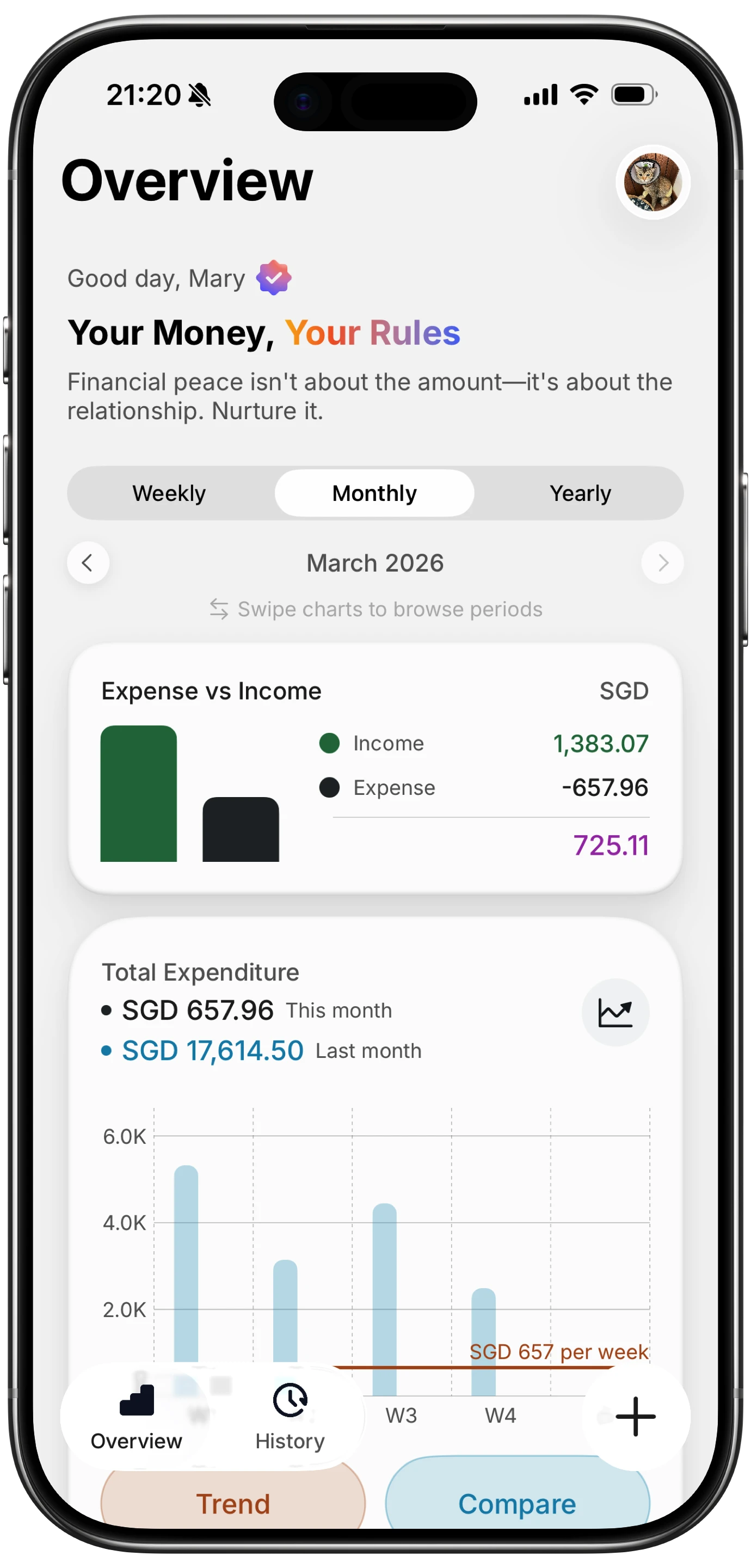
Watchlists are Simplifi's standout. You can build a saved view for almost any slice of spending ("eating out this month," "everything at Amazon," "subscriptions over $10") and pin it so the number is always visible. It is a smarter take on category limits because you decide what deserves attention.
Automatic categorization is solid out of the box and improves as you correct it. You can also create rules so a given merchant always lands in the right bucket.
Reports cover the basics well: spending trends, income vs. expenses, net worth, and projected cash flow that estimates your balance weeks ahead. It is not as deep as a dedicated investment tool, but for day-to-day budgeting it is more than enough.
For a side-by-side of how this model compares to envelope and zero-based systems, see our Monarch vs. YNAB vs. Simplifi breakdown.
Account Syncing Reliability
A budgeting app that pulls from your bank is only as good as its connections, so this section matters more than any feature list.
The honest read in 2026: syncing is solid for major US banks. Chase, Bank of America, Wells Fargo, American Express, and the big national institutions generally connect cleanly and refresh on schedule. For the average user with mainstream accounts, Simplifi works quietly in the background the way it should.
The friction shows up at the edges:
- Capital One has been a recurring sore spot, with users periodically needing to re-authenticate the connection.
- Smaller credit unions and regional banks can be hit or miss depending on the aggregator's coverage.
- Occasional reconnects are part of the deal across the whole bank-linked category: handshakes expire and need re-approval, sometimes at the worst moment.
None of this is unique to Simplifi. It is the bank-aggregator model showing through, and Monarch, Copilot, and Rocket Money all have their own bad-sync days. The difference is usually which specific banks each one handles gracefully.
If reliable syncing is non-negotiable, check your two or three most important institutions during the 30-day window before you fully commit. And if the idea of any third party holding read access to your accounts is a dealbreaker, that points you toward a different model entirely, one we cover in the alternatives below.
Quicken Simplifi Review 2026: Pros and Cons
After extended use, here is the balanced ledger.
| Pros | Cons |
|---|---|
| Among the cheapest bank-linked budgeting apps, especially on promo | No free tier; annual billing only |
| Clean, genuinely mobile-first app and matching web dashboard | Promo price can jump toward list at renewal |
| Spending plan is flexible and low-friction | Too loose for strict zero-based budgeters |
| Watchlists are a flexible, standout tracking tool | Sync hiccups at Capital One and some credit unions |
| Fast automatic categorization and real-time cash-flow projection | Investment tracking is basic vs. dedicated tools |
| 30-day money-back guarantee | Requires linking bank credentials to be useful |
Who it fits: solo budgeters and couples who want automation, a real-time "safe to spend" number, and a low annual cost, without the learning curve of zero-based budgeting.
Who should look elsewhere: strict budgeters who want every dollar assigned a job (YNAB), households that need deep collaboration (Monarch), or privacy-first users who refuse to hand over bank logins.
Simplifi vs. the Alternatives
Price is only meaningful next to what you give up or gain. Here is how Simplifi lines up against the apps people cross-shop it with most.
| App | Annual Price | Free Tier | Bank Link | Best For |
|---|---|---|---|---|
| Quicken Simplifi | ~$48 promo / $71.88 list | No | Required | Low-cost, mobile-first budgeting |
| Monarch Money | $99.99 | No | Required | Households, all-in-one dashboard |
| YNAB | $109 | No (34-day trial) | Optional | Strict zero-based budgeting |
| Copilot Money | $95 | No (30-day trial) | Required | Solo Apple users, AI categorization |
| Finny | Free / Optional Pro | Yes | None | Privacy-first, no bank link |
A few takeaways from the table:
- vs. Monarch: Simplifi is roughly half the price and lighter to set up, but Monarch wins decisively on household sharing and net worth depth. We compare them head to head in our Monarch Money vs. Quicken Simplifi guide.
- vs. YNAB: Simplifi is cheaper and far easier to start. YNAB is the better tool if you actively want the discipline of assigning every dollar.
- vs. Copilot: Copilot has the slicker design and stronger AI categorization but is Apple-only and costs more.
Where Finny fits
If the recurring theme of bank-link friction in this review gave you pause, that is the gap Finny fills. It is a privacy-first, no-bank-link expense tracker: nothing connects to your bank, so there are no sync failures to babysit and no credentials handed to an aggregator. The core app is free forever, and Finny Pro costs a low yearly price, cheaper than a single year of Simplifi at list price. You log spending by typing, talking, or snapping a receipt for the AI to read, and it keeps every transaction in its original currency while converting your totals automatically.
It is a fundamentally different model than Simplifi's: manual-first instead of bank-first, private instead of connected. Which one wins depends entirely on whether you want automation or control. For the full landscape, our best personal finance apps for 2026 roundup maps every option.
Is Quicken Simplifi Worth It?
For the right person, yes. If you want a low-cost, mobile-first app that hands you a trustworthy "safe to spend" number without a steep learning curve, Simplifi is one of the best values in budgeting, especially at the promo price. The spending plan and watchlists are a genuinely good fit for people who found zero-based budgeting exhausting.
It is not worth it if you need strict zero-based control, deep household collaboration, or you refuse to link a bank account. And it is worth setting a renewal reminder so the promo-to-list jump does not catch you off guard.
The bottom line of this Quicken Simplifi review 2026: it is a strong, affordable budgeting app for mainstream US users who are comfortable connecting their banks, and a poor fit for everyone who is not.
Frequently Asked Questions
How much does Quicken Simplifi cost?
Quicken Simplifi is billed annually. The list price is $5.99 per month billed yearly, which is $71.88 per year. Promotions frequently drop that to around $3.99 per month, or roughly $48 for the first year. There is no free tier and no monthly billing option, but Simplifi offers a 30-day money-back guarantee so you can try it risk-free for the first month.
Is Quicken Simplifi worth it?
For solo budgeters and couples who want low-cost, mobile-first automation, yes. Simplifi is one of the better values in the category, especially on promo. Its spending plan gives you a real-time "safe to spend" number without the learning curve of zero-based budgeting. It is less worth it if you need strict envelope budgeting, deep household features, or you would rather not link a bank account.
Does Quicken Simplifi have a free trial?
Not in the traditional sense. Simplifi does not offer a free tier or a no-card trial. Instead, it backs every annual subscription with a 30-day money-back guarantee: you pay up front, use the app fully for a month, and request a refund if it is not the right fit. Use that window to test your specific bank connections before committing for the year.
Is Quicken Simplifi better than Monarch?
It depends on your situation. Simplifi is roughly half the price, lighter to set up, and excellent for solo budgeting. Monarch costs more but wins on household collaboration, investment tracking, and its all-in-one dashboard. If you live alone and want a low bill, Simplifi usually wins. For couples managing shared finances, Monarch often justifies the extra cost. Our Monarch vs. Simplifi comparison breaks it down in detail.
Tired of bank-sync headaches and annual budgeting bills?
Finny is a privacy-first expense tracker with no bank links to babysit: log spending by text, voice, or receipt scan, see every currency at a glance, and keep the core app free forever. Pro is just a low yearly price if you want AI input and Tap to Track.