When Pocketbook shut down on 5 August 2022, hundreds of thousands of Australians lost the free budgeting app they had trusted for a decade. Owned by Zip and once boasting more than 800,000 users, Pocketbook was axed when the company pulled back to focus on its core buy now, pay later business. That left a gap that Aussies are still trying to fill in 2026. The good news is that the market for budgeting apps in Australia has matured a lot since then, thanks in large part to the Consumer Data Right (CDR) and open banking, which now make it far easier to see all your accounts in one place. The tricky part is picking the right tool, because "best" depends heavily on whether you want automatic bank feeds, hands-on control, or privacy above everything else.
This guide names real, currently available options, lists honest AUD pricing, and explains what each one actually does well. We tested and researched the apps Australians reach for most: Frollo, WeMoney, Up, PocketSmith, Goodbudget, YNAB, and Finny. By the end you should know which fits your situation.
What Changed: Open Banking and the Consumer Data Right
Before you compare apps, it helps to understand why the Australian landscape looks different from the United States or Europe. The Consumer Data Right is the government framework that lets you securely share your banking data with accredited third parties. In practice, that means many modern apps can pull transactions directly from the big four banks and dozens of smaller institutions without you handing over your login details to a scraper.
As of July 2026, the CDR has expanded beyond banks and energy providers to include large non-bank lenders and buy now, pay later providers. For budgeters, this matters because more of your financial life can now flow into a single dashboard automatically. Open banking is the engine behind most of the "connect your accounts" apps below.
There is a catch, though. Open banking requires you to authorise access, and your transaction data leaves your phone and sits on a provider's servers. For some people that trade-off is worth it for convenience. For others, especially anyone who values privacy or spends across borders, a manual or on-device approach is a better match. We will cover both camps.
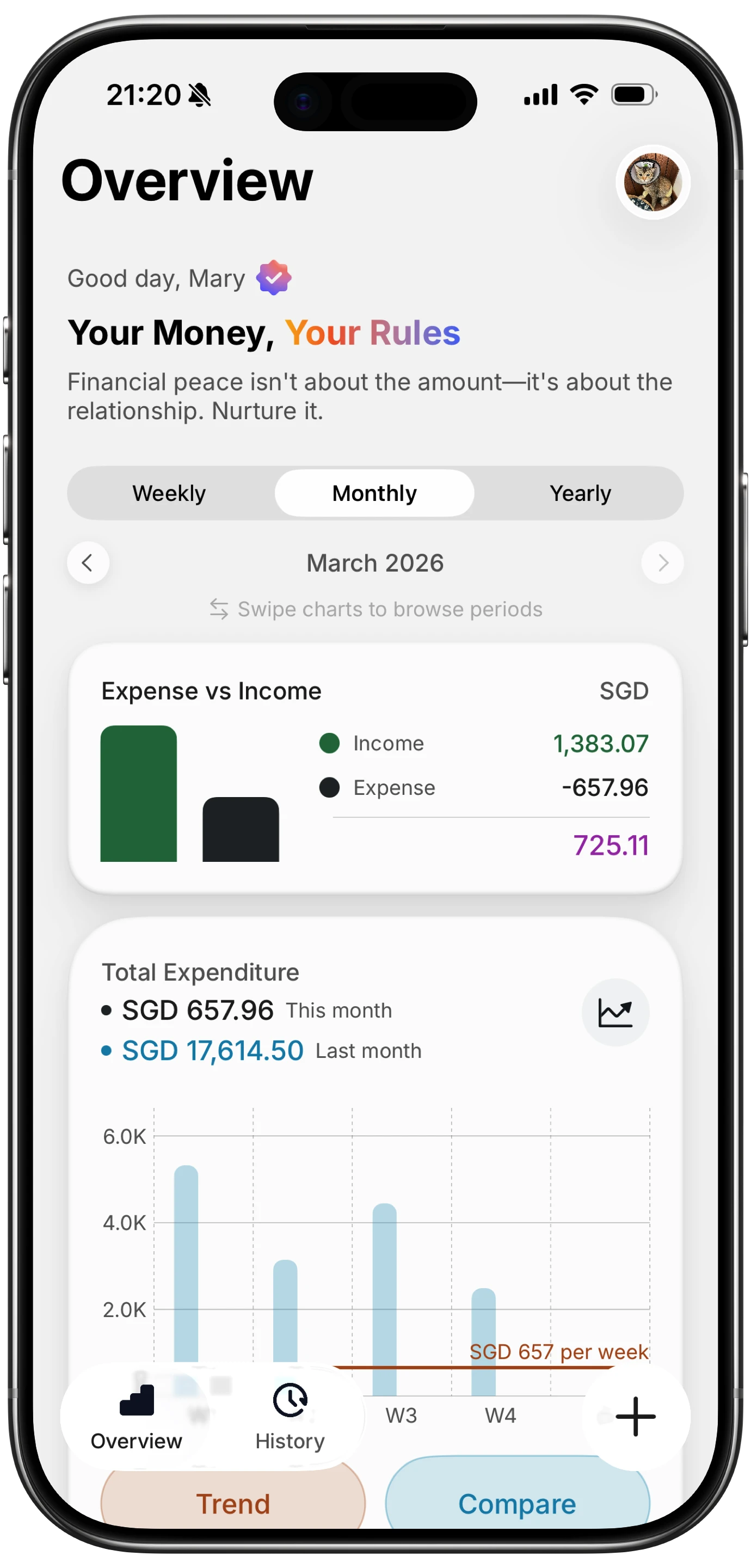
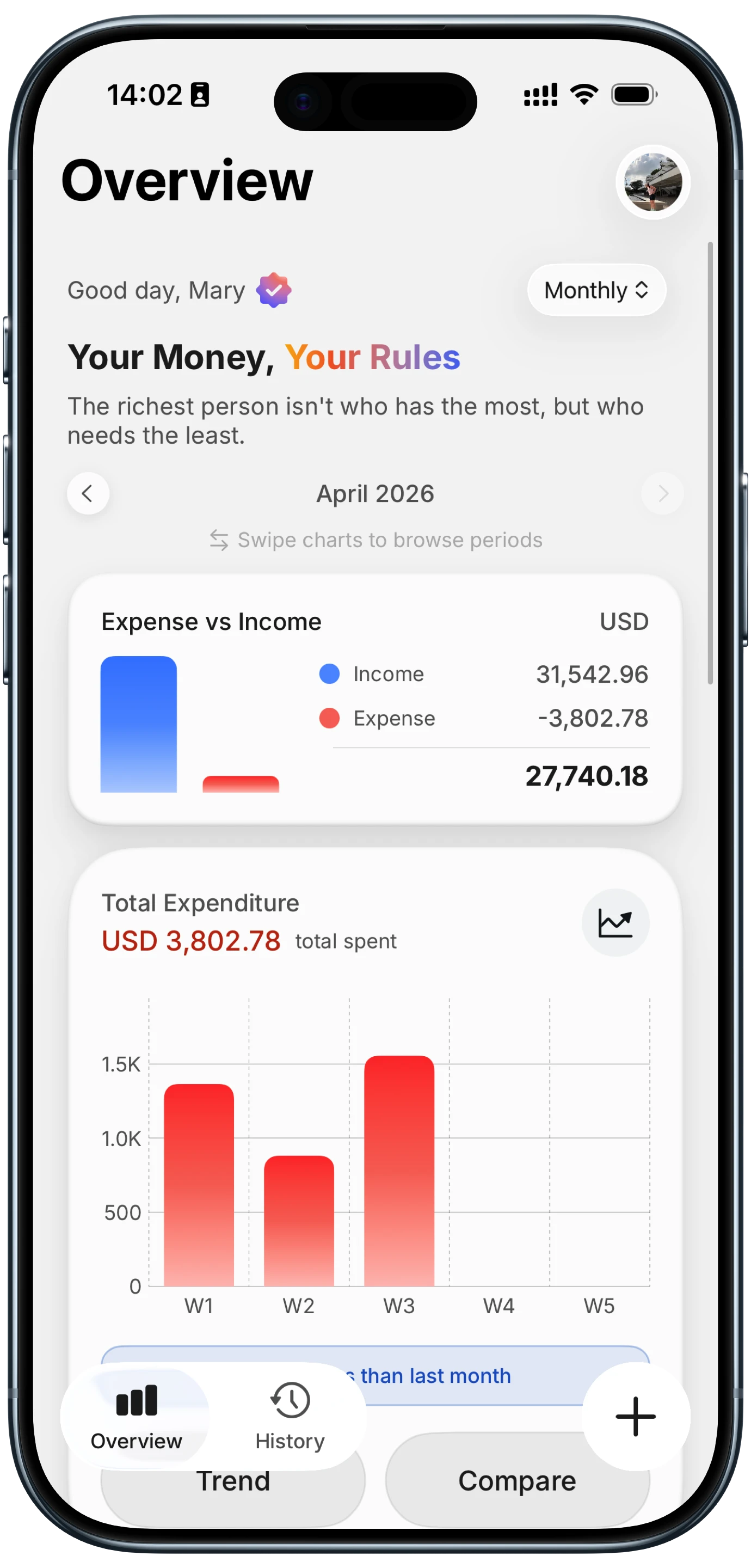
Finny app's Overview feature
The Best Budgeting Apps in Australia for 2026 at a Glance
Here is a quick comparison of the main contenders before we dig into each one. Prices are indicative and shown in AUD where the provider bills locally. YNAB bills in US dollars, so the AUD figure moves with the exchange rate.
| App | Platform | Price (AUD) | Best for |
|---|---|---|---|
| Finny | iOS only | Free, Pro a low monthly or yearly price | Privacy, no bank link, travel and multi-currency |
| Frollo | iOS and Android | Free | Full open banking view of all accounts |
| WeMoney | iOS and Android | Free, paid tiers available | Credit score plus budgeting in one place |
| Up | iOS and Android | Free (it is a bank account) | People who want banking and budgeting together |
| PocketSmith | iOS, Android, web | Free tier, paid approx $8 to $22/mo | Cashflow forecasting and long-term planning |
| Goodbudget | iOS, Android, web | Free, Plus approx $12/mo | Envelope budgeting for couples and families |
| YNAB | iOS, Android, web | Approx $170/yr (billed in USD) | Zero-based budgeting die-hards |
The Open Banking Apps: Frollo, WeMoney, and Up
If you want your budget to fill itself in, these three lean hardest on Australian bank connectivity.
Frollo is an Australian fintech built around open banking. You link accounts from different banks and lenders, and it categorises your spending automatically. A standout feature is the downloadable Financial Passport, which summarises your income, spending, assets, and liabilities over the last 12 months. Frollo is free, which makes it one of the most generous CDR-powered options going.
WeMoney is arguably the closest spiritual successor to Pocketbook's free model. It pairs budgeting with a free Equifax credit score, a debt repayment planner, spending analytics, and an active community forum. If you are working on your credit health as well as your spending, having both in one app is convenient. Core features are free, with paid tiers for extras.
Up is a little different because it is not a standalone budgeting app, it is a neobank. Its in-app budgeting tools, spending insights, and savers are built directly into the banking experience, so if you already bank with Up (or are willing to switch), you get budgeting at no extra cost. CommBank and ANZ Plus have added similar built-in budgeting features too, which is worth knowing if you would rather stay with your existing bank.
The trade-off with all three is the same: they work best when your accounts are Australian and connected, and your data lives in the cloud.
The Planners and Envelope Apps: PocketSmith, Goodbudget, and YNAB
Some people do not just want to see where money went, they want to plan where it goes next.
PocketSmith is the forecasting specialist. It is built around linked accounts, budgets, and long-range projections, letting you model how today's spending affects your balance months or even years ahead. It offers a free tier with manual entry, plus paid plans that run roughly $8 to $22 per month depending on how many accounts and how much forecasting you need. If you are saving for a house deposit or planning around irregular income, this foresight is genuinely useful.
Goodbudget takes the classic envelope method digital. You divide your income into virtual envelopes for rent, groceries, fun, and so on, then spend from each until it is empty. It syncs across phones and the web, which makes it a favourite for couples and households sharing one budget. There is a free version and a Plus plan (around $12 AUD per month) with unlimited envelopes. Note that Goodbudget is manual by design, so it does not connect to Australian bank feeds.
YNAB (You Need A Budget) is the cult favourite for zero-based budgeting, where every dollar gets a job. Its bank connectivity for Australian institutions has improved, and it works with the major banks. The sticking point is price: YNAB bills in US dollars at about $109 per year USD, which lands around $170 AUD per year at current exchange rates. It is powerful, but it is also the most expensive option on this list by a wide margin. If the philosophy appeals but the price does not, our best YNAB alternatives for 2026 roundup covers cheaper ways to get the same discipline.
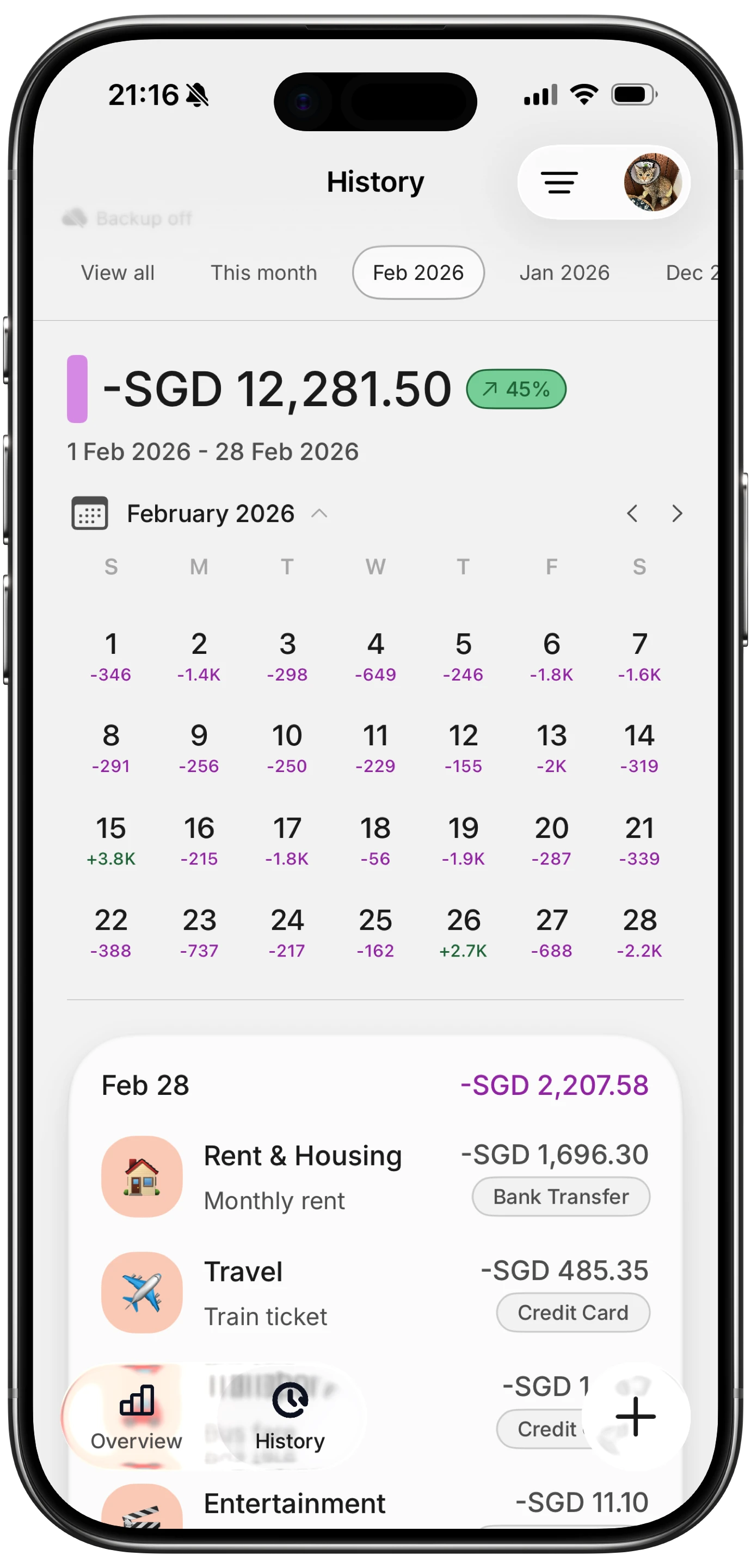
Finny app's History calendar feature
Where Finny Fits: Privacy-First and Built for People Who Travel
Every app above shares one assumption: that you want your bank accounts connected. Finny is built on the opposite idea, and for a lot of Australians that is exactly the point.
Finny is an AI-powered expense tracker for iPhone that requires no bank login at all. Your data stays on your device rather than sitting on a provider's servers, which sidesteps the open banking privacy trade-off entirely. You log expenses by typing something as simple as "coffee 5", speaking it aloud, or snapping a receipt, and the AI turns it into a categorised entry that you review before saving. It is faster than manual entry and more private than a bank feed.
The free-forever core covers manual tracking, custom categories, spending charts, offline support, and support for 150+ currencies, plus one free AI credit so you can try the smart input. Finny Pro, at a low monthly or yearly price, unlocks the AI input for everyday use, Tap to Track for logging in a couple of taps, batch receipt scanning of up to five receipts at once, and cloud sync. Even at the Pro price, it is a fraction of what YNAB costs.
That multi-currency support is where Finny really earns its place on an Australian list. If you travel through Asia, work remotely, or shop from overseas retailers in USD, Finny keeps the original amounts intact while still giving you a unified home-currency view. Open banking apps built around AUD and local bank feeds struggle with that. For a deeper look, see our guides to the best multi-currency expense tracker in 2026 and how to avoid foreign transaction fees.
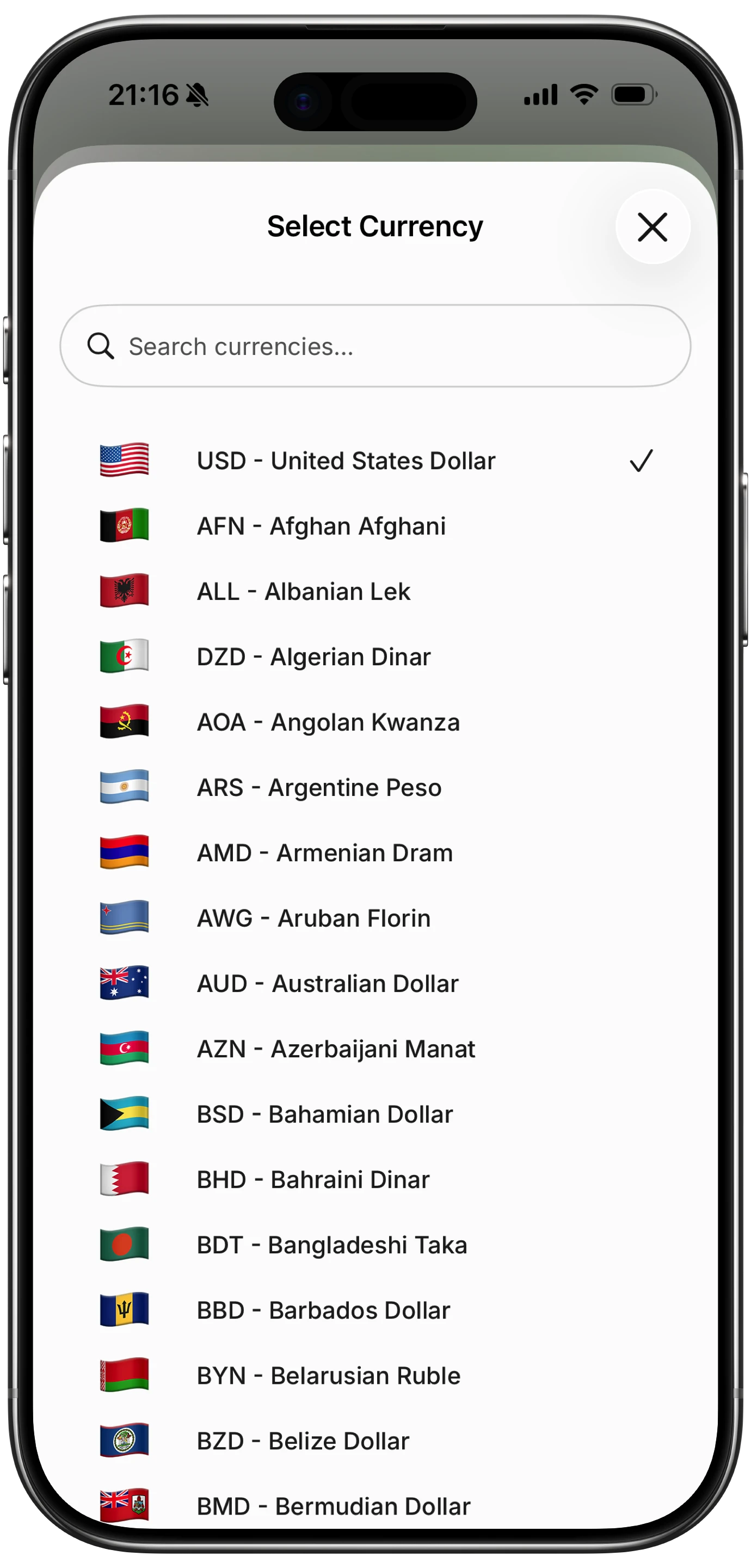
Finny app's multi-currency feature
The obvious limitation: Finny is iOS and Apple only, so Android users will need to look at Frollo, WeMoney, or PocketSmith instead. And because it does not connect to banks, you do the logging yourself (which the AI input makes quick, but it is still a habit to build). If the idea of skipping the bank link appeals, our list of the best expense trackers with no bank login for 2026 puts it in context.
How to Choose the Right App for You
There is no single winner, so match the tool to your habits:
- You want it automated and free. Start with Frollo or WeMoney. Both use open banking to fill in your budget and cost nothing for core features.
- You want banking and budgeting in one. Look at Up, or check whether CommBank or ANZ Plus already give you enough built-in tools.
- You want to forecast the future. PocketSmith is the planner's choice for cashflow projections.
- You budget as a couple or family. Goodbudget's shared envelopes are hard to beat, and they are manual so nobody needs to link a bank.
- You love zero-based budgeting and do not mind paying. YNAB, if the AUD price does not scare you off.
- You care about privacy or spend across currencies. Finny keeps data on-device, needs no bank login, and handles 150+ currencies for travellers and remote workers.
If you are brand new to this, it is worth learning a simple framework before you pick software. Our guides to how to track expenses and the 50/30/20 rule will help you set up a budget that any of these apps can then support.
Ready to Start Tracking Without Linking a Bank?
If you would rather keep your financial data on your own phone and log spending in seconds, Finny is free to start and takes about a minute to set up. Download Finny at getfinny.app and try the AI input with your free credit.
Frequently Asked Questions
Is Pocketbook still available in Australia?
No. Pocketbook was shut down by its owner Zip on 5 August 2022 and its data was deleted, so it is no longer an option. Frollo and WeMoney are the closest free replacements for its open banking style, while Finny suits people who want to skip bank connections entirely.
What is the cheapest budgeting app in Australia?
Several apps have genuinely free tiers, including Frollo, WeMoney, and the free plans of PocketSmith and Goodbudget. Among paid apps, Finny is one of the most affordable at a low monthly or yearly price, well below YNAB's roughly $170 AUD per year. Finny also has a free-forever core if you do not need the Pro features.
Do budgeting apps in Australia need access to my bank account?
Not always. Open banking apps like Frollo and WeMoney use the Consumer Data Right to connect securely to your accounts, which is convenient but means your data leaves your device. Manual and on-device apps like Finny and Goodbudget never ask for a bank login, so your information stays private and under your control.
Which budgeting app is best for travellers and multi-currency spending?
Finny is a strong pick because it preserves original currency amounts across 150+ currencies while still showing a unified total in your home currency, and it works offline. Most Australian open banking apps are optimised for AUD and local bank feeds, so they handle overseas spending less gracefully.
Can I use these budgeting apps on Android?
Most yes, but not all. Frollo, WeMoney, Up, PocketSmith, Goodbudget, and YNAB all offer Android apps. Finny is iOS and Apple only, so Android users should choose from the other options on this list.
The Bottom Line
The budgeting scene in Australia has recovered well since Pocketbook closed, and open banking under the Consumer Data Right has made automatic tracking easier than ever. If you want a hands-off, connected view of everything, Frollo and WeMoney lead the free pack, PocketSmith wins on forecasting, and YNAB rewards committed zero-based budgeters willing to pay a premium. If instead you value privacy, want to avoid handing over bank logins, or regularly spend in more than one currency, Finny gives you AI-fast logging, on-device data, and 150+ currency support for a fraction of the price. Pick the philosophy that matches how you actually manage money, and the right app becomes obvious. For a broader shortlist beyond Australia, our best money tracker app in 2026 guide is a good next read.