Most people think of retirement planning as a decades-long grind: save aggressively, invest consistently, and never stop until the day you finally quit working. But there is a lesser-known milestone that changes the equation entirely. Once you reach it, you no longer need to save another dollar for retirement. Your existing investments do the rest.
That milestone is called Coast FIRE. It sits at the intersection of compound interest and intentional spending, and understanding it can reshape how you think about work, income, and financial freedom. This guide breaks down what Coast FIRE means, how to calculate your number, and why knowing your actual expenses is the key to making it work. For a deeper look at how growth compounds over time, see our guide on compound interest definitions and formulas.
What Is Coast FIRE
Coast FIRE is the point at which you have invested enough money that compound growth alone will carry your portfolio to your retirement target, without any additional contributions. Once you hit this number, you can "coast" by earning just enough to cover your living expenses, with no obligation to save more for retirement.
The concept comes from the broader FIRE (Financial Independence, Retire Early) movement, but it is more flexible. Traditional FIRE requires accumulating 25 to 30 times your annual expenses before you stop working entirely. Coast FIRE only requires reaching an investment threshold early enough that time and market returns do the heavy lifting.
In practical terms, someone who reaches Coast FIRE at age 35 could switch from a high-paying, high-stress career to lower-paid work they enjoy, take a part-time role, freelance, or start a passion project. The only financial requirement is covering current living costs.
How Coast FIRE Differs from Traditional FIRE
The FIRE movement has several variations, and each defines "enough" differently.
| FIRE Variation | What It Means | Required Savings |
|---|---|---|
| Traditional FIRE | Full financial independence, no work needed | 25x annual expenses |
| Lean FIRE | Financial independence on a minimal budget | 25x reduced expenses |
| Fat FIRE | Financial independence with a generous lifestyle | 25x higher expenses |
| Barista FIRE | Semi-retirement with part-time work for benefits | Partial savings + part-time income |
| Coast FIRE | Enough invested that no more contributions are needed | Varies by age and target |
The critical distinction: traditional FIRE means you never need to work again. Coast FIRE means you never need to save for retirement again, but you still need income for daily life. This is a significant psychological and practical difference. It removes the pressure to maximize earnings and save aggressively, replacing it with a simpler question: can you cover your monthly expenses?
How to Calculate Your Coast FIRE Number
The Coast FIRE formula relies on three variables:
- Your retirement target: The portfolio value you need at retirement age
- Expected annual return: The average growth rate of your investments
- Years until retirement: How long your money has to grow
The formula is:
Coast FIRE Number = Retirement Target / (1 + Annual Return) ^ Years Until Retirement
Step 1: Determine Your Retirement Target
A common starting point is the 4% rule. If you expect to spend $40,000 per year in retirement, you need $1,000,000 (40,000 x 25). If you expect $60,000 per year, you need $1,500,000.
Your target spending in retirement depends on the lifestyle you want. This is where expense tracking becomes essential. If you know your current annual spending and can estimate what changes in retirement (no commute costs, potentially lower housing costs, but possibly higher healthcare), you can set a realistic target.
Step 2: Choose an Expected Return
Most Coast FIRE calculations use a 7% average annual return, which reflects the historical inflation-adjusted return of a diversified stock portfolio. Some people use 6% for a more conservative estimate or 8% if they have a higher risk tolerance. The rate you choose significantly affects your coast number.
Step 3: Run the Calculation
Here are examples for a $1,000,000 retirement target at age 65, assuming a 7% annual return:
| Current Age | Years to 65 | Coast FIRE Number |
|---|---|---|
| 25 | 40 | $66,780 |
| 30 | 35 | $93,663 |
| 35 | 30 | $131,367 |
| 40 | 25 | $184,249 |
| 45 | 20 | $258,419 |
| 50 | 15 | $362,446 |
The numbers are striking. A 25-year-old who has $67,000 invested could theoretically stop contributing to retirement entirely and still reach $1,000,000 by age 65. A 35-year-old needs about $131,000. The earlier you start, the less you need, because compound growth has more time to work.
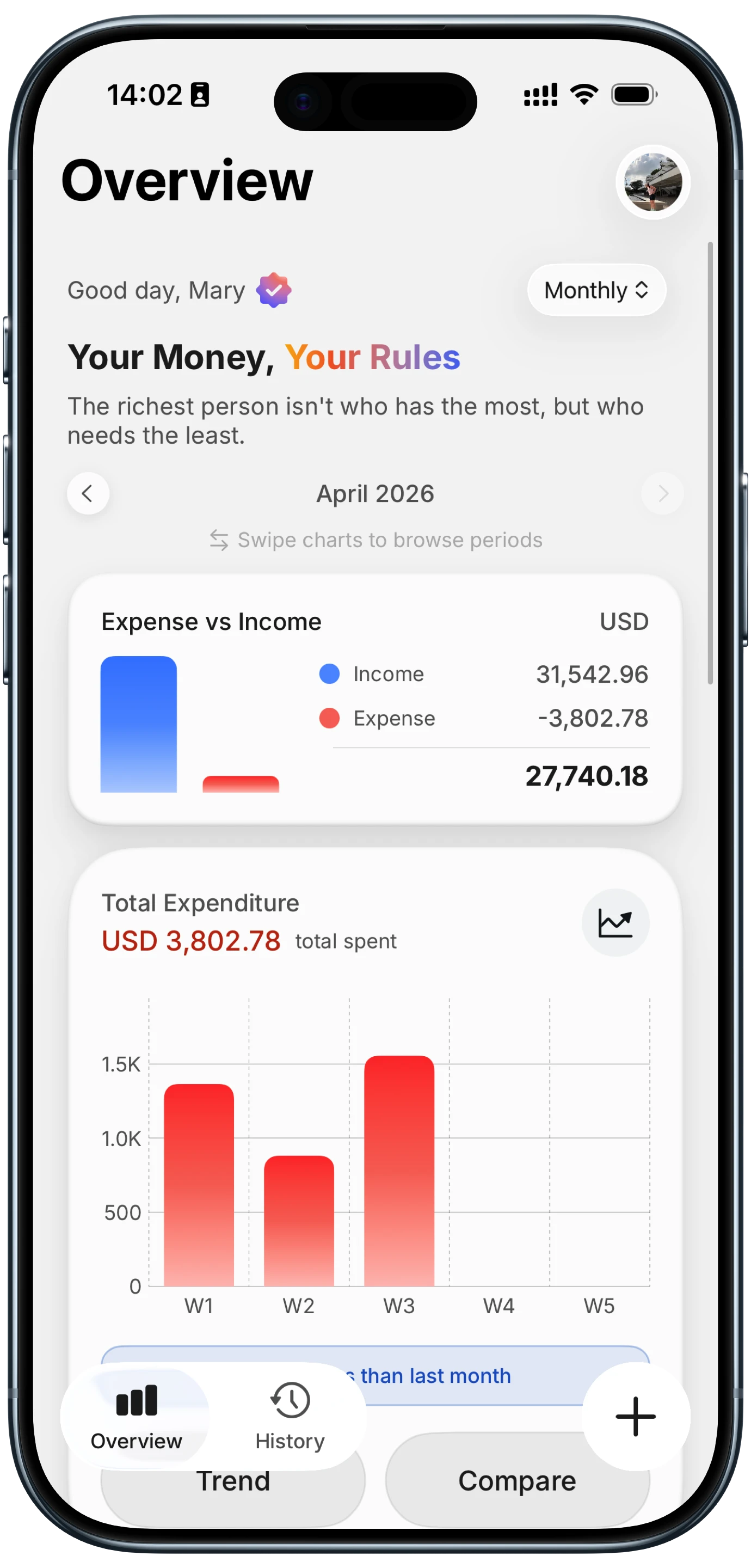
Finny app's Overview feature
Step 4: Adjust for Your Situation
These are baseline figures. You should adjust for:
- Higher retirement spending: If you want $60,000/year, multiply the coast numbers by 1.5
- Earlier retirement: If you plan to retire at 55, you have fewer years of growth, so the coast number rises
- Conservative returns: Using 6% instead of 7% increases your required number significantly
- Inflation concerns: Some calculations already account for inflation (using real returns), but verify your assumptions
What Happens After You Hit Coast FIRE
Reaching Coast FIRE does not mean you stop working. It means you stop needing to save. This creates a new financial reality where your only obligation is covering your current expenses.
This is where knowing your actual spending matters more than ever. If your monthly expenses are $3,500, you need to earn roughly $3,500 per month (plus taxes). That might come from a full-time job you enjoy, part-time work, freelancing, or a combination.
The freedom is not about doing nothing. It is about choosing work based on meaning, interest, or flexibility rather than salary. Some people who reach Coast FIRE:
- Switch to a lower-paying but more fulfilling career
- Drop to part-time hours
- Start a small business without the pressure of it replacing a full salary
- Take extended breaks between contracts or projects
- Move to a lower cost-of-living area
For a broader look at managing your finances through transitions like these, see our guide on how to manage personal finances.
Why Expense Tracking Is Essential for Coast FIRE
Coast FIRE planning has two sides: the investment side and the spending side. Most discussions focus on investments, but your expenses determine two critical things.
Your Retirement Target Depends on Your Spending
The entire calculation starts with how much you expect to spend annually in retirement. If you guess, you might overshoot (saving more than necessary) or undershoot (running out of money). Tracking your expenses over months and years gives you real data to work with, not estimates.
Your Post-Coast Income Needs Depend on Current Spending
Once you coast, your minimum income equals your expenses. If you do not know your actual monthly spending, you cannot confidently make career changes. You might think you spend $3,000 a month when the real number is $4,200. That gap could mean the difference between comfortably coasting and slowly going into debt.
An expense tracking app like Finny helps you build this awareness over time. By logging daily expenses, whether through text input, receipt scanning, or manual entry, you create a detailed picture of where your money goes. When you are ready to calculate your coast number or evaluate whether you have reached it, you have real spending data instead of rough guesses.
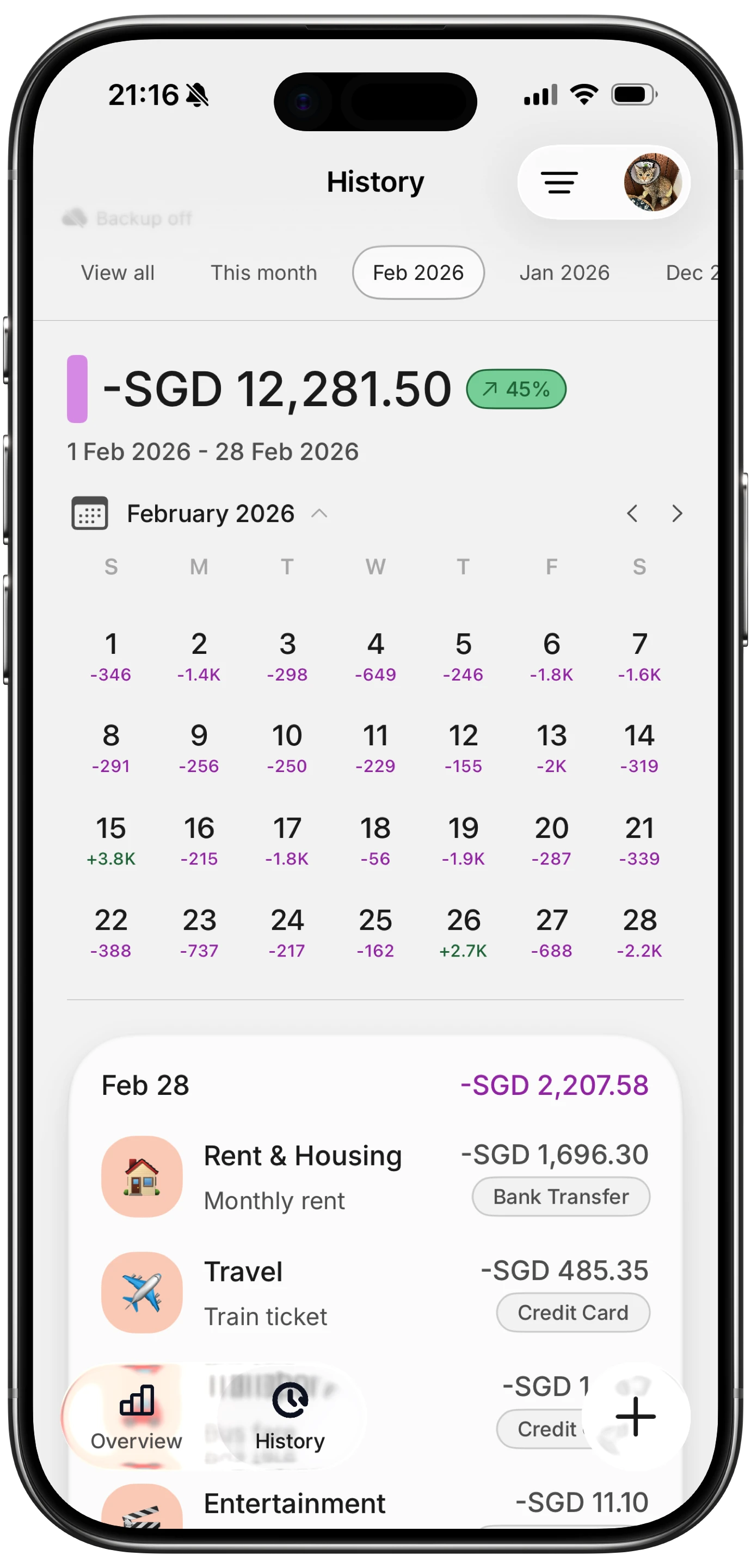
Finny app's History calendar feature
Identifying Your True Minimum
Tracking expenses also helps you identify which costs are fixed and which are flexible. This matters for Coast FIRE because it tells you the range of income you need:
- Baseline minimum: Rent, utilities, insurance, groceries, transportation. These are non-negotiable.
- Comfortable minimum: Baseline plus dining out, subscriptions, hobbies, and modest entertainment.
- Current lifestyle: Everything you spend now, including discretionary purchases.
Knowing these tiers lets you plan realistically. Maybe you can coast on baseline minimum income while building a side project. Or maybe you want your comfortable minimum covered and are willing to work part-time for that. For tips on identifying where your money goes each day, see our guide on how to track daily spending.
Pros and Cons of Coast FIRE
Advantages
Lower pressure than traditional FIRE. You do not need to save 50% or more of your income for decades. Once you hit your coast number, the savings pressure disappears.
Achievable at a younger age. Because the required number is much lower than full FIRE, many people can reach Coast FIRE in their 30s or early 40s.
More career flexibility. You can pursue work you find meaningful rather than optimizing for the highest salary.
Psychological relief. Knowing that retirement is handled, regardless of future savings, reduces financial anxiety considerably.
Simpler planning. Your financial life simplifies to one question: can I cover my expenses this month?
Disadvantages
Market risk. The calculation assumes average returns over decades. Prolonged downturns, especially early in the growth period, can derail projections.
No safety margin by default. If you stop contributing entirely, you have no buffer against underperformance. Many financial planners suggest continuing to save at least a small amount.
Healthcare gaps. If you leave a full-time job in the US before age 65, you lose employer-sponsored health insurance. This is a significant expense that many Coast FIRE plans underestimate.
Lifestyle inflation. Your expenses at 35 may not reflect your expenses at 55. Family changes, housing needs, and health costs can all increase over time. Ongoing expense tracking helps you catch these shifts early. Understanding lifestyle creep is important for anyone on the coast FIRE path.
Social pressure. Choosing lower-paying work or part-time hours can be difficult to explain to family and peers who measure success by income.
Building a Coast FIRE Plan
If Coast FIRE appeals to you, here is a practical path forward.
1. Track your spending for at least three months. You need real data on your monthly expenses. Use an app like Finny to log everything and review your spending categories.
2. Calculate your retirement target. Multiply your expected annual retirement spending by 25 (for a 4% withdrawal rate).
3. Determine your coast number. Use the formula above with your current age, target retirement age, and a conservative return estimate (6% to 7%).
4. Compare your current investments to your coast number. If you have already passed it, you may be coasting without realizing it. If not, calculate how many more months or years of saving you need.
5. Plan your post-coast income. Based on your tracked expenses, determine the minimum income you need. Explore career options that meet that threshold.
6. Build a buffer. Consider overshooting your coast number by 10% to 20% to account for market volatility and unexpected expense increases.
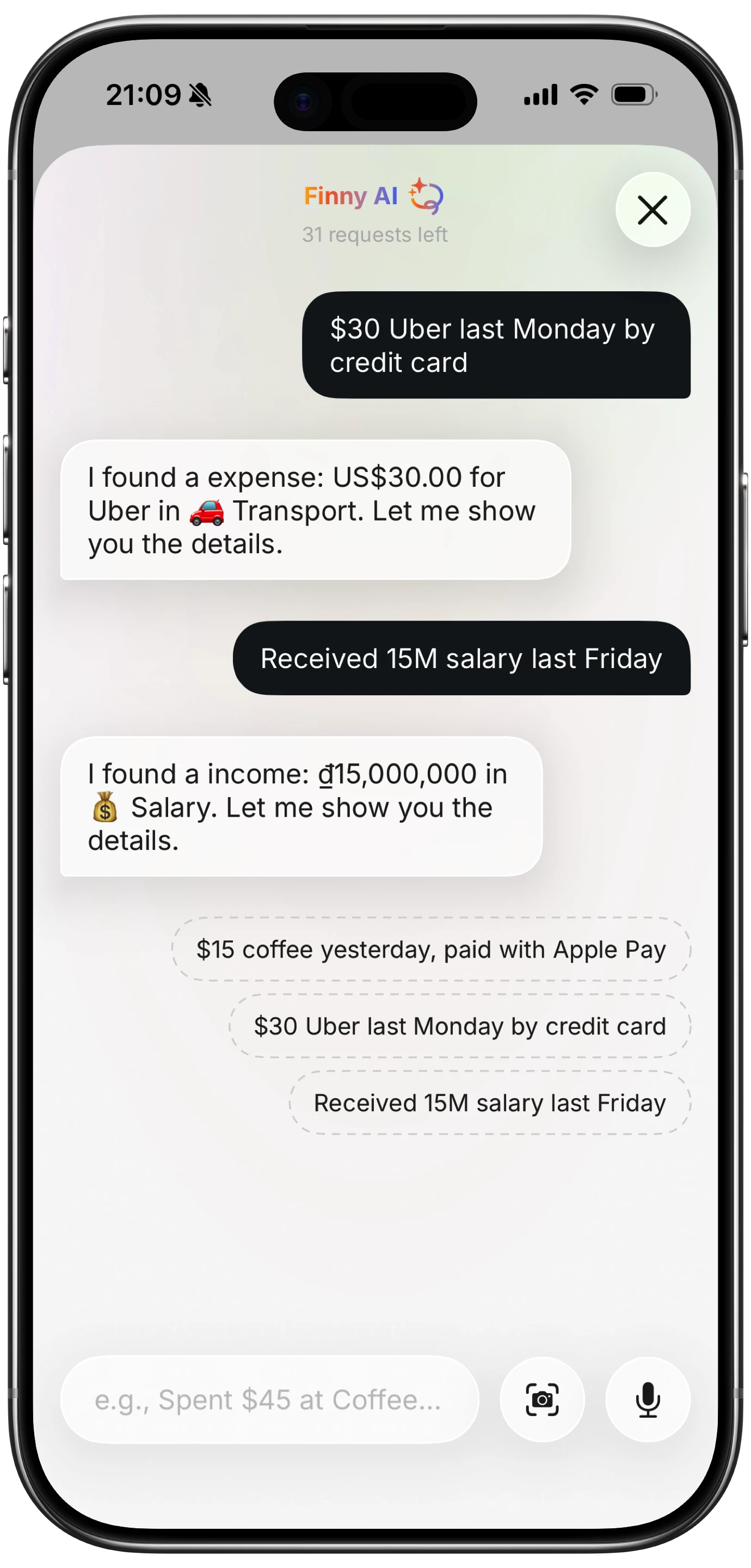
Finny app's AI chat feature
The Bottom Line
Coast FIRE is a realistic, flexible alternative to traditional early retirement planning. By investing enough early in life and letting compound growth handle the rest, you free yourself from the obligation to save aggressively for decades. The tradeoff is that you still need to earn an income for daily expenses, but you get to choose what that work looks like.
The foundation of any Coast FIRE plan is knowing your numbers: your investment balance, your retirement target, and most importantly, your actual spending. Without accurate expense data, the calculations are just guesswork.
Whether you are years away from your coast number or closer than you think, the first step is the same: understand where your money goes today.
Common Questions About Coast FIRE
What is Coast FIRE in simple terms?
Coast FIRE means you have enough money invested that compound growth will fund your retirement without any additional contributions. You still work to cover daily expenses, but you no longer need to save for the future.
How much do I need for Coast FIRE?
It depends on your age, target retirement age, expected spending, and assumed investment return. A 30-year-old targeting $1,000,000 at age 65 with 7% returns needs roughly $94,000 invested. A 40-year-old needs about $184,000.
Is Coast FIRE risky?
The main risk is market underperformance. If returns average below your assumption over decades, your portfolio may fall short. Using a conservative return estimate and building a buffer above your coast number reduces this risk.
Can I still save after reaching Coast FIRE?
Yes, and many people do. Any additional savings above your coast number provide extra security or let you retire earlier than planned. Coasting is a minimum threshold, not a ceiling.
How do I know my expenses well enough to plan for Coast FIRE?
Track your spending consistently for several months using an expense tracking app. Categorize expenses into fixed, flexible, and discretionary. This gives you a realistic baseline for both your retirement target and your post-coast income needs.
Ready to understand your spending and plan your path to Coast FIRE?
Download Finny to track daily expenses, review spending patterns, and build the financial clarity you need to calculate your coast number with confidence.