What Is Conscious Spending? Spend More on What Matters
Traditional budgeting tells you to spend less. Conscious spending tells you to spend deliberately. The difference matters because most people do not have a spending problem. They have an awareness problem. Money disappears into purchases they do not remember, value, or enjoy.
Conscious spending is a financial approach where you intentionally allocate money toward things you genuinely value while cutting ruthlessly on things you do not care about. Instead of restricting every category equally, you spend generously where it matters to you and minimize everywhere else. For practical budgeting methods, see our guide on how to budget money.
How Conscious Spending Differs From Traditional Budgeting
| Approach | Philosophy | Feels Like |
|---|---|---|
| Traditional budgeting | Spend less overall | Restriction, deprivation |
| Conscious spending | Spend deliberately | Choice, alignment |
| No plan | Spend whatever, whenever | Freedom (then regret) |
Traditional budgets set limits on every category: $400 for groceries, $100 for dining out, $50 for entertainment. When you exceed a limit, you feel guilty. The system works through restriction, which is why most people abandon it.
Conscious spending starts with a different question: what do you actually care about? If you love travel and could not care less about having a new car, you should spend more on travel and drive an older car. If quality food is important to you, spend more on groceries and less on clothes.
The total spending may be the same. The distribution changes based on your values.
The Conscious Spending Framework
Ramit Sethi popularized a conscious spending plan with four categories:
1. Fixed Costs (50-60% of take-home pay)
Rent/mortgage, utilities, insurance, loan payments, subscriptions, transportation. These are non-negotiable monthly obligations.
2. Investments (10% of take-home pay)
Retirement contributions, index fund investments, other long-term wealth building. This is automated and happens before discretionary spending.
3. Savings (5-10% of take-home pay)
Emergency fund, vacation fund, large purchase funds. Short-to-medium-term goals. For more on building savings, see our guide on emergency funds.
4. Guilt-Free Spending (20-35% of take-home pay)
Everything else. Dining out, hobbies, entertainment, clothes, gifts. This is where conscious spending lives. You spend this money without guilt because your fixed costs are covered, you are investing, and you are saving. The key: spend this portion on what you actually value.
How to Build a Conscious Spending Plan
Step 1: Track Current Spending
You cannot spend consciously if you do not know where money currently goes. Track every expense for one month to establish a baseline. AI-assisted input makes this fast: type "coffee $5" or scan a receipt, and your data builds itself.
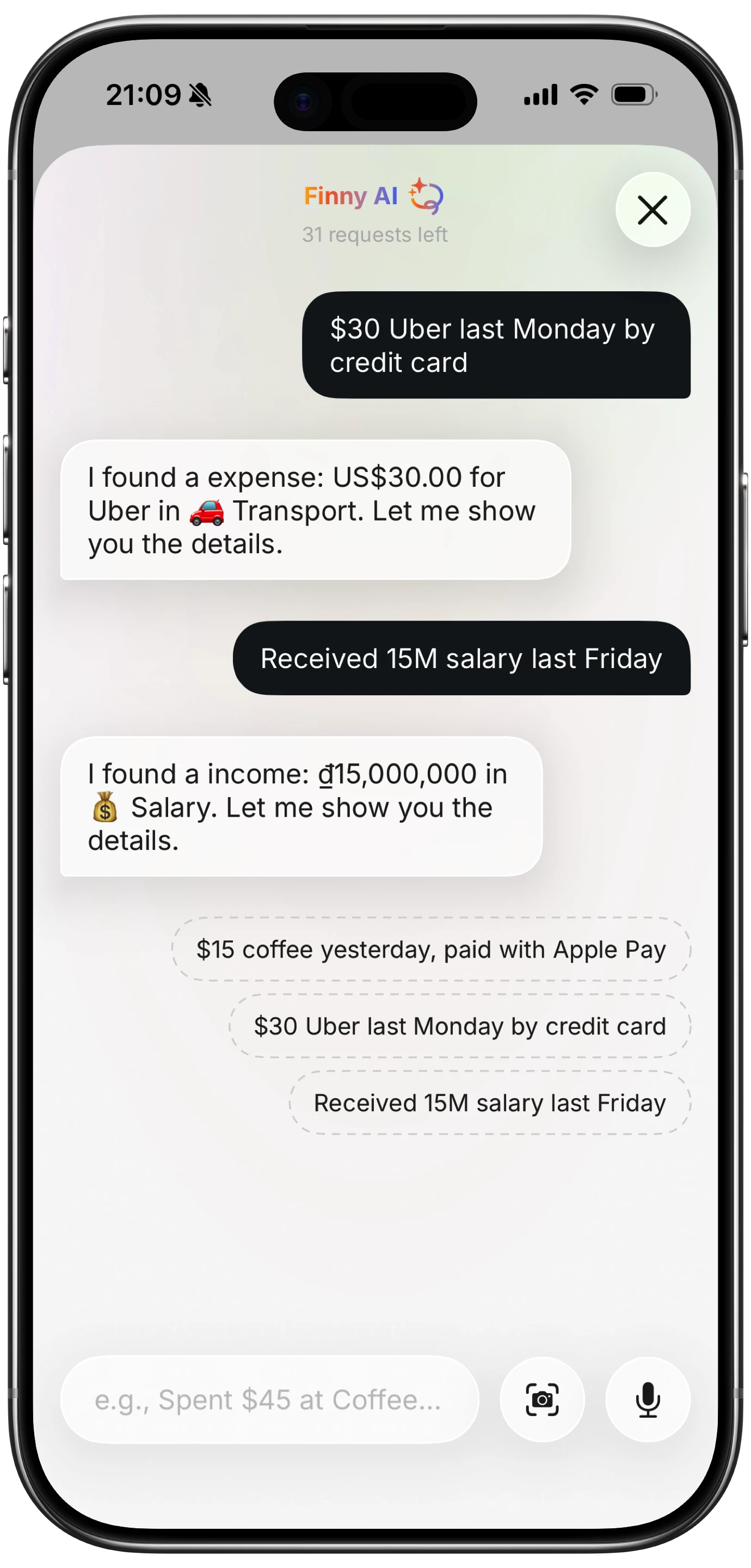
Finny app's AI chat feature
Step 2: Identify What You Value
Review your spending data and ask two questions about each category:
- Does this spending make me happy? Not in the moment, but genuinely satisfied.
- Would I notice if I spent less here? Some categories can be cut without any impact on your quality of life.
Common realizations people have:
- "I spend $200/month on dining out but rarely enjoy the meals."
- "I spend $15/month on gym but go three times a week and love it."
- "I have six subscriptions but only use two regularly."
Step 3: Reallocate
Cut spending in low-value categories and redirect to high-value ones. This is not about spending less overall. It is about spending better.
| Category | Before | After | Change |
|---|---|---|---|
| Dining out | $300 | $150 | Cut: low-value meals |
| Travel fund | $0 | $200 | Added: high priority |
| Subscriptions | $80 | $30 | Cut: unused services |
| Hobby supplies | $50 | $100 | Increased: high value |
| Clothes | $150 | $50 | Cut: impulse purchases |
| Total | $580 | $530 | Saved $50 and happier |
Step 4: Automate the Important Parts
Set up automatic transfers for investments and savings so they happen before you see the money. What remains is your guilt-free spending pool.
Step 5: Review Monthly
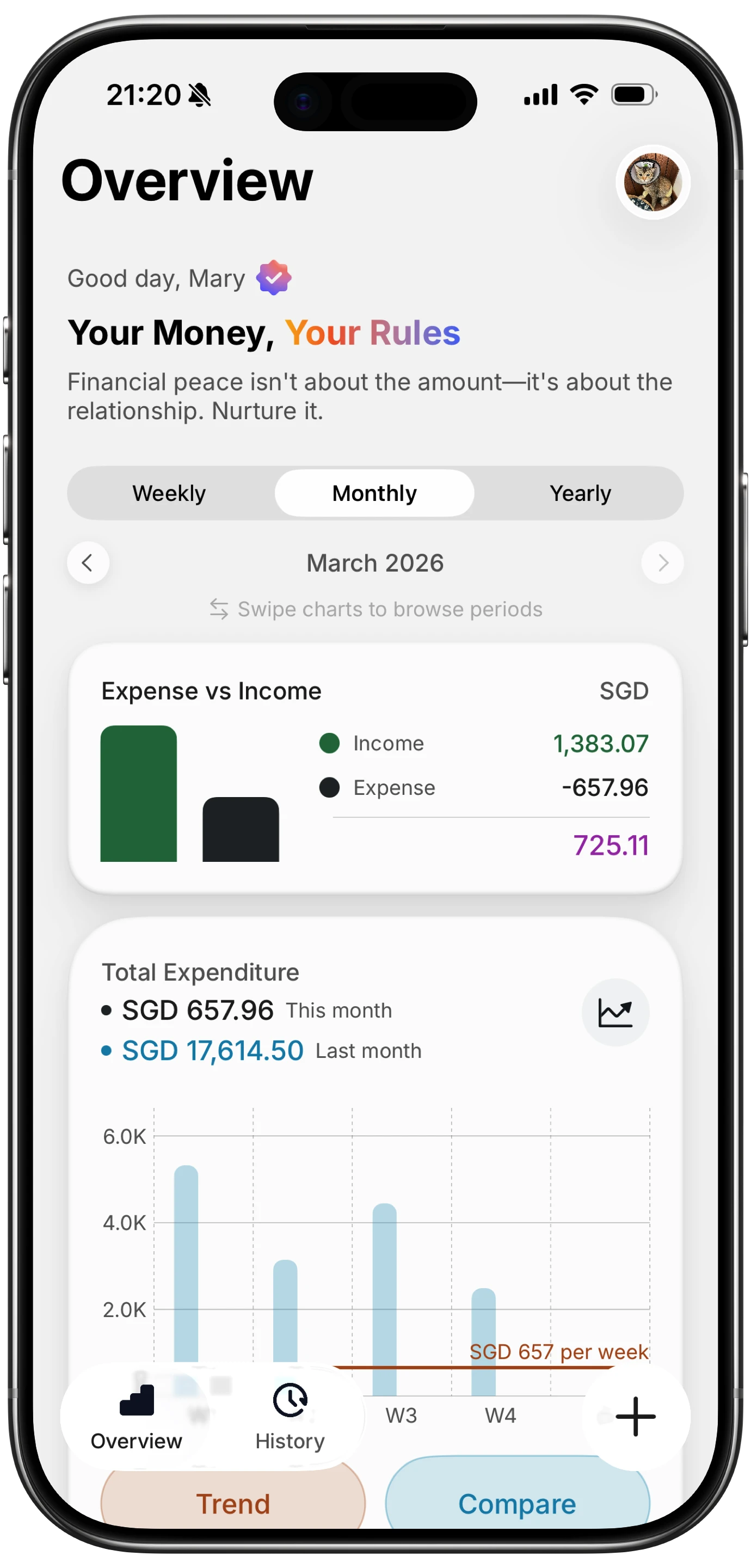
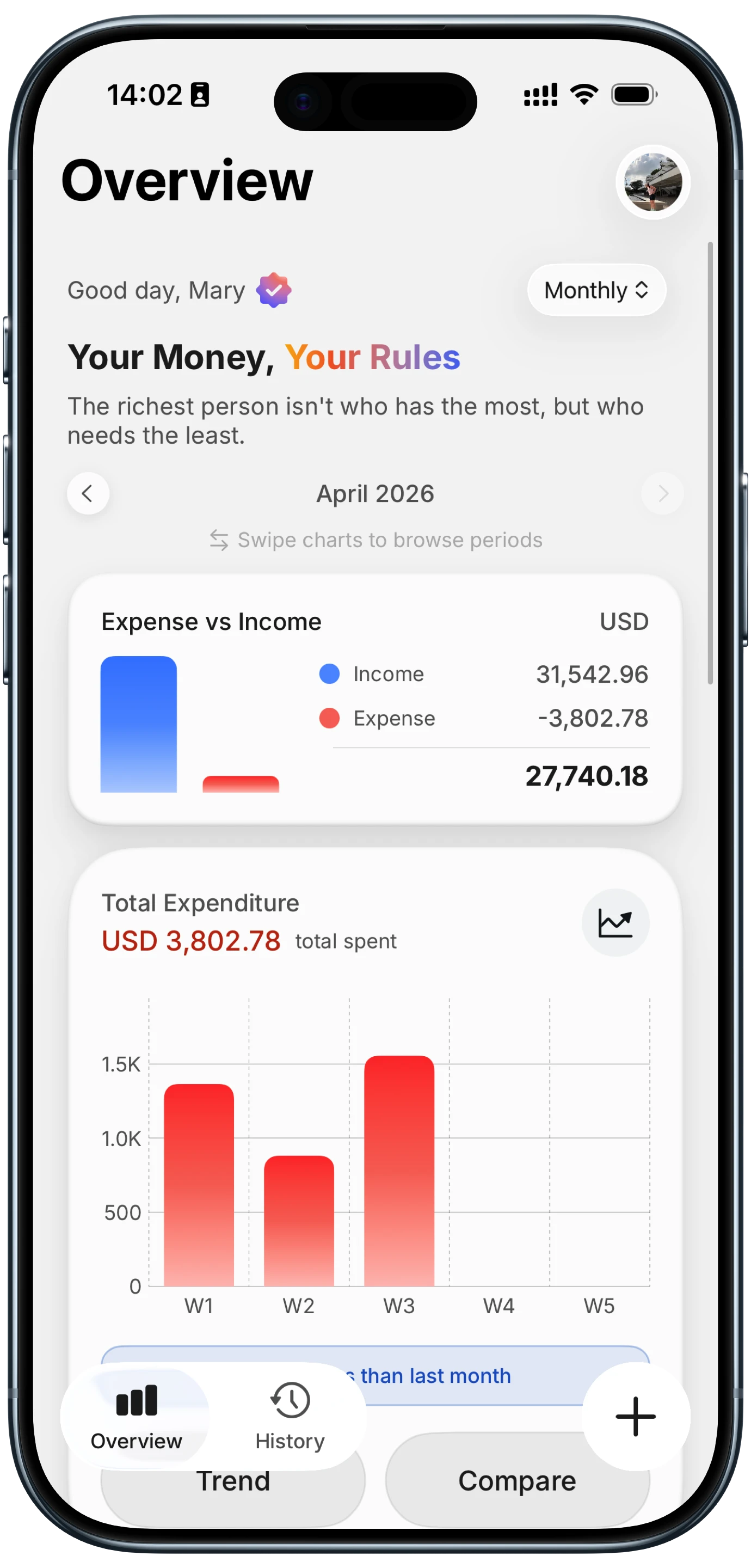
Finny app's Overview feature
Check your spending data each month. Are you still aligned with your values? Has a new expense crept in that you do not care about? Monthly review keeps conscious spending intentional rather than letting it drift back into unconscious habits.
Why Conscious Spending Works Better Than Restriction
It aligns with psychology. Humans are poor at sustained deprivation but good at making choices. Conscious spending frames financial decisions as choices rather than sacrifices.
It is sustainable. Restrictive budgets fail because they require constant willpower. Conscious spending only requires awareness and periodic review.
It improves satisfaction. Research on spending and happiness shows that money spent on valued experiences and priorities creates more satisfaction than money spent mindlessly on a mix of everything.
It reduces guilt. When you know your fixed costs are covered and you are investing, spending $100 on a nice dinner feels justified rather than irresponsible.
Common Conscious Spending Mistakes
Skipping the tracking step. You cannot spend consciously without data. Gut feelings about spending are almost always wrong. Track first, then decide.
Treating it as permission to overspend. Conscious spending is not "buy whatever you want." It is deliberate allocation within your means. Fixed costs, investing, and savings come first.
Not reviewing regularly. Values and circumstances change. A conscious spending plan from six months ago may not reflect your priorities today. Monthly check-ins keep it current. For more on spending reviews, see our guide on comparing monthly spending.
Confusing wants with values. An impulse purchase feels like something you want in the moment. A value is something that consistently matters to you over time. Conscious spending serves values, not impulses.
The Bottom Line
Conscious spending is not about spending less. It is about spending with intention. When you track your expenses, identify what genuinely matters to you, and redirect money from low-value to high-value categories, you end up both financially healthier and more satisfied with how you use your money.
The foundation is data. You need to see where your money goes before you can decide where it should go. Daily expense tracking turns unconscious spending into a visible, controllable system.
Common Questions About Conscious Spending
Is conscious spending the same as budgeting?
Not exactly. Budgeting sets limits on categories. Conscious spending sets priorities. You may spend more in some categories than a traditional budget would allow, as long as your overall financial obligations (fixed costs, investing, savings) are met first.
How do I know what I truly value?
Track your spending for a month, then review each category. Things you spend on happily and consistently are likely values. Things you spend on impulsively and regret are not. The data reveals patterns that gut feelings miss.
Can I practice conscious spending on a low income?
Yes. Conscious spending is about allocation, not amount. Even on a tight budget, directing limited resources toward what matters most and away from what does not improves both your finances and your satisfaction.
How often should I review my conscious spending plan?
Monthly for a quick check, quarterly for a deeper review. Life changes, and your spending priorities should change with it.
What if my partner and I have different spending values?
This is common and healthy. Discuss your individual priorities, agree on shared obligations (housing, savings), and allocate separate guilt-free spending pools that each person controls. See our guide on money dates for couples for how to structure these conversations.
Ready to spend on what actually matters to you?
Download Finny to track every expense with AI-assisted input. See where your money goes, identify what you value, and build a spending plan that reflects your priorities. No bank connections required.