You check your bank balance at the end of the month and wonder where the money went. Bills were paid, rent was covered, groceries were bought. But somewhere between the morning coffees, the streaming subscriptions, and the impulse purchases, hundreds of dollars slipped through without much thought.
The culprit is usually discretionary spending, the portion of your budget that covers wants rather than needs. Understanding this category is the single most effective step toward saving more money, because it is the one area where you have genuine flexibility. This guide breaks down what counts as discretionary spending, how to separate it from fixed expenses, and how tracking it by category makes it visible and controllable. For a broader look at managing your money, see our guide on how to manage personal finances.
What Is Discretionary Spending
Discretionary spending is money you spend on non-essential items and activities. These are purchases you choose to make but could survive without. They improve your quality of life, but skipping them would not put your health, housing, or basic needs at risk.
Common examples of discretionary spending include:
- Dining out and takeout coffee
- Entertainment (movies, concerts, games)
- Streaming subscriptions (Netflix, Spotify, etc.)
- Clothing beyond basic needs
- Hobbies and recreation
- Vacations and travel
- Gym memberships
- Gifts that go beyond obligations
- Impulse purchases and convenience upgrades
Discretionary spending is not inherently bad. Spending money on things you enjoy is part of a balanced financial life. The problem arises when discretionary expenses grow unchecked and crowd out savings, debt repayment, or other financial goals.
Discretionary vs Non-Discretionary Expenses
To control discretionary spending, you first need to distinguish it from non-discretionary, or fixed, expenses. Non-discretionary expenses are costs you must pay to maintain basic living standards and meet legal or contractual obligations.
| Category | Discretionary | Non-Discretionary |
|---|---|---|
| Housing | Home decor, upgrades | Rent or mortgage |
| Food | Restaurants, specialty groceries | Basic groceries |
| Transportation | Ride-shares for convenience, car upgrades | Gas, insurance, public transit pass |
| Healthcare | Elective procedures, wellness products | Insurance premiums, prescriptions |
| Communication | Premium app subscriptions | Basic phone plan, internet |
| Clothing | Fashion purchases, accessories | Work-appropriate basics |
| Finance | Investment apps with premium tiers | Debt payments, taxes |
Some expenses sit in a gray area. A gym membership might feel essential for your mental health but is technically discretionary. A basic phone plan is non-discretionary, but the latest flagship phone is not. The key question is: would not paying this put my health, shelter, or legal standing at risk? If the answer is no, it is discretionary.
The Three Spending Buckets
A practical way to organize your expenses is to sort them into three buckets:
-
Fixed non-discretionary: Costs that stay roughly the same each month and cannot be skipped. Rent, insurance, loan payments, utilities.
-
Variable non-discretionary: Essential costs that fluctuate. Groceries, gas, medical copays. You need them, but the amount changes.
-
Discretionary: Everything else. Dining out, entertainment, subscriptions, hobbies, shopping for wants.
This three-bucket approach helps you see your spending landscape clearly. Fixed costs are hard to change quickly. Variable necessities offer some flexibility through smarter shopping. But discretionary spending is where you have the most immediate control.
Why Discretionary Spending Is the Key Lever for Saving
Most people who want to save more focus on finding ways to earn more income. That is useful but slow. Discretionary spending, on the other hand, is the fastest lever you can pull.
Here is why:
It is immediately adjustable. You cannot renegotiate your rent mid-lease, but you can skip dining out this week. Discretionary cuts take effect the moment you make them.
It is often larger than people realize. Studies consistently show that the average household spends 20-35% of after-tax income on discretionary items. For a household earning $5,000 per month after taxes, that could be $1,000 to $1,750 in flexible spending. Even a 20% reduction frees up $200 to $350 per month.
Small daily amounts compound. A $6 coffee five days a week is $130 per month, or $1,560 per year. A $15 lunch habit adds up to $300 per month. These amounts are easy to overlook individually but significant in total.
It reveals spending patterns. When you track discretionary spending, you often discover categories you did not realize were consuming so much. Subscriptions you forgot about, convenience purchases you make out of habit, or social spending that consistently exceeds what you planned.
The goal is not to eliminate all discretionary spending. That is unsustainable and miserable. The goal is to spend intentionally, directing money toward discretionary items that genuinely improve your life while reducing spending on things that do not.
How to Identify Your Discretionary Spending
Knowing the definition is one thing. Actually identifying your own discretionary expenses requires looking at real numbers. Here is a practical process:
Step 1: Gather Your Spending Data
Pull together at least one month of transactions, ideally three. Bank statements work, but an expense tracking app provides cleaner data because transactions are already categorized. If you have been using Finny or a similar tracker, your spending history is already organized and ready to review.
Step 2: Sort Every Transaction
Go through each expense and label it as non-discretionary or discretionary. Be honest with yourself. That premium streaming bundle with five services is not a necessity, even if it feels like one.
For transactions that feel borderline, ask:
- Could I meet this need for less money? (Eating at home vs. dining out)
- Would skipping this create a real hardship? (Winter coat vs. designer jacket)
- Is this a habit or a deliberate choice? (Daily snack run vs. planned treat)
Step 3: Calculate Your Discretionary Percentage
Add up all discretionary spending and divide by your total after-tax income. This gives you your discretionary spending rate.
Under 20%: You are already lean. Savings improvements may need to come from increasing income or optimizing fixed costs.
20-35%: This is the typical range. There is likely room to reduce without major lifestyle changes.
Over 35%: Significant opportunity to redirect money toward savings or debt repayment.
Step 4: Rank by Impact
List your discretionary categories from largest to smallest. The top three categories usually account for the majority of discretionary spending. These are your highest-impact targets for reduction.
For most people, the biggest discretionary categories are dining out, entertainment and subscriptions, and shopping for non-essentials. Your list may differ, which is exactly why tracking matters.
How Category-Based Expense Tracking Makes It Visible
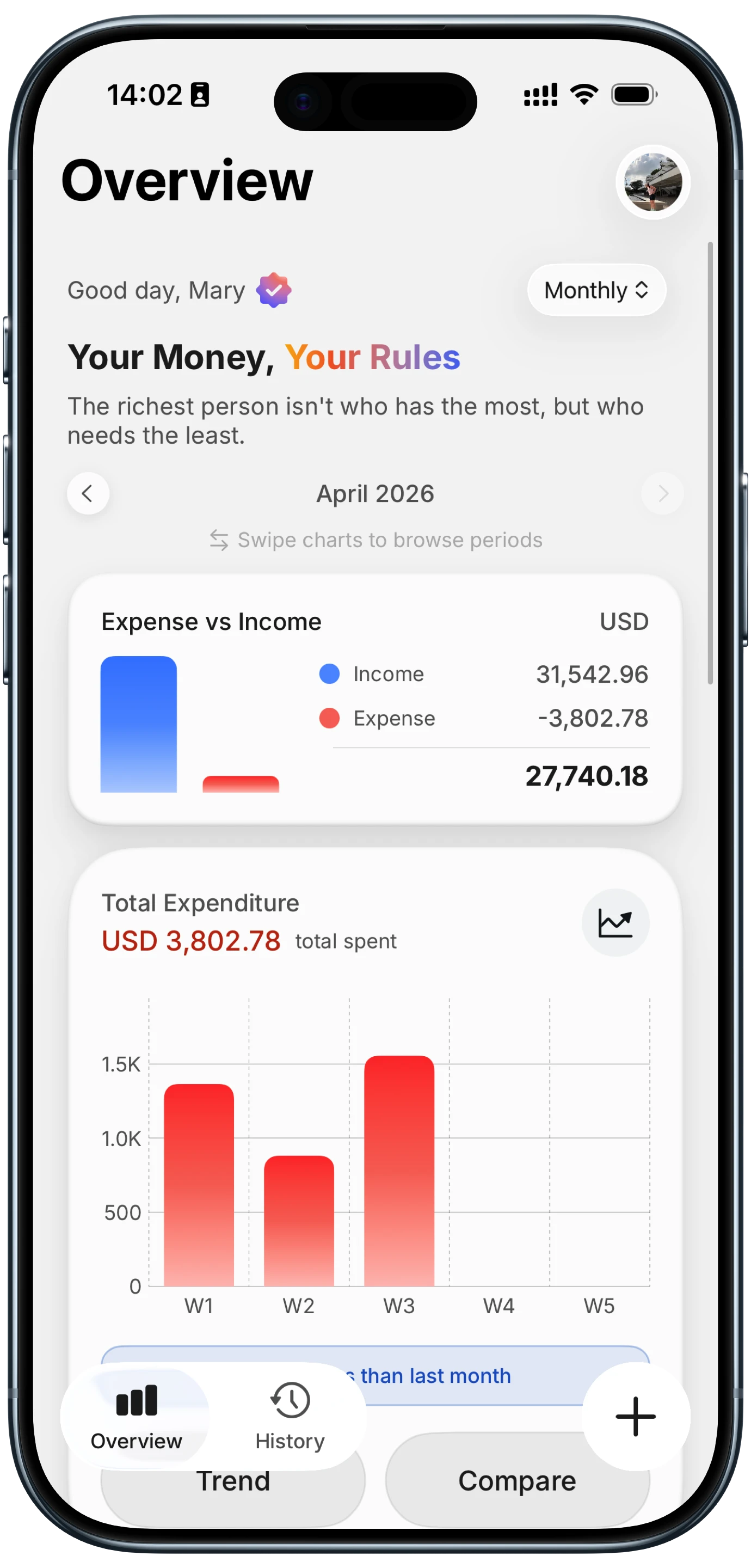
The biggest challenge with discretionary spending is that it is invisible by default. Individual purchases feel small and harmless. The $4 here and $12 there only become significant when you see them aggregated over weeks and months.
This is where category-based expense tracking changes the picture.
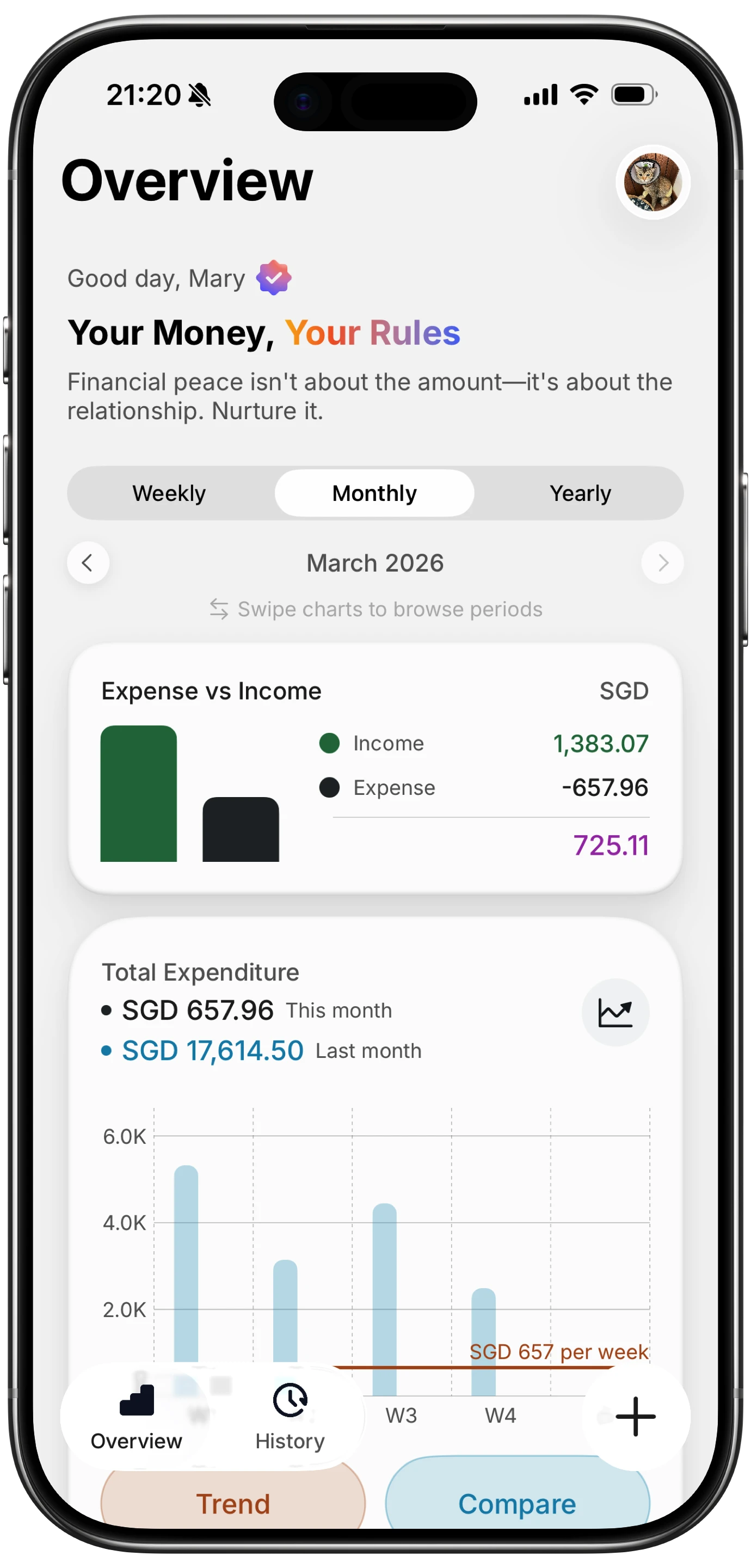
Finny app's Overview feature
Automatic Categorization Surfaces Patterns
When every expense is assigned to a category, your spending data tells a story. Instead of a list of transactions, you see that you spent $280 on dining out, $85 on subscriptions, and $150 on impulse shopping last month. The categories make the patterns obvious.
Finny uses AI-assisted categorization to sort expenses as you log them. You type "lunch with team at Thai place" and it categorizes the transaction under dining. Over time, your category totals reveal exactly where discretionary money is going. For more on how this works, see our guide on automatic expense categorization.
Visual Breakdowns Create Accountability
Seeing a pie chart or bar graph of your spending categories has a psychological effect that raw numbers do not. When dining out visually dominates your spending breakdown, the insight hits differently than reading "$280" on a spreadsheet.
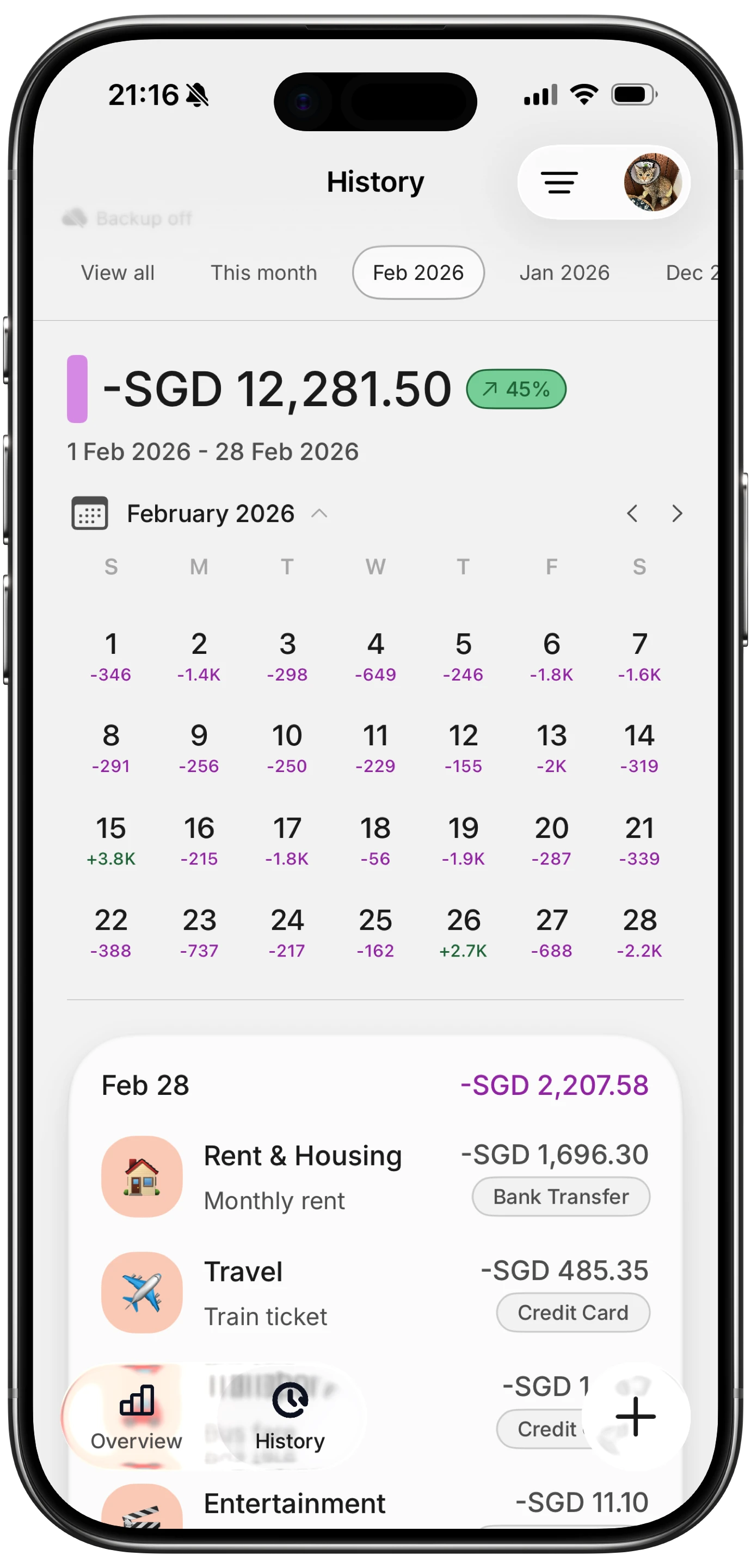
Finny app's History calendar feature
Good expense trackers present this data clearly without requiring you to build your own charts. The goal is to make discretionary spending impossible to ignore, not through guilt, but through clarity.
Tracking Over Time Reveals Trends
A single month of data is a snapshot. Three months shows a pattern. Six months reveals habits. Category-based tracking lets you compare your discretionary spending across months and see whether your efforts to reduce it are actually working.
If your dining category dropped from $320 in January to $240 in February to $180 in March, you have concrete evidence that your behavior changed. If it crept back up to $300 in April, you know exactly where to refocus.
Practical Strategies to Reduce Discretionary Spending
Once you can see your discretionary spending clearly, here are proven strategies to bring it down without making yourself miserable.
The 24-Hour Rule
For any non-essential purchase over a set threshold (say $30), wait 24 hours before buying. Most impulse purchases lose their appeal after a day. This single habit can eliminate a surprising amount of discretionary spending.
The Subscription Audit
List every recurring subscription and ask two questions: Did I use this in the past 30 days? Would I sign up for it again today at this price? Cancel anything that fails both tests. For a deeper look at this process, see our guide on how to stop subscription creep.
Category Budgets
Set a specific monthly limit for your top discretionary categories. Instead of a vague goal to "spend less on eating out," set a $150 dining budget. Track against it weekly. Finny's category tracking makes this straightforward because you can see your running total at any point in the month.
Swap, Don't Eliminate
Cutting all discretionary spending is a recipe for burnout. Instead, swap expensive habits for cheaper alternatives. Cook a nice meal at home instead of a restaurant. Use the library instead of buying books. Host a movie night instead of going to the theater. You still enjoy yourself, just at a lower cost.
Automate Savings First
Move savings to the beginning of the month rather than saving "whatever is left." When you pay yourself first, discretionary spending naturally adjusts to fit what remains. This removes the need for willpower on every individual purchase. For more on this approach, see our guide on pay yourself first.
The 50/30/20 Framework for Discretionary Spending
One popular guideline for balancing discretionary spending is the 50/30/20 rule:
- 50% of after-tax income goes to needs (non-discretionary expenses)
- 30% of after-tax income goes to wants (discretionary spending)
- 20% of after-tax income goes to savings and debt repayment
This is a starting point, not a rigid rule. If you live in a high-cost area, your needs may consume 60% or more. If you are aggressively paying off debt, you might limit wants to 15-20%. The value of the framework is that it gives you a benchmark to compare against.
If your discretionary spending consistently exceeds 30% of income while your savings rate is below 20%, the numbers are telling you where to adjust. You can use a 50/30/20 Budget Calculator to see exactly how your income should split across these three buckets.
The Bottom Line
Discretionary spending is the gap between what you must pay and what you choose to pay. It includes dining out, entertainment, subscriptions, shopping for wants, and dozens of small daily purchases that add up faster than most people expect.
The key insight is simple: you cannot control what you cannot see. Category-based expense tracking turns invisible spending into visible data. When you know that dining costs you $300 a month and subscriptions run $120, you can make informed decisions about what to keep, what to reduce, and what to cut.
You do not need to live without enjoyment. You need to spend on what actually matters to you and stop leaking money on things that do not. Tracking makes the difference between guessing and knowing.
Common Questions About Discretionary Spending
What is considered discretionary spending?
Discretionary spending includes any expense that is not essential for basic living. Dining out, entertainment, hobbies, non-essential shopping, and subscriptions are common examples. If you could skip the expense without affecting your health, housing, or legal obligations, it is discretionary.
What is the difference between discretionary and non-discretionary expenses?
Non-discretionary expenses are costs you must pay, like rent, utilities, insurance, and groceries. Discretionary expenses are optional purchases you choose to make, like restaurant meals, streaming services, or new clothing beyond what you need. The key distinction is necessity versus choice.
How much of my income should go to discretionary spending?
The 50/30/20 guideline suggests allocating 30% of after-tax income to discretionary spending. However, this varies by income level, cost of living, and financial goals. If you are focused on paying down debt or building savings, reducing discretionary spending to 15-20% of income can accelerate your progress.
How do I track discretionary spending effectively?
Use a category-based expense tracking app to log every purchase and assign it to a category. Review your category totals weekly or monthly to see where discretionary money is going. Over time, patterns emerge that help you identify the easiest areas to cut back without sacrificing what you value most.
Ready to see where your discretionary spending actually goes?
Download Finny to categorize every expense automatically, spot patterns in your spending, and take control of the money you did not realize you were losing. No bank connections required, fully offline-capable, and designed to make your spending visible.