Banks With the Best Money Management Tools (2026)
For years, "money management" meant exporting a statement and squinting at it in a spreadsheet. That has changed. Many banks and neobanks now build budgeting, spending categorization, and savings tools directly into their apps, so you can see where your money goes without leaving your checking account.
The quality varies a lot. Some banks offer a real budgeting workspace with category limits and alerts. Others give you a pie chart and call it a day. If you are trying to find the banks with the best money management tools, it helps to know what each one actually does before you switch accounts. For a wider view of standalone options, our guide to the best money management apps in 2026 covers tools that work no matter where you bank.
This article reviews current 2026 offerings, honestly. It also covers the one limitation every bank shares, no matter how polished the app is.
What "money management tools" means inside a bank app
Before comparing banks, it helps to define the term. When a bank advertises money management features, it usually means some mix of the following.
- Spending categorization. Transactions get sorted into groups like Groceries, Dining, or Transport, usually based on the merchant category code from the card network.
- Budgets and limits. You set a monthly cap for a category and the app tracks progress against it.
- Spending insights. Charts, trends, and month-over-month comparisons that summarize activity.
- Savings tools. Sub-accounts, "buckets," or "pods" that let you separate money for specific goals.
- Alerts. Notifications when a balance is low, a large charge posts, or a budget is close to its limit.
None of this is new in concept. The difference in 2026 is that more banks ship these features by default, with no setup and no extra fee. The catch is that the depth ranges from genuinely useful to barely there.
Banks with strong built-in budgeting tools
A handful of banks and neobanks have invested real effort into in-app money management. These stand out in 2026.
Monzo
Monzo, a UK neobank, is often cited as a benchmark for in-app budgeting. It automatically categorizes spending and lets you set strict per-category budgets, with real-time warnings if you are on pace to overspend before the month ends. Its Salary Sorter splits an incoming paycheck into spending, savings, and bills the moment it lands.
Ally Bank
Ally's Spending Account includes "buckets," a tool that lets you organize regular expenses into categories and allocate funds to each. Savings buckets do the same on the savings side. It is straightforward and well integrated, though it stays inside Ally accounts.
SoFi
SoFi offers a cash flow tracker that shows income against spending side by side, plus Vaults for organizing savings goals. The tools are clear and require little configuration.
Revolut
Revolut provides automatic categorization, instant transaction notifications, and a subscription dashboard that surfaces recurring charges. It is strong for travel and multi-currency spending in particular.
Traditional banks
Larger banks have caught up partway. Bank of America offers automatic spending categorization with budgets and alerts. Chase presents spending as bar charts and tables pulled from Chase checking and credit accounts. PNC's Virtual Wallet splits money across spending, reserve, and growth views. Chime focuses more on automated round-ups into savings than on detailed budgeting.
How automatic categorization holds up in bank apps
Categorization is the feature people rely on most, and it is also where bank apps are weakest. Most banks categorize transactions using the merchant category code attached to each charge. That code is assigned by the payment network, not by you, and it is often wrong or vague.
A warehouse club might land in "Shops" when most of your spend there is groceries. A restaurant supply store and a sit-down dinner can both end up under "Dining." A few banks let you recategorize a transaction. Many do not. Apple Card, for example, categorizes purchases automatically but does not let you change a transaction's category or set budget goals for categories.
The practical result is that a bank's categories give you a rough shape, not an accurate one. If precise numbers matter to you, look closely at two things before relying on a bank's tools:
- Can you recategorize a transaction? If not, errors are permanent.
- Can you create custom categories? Fixed category sets cannot model your actual life.
For a deeper look at how this works and where it breaks, see our guide to automatic expense categorization.
Comparison: banks with the best money management tools
The table below summarizes how several 2026 options compare. Treat it as a starting point and verify current features directly, since bank apps change often.
| Bank | Budgeting tools | Categorization | Key limitation |
|---|---|---|---|
| Monzo | Per-category budgets, real-time overspend alerts, Salary Sorter | Automatic, fairly granular | Only sees money inside Monzo |
| Revolut | Budgets, subscription dashboard, instant alerts | Automatic | Best features tied to paid plans; Revolut-only data |
| Ally | Spending and savings "buckets" | Automatic, basic | No view of non-Ally accounts |
| SoFi | Cash flow tracker, Vaults for goals | Automatic, basic | Limited to SoFi accounts |
| Bank of America | Budgets, spending limits, alerts | Automatic | Fixed categories, BofA accounts only |
| Chase | Spending charts and tables | Automatic | No custom categories; Chase accounts only |
| Chime | Round-ups into savings | Basic | Light on budgeting depth |
| Apple Card (via Apple Wallet) | Weekly and monthly spending wheel | Automatic | Cannot recategorize or set budgets |
Every row shares the same final column theme, and that is not a coincidence. It points to the structural limit of bank-built tools.
The limitation every bank app shares
Here is the honest part. A bank app, no matter how good, can only see the money that flows through that bank.
If your paycheck lands at one bank, your everyday card is from a second, your travel card is a third, and you still use some cash, then each app shows a slice. None of them shows the whole. You cannot get a single accurate monthly total, because no single bank has all the data.
This creates real problems:
- Incomplete budgets. A category budget inside one bank ignores spending on every other card.
- Double-counting risk. Moving money between your own accounts can look like income or spending if you try to combine apps manually.
- No shared household view. Partners with separate banks cannot see a joint picture.
- Fragmented history. Switching banks usually means losing your spending history.
Bank tools are genuinely useful for the accounts they cover. They are just not designed to be your one source of truth. They are a feature of a banking product, not a dedicated money management system.
How to choose
Choosing here is less about finding the single best bank and more about matching tools to how your money is actually arranged.
- If almost all your money flows through one bank, then a bank with strong tools, such as Monzo, Ally, or SoFi, may cover most of your needs. Pick the one whose budgeting depth matches how detailed you want to be.
- If you have multiple accounts and cards, no single bank app will give you an accurate total. The bank tools still help per account, but you need something that sits above all of them.
- If accuracy of categories matters, prioritize banks that let you recategorize transactions and avoid relying on fixed category sets.
- If you share finances, check whether the bank supports a genuine joint view, since most do not across separate institutions.
A dedicated expense tracker is what fills the cross-account gap. Instead of logging into one bank, you log expenses into one app, which then reflects every account, card, and wallet in a single view. Our roundup of the best expense tracker apps in 2026 walks through how those tools differ from bank-built features.
Frequently Asked Questions
Which bank has the best budgeting app in 2026?
There is no single winner, because it depends on where you bank and how detailed you want to be. Among neobanks, Monzo is frequently praised for granular budgets and real-time overspend alerts. Revolut is strong for subscriptions and travel. Among larger banks, Bank of America and Chase offer solid categorization and charts. All of them share the same limit: they only see accounts held at that bank.
Do banks automatically categorize your spending?
Most modern bank apps do categorize spending automatically, using the merchant category code attached to each transaction. That code comes from the payment network, so it is not always accurate. A grocery run at a warehouse club can land under "Shops." Some banks let you correct a category, but many, including Apple Card, do not, which means errors stay in your reports.
Can a bank app track all my accounts in one place?
Generally no. A bank app can only see the accounts and cards issued by that bank. If you hold money at more than one institution, each app shows only its own slice, and you cannot get one accurate combined total from them. A dedicated tracker that you log into directly is what consolidates everything into a single view.
Are bank budgeting tools free?
Most basic budgeting and categorization features are included free with the account. Some neobanks, including Revolut, place their more advanced tools behind paid plan tiers. Always confirm current pricing with the bank, since plan structures and included features change regularly. Free bank tools are useful, but their value is still limited to that one bank's accounts.
The bottom line
Banks with the best money management tools have made real progress. Monzo, Ally, SoFi, Revolut, and the larger institutions all offer budgeting and categorization that beats the spreadsheet era. If your financial life lives inside one bank, those tools may be all you need.
The structural gap remains for everyone else. A bank only sees its own money, and most people spread spending across several cards, accounts, and a digital wallet or two. That is the gap a dedicated tracker is built to close.
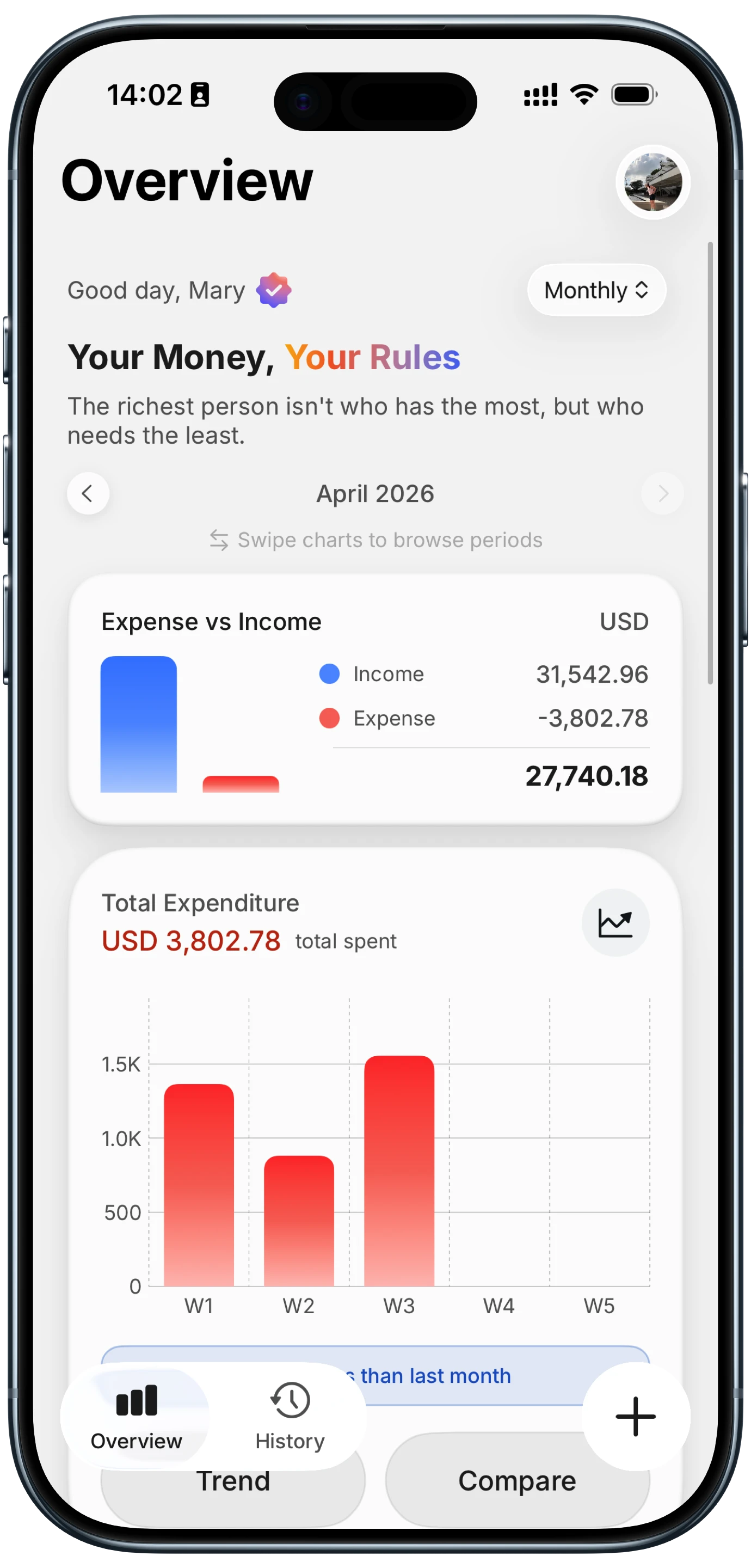
Finny takes that approach. It is an AI-assisted expense tracker for iPhone where you log spending by typing, voice, a receipt photo, or a quick chat, and it pulls every account and wallet into one Unified Currency View. There are no bank connections, your data stays on your device, and the free tier covers unlimited manual tracking and charts. If your money lives in more than one place, see how Finny brings it together at getfinny.app.