You downloaded a budgeting app, spent an hour setting it up, then never opened it again. If that sounds familiar, the app was probably too complicated, not you.
The best simple budget app does one thing well: it makes tracking your money fast enough that you actually stick with it. No learning curves, no mandatory tutorials, no 47 budget categories to configure before you can log your first expense.
This guide is specifically for people who tried feature-heavy apps like YNAB and found the process exhausting. Every app here was chosen for ease of use, clean design, and minimal taps to get started. If you want a more comprehensive comparison across all features, our best expense tracker apps in 2026 guide covers the full landscape.
Why Simplicity Matters More Than Features
The budgeting app graveyard is full of powerful tools that nobody uses. Research consistently shows that the biggest predictor of budgeting success is consistency, not methodology. A basic app you open every day beats a sophisticated one you abandon after a week.
The three most common reasons people quit budgeting apps are complexity during setup, too many taps to log a single expense, and guilt-inducing interfaces that make you feel bad about spending. The apps below avoid all three.
For a beginner-friendly introduction to tracking your finances, see our budgeting for beginners guide.
What We Measured
We evaluated each app on simplicity-specific criteria:
- Taps to log: How many screen interactions to record a single expense
- Setup time: How long from download to first logged transaction
- Learning curve: Can you use it without reading documentation?
- Visual clarity: Is the dashboard clean or cluttered?
- Price: Simple should not mean expensive
Quick Comparison Table
| App | Taps to Log | Setup Time | Price | Offline | Bank Required | Platform |
|---|---|---|---|---|---|---|
| Finny | 1-2 (AI) or 4 (manual) | Under 2 min | Free/a low monthly price | Yes | No | iOS |
| Goodbudget | 4-5 | 5-10 min | Free/$10/mo | Partial | No | iOS, Android |
| 1Money | 3-4 | Under 2 min | Free | Yes | No | Android |
| PocketGuard | 0 (auto) | 5-10 min | Free/$12.99/mo | No | Yes | iOS, Android |
| EveryDollar | 3-4 | 5-10 min | Free/$79.99/yr | No | Optional | iOS, Android |
| Spendee | 3-4 | 3-5 min | Free/$2.99/mo | Partial | Optional | iOS, Android |
| Wallet by BudgetBakers | 3-4 | 5-10 min | Free/$5.49/mo | Yes | Optional | iOS, Android |
The Best Simple Budget Apps in 2026
Finny: Simplest AI-Powered Tracking
Finny strips expense tracking down to its essentials, then uses AI to make even that faster. The result is an app that takes under two minutes to set up and less than five seconds to log most expenses.
The fastest method is Tap to Track. If you pay with Apple Pay, Finny automatically captures the transaction the moment it happens. You do not open the app, type anything, or even think about it. For Apple Pay users, this is as simple as budgeting gets: zero taps.
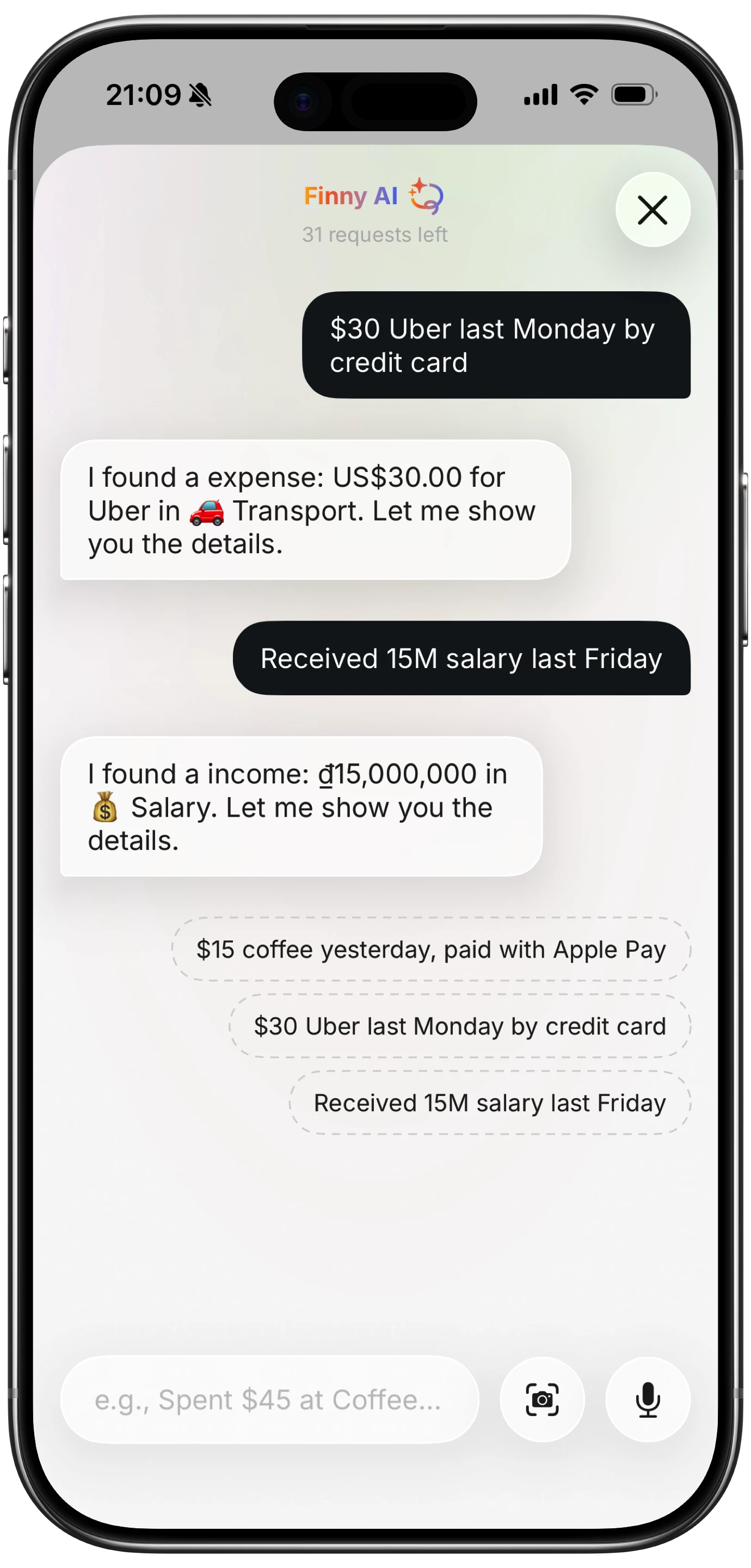
Finny app's AI chat feature
When you do need to log manually, the AI input accepts natural language. Type "coffee 4.50" or say "lunch with Sarah, 22 dollars" and Finny extracts the amount, category, and merchant automatically. No dropdown menus, no date pickers, no category wheels. You can also scan receipts, and the Batch Snap and Log feature handles up to five at once if you have been collecting them.
The free tier includes unlimited manual logging, custom categories, and charts. Pro at a low monthly price adds AI input, voice logging, and receipt scanning. Even at the Pro tier, Finny costs less per month than a single coffee.
For tips on logging expenses with minimal effort, see our guide on how to log expenses without typing.
Price: Free tier available. Pro at a low monthly or yearly price.
Best for: People who want the fewest possible steps between spending money and recording it.
Goodbudget: Simplest Envelope Budgeting
Goodbudget takes the old-fashioned cash envelope system and makes it digital. You create envelopes for categories like groceries, dining out, and entertainment, then allocate money to each at the start of the month. When you spend, you pull from the appropriate envelope.
The concept is dead simple: when an envelope is empty, you stop spending in that category. There are no algorithms, no AI, and no automated imports. You log everything manually, which keeps you aware of every dollar.
The free plan gives you 10 envelopes and syncing across 2 devices, which is enough for most individuals. Couples and families may want the Plus plan at $10/mo for unlimited envelopes and 5 devices. No bank connection is required.
The tradeoff is that manual entry for every transaction can feel tedious over time, especially compared to AI-assisted alternatives. Goodbudget works best for people who find the physical act of logging an expense helpful for building awareness.
Price: Free (10 envelopes) or $10/mo ($80/yr).
Best for: People who like the discipline of envelope budgeting and prefer not to connect bank accounts.
1Money: Simplest Free Option (Android)
1Money is a clean, no-nonsense expense tracker that is completely free in 2026. The interface uses large, colorful category icons that make logging fast and visually clear. You tap a category, enter an amount, and you are done.
The app includes multi-currency support with automatic exchange rate updates, budget planning, and charts for reviewing your spending. It supports debt and savings tracking as well. Despite being free, it does not display ads, which is rare.
The main limitation is platform availability. 1Money is Android-only, so iPhone users will need to look elsewhere. The app also lacks AI input or receipt scanning, so every transaction requires manual entry.
Price: Free.
Best for: Android users who want a clean, fully free expense tracker with no catches.
PocketGuard: Simplest Automated Overview
PocketGuard connects to your bank accounts and does the categorizing for you. Its signature feature is the "In My Pocket" number, which shows how much money you have left to spend after accounting for bills, goals, and necessities. That single number is the entire budgeting system for many users.
Setup takes 5 to 10 minutes because you need to link bank accounts and let the app analyze your transactions. After that, the app runs largely on autopilot. You open it, see your number, and decide whether to spend.
The free version is quite limited with only 2 budget categories and 2 bank connections. Most users will need PocketGuard Plus at $12.99/mo, which unlocks unlimited categories, debt payoff planning, and subscription tracking. That price is steep for a simplicity-focused app.
Price: Free (very limited) or $12.99/mo ($74.99/yr).
Best for: People who want automated tracking and a single "spendable" number.
EveryDollar: Simplest Zero-Based Budget
EveryDollar, from Dave Ramsey's Ramsey Solutions, offers zero-based budgeting with a cleaner interface than YNAB. The concept is the same (give every dollar a job), but the execution is more approachable. The app relaunched in early 2026 with a refreshed design and a new "margin finder" feature that identifies breathing room in your budget.
The free version lets you create a full zero-based budget and log transactions manually. The premium plan at $79.99/yr adds bank syncing so transactions import automatically. If you follow Dave Ramsey's financial philosophy, this app translates his teachings directly into a budgeting workflow.
The downside is that zero-based budgeting still requires regular engagement. You need to assign every dollar each month and reconcile transactions frequently. It is simpler than YNAB, but not as effortless as apps that skip the budgeting step entirely.
Price: Free (manual) or $79.99/yr (with bank sync).
Best for: Dave Ramsey followers who want a straightforward zero-based budgeting tool.
Spendee: Simplest Shared Budgeting
Spendee stands out for its clean visual design and shared wallet feature. The app uses a timeline view for transactions and simple pie charts for spending breakdowns. Adding an expense takes 3 to 4 taps, and the interface feels modern without being cluttered.
Shared wallets let couples or roommates track joint expenses in one place. Each person logs their spending, and the app shows combined totals and individual contributions. This works well for splitting household costs or tracking shared vacation budgets.
The free tier covers basic tracking for one wallet. Premium at $2.99/mo adds bank connections, shared wallets, and multiple currency support. The price is reasonable, though the bank connection feature can be unreliable in some regions.
Price: Free (1 wallet) or $2.99/mo ($22.99/yr).
Best for: Couples or roommates who want simple shared expense tracking.
Wallet by BudgetBakers: Simplest All-in-One Option
Wallet by BudgetBakers tries to be simple and comprehensive at the same time. It offers bank syncing, manual entry, budgets, recurring transactions, and multi-currency support. The interface is reasonably clean despite the feature density, with a card-based layout that keeps different functions organized.
The app works offline and syncs when you reconnect, which is useful for travelers. Bank connections are available in many countries but are optional. The free version includes basic tracking and budgets. Premium at $5.49/mo adds bank sync, exports, and advanced analytics.
The tradeoff is that having many features means more menus to navigate. Wallet is simpler than YNAB but more complex than focused tools like Finny or 1Money. It works best for users who want room to grow into more features over time.
Price: Free (basic) or $5.49/mo.
Best for: Users who want a balance between simplicity now and advanced features later.
Why People Quit YNAB (and What to Use Instead)
YNAB is a powerful budgeting tool, but it is not for everyone. The three most common complaints are:
Too expensive. At $14.99/mo ($109/yr), YNAB is the most expensive personal budgeting app on the market. Every app on this list costs less, and several are free.
Too complex. YNAB's four-rule system requires genuine onboarding before it clicks. You need to understand concepts like "aging your money" and "rolling with the punches." For people who just want to track what they spend, this is overkill.
Too demanding. If you fall behind on YNAB by even a week, reconciling feels like doing your taxes. The app works best with daily engagement, which is a high bar for most people.
If you recognize yourself in any of these complaints, a simpler tool will likely serve you better. The goal is not to use the most sophisticated app. The goal is to understand your spending, and that only works if you actually use the tool consistently.
For a step-by-step approach to getting started, read our guide on how to track expenses effectively.
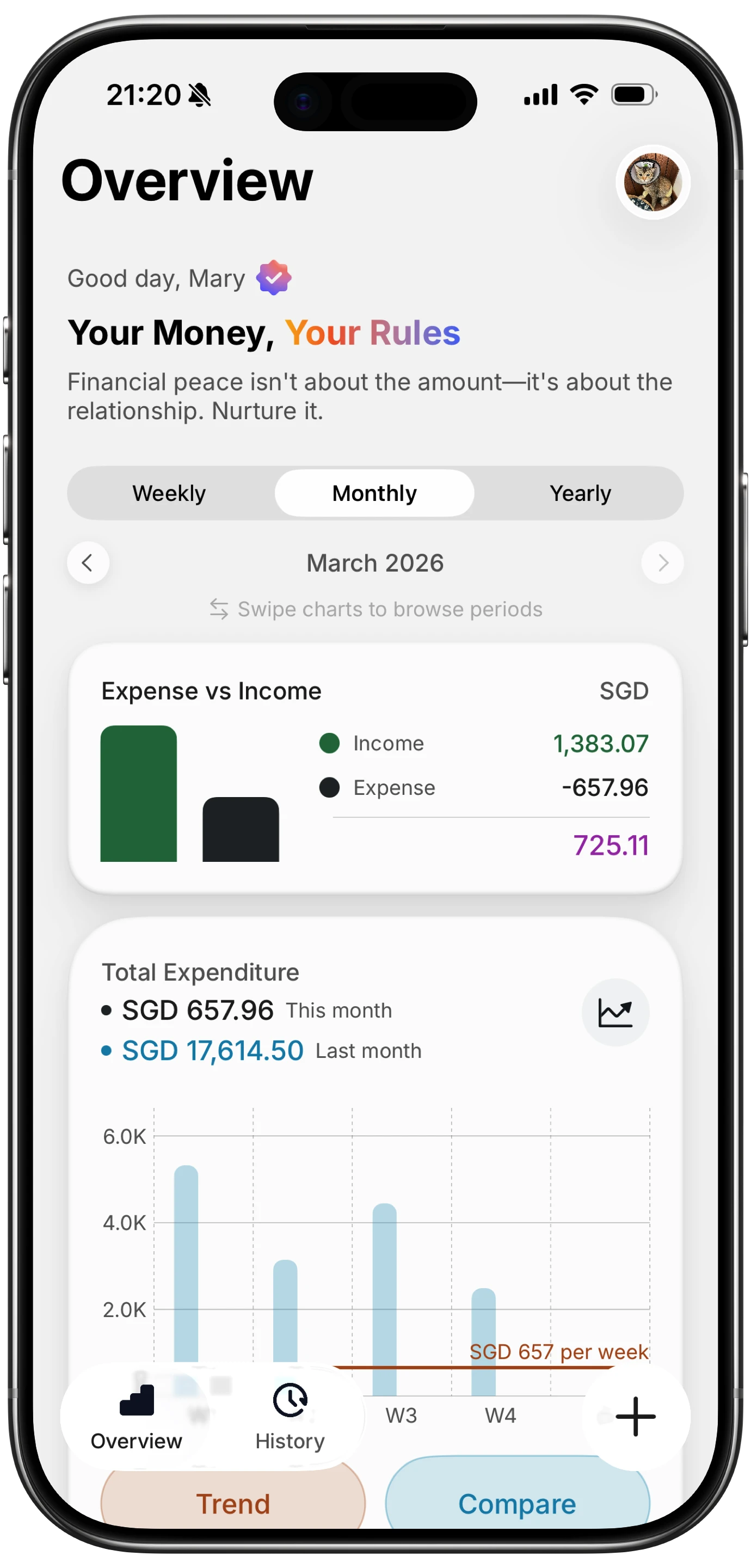
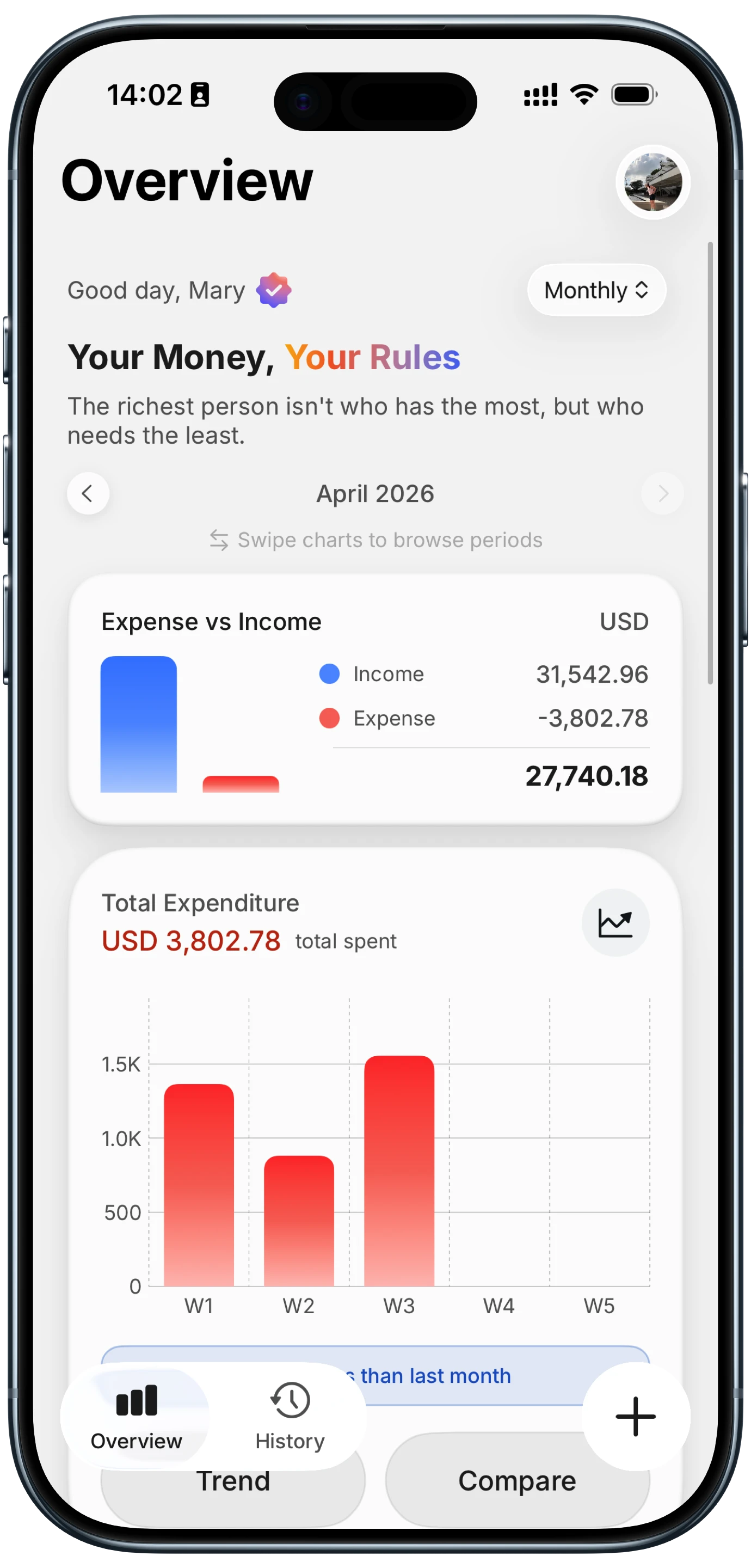
Finny app's Overview feature
Tips for Sticking With a Budget App
Choosing a simple app is the first step. Here are practical habits that help you keep using it.
Log immediately. The longer you wait to record an expense, the less likely you will do it. Apps with AI input or automatic tracking remove this friction entirely.
Start with three categories. Do not create 20 budget categories on day one. Start with essentials, dining, and everything else. Add more categories only when you feel the need.
Review weekly, not daily. Checking your spending once a week is enough to stay aware without feeling micromanaged. Most simple budget apps have a weekly summary or chart that makes this easy.
Forgive missed days. Everyone skips a day. The difference between people who stick with budgeting and those who quit is whether they resume the next day or give up entirely.
FAQ
What is the simplest budget app for beginners?
For iPhone users, Finny offers the lowest barrier to entry. You can log your first expense within 60 seconds of downloading the app, and AI input means you never need to navigate menus or pick from dropdown lists. For Android users, 1Money provides a clean, free experience with large visual icons that make categories obvious at a glance.
Can a simple budget app actually help me save money?
Yes. Simplicity increases consistency, and consistency is what produces results. Studies on financial behavior consistently show that people who track their spending, even roughly, spend 10 to 20 percent less than those who do not. The mechanism is awareness: once you see the numbers, you naturally adjust.
Do I need to connect my bank account to use a budget app?
No. Several apps on this list, including Finny, Goodbudget, and 1Money, work entirely without bank connections. You log transactions manually or use AI input to speed up the process. This approach offers better privacy and works in any country, regardless of banking infrastructure. For more on this topic, see our guide on tracking expenses without linking your bank.
Is YNAB worth the learning curve?
YNAB is worth it if you commit fully to the zero-based budgeting method and use it every day. The system genuinely works for people who embrace it. But if you have tried it and bounced off, there is no shame in switching to something simpler. A low-cost app you use daily will always outperform a $14.99/mo app you opened twice.
What is the cheapest simple budget app?
1Money and Goodbudget's free tier cost nothing. Finny's free tier offers unlimited manual tracking with custom categories and charts. Among paid options, Finny Pro at a low monthly price and Spendee at $2.99/mo are the most affordable. For context, YNAB costs $14.99/mo and PocketGuard Plus costs $12.99/mo.