Most budgeting advice assumes everyone starts from the same place. They do not. Someone earning $30,000 a year faces different constraints than someone earning $120,000, and generic tips like "spend less on coffee" miss the point entirely.
Good budgeting tips account for where you actually are. The strategies that help a student stretch a part-time paycheck are not the same ones that help a dual-income household manage lifestyle creep. Both need a budget, but they need different budgets.
This guide organizes 20 practical tips by income level, with additional sections for irregular earners, students, and couples. Pick the ones that match your situation and skip the rest. If you are starting from scratch, our budgeting for beginners guide covers the fundamentals first.
Budgeting Tips for Lower Incomes
When your income is tight, every dollar matters more. These tips focus on maximizing what you have and building a foundation without feeling deprived.
1. Track every expense for 30 days before making a budget
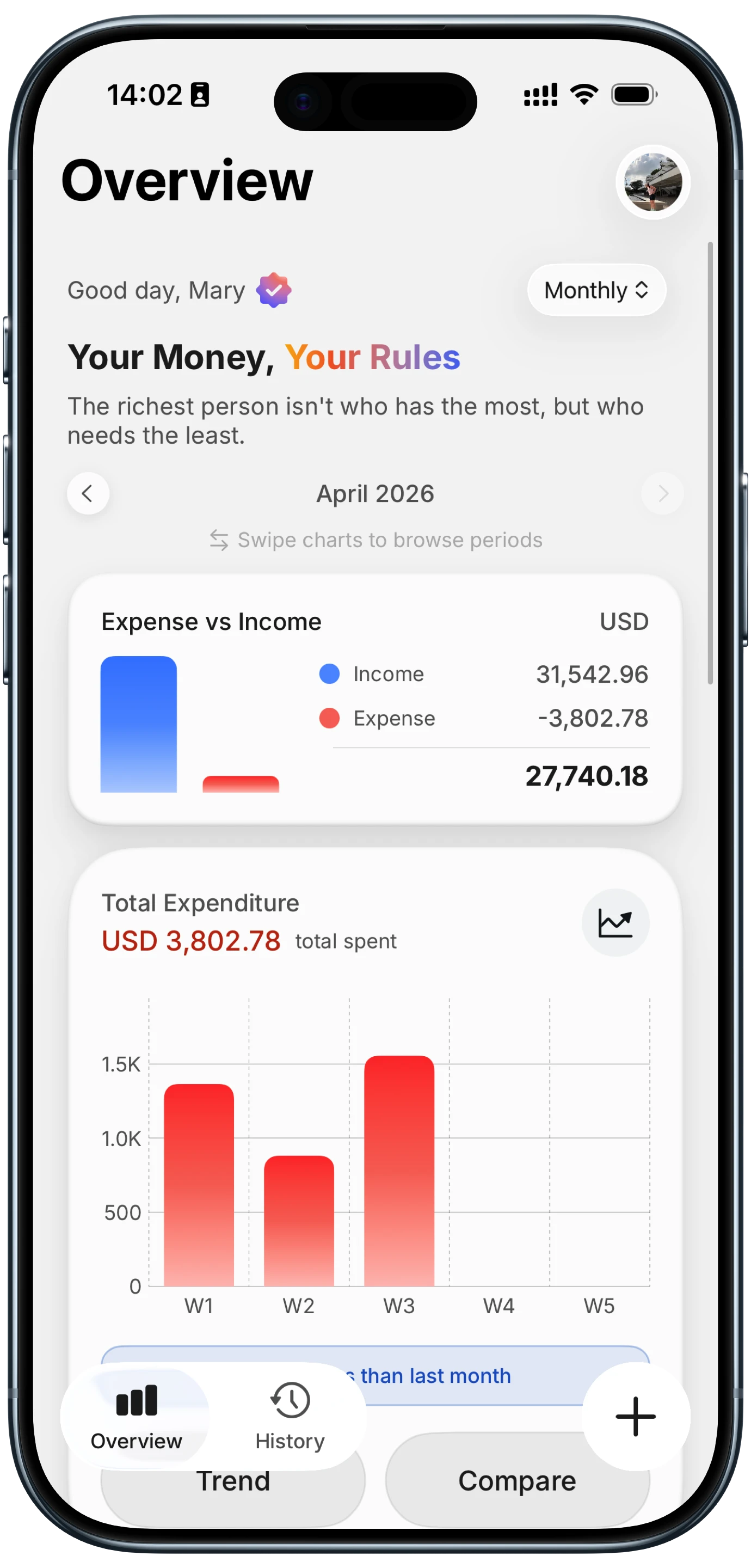
You cannot fix what you cannot see. Before setting limits, spend one month logging everything you spend. This reveals patterns you would never notice otherwise, like how small daily purchases add up to hundreds per month. Use an expense tracker that makes logging fast, such as Finny, where you can log a transaction by voice or a quick text entry.
2. Use the 50/30/20 rule as a starting point, then adjust
Allocate 50% of after-tax income to needs, 30% to wants, and 20% to savings and debt. If your needs consume more than 50%, that is normal on a lower income. Adjust to 60/20/20 or even 70/20/10 and work toward better ratios over time. Our breakdown of the 50/30/20 rule explains how to adapt it to your situation.
3. Build a $500 emergency buffer before anything else
A full emergency fund feels impossible when money is tight. Start smaller. A $500 buffer covers most minor surprises: a flat tire, a vet bill, a broken phone. Automate $20 per week and you will hit $500 in six months. This one buffer can prevent a spiral into credit card debt.
4. Negotiate recurring bills once a year
Call your internet, phone, and insurance providers and ask for a lower rate. Mention competitor pricing. This takes 30 minutes and saves $20 to $50 per month on average. That is $240 to $600 per year redirected to savings or debt. For more ideas on stretching a tight budget, see our guide on how to save money on a low income.
5. Cook in bulk on weekends
Meal prepping two or three recipes on Sunday cuts grocery waste and eliminates impulse takeout orders during the week. A family of two can eat well for $60 to $80 per week with planning, compared to $150 or more without it.
6. Use free tools instead of paying for budgeting apps
You do not need a $10/month subscription to track your money. Finny's free tier includes unlimited manual tracking, custom categories, charts, and support for 150+ currencies. Paid tools are helpful, but they should never be a barrier to getting started.
Budgeting Tips for Middle Incomes
With a moderate income, the biggest risk is not poverty. It is stagnation. You earn enough to be comfortable but not enough to ignore inefficiencies. These tips focus on optimization and building momentum.
7. Automate savings on payday, not at the end of the month
Pay yourself first. Set up automatic transfers to savings and investment accounts the day your paycheck arrives. If you wait until the end of the month, whatever is left will feel like all you can afford to save. Automation removes that temptation.
8. Audit subscriptions quarterly
The average American spends over $200 per month on subscriptions, and most people underestimate their total by 50% or more. Review every recurring charge once per quarter. Cancel anything you have not used in 30 days. Setting up recurring transaction tracking helps here. Finny's recurring transactions feature lets you log subscriptions with automatic reminders, so nothing slips through unnoticed.
9. Use sinking funds for predictable big expenses
Car insurance, holiday gifts, annual memberships: these are not surprises, but they feel like it when you pay them all at once. Divide the annual cost by 12 and save that amount monthly in a dedicated sinking fund. This smooths out your cash flow and prevents budget-breaking months.
10. Set a 48-hour rule for purchases over $50
Impulse spending is the biggest budget leak for middle-income earners. Before buying anything non-essential over $50, wait 48 hours. Most impulse urges fade within a day or two. The things you still want after waiting are the ones worth buying.
11. Budget for fun explicitly
The fastest way to abandon a budget is to make it joyless. Allocate a specific amount for entertainment, dining out, or hobbies each month. Spending within that limit is guilt-free. This makes the budget sustainable instead of something you resent.
12. Review your tax withholding
If you consistently get a large tax refund, your withholding is too high. That refund is not free money. It is your money that the government held interest-free for a year. Adjust your W-4 to bring home more each paycheck and redirect the difference to savings or debt.
13. Compare your spending month over month
Trends matter more than individual transactions. If your grocery spending jumped 20% in two months, something changed. Monthly comparisons surface these shifts before they become habits. A good expense tracker with charts and category breakdowns makes this easy to spot.
Budgeting Tips for Higher Incomes
Higher income creates different problems: lifestyle inflation, complexity, and the false sense that budgeting is unnecessary. These tips address the specific challenges that come with earning more.
14. Budget by percentages, not fixed dollar amounts
When income fluctuates or grows, fixed-dollar budgets become outdated quickly. Instead, budget by percentages. Allocate 25% to housing, 15% to transportation, 20% to savings, and so on. As income rises, your savings automatically scale up rather than staying flat while spending absorbs the rest.
15. Max out tax-advantaged accounts before lifestyle upgrades
In 2026, you can contribute $24,500 to a 401(k) and $7,500 to an IRA. Before upgrading your car or apartment after a raise, increase your retirement contributions. The tax savings alone make this worthwhile, and it prevents lifestyle inflation from consuming every raise. Our guide on how to budget money includes strategies for allocating raises deliberately.
16. Hire an accountant if your tax situation is complex
If you have investment income, rental properties, stock options, or a side business, a good CPA pays for themselves in tax savings. This is not a budgeting tip in the traditional sense, but optimizing your tax bill is one of the highest-return financial moves at higher income levels.
17. Track net worth quarterly, not just cash flow
At higher income levels, cash flow budgeting alone misses the bigger picture. Your net worth, which includes investment growth, real estate equity, and debt reduction, tells a more complete story. Quarterly net worth tracking keeps you focused on building wealth, not just managing expenses.
18. Create a giving budget
Charitable giving is easier to sustain when it is planned. Decide on an annual giving target, divide it by 12, and set it aside monthly. This prevents end-of-year scrambling and lets you be intentional about which causes you support.
Budgeting Tips for Irregular Income
Freelancers, contractors, commission earners, and seasonal workers face a unique challenge: their income changes every month. Standard budgets assume a steady paycheck, which makes them frustrating to follow when your earnings fluctuate.
19. Budget from your lowest expected monthly income
Estimate the minimum you are likely to earn in any given month and build your budget around that number. In good months, the surplus goes to savings, debt, or sinking funds. In lean months, you are already covered. This prevents the cycle of overspending in high months and scrambling in low ones.
20. Keep a one-month income buffer in checking
Before worrying about investments or extra debt payments, save enough to cover one full month of expenses in your checking account. This buffer smooths out the timing mismatch between when you earn and when bills are due. It turns irregular income into something that feels predictable.
Tips for Students
Students operate under extreme constraints: limited income, high costs, and no safety net. The budgeting principles are the same, but the execution is different.
Treat financial aid like a paycheck. When a lump sum arrives at the start of a semester, divide it by the number of months it needs to last. Transfer that monthly amount to checking and leave the rest untouched.
Use campus resources before paying retail. Free tutoring, gym access, software licenses, and health services are built into your tuition. Every campus resource you use is money you do not spend elsewhere.
Start tracking expenses now, not after graduation. The habits you build in college carry forward. Students who track spending during school are far more likely to budget successfully once they start earning full-time income. Even basic tracking with a free app creates awareness that compounds over years.
Tips for Couples
Managing money as a couple introduces communication challenges on top of financial ones. The budget itself is straightforward. Agreeing on it is the hard part.
Have a monthly money meeting. Fifteen minutes once a month to review spending, check progress on shared goals, and flag upcoming expenses. This prevents resentment from building and keeps both partners informed.
Decide on a system: joint, separate, or hybrid. Joint accounts simplify shared expenses. Separate accounts preserve autonomy. A hybrid, where both partners contribute to a shared account for joint costs while keeping personal spending separate, works well for many couples.
Set a spending threshold for individual purchases. Agree on an amount, say $100, above which both partners discuss the purchase before buying. This is not about control. It is about respect and alignment on shared financial goals.
Track shared expenses in one place. When both partners log expenses into the same tracker, there is no confusion about where the money went. Finny supports multiple currencies and categories, which helps couples who split costs across different accounts or spend in different currencies while traveling.
How to Make Any Budget Stick
The best budget is the one you actually follow. Here are the principles that make budgets sustainable regardless of income level.
Reduce friction in tracking. The more effort it takes to log an expense, the less likely you are to do it. Tools with voice input, receipt scanning, or automatic transaction logging remove the biggest barrier to consistent tracking. If you want to see how different apps compare on this front, our best expense tracker apps guide breaks down the options.
Review weekly, not just monthly. A quick five-minute check every Sunday catches overspending before it snowballs. Monthly reviews are too late to course-correct.
Expect imperfect months. No one follows a budget perfectly every month. The goal is consistency over time, not perfection in any single period. When you overspend in one category, adjust the next month rather than abandoning the whole system.
Celebrate milestones. When you hit a savings goal, pay off a debt, or complete a full month of tracking, acknowledge it. Small rewards reinforce the behavior that got you there.
Frequently Asked Questions
What is the best budgeting method if I have never budgeted before?
Start with the 50/30/20 rule. It is simple enough to follow without feeling overwhelmed, and it covers the three most important categories: needs, wants, and savings. Once you are comfortable, you can graduate to zero-based budgeting for more detailed control. Our guide on the 50/30/20 rule walks you through how to set it up.
How do I budget when my income changes every month?
Use your lowest expected monthly income as your baseline budget. In months when you earn more, direct the surplus to savings or debt payoff. Keep a one-month expense buffer in your checking account to smooth out the gaps between high and low earning months.
Should couples combine finances or keep them separate?
There is no single right answer. Joint accounts simplify shared expenses but can cause friction over personal spending. Separate accounts preserve independence but make shared goals harder to track. A hybrid approach, where both partners fund a joint account for shared costs and maintain personal accounts for discretionary spending, offers the best of both worlds.
How much of my income should go to savings?
The standard recommendation is 20% of after-tax income, following the 50/30/20 rule. If that is not possible right now, start with whatever you can, even 5%. The habit of saving consistently matters more than the exact percentage. Increase the amount whenever your income goes up or an expense disappears.
Do budgeting apps actually help, or can I use a spreadsheet?
Both work. Spreadsheets offer full control and cost nothing. Apps reduce friction by automating tracking, categorization, and reporting. The right choice depends on your personality. If you enjoy spreadsheets and will update them consistently, use one. If you need something faster and more portable, an app with AI input like Finny removes enough friction to make daily tracking realistic. At a low monthly price for Pro or free for manual tracking, the cost is negligible compared to the visibility it provides.