Family Budget App: 5 Best Options Compared for 2026
Managing money as an individual is straightforward. Managing it as a family is a different challenge entirely. Between groceries, school supplies, subscriptions, and the occasional surprise car repair, family expenses move fast and come from every direction.
A family budget app can bring order to that chaos. The right one gives everyone visibility into where money is going, helps you plan around shared goals, and keeps household spending on track without turning every dinner into a finance meeting.
But not every budgeting app is built for families. Some assume a single user. Others require bank connections that not every household is comfortable with. Pricing ranges from free to over $14 per month, and the features you need depend on how your family handles money.
This guide compares five popular options for 2026, explains what to look for in a family budgeting tool, and offers practical tips for getting your household on the same financial page. If you are also looking for individual tracking tools, our best expense tracker apps in 2026 guide covers a wider range of options. For a roundup focused specifically on multi-user and allowance-aware tools, see our guide to the best app to manage family expenses.
What Makes a Good Family Budget App
Before diving into specific apps, it helps to know which features matter most for households with more than one person spending money.
Shared Access
The most basic requirement. If only one person can see the budget, the rest of the family is flying blind. Look for apps that support multiple users, shared wallets, or at least easy ways to view the same data on different devices.
Low Friction Expense Tracking
Families are busy. If logging a grocery run takes two minutes of tapping through menus, nobody will do it consistently. The best tools make tracking fast, whether through bank syncing, AI input, or simple manual entry. For more on building this habit, see our guide on how to track expenses.
Flexible Categories
Family spending does not fit neatly into generic categories. You need to distinguish between school lunches and date-night dinners, between kids' clothing and your own. Custom categories and tags help you understand where money actually goes.
Reasonable Pricing
Families are often more price-sensitive than individuals. An app that costs $15 per month adds $180 per year to household expenses. That is real money, especially when you are trying to save it.
Privacy Options
Not every family member needs to see every transaction. Some apps let you control what is shared and what stays private, which is particularly useful for couples managing joint and individual finances. We cover this in more detail in our budgeting app for couples guide.
Quick Comparison Table
| App | Monthly Price | Shared Access | Bank Connection Required | Offline Support | AI Input | Best For |
|---|---|---|---|---|---|---|
| YNAB | $14.99/mo | Up to 6 users | Yes | No | No | Zero-based budgeting families |
| Goodbudget | Free / $10/mo | Up to 5 devices | No (Plus adds sync) | Partial | No | Envelope budgeting households |
| Honeydue | Free | 2 partners | Yes | No | No | Couples on a budget |
| PocketGuard | Free / $12.99/mo | No multi-user | Yes | No | No | "In My Pocket" snapshot |
| Finny | a low monthly price | Shared wallets | No | Yes | Text, voice, photo | Fast tracking without bank links |
The 5 Best Family Budget Apps in 2026
YNAB
YNAB (You Need a Budget) has been a household name in personal finance since 2004. It uses zero-based budgeting, meaning every dollar of income gets assigned a specific purpose before you spend it. For families, this method forces conversations about priorities: how much goes to groceries, how much to the kids' activities fund, how much to savings.
One subscription covers up to six people, each with their own login. Both partners can review the budget, categorize transactions, and adjust allocations in real time. The educational resources are genuinely helpful, and the community forums are full of families sharing strategies that work.
The main drawback is cost. At $14.99 per month ($109/year), YNAB is the most expensive option on this list. It also requires bank connections and does not work offline. If you prefer not to share bank credentials with a third party, that is a real limitation.
Best for: Families who want a structured, zero-based system and are willing to invest in it.
Goodbudget
Goodbudget takes the classic envelope budgeting method and puts it on your phone. You create digital envelopes for each spending category, allocate money to each one, and track spending against those limits. When an envelope runs out, that category is done for the month.
The free plan includes 10 envelopes, one account, and one year of transaction history. The Plus plan ($10/month or $80/year) unlocks unlimited envelopes, multiple accounts, debt tracking, and seven years of history. Both plans support sharing across up to five devices, so family members can update the same budget from their own phones.
Goodbudget does not require bank connections on the free tier, which is a plus for privacy-minded families. The trade-off is manual entry for every transaction. The Plus plan adds bank syncing for those who want it.
Best for: Families who like the envelope method and want a simple, visual way to manage spending categories.
Honeydue
Honeydue is designed specifically for couples, making it a strong option for two-partner households. It is completely free, with no paid tier. Revenue comes from optional tips ($1 to $10/month) and financial product recommendations.
Both partners link their accounts, set spending limits by category, and receive notifications when approaching those limits. The standout feature is flexible privacy controls: for each account, you choose to share balances and transactions, share only balances, or hide the account entirely. A built-in chat lets you discuss transactions without switching apps.
The limitation is scope. Honeydue is built for couples, not larger families. There is no way to add children or other household members. It also requires bank connections and does not work offline.
Best for: Couples who want free, shared financial visibility with strong privacy controls.
PocketGuard
PocketGuard takes a different approach. Instead of detailed budgets, it answers one question: "How much do I have left to spend?" The app connects to your bank accounts, identifies recurring bills and savings goals, and shows your "In My Pocket" number, the amount that is safe to spend right now.
The free plan covers basic tracking. PocketGuard Plus ($12.99/month or $74.99/year) adds unlimited accounts, financial goal setting, debt payoff planning, and subscription tracking.
For families, PocketGuard's simplicity is both a strength and a weakness. The "In My Pocket" view gives a quick, clear picture. But there is no multi-user access, so only one person gets the full view. If you want the whole family on the same page, you would need to share a single login.
Best for: Families where one person manages finances and wants a quick daily snapshot of spending room.
Finny
Finny approaches family budgeting from a different angle. Rather than connecting to bank accounts and automating everything, it focuses on making manual tracking so fast that it becomes effortless.
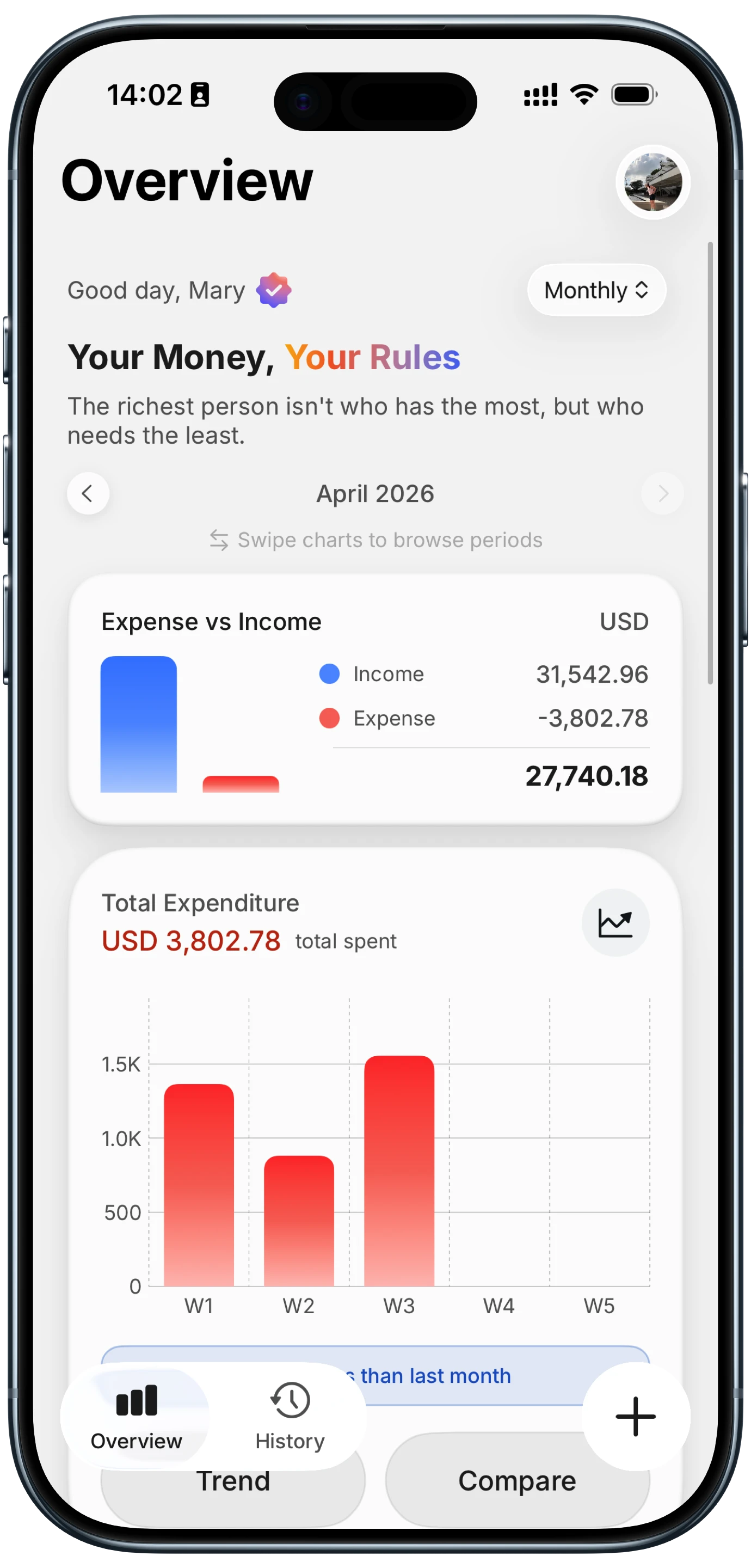
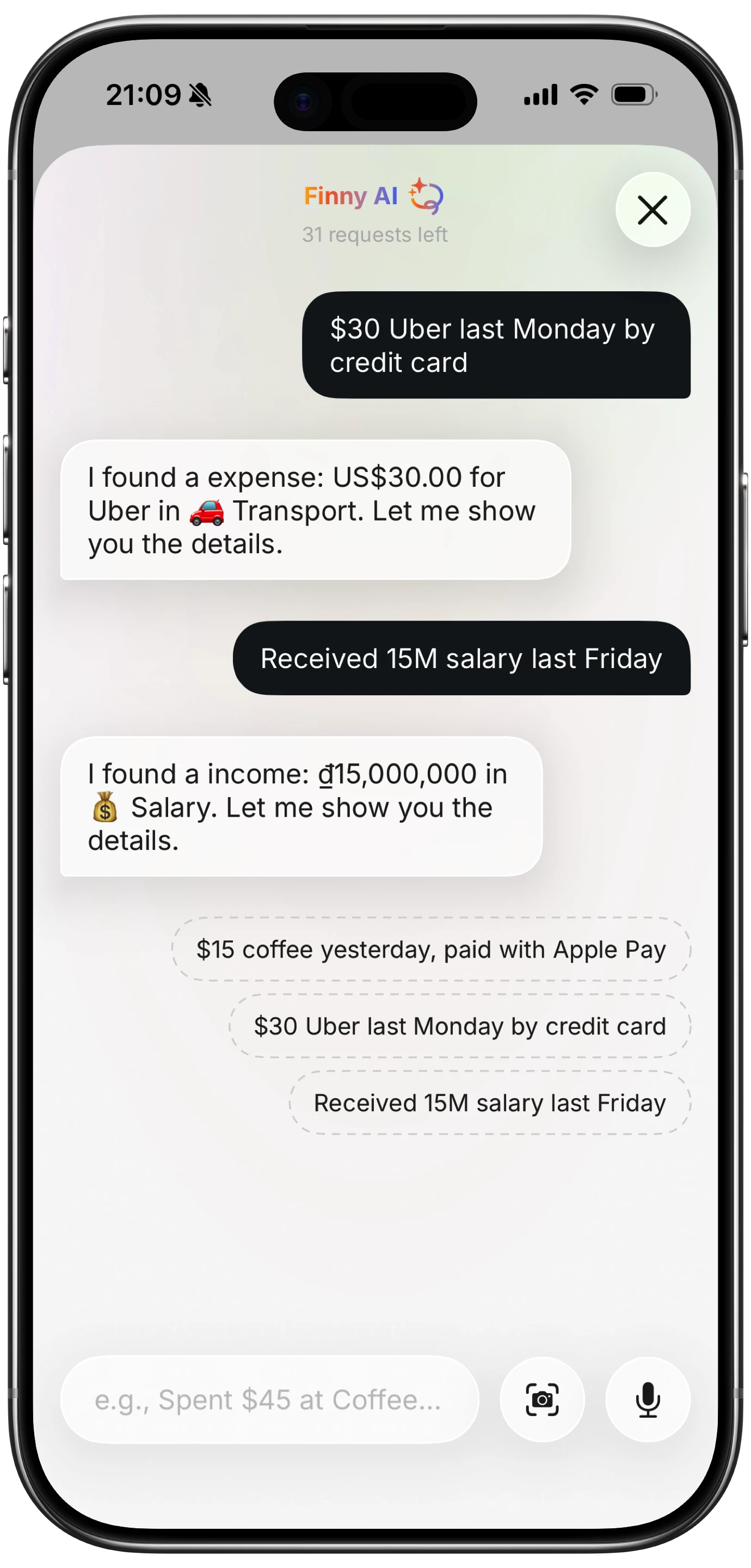
The core of the experience is Tap to Track, which captures Apple Pay transactions the moment they happen. You pay for something, and it appears in the app before you put your phone away. For the many purchases that are not Apple Pay, AI input handles the rest: type "groceries 87.50 at Costco," dictate it by voice, or scan a receipt photo. The app figures out the amount, category, and merchant.
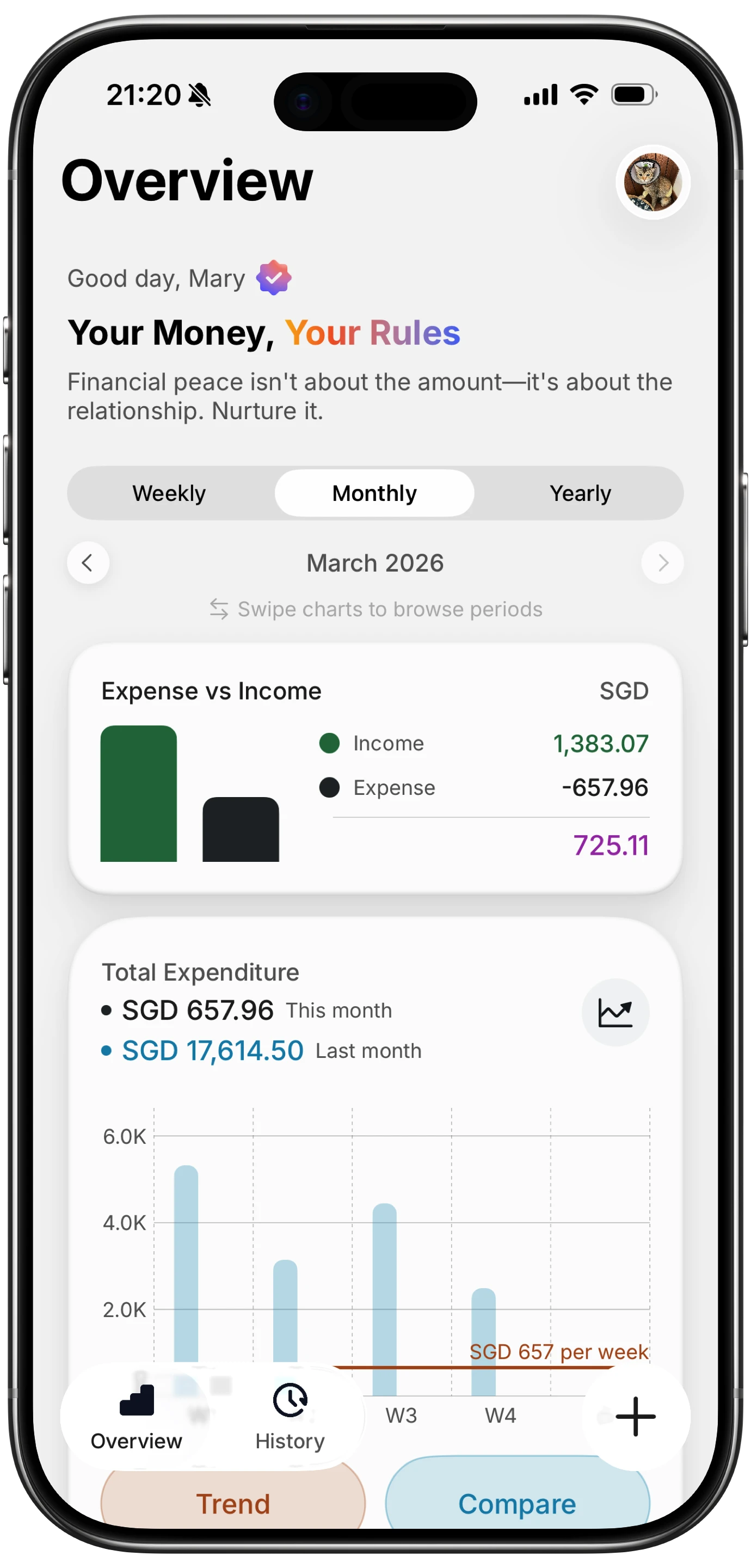
Shared wallets let family members track against the same budget. The app works fully offline, which matters for families on the go. And at a low monthly or yearly price, it costs a fraction of most alternatives.
The trade-off is platform availability. Finny is currently iPhone-only, so Android users in the family would need a different solution. It also does not connect to bank accounts, which means every expense needs to be logged, either through Tap to Track, AI input, or manual entry.
Best for: iPhone families who want fast, private expense tracking at a low price point.
How to Choose the Right App for Your Family
The best choice depends on how your household operates. Here are a few common situations and which apps tend to fit.
"We want full control over every dollar."
YNAB's zero-based approach gives you that. Every dollar is assigned a job, and both partners participate in the allocation. It takes effort upfront but builds strong financial habits over time. For a deeper look at this budgeting method, see our guide on how to budget money.
"We just need to stop overspending in certain categories."
Goodbudget's envelope system is built for exactly this. Set a grocery envelope at $600, a dining-out envelope at $200, and watch the balances drop as you spend. When an envelope hits zero, you know to stop or reallocate.
"We want shared visibility but we are price-sensitive."
Honeydue is free and covers the essentials for couples. Finny at a low monthly price is the most affordable paid option and works well for families who do not want bank connections.
"One person manages finances. I just need a quick view."
PocketGuard's "In My Pocket" number gives you that at a glance without requiring the whole family to engage with the app.
Tips for Getting Your Family on Board
Choosing an app is the easy part. Getting everyone to use it consistently is harder. A few practical suggestions.
Start with one category. Do not try to track everything on day one. Pick the category that causes the most friction, usually groceries or dining out, and track just that for two weeks. Once the habit sticks, expand.
Make it visible. Share a weekly summary at dinner or post the budget somewhere the family can see it. Visibility creates accountability without requiring constant app usage from every member.
Keep it judgment-free. The goal is awareness, not policing. If someone overspends, the conversation should be about adjusting the plan, not assigning blame. For households where partners earn very different amounts, our guide on how to split household bills fairly on different salaries covers the math and the conversation.
Review monthly. Set a recurring time, even just 15 minutes, to review the past month and adjust the next one. This is where the real value of a money tracker app shows up: in the patterns you spot over time.
Let the kids participate. For older children, involving them in budgeting teaches financial literacy. Seeing how the family allocates money builds skills they will carry into adulthood. For iPhone households with a teen on Apple Cash, our Apple Cash Family teen spending tracker guide covers parental controls and a weekly review workflow that builds money skills without surveillance. If you also share a place with non-family adults, our guide to how to track shared expenses with roommates covers the same dynamics in a different household structure.
Frequently Asked Questions
What is the best free family budget app?
Honeydue is the best completely free option for couples. It includes shared accounts, spending limits, and privacy controls with no paid tier. Goodbudget's free plan is another solid choice, offering envelope budgeting with shared access across devices, though it limits you to 10 envelopes and one year of history.
Do family budget apps require linking bank accounts?
Not all of them. Goodbudget (free tier) and Finny both work without bank connections. You log expenses manually or through AI input. YNAB, Honeydue, and PocketGuard rely on bank syncing for their core experience, though YNAB also supports manual entry.
Can kids use family budget apps?
Most apps are designed for adults. YNAB supports up to six users, so older teens could have their own login. Goodbudget shares across devices rather than individual accounts. For younger children, the best approach is usually involving them in budget review sessions rather than giving them app access.
How much should a family budget app cost?
That depends on the features you need. Free options like Honeydue and Goodbudget cover basics. Paid apps range from a low monthly price (Finny) to $14.99/month (YNAB). Consider whether the app's features justify the cost relative to your household budget. An app that costs $180/year should be delivering significant value.
Is it better to use one app for the whole family or separate apps?
One shared app is usually better for joint expenses and household budgets. It keeps everyone aligned and avoids duplication. However, individual family members may still want their own tool for personal spending. Many households use a combination: one shared app for the family budget and individual tools for personal expenses.
Final Thoughts
There is no single best family budget app. The right choice depends on your household size, how you share finances, your comfort with bank connections, and what you are willing to spend on a tool meant to help you save.
If structure matters most, YNAB delivers. If visual budgets appeal to you, Goodbudget is solid. If you want free shared visibility, Honeydue covers the essentials. And if speed, privacy, and affordability are your priorities, Finny keeps tracking from becoming another chore.
The most important thing is consistency. Pick an app, give it a real try for at least a month, and check in regularly. The app that works is the one your family actually uses.
Download Finny to start tracking family expenses in seconds, no bank connection needed.