Money conversations strain relationships. Different spending habits, unclear expense ownership, and competing financial priorities create friction that goes beyond dollars. In 2026, couples need tools that facilitate transparency without eliminating individual autonomy.
The best budgeting app for couples does more than track transactions. It provides shared visibility into household finances while respecting that partners may have different relationships with money and different needs for privacy.
This guide compares apps designed for shared finances, explains different approaches to couple budgeting, and helps you find a system that reduces money arguments instead of creating new ones. For individual tracking options, see our best money tracker apps in 2026 guide.
Why Couples Need Different Tools
Individual budgeting apps assume one person, one income, one set of priorities. Couples face additional complexity:
Shared and separate expenses: Some costs are clearly joint (rent, utilities). Others are personal. Many fall in gray areas.
Different spending styles: One partner may be naturally frugal while the other values experiences. Neither is wrong, but conflict arises without shared understanding.
Income disparities: Different incomes create questions about proportional contributions and spending authority.
Visibility vs. privacy: Full transparency works for some couples. Others need personal spending freedom without detailed scrutiny.
Multiple accounts: Joint accounts, individual accounts, credit cards in different names create tracking fragmentation.
The right app addresses these dynamics, not just transaction logging. If you have kids and want to manage the whole household, our guide to the best family budget apps compares options built for families of all sizes, and our roundup of the best app to manage family expenses covers multi-user setups with allowance and kid-tracking features.
Models for Couple Budgeting
Before choosing an app, understand the approach that fits your relationship.
Model 1: Fully Joint
All income goes to shared accounts. All expenses are visible to both partners. No individual "allowances" or private spending.
Works for: Couples with similar spending habits, complete financial trust, preference for simplicity over privacy.
Challenges: No personal spending freedom. Every purchase is visible and potentially questioned.
Model 2: Proportional Contribution
Partners contribute to shared expenses proportionally based on income. Individual income beyond contributions is personal.
Example: Combined expenses are $4,000/month. Partner A earns 60% of household income and contributes $2,400. Partner B contributes $1,600. Remaining income is individual.
Works for: Couples with income disparities, desire for fairness without full merger.
Challenges: Requires calculation and agreement on what counts as "shared."
Model 3: Equal Split with Personal Accounts
Shared expenses split 50/50 regardless of income. Each partner manages personal finances independently.
Works for: Couples with similar incomes, strong independence preferences, established separate financial habits.
Challenges: Can feel unfair with significant income differences.
Model 4: Hybrid with Allowances
Joint account for shared expenses. Personal "allowance" for individual spending. Remaining money goes to shared savings/goals.
Works for: Couples wanting transparency on shared finances with personal spending freedom.
Challenges: Requires agreement on allowance amounts and what qualifies as shared.
Features to Look For in Couple Budgeting Apps
Shared Wallets or Accounts
The ability to link multiple users to the same budget or wallet is essential. Look for:
- Simultaneous access for both partners
- Real-time sync so both see current data
- Ability to add expenses from either phone
- Shared budget views
Personal and Joint Tracking
Apps should support both shared and individual expenses:
- Separate categories for joint vs. personal spending
- Optional visibility controls (can you hide certain transactions?)
- Split transaction support (dinner that is 60% joint, 40% entertainment)
Multiple Account Aggregation
Most couples have multiple accounts:
- Individual checking accounts
- Joint checking account
- Credit cards in different names
- Savings accounts (joint and individual)
The app should aggregate these or allow manual tracking across all.
Goal Tracking
Shared financial goals matter:
- Emergency fund progress
- Vacation savings
- Down payment tracking
- Debt payoff visibility
Both partners should see progress toward shared goals.
Bill Splitting
For couples who split expenses:
- Ability to record who paid
- Running balance of who owes whom
- Support for percentage or dollar splits
Best Budgeting Apps for Couples Compared
Honeydue
Honeydue is built specifically for couples, with features designed around shared finances.
Key Features:
- Joint and individual account views
- Bill reminders and splitting
- In-app chat about transactions
- Customizable expense visibility
- Free to use
Strengths:
- Purpose-built for couples
- Choose which transactions partner sees
- Bill splitting with balance tracking
- Communication features reduce external arguments
Limitations:
- Less robust than full-featured finance apps
- Limited reporting and analytics
- Occasional sync issues reported
Best for: Couples who want an app specifically designed for shared finances with built-in communication.
Monarch Money
Monarch offers robust features with collaboration support for couples.
Key Features:
- Multi-user household support
- Comprehensive bank syncing
- Net worth tracking
- Goals and planning tools
- Cash flow forecasting
Strengths:
- Full-featured financial dashboard
- Reliable bank aggregation
- Good for couples who want comprehensive tracking
Limitations:
- $9.99/month or $99/year
- Less specialized for couples than Honeydue
- Both partners need to engage with the full interface
Best for: Couples who want comprehensive financial tracking beyond just shared expenses.
YNAB (You Need A Budget)
YNAB's methodology works well for couples willing to adopt proactive budgeting together.
Key Features:
- Zero-based budgeting methodology
- Shared access to budgets
- Goal tracking
- Educational resources for learning together
Strengths:
- Transforms financial behavior
- Powerful shared budgeting once adopted
- Strong methodology creates shared framework
Limitations:
- $14.99/month or $99/year
- Requires both partners to commit to methodology
- Learning curve can create friction
Best for: Couples willing to adopt a new budgeting philosophy together. See zero-based budgeting for methodology details.
Splitwise
Splitwise focuses on expense splitting rather than comprehensive budgeting.
Key Features:
- Expense splitting with running balances
- Group support (for roommates too)
- Receipt scanning
- Simplified tracking
Strengths:
- Excellent at tracking who owes whom
- Low friction for splitting
- Free tier sufficient for most needs
Limitations:
- Not a budgeting app; purely splitting
- No bank syncing
- No budget or goal features
Best for: Couples who keep mostly separate finances and just need to track shared expenses.
Finny
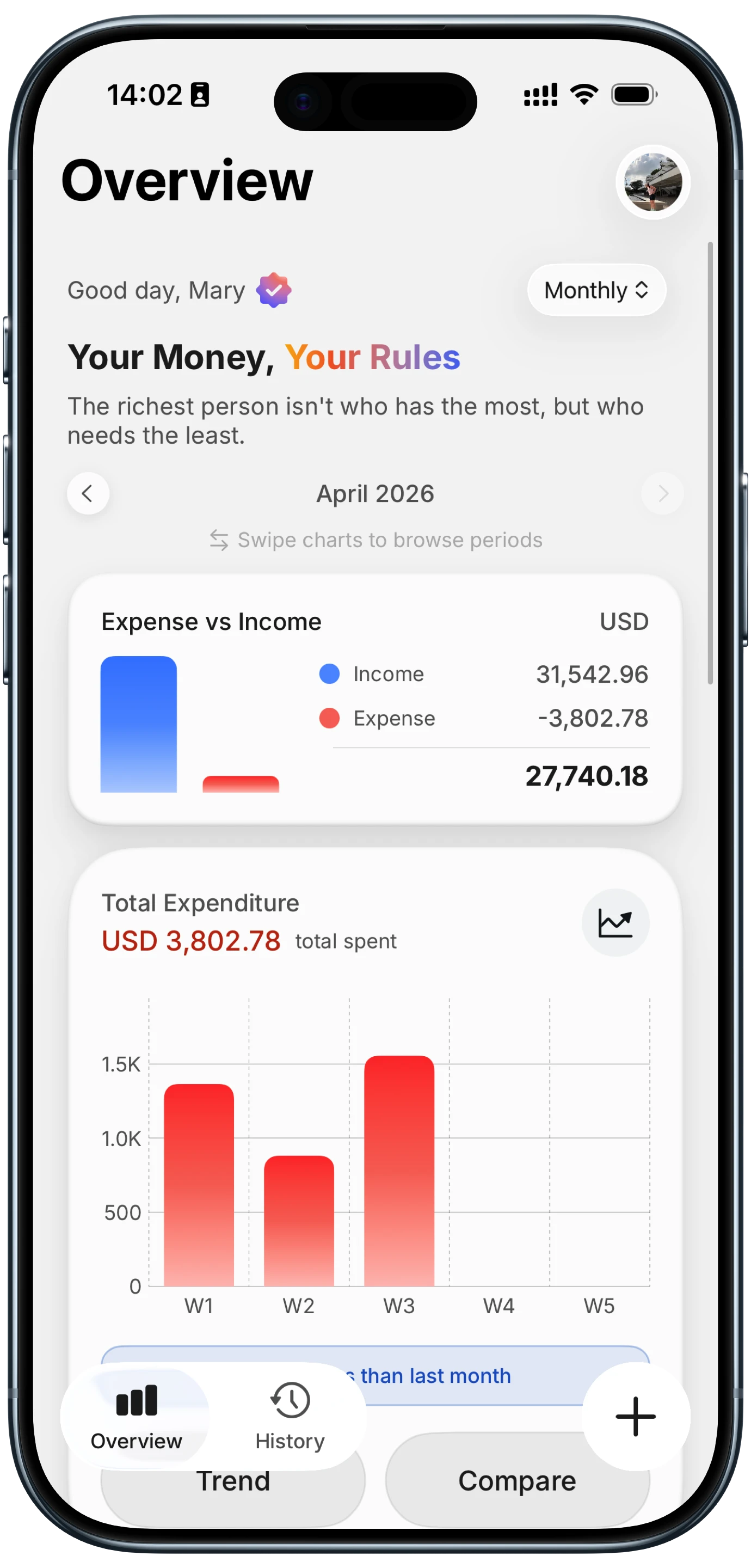
While not couple-specific, Finny's privacy-first approach works for couples who track individually but share results.
Key Features:
- AI-assisted expense logging
- Offline-first design
- Privacy-focused (no bank connections required)
- Multi-currency support
Strengths:
- Low friction logging reduces tracking resistance
- Privacy design means each partner controls their data
- Can export or share reports manually
Limitations:
- No built-in couple sharing features
- Requires manual communication of shared expenses
- iOS only
Best for: Couples who prefer individual tracking with periodic reconciliation rather than real-time shared access.
Feature Comparison Table
| Feature | Honeydue | Monarch | Goodbudget | Splitwise | Finny |
|---|---|---|---|---|---|
| Built for couples | Yes | Partial | Partial | Partial | No |
| Shared wallets | Yes | Yes | Yes | Yes | No |
| Privacy controls | Yes | Limited | Limited | N/A | Individual |
| Bill splitting | Yes | No | No | Yes | No |
| Bank syncing | Yes | Yes | No | Optional | No |
| Budget features | Basic | Advanced | Envelope-based | No | Manual |
| Price | Free | $99/yr | Free+ | Free+ | Free+ |
| In-app communication | Yes | No | No | Yes | No |
Setting Up Shared Finances: A Practical Guide
Step 1: Discuss Financial Styles
Before any app, have the conversation:
- How do you each feel about money visibility?
- What should be shared vs. personal?
- How should income differences affect contributions?
- What are shared financial goals?
The app implements decisions; it does not make them for you. If you are early in this process, our guide on what to do when you just combined finances with your partner lays out a first-month playbook.
Step 2: Agree on Categories
Create shared understanding of expense categories:
| Category | Joint or Personal | Notes |
|---|---|---|
| Rent/mortgage | Joint | Split proportionally |
| Utilities | Joint | Split equally |
| Groceries | Joint | Shared meals |
| Dining out together | Joint | Both present |
| Individual meals | Personal | Work lunches, solo |
| Entertainment together | Joint | Movies, trips |
| Personal hobbies | Personal | Individual interests |
| Clothing | Personal | Unless agreed otherwise |
| Gifts for each other | Personal | Obviously |
Step 3: Set Up the System
Based on your chosen model:
Fully Joint: One shared account, one app, full visibility Proportional: Track income, calculate percentages, set contributions Hybrid: Joint account plus personal allowances, track separately
Step 4: Establish Check-In Rhythm
Money requires ongoing conversation:
- Weekly: Quick review of spending, any surprises
- Monthly: Budget review, goal progress, adjustments
- Quarterly: Bigger picture financial review
The app provides data. You provide the discussion. For more detailed strategies on shared finances, see our guide on how to track spending as a couple. You can also browse our comparison of the best budgeting apps for couples in 2026 for additional options.
Step 5: Handle Disagreements Constructively
Apps surface spending that might otherwise go unnoticed. Establish ground rules:
- No surprise criticism over small purchases
- Agreed thresholds for consulting partner before buying
- Focus on patterns, not individual transactions
- Budget, not judge
Tracking Joint Net Worth
Beyond monthly expenses, couples benefit from tracking combined net worth. This includes:
Assets:
- Bank account balances (joint and individual)
- Investment accounts
- Retirement accounts (both partners)
- Home equity
- Vehicle values
Liabilities:
- Mortgage balance
- Student loans (both partners)
- Credit card debt
- Auto loans
Net worth tracking shows whether you are building wealth together, not just managing cash flow. Monarch and Copilot Money offer net worth features. For net worth concepts, see what is net worth.
Privacy in Shared Finances
Complete transparency is not the only valid approach. Healthy couples can have:
- Personal allowance privacy: Agreed discretionary spending without itemization
- Gift hiding: Obviously, surprise gifts should not appear in shared views
- Historical privacy: Past finances before the relationship may stay individual
- Partial visibility: See totals but not transaction details
Honeydue specifically supports choosing which transactions to share. Other apps require workarounds or separate accounts.
The Bottom Line
The best budgeting app for couples depends on your financial model, privacy preferences, and how much tracking structure you want.
For couples who want a purpose-built solution with communication features and privacy controls, Honeydue offers the most relevant features at no cost.
For couples who want comprehensive financial management with shared access, Monarch Money provides a robust platform.
For couples willing to commit to a methodology together, YNAB transforms how you both relate to money.
For couples who primarily need expense splitting, Splitwise handles the math simply.
The technology matters less than the conversations it enables. Any app that surfaces financial data reduces the friction of money discussions. The goal is not perfect tracking but reduced conflict and aligned financial direction.
Choose a tool, set it up together, and commit to using the data for conversations, not accusations.
Common Questions About Budgeting Apps for Couples
What is the best free budgeting app for couples?
Honeydue offers the most couple-specific features for free, including shared wallets, bill splitting, and privacy controls. Splitwise is also free for expense splitting.
Should couples have joint or separate accounts?
There is no universal right answer. Many financial advisors suggest hybrid approaches: joint account for shared expenses, individual accounts for personal spending. The right balance depends on your relationship dynamics and preferences.
How do you track expenses when incomes are very different?
Consider proportional contribution: each partner contributes the same percentage of their income to shared expenses. Apps like Honeydue can track these contributions and maintain running balances.
What if one partner does not want to track expenses?
Focus on shared expenses only rather than complete financial tracking. Use a simple splitting app like Splitwise that requires minimal engagement. Alternatively, one partner can manage shared tracking while the other simply provides data when needed.
How often should couples review finances together?
Weekly quick check-ins and monthly deeper reviews work for most couples. The frequency matters less than consistency. Regular small conversations prevent the buildup that leads to larger conflicts.
Ready to track your expenses with less friction?
Download Finny to log expenses using AI, receipts, or text. Whether tracking individually or sharing results with a partner, low-friction logging keeps financial data current.