Monarch Money vs Rocket Money 2026: Which to Pick?
If you are weighing Monarch Money vs Rocket Money, you are probably comparing two apps that do not actually do the same job. One is a full budgeting and net-worth platform built to run your whole financial life. The other is a subscription-cancellation and bill-negotiation tool with budgeting bolted on. Picking the wrong one means paying for features you will never open, or worse, expecting a feature that simply is not there.
This guide breaks down the real difference between the two: what each app is built for, what they actually cost once you account for hidden fees, how deep their budgeting and syncing go, and how each handles shared household finances. By the end you will know which solves your problem, plus a cheaper, no-bank-link option if neither fits.
Monarch Money vs Rocket Money at a Glance
Before the details, here is the short version. Monarch Money is a comprehensive money manager. Rocket Money (formerly Truebill) is a subscription watchdog that also negotiates bills. They overlap on the word "budgeting," and almost nowhere else.
| Feature | Monarch Money | Rocket Money |
|---|---|---|
| Core purpose | Full budgeting + net worth | Cancel subscriptions, negotiate bills |
| Price | Core $99.99/yr or $14.99/mo; Plus $199/yr | Free, or Premium "pay-what's-fair" $7–$14/mo |
| Free tier | No (7-day trial) | Yes |
| Bill negotiation cut | None | 35–60% of first-year savings |
| Platforms | iOS, Android, web | iOS, Android, web |
| Institutions | 11,000+ (Plaid, MX, Finicity) | Bank link required |
| Budgeting depth | Deep (categories, goals, investments) | Light (spending snapshot) |
| Couples / household | Built-in, separate logins | Limited |
| Investments / net worth | Yes, native | Basic balance view |
If you want a one-line answer: choose Monarch to plan and track everything, choose Rocket Money to hunt down recurring charges and shave a few bills. Most people lean toward one of those goals strongly, which usually decides the question before you compare another feature.
For a wider field of options, our roundups of apps like Monarch Money and apps like Rocket Money cover the closest alternatives to each.
What Each App Is Actually For
The biggest mistake in any monarch vs rocket money comparison is treating them as interchangeable. They were built to answer different questions.
Monarch Money: the whole-picture platform
Monarch is designed to be the single place you see your entire financial life. It connects to over 11,000 institutions through Plaid, MX, and Finicity, then pulls checking, savings, credit cards, loans, and investment accounts into one dashboard. From there you get category-based budgeting, savings goals with projected timelines, recurring-bill detection, and a live net-worth chart that updates as balances move.
In 2026 Monarch added an AI assistant that answers plain-language questions about your spending, plus receipt scanning and bill splitting. It is the kind of app you set up once and use for years to make real decisions: Can we afford this? Are we saving enough? Where did the money go this month?
Rocket Money: the subscription and bill cutter
Rocket Money starts from a narrower, sharper promise. Connect a bank account, and it scans your transactions for recurring charges: streaming services, gym memberships, that free trial you forgot to cancel. It surfaces them in one list and, on Premium, will cancel unwanted subscriptions on your behalf so you do not have to navigate retention flows yourself.
Its second headline feature is bill negotiation. You upload a bill, Rocket Money's team tries to lower it, and you keep the savings, minus their cut. Rocket Money does include a budgeting view, spending categories, and a balance overview, but these are lighter than Monarch's and clearly secondary to the cancel-and-negotiate core.
Pricing and the True Cost of Each
Price is where a clean comparison gets messy, because the two apps charge in completely different ways. Knowing the sticker price is not enough.
Monarch's flat subscription
Monarch is straightforward. Monarch Core is $99.99 per year (about $8.33 per month) or $14.99 billed monthly. Monarch Plus, aimed at power users tracking investments or business finances, runs $199 per year, annual only. There is no free tier, but every plan starts with a 7-day free trial, and promo codes for 30–50% off the first year circulate often. Whatever you pay, that is the full cost. Nothing is skimmed off your savings later.
Rocket Money's two hidden layers
Rocket Money looks cheaper because it has a free tier, but the true cost has two moving parts.
First, Premium uses a "pay-what's-fair" slider that most users land between $7 and $14 per month. Several useful features, including the cancellation service and faster syncing, sit behind that paywall, so the free tier alone is fairly limited.
Second, and more importantly, bill negotiation takes 35–60% of your first-year savings as a success fee. Negotiate $300 off your internet bill and you could owe Rocket Money $105 to $180 of that. The math can still come out ahead, but it means the app's real cost scales with how much it saves you, not a predictable flat rate.
| Cost factor | Monarch Money | Rocket Money |
|---|---|---|
| Headline price | $99.99/yr (Core) | Free / $7–$14/mo (Premium) |
| Billing model | Flat subscription | Tiered + success fees |
| Negotiation fee | None | 35–60% of first-year savings |
| Predictable yearly cost | Yes | No (varies with savings) |
So the "cheaper" app is only cheaper if you stick to the free tier and never negotiate a bill. Use Rocket Money the way it is designed to be used, and the gap narrows fast. For the deeper breakdown on Monarch's tiers and whether they earn the price, see our Monarch Money review for 2026.
Account Syncing and Feature Depth
Both apps require a bank connection to do their main job, but they ask very different amounts of that connection.
Monarch routes through multiple aggregators (Plaid, MX, Finicity) and supports more than 11,000 institutions, with the large majority syncing daily without intervention. That breadth matters because Monarch is trying to mirror your entire net worth, including investment and loan accounts that narrower apps ignore. Smaller credit unions can occasionally need a reconnect, but the multi-aggregator setup tends to hold up across a diverse mix of accounts.
Rocket Money also links your bank, but it only needs enough access to spot recurring charges and show balances. Its categorization and budgeting layer works, and it is fine for a quick "where is my money going" glance, but it is not built for serious category targets, goal tracking, or investment monitoring. There is no real net-worth modeling the way Monarch does it.
In practice, depth is the dividing line. Monarch rewards the person who wants to slice spending by category, set goals, and watch a long-term net-worth trend. Rocket Money rewards the person who just wants a tidy list of subscriptions and a nudge when a bill creeps up. Neither is doing the other's job poorly; they are doing different jobs.
One thing both share: each wants ongoing access to your transaction history through an aggregator. If that is the part that makes you hesitate, it is worth knowing you can track expenses without linking a bank at all and still keep a clear picture of your spending.
Couples and Household Finances
Shared money is where these two apps separate most clearly, because only one of them was actually designed for it.
Monarch treats households as a first-class feature. Both partners get their own secure login, see the same accounts, budgets, and goals in real time, and can add or recategorize transactions independently, with no extra charge for additional members. Combined with investment tracking and the shared net-worth view, it is genuinely built for two people running one financial plan together. For couples who want full transparency without emailing spreadsheets back and forth, this is one of Monarch's strongest reasons to exist.
Rocket Money is far more single-user oriented. It is designed around one person's accounts, one subscription list, one set of bills to negotiate. There is no robust couples model with separate logins and shared budgets the way Monarch offers. A household could still each run their own Rocket Money to police their own subscriptions, but coordinating a joint budget inside it is not what the app is for.
If shared visibility is a priority, this category alone often settles the monarch money or rocket money question in Monarch's favor. If you are budgeting solo and mainly want to stop paying for forgotten services, Rocket Money's single-user focus is not a drawback at all.
Verdict: Monarch Money or Rocket Money?
The honest answer to Monarch Money vs Rocket Money is that most people do not have to choose between equals, they have to identify their actual goal.
Choose Monarch Money if you want to:
- Run a complete budget with categories, goals, and timelines
- See net worth and investments in one place
- Share finances with a partner using separate logins
- Set up one app and use it as your financial home base for years
Choose Rocket Money if you mainly want to:
- Find and cancel forgotten subscriptions
- Have someone negotiate your bills down (and accept the fee)
- Get a light budgeting view without doing much setup
- Start free before deciding whether to pay
Some people even run both: Monarch as the budgeting brain, Rocket Money as the occasional bill-trimming tool. That works, but it is two subscriptions and two bank connections.
A cheaper, no-bank-link option
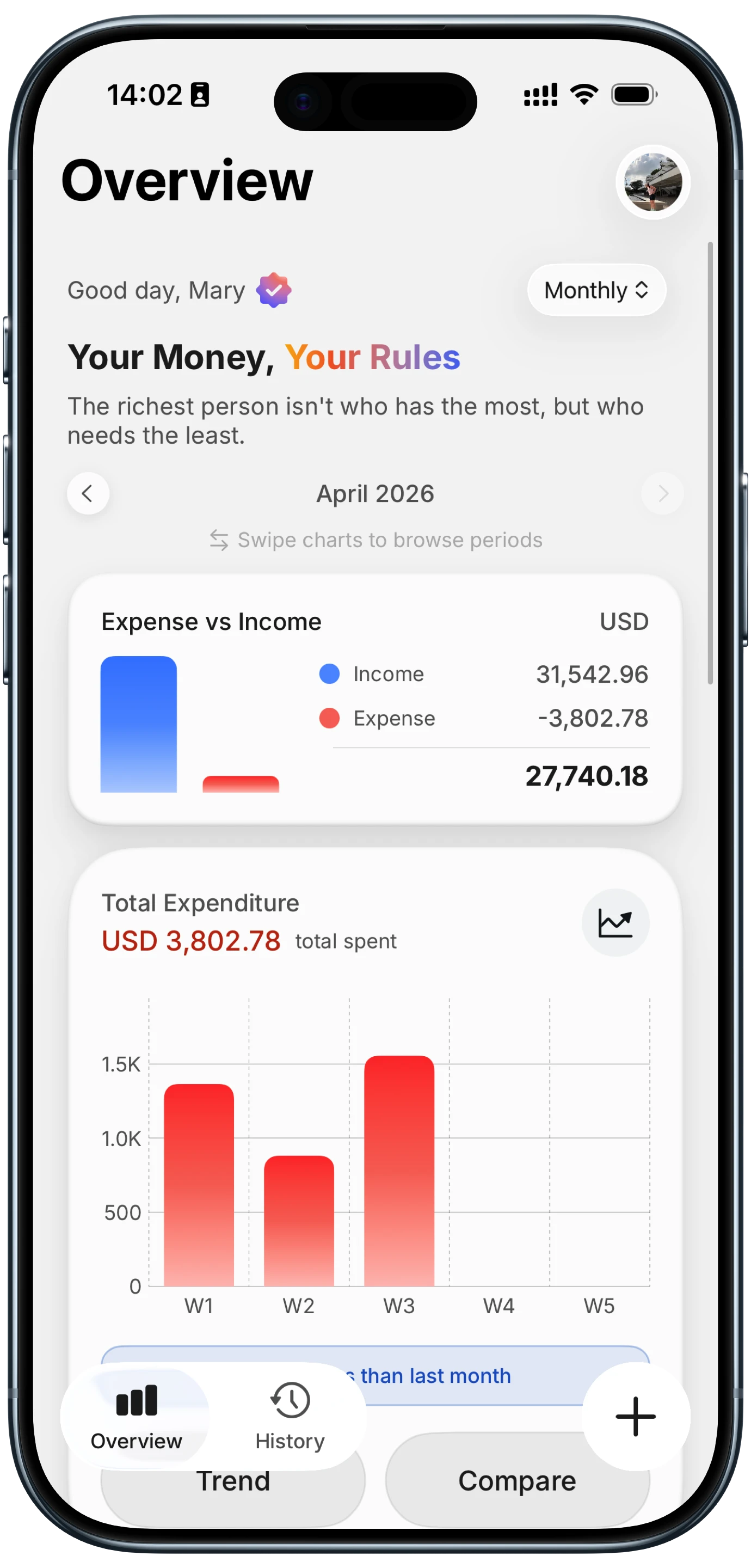
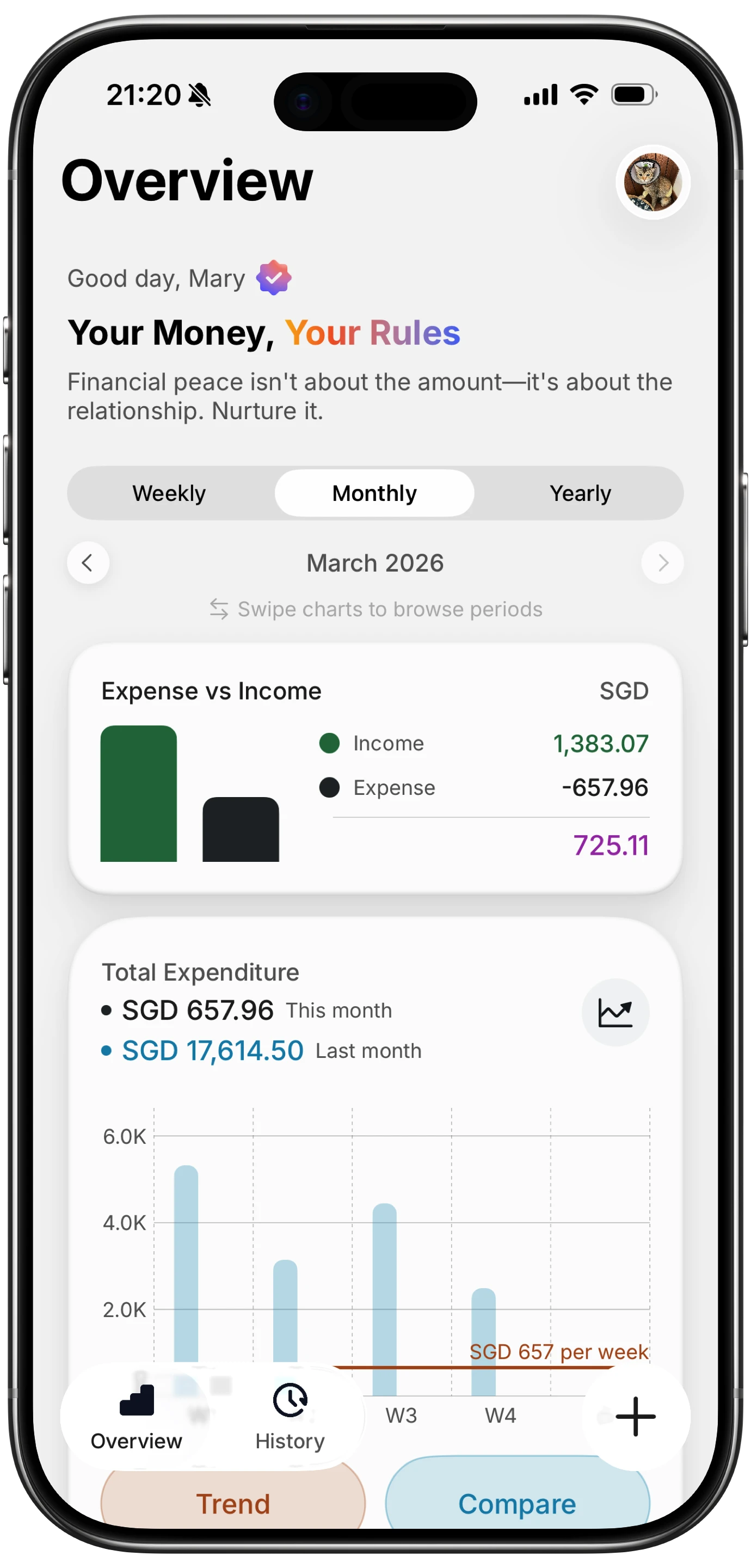
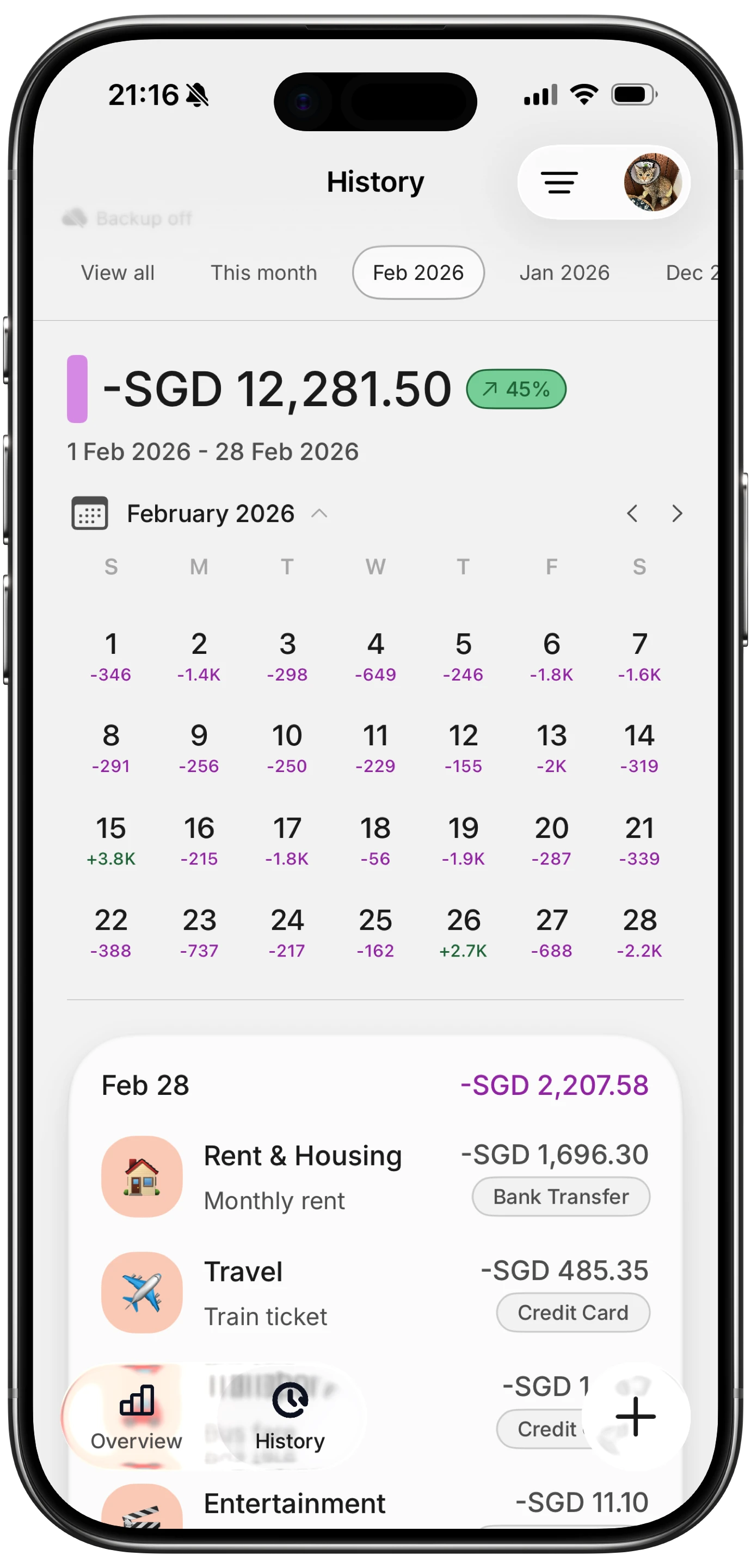
If Monarch's $99.99 a year feels steep and you would rather not hand Rocket Money standing access to your bank, there is a middle path. Finny is a private, AI-assisted tracker that never links a bank account. You log spending with Tap to Track (Apple Pay auto-logging through iOS Shortcuts), AI text or voice input, or a quick receipt snap, and review it with charts, multi-currency totals, and Home Screen widgets. Finny Pro is a low yearly price, a fraction of Monarch, with no negotiation cut and no aggregator holding your transaction history. It will not cancel a subscription for you, but for fast, private, hands-on tracking, it covers the part most budgeting apps overcharge for.
Frequently Asked Questions
Is Monarch Money better than Rocket Money?
It depends on the job. Monarch is better if you want comprehensive budgeting, net-worth tracking, investment monitoring, and couples sharing in one place. Rocket Money is better if your main goal is finding and canceling subscriptions or negotiating bills down. They are not really competitors so much as tools for different problems. If you want one app to manage your whole financial life, Monarch wins; if you want a focused subscription cutter, Rocket Money wins.
Does Rocket Money help you budget?
Yes, but lightly. Rocket Money includes spending categories, a balance overview, and basic budgeting alongside its core subscription and bill features. It is enough for a quick read on where your money goes, but it is shallower than a dedicated budgeting app. There are no deep category targets, goal timelines, or investment tracking. If budgeting is your primary need rather than canceling subscriptions, a fuller platform like Monarch will serve you better.
Is Monarch worth $99 a year?
For the right user, yes. The $99.99 Core plan earns its price if you use the full toolkit: category budgeting, savings goals, net-worth and investment tracking, the 2026 AI assistant, and couples sharing with separate logins. If you only need basic expense tracking or subscription cleanup, it is overkill, and a cheaper or free app makes more sense. Promo codes for 30–50% off the first year also soften the cost if you watch for them.
Can Rocket Money replace Monarch?
Not for most people. Rocket Money lacks the deep budgeting, goal tracking, native investment and net-worth views, and the robust couples model that Monarch is built around. It can replace Monarch only if your needs are narrow, mainly canceling subscriptions and a light spending glance. If you rely on Monarch for full household budgeting and net worth, Rocket Money will feel like a downgrade. They are better thought of as complements than substitutes.
The Bottom Line
The Monarch Money vs Rocket Money decision comes down to one question: do you need a full financial command center, or a focused tool to trim recurring costs? Monarch is the deeper, pricier platform for budgeting, net worth, and couples. Rocket Money is the lighter, free-to-start app for killing subscriptions and negotiating bills, as long as you accept that the negotiation fee makes its true cost variable.
If neither fits, the third path is to skip bank linking entirely and track spending yourself. Want fast, private expense tracking without a bank login or a negotiation cut? Try Finny and log your first expense in seconds, then decide whether you still need anything heavier.