If you already know which of your debts is "bad" (high-interest, depreciating, the kind that drags you down), you do not need another article explaining the categories. You need a plan to get rid of it.
This guide is the practical companion to our broader good debt vs bad debt explainer. It walks through how to pay off bad debt fast in 2026 with a concrete six-step plan, the math behind picking a payoff method, and the spending habits that prevent the same balance from creeping back next year.
Why "Fast" Matters
The fastest reasonable payoff is almost always the cheapest. Compounding works against you with debt the same way it works for you with investments. A $5,000 credit card balance at 22% APR costs $1,100 in interest in year one if you only make minimums. The same $5,000 paid off in 8 months costs maybe $300 in interest.
Speed is not just about cost. It is also about willpower. Six-month payoffs feel achievable. Three-year payoffs feel like background noise that gradually fades into "this is just my life now." The faster the timeline, the more likely you finish.
Step 1: Make the Real List
Open every account, every card, every loan. Write down four things for each:
| Account | Balance | APR | Minimum Payment |
|---|---|---|---|
| Card A | $2,400 | 24.9% | $60 |
| Card B | $850 | 19.9% | $25 |
| Personal loan | $3,200 | 12.5% | $95 |
| BNPL plans | $640 | 0% (until July) | $80 |
| Total | $7,090 | $260 |
Most people who feel "drowning in debt" have never seen this list on one page. The number is usually smaller than the dread suggests, and the structure is usually simpler. The total APR-weighted picture tells you where the bleeding is happening.
If you cannot remember an account, log into the issuer's website. Pull old statements. Include any debt going to collections, even if you have been ignoring it.
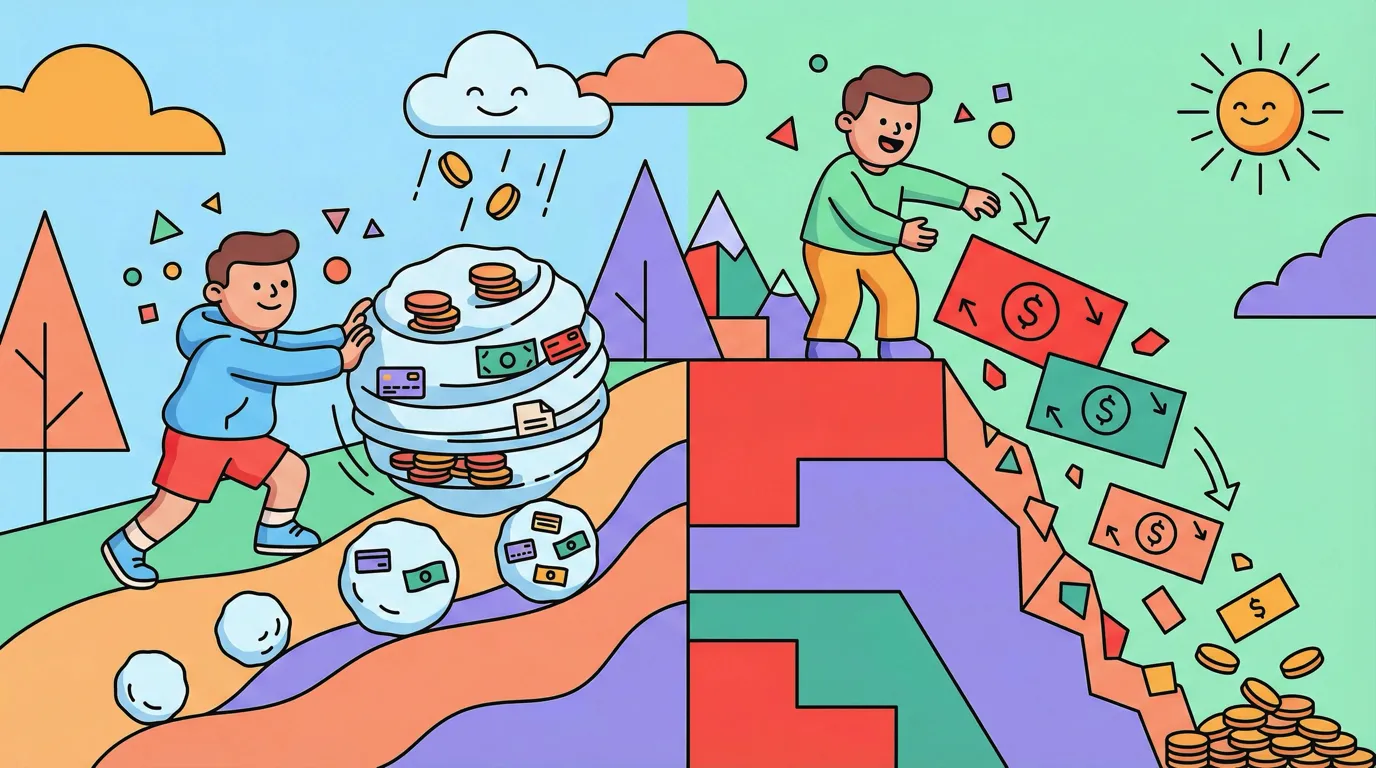
Step 2: Pick a Payoff Method (Avalanche vs Snowball)
There are two payoff methods. Both work. The right one depends on what keeps you motivated.
Debt Avalanche (Highest Interest First)
Order debts by APR, highest to lowest. Pay minimums on everything. Throw every extra dollar at the top of the list. When that debt is gone, roll its payment into the next highest APR.
Mathematically optimal. Saves the most money. Slowest psychological wins because the biggest balance often has the highest rate.
Debt Snowball (Smallest Balance First)
Order debts by balance, smallest to largest. Pay minimums on everything. Throw every extra dollar at the smallest balance. When it is gone, roll its payment into the next smallest.
Mathematically slightly more expensive. Provides quick wins because small balances disappear in weeks. Behavioral research suggests snowball completers stay on track longer because they see momentum.
For the deeper comparison and a worked example, see debt snowball vs avalanche. Our recommendation: pick avalanche if the math motivates you, snowball if the wins motivate you. The best method is the one you will actually finish.
Step 3: Find Money in Your Current Spending
You cannot pay off debt faster without freeing up cash. The two ways to do that are spending less and earning more. Spending less is faster to start.
To find money to redirect, you need to see where it is currently going. Track every expense for at least 30 days. You will probably find at least one of these:
- A subscription you forgot ($15 to $40 per month, instantly)
- Dining out you underestimated ($150 to $400 per month for many households)
- Convenience purchases (rideshare, fast food, last-minute groceries)
- Brand premiums that are not earning their keep (premium streaming tiers, premium cell plans)
A typical first month of careful tracking surfaces $100 to $300 in monthly redirect potential. Apply that directly to your highest-priority debt (avalanche) or smallest balance (snowball).
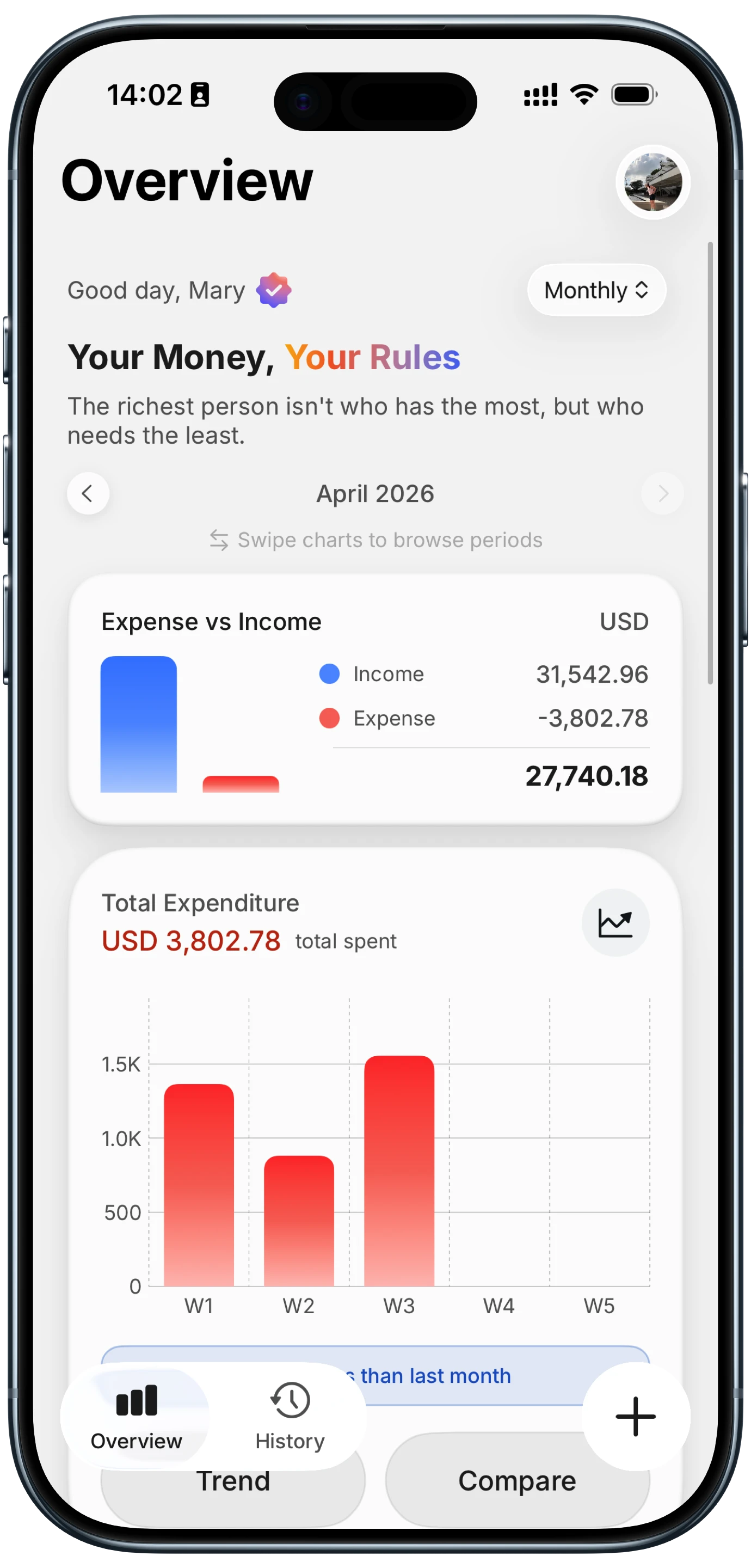
For the categorization workflow, see how to track expenses and how to stop overspending. Finny makes the daily logging painless: type "12 lunch," snap a receipt, or log Apple Pay automatically. Pro costs a low monthly price with no bank login required, which is a useful guardrail when you are trying not to swipe a card you are simultaneously trying to pay off.
Step 4: Earn the Math Back Where You Can
If you have credit cards or store cards above 20% APR, two specific moves can take 6 to 12 months of interest off your payoff:
Balance Transfer to a 0% Intro Card
Most major issuers offer 12 to 21 month 0% intro APR cards with a 3% to 5% transfer fee. The math: pay 3% to 5% once instead of 22% APR for the same period. Worth it for any balance you can pay off within the intro window.
The trap: if you do not pay off within the intro period, the deferred-interest math on some cards charges back the full intro-period interest at the regular rate. Read the terms before transferring.
Personal Consolidation Loan
A personal loan at 8% to 12% replaces credit card debt at 20% to 25%. The savings on a $10,000 balance can reach $1,500 to $2,000 over a 24-month payoff. Credit unions often have the best rates for borrowers with reasonable credit.
The trap: if you consolidate and then run the cards back up, you have doubled your debt. Treat consolidation as the last loan you take, not a refresh.
Step 5: Automate the Payoff
Once you have a method (Step 2) and a redirect amount (Step 3), automate it.
- Set the minimum payment on every account on autopay.
- Set a separate automatic extra payment to the priority debt for the redirect amount.
- Schedule the automatic extra to hit a few days after you get paid, before the money has time to disappear into other categories.
Manual extra payments rely on willpower every month. Automation removes the decision. The fastest debt payoffs are usually the most automated ones.
Step 6: Stay Out of New Debt While You Pay
The single biggest threat to your payoff is adding new debt while you work down the old. Three guardrails:
- Use a debit card or cash for daily spending. Cards are fine for known recurring bills only. Daily-spending swipes are where the cycle restarts.
- Maintain a starter emergency fund. A small buffer ($500 to $1,000) prevents the next surprise from hitting a credit card. For more, see how to build an emergency fund fast.
- Pause big optional spending. Vacations, electronics, lifestyle upgrades. The 12 to 18 months of payoff is a temporary discipline, not a forever lifestyle.
A Sample 6-Month Payoff
A worked example with the list from Step 1 ($7,090 across four accounts):
- Total minimums: $260
- Found redirect: $400/month from tracked spending (canceled subscriptions, fewer rideshares, eating in twice more per week)
- Total monthly to debt: $660
- Method: avalanche (start with Card A at 24.9%)
Month-by-month:
- Month 1: Pay $60 minimums on B, $95 on personal loan, $80 BNPL, $425 to Card A. Card A balance after month 1: ~$2,025.
- Month 3: Card A nearly cleared. BNPL paid off. Now redirect that $80 to Card A.
- Month 5: Card A is gone. Roll its $425 + $80 (BNPL) onto Card B and personal loan.
- Month 8: Card B gone.
- Month 12 to 14: Personal loan gone. Total debt-free.
Numbers will differ for your situation but the pattern holds: a $400 monthly redirect retires roughly $7,000 in unsecured debt within 14 months at typical rates.
Common Questions
What is the fastest way to pay off bad debt?
The fastest method is the avalanche: pay minimums on everything, then throw every extra dollar at the highest-APR debt. This minimizes total interest paid. If you struggle with motivation, the snowball method (smallest balance first) is slightly slower but tends to keep people committed because of the early wins. Both methods finish faster than minimum-only payments by years.
Should I save an emergency fund or pay off debt first?
Build a starter emergency fund of $500 to $1,000 first, then attack high-interest debt aggressively, then build the full 3 to 6 month emergency fund. Without any buffer, the next surprise expense will hit a credit card and undo your payoff. With $1,000 in cash, most everyday emergencies stay off the cards. After the high-interest debt is gone, redirect the payoff money to growing the emergency fund.
Is it better to pay off small debts first or high-interest debts first?
Mathematically, highest interest first (avalanche) saves the most money. Behaviorally, smallest balance first (snowball) is more motivating because you eliminate accounts faster. The math difference is usually a few hundred dollars; the behavioral difference is usually whether you finish at all. Pick based on what keeps you committed.
Can I pay off bad debt without a budget?
You can pay it off without a strict line-item budget, but you cannot pay it off without seeing where your money goes. At minimum, track expenses for 30 days to find redirect opportunities. The tracking is what creates the redirect, even if you skip a formal budget structure.
How long does it take to pay off credit card debt?
It depends on your balance, your rate, and how much you redirect. A $5,000 balance at 22% APR with $400 monthly payments clears in about 14 months. The same balance with minimum-only payments takes over 16 years and costs roughly $7,000 in interest. The redirect amount is the variable that matters most.
The Bottom Line
Paying off bad debt fast is a six-step process: list every balance, pick a method, find redirect money in your current spending, earn the math back through balance transfers or consolidation if it makes sense, automate the payoff, and stay out of new debt while you work the old.
The hardest step is Step 3, finding the money. That is where tracking your expenses turns a vague intention into a concrete monthly number you can apply to the balance. For the broader framework on which debts qualify as "bad" in the first place, see our good debt vs bad debt guide. For the snowball-vs-avalanche math in detail, see debt snowball vs avalanche.
This article is general information, not personalized financial advice. For complex situations involving collections, bankruptcy, or large balances, consult a non-profit credit counselor or qualified financial advisor.