Saving Money Challenge: 8 Proven Plans for 2026
Most people know they should save more. The problem is not awareness. It is follow-through. Setting a vague goal like "save more this year" rarely leads anywhere, because there is no structure behind it.
A saving money challenge solves this by giving you a specific plan with clear rules, defined amounts, and a timeline. Instead of relying on willpower alone, you follow a system. The amounts start small enough that the habit forms before the difficulty increases.
This guide covers the most popular saving challenges, compares what each one offers, and helps you pick the right fit. If you are new to managing your finances, our expense tracking guide is a good place to start.
Why Saving Challenges Work Better Than Vague Goals
Setting a savings target without a plan is like deciding to get fit without choosing a workout. You need specific actions tied to specific days.
Saving challenges work because they use three behavioral principles:
- Small starting amounts. Most challenges begin with $1 to $5, which removes the friction of getting started.
- Gradual increases. As the habit strengthens, the amounts grow. By the time the deposits feel significant, the routine is already established.
- Clear progress tracking. Checking off weeks or days creates a visible streak that motivates you to continue.
Research on habit formation suggests that consistency matters more than intensity. A challenge that asks you to save $1 in week one is easier to commit to than one that asks for $200 on day one. That ease of entry is the entire point.
The 8 Best Saving Money Challenges
1. The 52-Week Money Challenge
This is the most well-known saving challenge. You save $1 in week one, $2 in week two, $3 in week three, and so on until you save $52 in week 52.
Total saved: $1,378
The beauty of this challenge is its gradual ramp. The first month costs you only $10 total. By the final month, weekly deposits range from $49 to $52, but by then the habit is deeply established.
Variation: Reverse 52-week challenge. Start at $52 in week one and decrease by $1 each week. This front-loads the harder deposits when motivation is highest and makes the final months feel effortless.
2. The 26-Week Savings Challenge
A shorter, faster alternative. Save $3 in week one, $6 in week two, $9 in week three, adding $3 each week. By week 26, your final deposit is $78.
Total saved: $1,053 in six months
This challenge suits people who want results in half a year rather than a full year. It is also a good reset if you start mid-year and want a goal before December.
3. The 100-Envelope Challenge
Number 100 envelopes from 1 to 100. Each day, pick an envelope at random and deposit the dollar amount written on it. After 100 days, you are done.
Total saved: $5,050
This challenge requires more cash on hand and a higher daily commitment (the average deposit is about $50). It works best for people with stable income and an appetite for a faster, more intensive savings sprint.
4. The No-Spend Challenge
Choose a period (a weekend, a week, or an entire month) and commit to spending only on essentials: rent, bills, groceries, and transportation. Everything else stops.
Total saved: Varies widely
The no-spend challenge is less about a fixed dollar amount and more about resetting spending habits. It forces you to confront how much discretionary money leaves your account without thought. For a deeper look at this approach, see our guide on what is a no spend day.
5. The $5 Bill Challenge
Every time a $5 bill lands in your wallet, set it aside. Do not spend it.
Total saved: $260 to $520+ per year (depending on how often you use cash)
This challenge is passive and requires almost no planning. Its weakness is that it only works if you regularly handle cash, which is increasingly uncommon.
6. The Round-Up Challenge
Every time you make a purchase, round the amount up to the nearest dollar and save the difference. A $3.40 coffee becomes a $0.60 contribution to savings.
Total saved: $300 to $700+ per year (depending on purchase frequency)
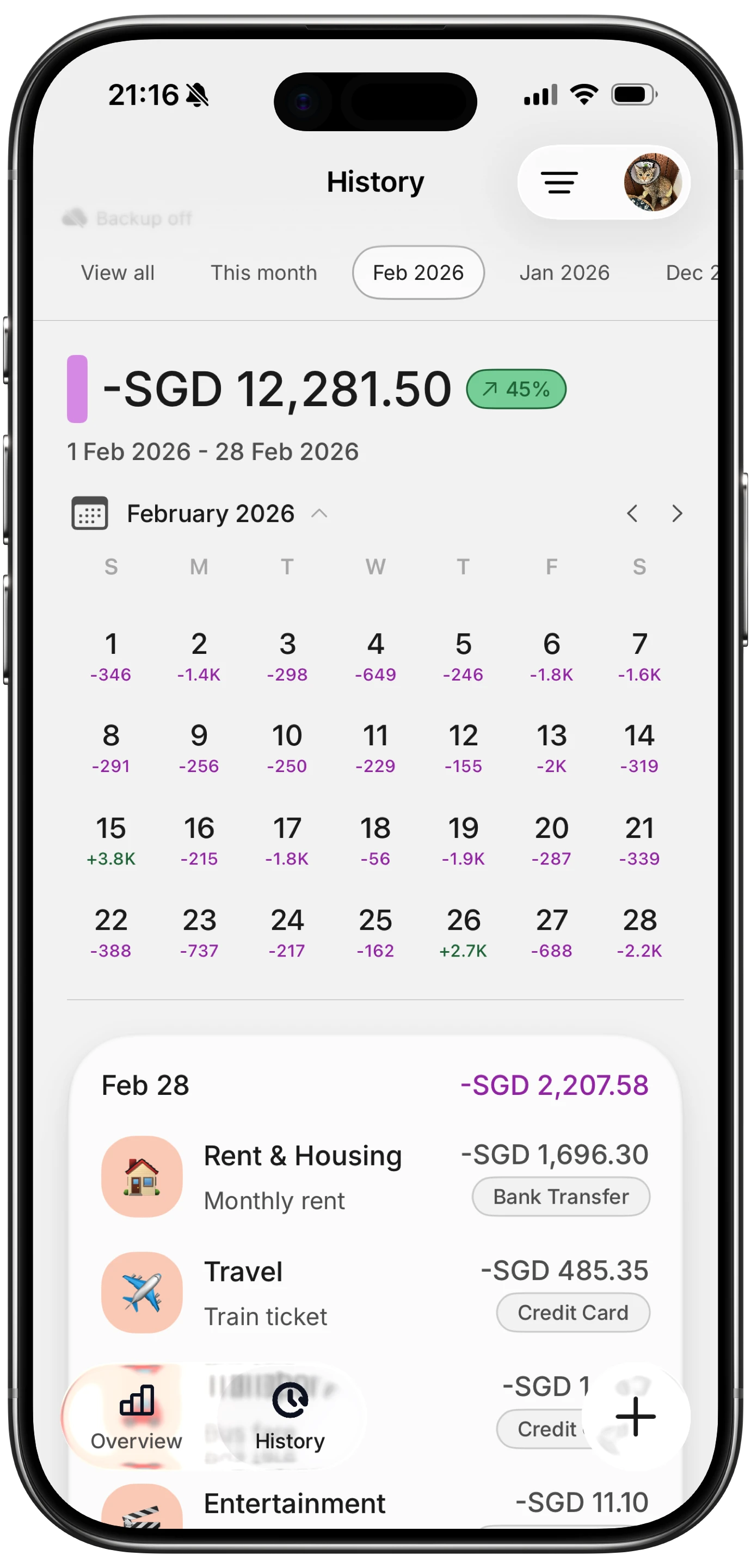
Some banking apps automate this, but you can also do it manually by tracking your expenses and calculating the rounding at the end of each day.
7. The Spare Change Challenge
Similar to the round-up challenge but focused on physical coins. At the end of each day, empty all coins from your pockets or wallet into a jar.
Total saved: $150 to $400+ per year
This is the lowest-effort challenge on the list. The amounts are small, but the point is building awareness that every bit of money counts.
8. The Fixed-Amount Weekly Challenge
Pick a number you can afford, such as $25 or $50, and transfer that exact amount to savings every week without exception.
Total saved: $1,300 to $2,600 per year
This is the simplest challenge, with no calculations and no changing amounts. Set up an automatic weekly transfer and it runs itself. It lacks the gamified element of other challenges, but it is the most reliable.
Saving Money Challenge Comparison
| Challenge | Duration | Total Saved | Difficulty | Best For |
|---|---|---|---|---|
| 52-Week | 12 months | $1,378 | Easy start, harder finish | Beginners |
| 26-Week | 6 months | $1,053 | Moderate | Mid-year starters |
| 100-Envelope | ~3.5 months | $5,050 | High | Aggressive savers |
| No-Spend | 1 day to 1 month | Varies | Moderate to high | Habit reset |
| $5 Bill | Ongoing | $260 to $520 | Very easy | Cash users |
| Round-Up | Ongoing | $300 to $700 | Easy | Daily spenders |
| Spare Change | Ongoing | $150 to $400 | Very easy | Anyone |
| Fixed Weekly | 12 months | $1,300 to $2,600 | Easy | People who prefer automation |
How to Track Your Saving Challenge Progress
The challenge itself is only half the equation. Tracking your progress is what keeps you accountable. There are several ways to do this.
Spreadsheets. A simple Google Sheet or Excel file with weeks as rows and deposit amounts as columns works fine. The downside is that you have to remember to update it.
Printable charts. Many websites offer free 52-week challenge printables you can stick on your fridge. Checking off each week provides a visual sense of accomplishment.
Expense tracking apps. The most effective approach is using an app that records both your spending and your savings. When you can see exactly where your money goes, you can identify opportunities to redirect more toward your challenge.
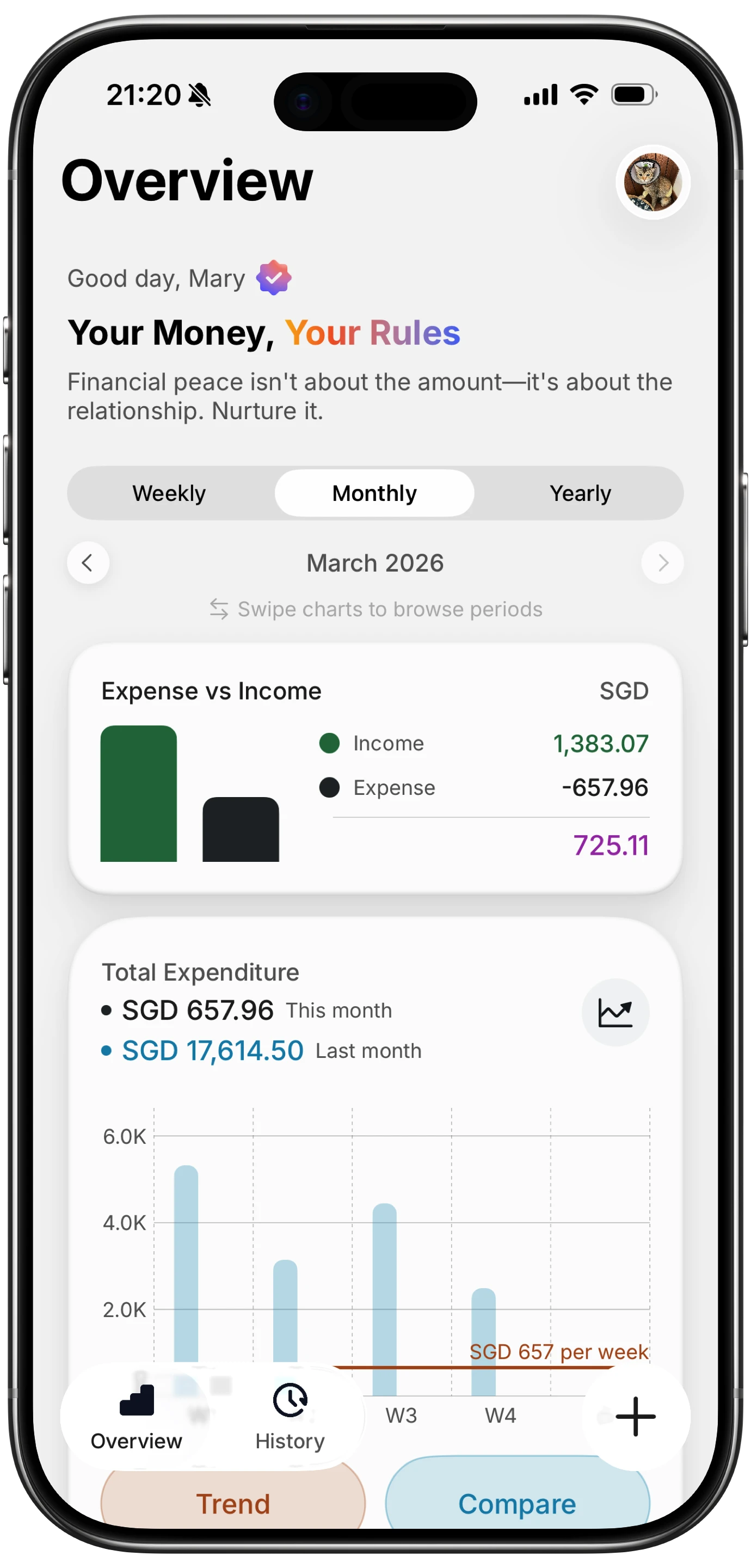
Apps like Finny let you log transactions in seconds using Tap to Track or voice input, so you always know your real spending. When you pair a saving challenge with consistent expense tracking, you build two powerful habits at once.
Tips to Actually Finish Your Saving Challenge
Starting a challenge is easy. Finishing one is where most people fail. Here are practical strategies that help.
Automate what you can. For fixed-amount challenges, set up a recurring bank transfer. Remove the decision from each week entirely.
Keep savings separate. Use a dedicated savings account or at minimum a separate label. When savings sit in your checking account, they get spent accidentally.
Plan for tight weeks. If week 45 of the 52-week challenge feels too steep, allow yourself to swap it with an earlier, smaller week. The goal is completing all 52 deposits, not doing them in exact order.
Pair it with a budget. A saving challenge works best when you know how much discretionary income you actually have. If you have not built a budget yet, our how to budget money guide walks through the main methods.
Track spending to find hidden savings. Many people discover they have more room to save than they thought once they start tracking where money actually goes. Small daily expenses like coffee, delivery fees, and subscriptions can total hundreds per month. Understanding your spending patterns through a good tracking tool makes the challenge feel less like deprivation and more like reallocation.
How Much Should You Save Each Month?
The answer depends on your income, expenses, and goals. But a common framework is the 50/30/20 rule: 50% of after-tax income for needs, 30% for wants, and 20% for savings and debt repayment.
If 20% feels out of reach, start with whatever you can. A saving challenge is designed to build the habit first. Even $1 a week is infinitely more than $0 a week. Once the habit is established, increasing the amount becomes much easier.
For someone earning $4,000 per month after tax, 20% means $800 per month in savings. The 52-week challenge averages about $115 per month, well within reach and a solid starting point.
Frequently Asked Questions
What is the best saving money challenge for beginners?
The 52-week money challenge is the most beginner-friendly option. It starts at just $1, so there is almost no barrier to entry. The gradual increase gives you time to adjust your spending before the amounts become significant. If you want something even simpler, the fixed-amount weekly challenge removes the variable deposits entirely.
How much money do you save with the 52-week challenge?
You save $1,378 over the course of one year. The deposits start at $1 and increase by $1 each week, ending at $52 in the final week. If you do the reverse version (starting at $52 and working down), the total is the same.
Can you do a saving challenge with irregular income?
Yes, but choose a flexible format. The no-spend challenge and the round-up challenge both adapt to variable income because they are based on your actual spending rather than fixed deposit amounts. For the 52-week challenge, you can rearrange the weeks, saving larger amounts when income is higher and smaller amounts during lean periods.
What is the fastest way to save $1,000?
The 26-week challenge gets you to $1,053 in six months. If you need $1,000 even faster, the 100-envelope challenge can reach $5,050 in about 100 days, but the daily deposits average $50, which requires significant disposable income. A more realistic fast approach is a no-spend month combined with redirecting all discretionary spending to savings.
How do I stay motivated during a saving challenge?
Track your progress visually, whether on paper or in an app. Seeing the total grow each week reinforces the habit. Set milestone rewards at the 25%, 50%, and 75% marks. Keep savings in a separate account so the balance is clearly visible. And remember that missing one week does not mean the challenge is over. Just pick up where you left off.
A saving money challenge is one of the simplest ways to build a real savings habit. Pick the one that matches your income and lifestyle, track your progress consistently, and give yourself permission to adjust along the way. The goal is not perfection. It is progress.
If you want a simple way to track both your spending and your saving challenge progress, download Finny and start logging your finances in seconds.